This is where it gets tricky for me. Many questions, few convincing answers. So bear with me, this will not be a particularly coherent post! If you'd have asked me once what 'evil' means, I'd have said 'absence of God'. However, I'm now more likely to say that 'God is everywhere', and by that I mean at the subatomic level, throughout the Universe[s].
How would I define evil? Essentially, by intent, a lack of good will. An ill will, indeed. But bad things happen naturally; the Boxing Day Tsunami of 2004 that claimed the lives of 230,000 people. Was this the work of Satan? Or just a case of being in the wrong place at the wrong time? Disease? How about the Holocaust? The work of one evil man, leveraging the incipient evil that resided within the dark heart of a nation?
Worth taking a look at this Wikipedia article on Theodicy, man's attempt to explain the existence of evil in a world governed by God. In its simplest form, the argument goes like this: Man is judged by God on the basis of whether or not he is good, or evil. Man is given freedom of choice. Man can choose to be good, or to be evil. If he has no free will, he cannot be judged. So evil is the result of man's freedom of choice, upon which he is ultimately judged by God. But why is this evil visited upon good people?
Let's go back into the cosmic realm again. Supermassive black holes, with a mass that's many thousands of times greater than our sun, are found in the centres of galaxies, sucking in matter, including entire solar systems, presumably along the civilisations that may be found on them. Imagine an advanced world being dragged inexorably towards an event horizon, beyond which nothing can escape; the only outcome, the destruction of everything. Where is God in all this?
I would like to return to the theme of consciousness, and in particular. A few years ago, I stumbled upon the concept of the philosophical zombie. Now, dear reader; if you - like me - consider yourself to be aware, conscious - do you think every human being has the same degree of awareness? The philosophical zombie thought-experiment posits that there are those among us who lack consciousness, but in every other way are, and behave like, humans. When I first came across this notion, I immediately thought of a corporate boss I worked for, insanely driven by the urge to make money, trampling rough-shod over the the lives of his underlings and demanding they they too flog their underlings harder to make him more money... a man I believe to be bereft of consciousness (though with a sharp intellect). I can see this type of man at work within Hitler's holocaust machine, like an Adolf Eichmann. The banality of evil? Maybe something that's merely alive, responding to stimuli, but lacking a consciousness.
When setting out to write this post, I was aware that it would be a mess - far more questions than answers. But one point I intended to make was this: there is no Satan stalking this world. No Devil, no equal-but-opposite to a Good God. People inclined to see Satan everywhere are the types more prone to believe in conspiracy theories and in general are not particularly successful in life.
As I wrote earlier, my personal view of God is not of an omnipotent Supreme Being, but rather of a tendency, a direction towards perfection, towards omniscience, total awareness of all. If the Universe is evolving spiritually towards perfection, it suggests that it is not, a yet, perfect; nor will it be perfect for many eons to come. But we can strive internally to distance ourselves from anger and violent emotions that are rooted in our biology; the reptilian part of the brain, instinctive.
The fight-or-flight reaction. Something tips a trigger, something in that primitive brain kicks off. Raised voice. Clenched fist. Anger that triggers anger; violence that triggers violence, lashing out mindlessly. Within the individual, this behaviour affects those in his or her immediate vicinity - family, workmates, people in the street. But the evil we saw in the Third Reich, the evil we see today in Islamic State and in Putin's Russia - is where an ideology is forced on people via indoctrination, propaganda, and hatred is inculcated until it can be turned into deadly violence. The Western World, Shi'ites, Christians, "Fascist Ukrainians". We need to be on guard against those who play to our base instincts, but also to guard against those who seek to play that game against us.
The Western World, for all its faults, is about tolerance, diversity, compromise, consensus; strong signals that hatred and hate-speech are no longer acceptable are positive drivers for a better society. But should the Western World tolerate intolerance? How should it respond to brutality?
I hope to return to some of the questions posed here, if not this Lent than in years to come, if not with answers, then maybe with a more nuanced attitude.
Previous post in this series: The infinitely long path from Zero to One
This time last year:
Civilisation and a civil society
This time three years ago:
Strong, late-winter sunshine
This time four years ago:
Jeziorki's wetlands freeze over
[Average temperature for that week was -9C. This week; +3C. Not once this winter did the wetlands freeze hard enough to walk across, let alone ride a motorbike over.]
This time five years ago
Kensington, a London village
This time six years ago:
Lenten reciples
This time seven years ago:
A walk through Sadyba
Friday, 27 February 2015


Thursday, 26 February 2015
The infinitely long path from Zero to One
In our childhood, the world around us consisted of shapeless blocks, vague monoliths, from which, with age and experience - and the chisel of thought - emerge statues of understanding. From out of crude lumps of unhewn observation they emerge, honed ever more finely, delicately nuanced, catalogued more precisely, with each passing year.
Watch an infant's wide unfocused eyes play over an unfamiliar room, pulling together sense and structure from what is around him. Have they seen this all before. No...?
We edge slowly along from uncertainty towards certainty, from darkness to light - yet we are not even the tiniest fraction of the way along the infinitely long road from Zero to One. One life, one consciousness, one brief chance - is to be our only glimpse into this process?
I don't believe this is the case. The journey is long and much learning lies ahead. We must all learn to overcome the reptile in the brain, that dim, brutal and selfish animal within us, and allow in the angelic; this is spiritual evolution; willing yourself ever closer along that multi-billion year-long path towards God-ness, towards absolute understanding; total Universal unity and infinite consciousness.
We will all die, but the atoms that make us, those atoms maintaining formation within the molecules of our DNA, within our protein - those atoms will keep on spinning as they have done so for many billions of years. What will we have taught them? For when they return to the soil, they will spin on, bearing with them fragments of memory and will and consciousness.
And they return from the dark collective of that rich loam once more as individual and conscious life, they will be another tiny step closer to God. The following phrase popped unbidden into my mind one day: "There is a seamless continuum which our souls observe through myriad eyes". We live, we learn, we die, we are reborn; it must happen many times.
The daughter of a famous Polish author, buried at Powązki cemetery in Warsaw, told me that each time she visits the grave, she finds objects left on it by his fans. One year, she noticed a plant growing by the headstone. She decided to leave it, and to let it grow. It grew into a plum tree. She realised that the fruit was nurtured by her father's body, and took some plums to her own garden, to let them grow into trees. This reminded me of a passage from Bill Bryson's book A Short History of Nearly Everything. And I quote:
So - if you wish to hurry your atoms to get recycled quickly into another conscious human being soon after your death - is it better to be buried or cremated?
Again, I haven't a clue; it's futile trying to work it out. There are billions of years to go before our sun fades and dies and billions more before the Universe slows down before beginning to contract. Conjecture; one for cosmologists to work out. In the meantime, the spiritual drive, the quest for higher awareness, drives us onwards.
The Universe: what's out there, what our humanity means in the scale of our galaxy and all the other hundreds of billions of galaxies out there - this is an absolutely must-read piece.
Next: dealing with evil on the universal scale
Previous post in this series: a glimpse of the afterlife
This time two years ago:
Images of God
This time three years ago:
City-centre living, Warsaw-style
This time four years ago:
Communist plaque on Zygmunt's Column
This time seven years ago:
Three weeks into Lent
Watch an infant's wide unfocused eyes play over an unfamiliar room, pulling together sense and structure from what is around him. Have they seen this all before. No...?
We edge slowly along from uncertainty towards certainty, from darkness to light - yet we are not even the tiniest fraction of the way along the infinitely long road from Zero to One. One life, one consciousness, one brief chance - is to be our only glimpse into this process?
I don't believe this is the case. The journey is long and much learning lies ahead. We must all learn to overcome the reptile in the brain, that dim, brutal and selfish animal within us, and allow in the angelic; this is spiritual evolution; willing yourself ever closer along that multi-billion year-long path towards God-ness, towards absolute understanding; total Universal unity and infinite consciousness.
We will all die, but the atoms that make us, those atoms maintaining formation within the molecules of our DNA, within our protein - those atoms will keep on spinning as they have done so for many billions of years. What will we have taught them? For when they return to the soil, they will spin on, bearing with them fragments of memory and will and consciousness.
And they return from the dark collective of that rich loam once more as individual and conscious life, they will be another tiny step closer to God. The following phrase popped unbidden into my mind one day: "There is a seamless continuum which our souls observe through myriad eyes". We live, we learn, we die, we are reborn; it must happen many times.
The daughter of a famous Polish author, buried at Powązki cemetery in Warsaw, told me that each time she visits the grave, she finds objects left on it by his fans. One year, she noticed a plant growing by the headstone. She decided to leave it, and to let it grow. It grew into a plum tree. She realised that the fruit was nurtured by her father's body, and took some plums to her own garden, to let them grow into trees. This reminded me of a passage from Bill Bryson's book A Short History of Nearly Everything. And I quote:
"[Atoms] are fantastically durable. Because they are so long-lived, atoms really get around. Every atom you possess has almost certainly passed through several stars and been part of millions of organisms on its way to becoming you. We are each so atomically numerous and so vigorously recycled at death that a significant number of atoms - up to a billion for each of us, it has been suggested - probably once belonged to Shakespeare. A billion more each came from Buddha and Genghis Khan and Beethoven, and any other historical figure you care to name. (The personages have to be historical, apparently, as it takes the atoms some decades to become thoroughly redistributed...)
So we are all reincarnations - though short-lived ones. When we die, our atoms will disassemble and move off to find new uses elsewhere - as part of a leaf, or other human being or drop of dew. Atoms themselves, however, go on practically for ever."Is this how consciousness flows from one living being to the next? I don't know. Nice as it would be to construct a theology around this, all I can only honestly say: "I don't know, but I want to know, and will continue to seek."
So - if you wish to hurry your atoms to get recycled quickly into another conscious human being soon after your death - is it better to be buried or cremated?
Again, I haven't a clue; it's futile trying to work it out. There are billions of years to go before our sun fades and dies and billions more before the Universe slows down before beginning to contract. Conjecture; one for cosmologists to work out. In the meantime, the spiritual drive, the quest for higher awareness, drives us onwards.
The Universe: what's out there, what our humanity means in the scale of our galaxy and all the other hundreds of billions of galaxies out there - this is an absolutely must-read piece.
Next: dealing with evil on the universal scale
Previous post in this series: a glimpse of the afterlife
This time two years ago:
Images of God
This time three years ago:
City-centre living, Warsaw-style
This time four years ago:
Communist plaque on Zygmunt's Column
This time seven years ago:
Three weeks into Lent
Wednesday, 25 February 2015
A peek into the Afterlife
A quote often misattributed to the atheist philosopher Bertrand Russell has the distinguished gent saying that he no more believes in life after death than life before birth.
Well - and here I intend to get controversial - I do have some reason to believe in life before birth. I have written snippets on this before on this blog; just snippets. Now I'd like to develop the theme further as part of this year's Lenten series of posts.
Strangely familiar, familiarly strange, well-known memories not attached to anything I've lived through... I've had these all my life, as early as I can remember, they are a part of me. What they are, I know not. How to categorise them - as a scientific or a spiritual phenomenon, remains beyond me.
Imagine a childhood summer's day on the beach, the sun glinting off the waves, the smell of suntan oil on damp towels; or a walk in a pine forest with your parents, or staring at a toyshop window just before Christmas, dusk, snow falling gently on the rushing shoppers. Can you feel those memories strongly? Can you conjure up your precise awareness of that moment? Do they match with what you felt then?
Here's one: PAFF! A flashback, unbidden. The Bath Road, near Turnham Green, West London. I am with my father, our way to the Polish church on Leysfield Road it is the mid-1960s - we pass a set of level crossing gates. (I google this, and indeed, between Abinger Road and Emlyn Road there were level crossing gates back then.)
Happens to you too? It's like a 'memory hiccup'. Unbidden, spontaneous; real. Train yourself, and you can put your finger precisely on where and when it was. Driving out of Harrow towards the M1, Christmas Eve. Yes, the leafless trees, hedges, wet fields...
Now it's going to get strange. I also get, though less frequently, the same phenomenon, except it's clearly not from my life's experiences. Mine; familiar; repeated; but where is it from and what does it mean? Most often these anomalous memory flashbacks correspond to America in the 1930s, '40s and '50s. I've had these all my life, since early childhood (four, five years old). My friends from university will vouch for the fact that I'd be reporting the same experiences 35 years ago. Since then, I've been able to bring greater definition to what I feel, yet the experiences remain a mystery, a phenomenon beyond the comprehension of science today.
They are fragile yet intense - when they happen, I try to catch that moment of anomalous consciousness, dwell upon it before it evaporates; but it is ephemeral, fleeting.
Let me whittle it down some more. Thee anomalous flashbacks don't feel like the Far East or Africa. They are not of high mountains nor rainforests. They don't feel ancient or mediaeval. They feel mid-20th century, USA or Scandinavia. A land of four separate seasons; single-storey houses with carports surrounded by neatly mown lawns, groves of tall pines and birch trees; modern office developments, low, long, white buildings amid snowy forests. Railway lines running through the plains, and big, open, blue skies.
Memories that feel as real as anything that resonates with my 1960s British childhood, yet are not of it. There are other ones; Edwardian England, fin-de-siècle France, the Pripyat marshes, Merrie England, 17th century, the Ice Age in Europe. Less strong, less frequent, yet also present in unbidden memories; pleasant memories, and ones I can reach for and experience should I wish to.
As it fades, I feel a certain frustration; something beautiful in my grasp has slipped away. I want to know more; I want to discover what this is.
And then there are dreams too; and that precious time between sleep and wakefulness when the consciousness is running free. Most dreams are a concoction of half-completed daytime thoughts, but I have rare ones that relate to another time and place; these follow the classic Greek unities of time, place and action. WWII, but America. One I had the other night; it is the late-1930s, early '40s, USA; at the State Fair, there is a beauty pageant at the US Department of Agriculture stand. Detail and accuracy are the key features of this type of dream. The most amazing one I ever had related to a hotel called Zig Zag in an American town of Zig Zag. The hotel, built of wood, was located on a main road running through a wooded valley. Thanks to Google, I located it the following morning - exactly as I dreamt it. The Zig Zag Inn, Zig Zag, Oregon (below). To preclude any chance of deja vu, I looked through all my parents' old National Geographic magazines with articles about Oregon - no sign of Zig Zag!
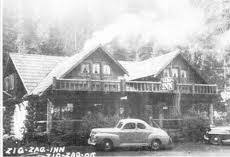
What this is all about is still life's greatest mystery for me. Is this a common phenomenon, that many people experience yet fail to identify, brushing to one side as being too marginal or strange to contemplate? Or am I alone on this one?
There are religions based on the concept of reincarnation, but I eschew a religious (as opposed to spiritual) explanation. Religions are based on dogma; I seek an answer based on something more rational. I may be way ahead of the science, but still I seek.
I cannot will such a memory into being. Seeking them for their own end is futile and disappointing. There are places where they are more likely to happen (in the kitchen, in the chilled-food section at Auchan, on Dolina Służewiecka between ulica Nowoursynowska and Rodowicza), on ul. Puławska at the junction with Idzikowskiego, the footpath in Las Kabacki alongside the Metro depot; and, most often, when there are changes in the weather (the onset of spring, for example).
Over many years, I've trained myself to identify the time and the place that the flashback is linked to. But what causes these flashbacks that tug my awareness back to recall some distant moment with such precision, creating such a sense of pleasant familiarity of Past? Was there a trigger? Smell is a most potent memory trigger, and easy to identify. The smell of summer rain on dusty ground. Taste also - a childhood ice cream (such as a Lyons Maid Raspberry Mivvi). Other triggers are harder to pinpoint. It maybe a combination of light and colour on the retina, a particular word, spoken or read; the feeling of frosty wind on the face as I walk out of the office on a winter's night; a splash of water on the neck – and BAM! suddenly that memory bursts into the mind, for a split second crowding out other mundane trains of thought and bringing that exact flavour of that moment in the past. The strangest are the flashbacks that are not only unbidden, but untriggered - totally spontaneous.
Like an archaeologist, I find myself analysing these fragments of memory as if they were shards of ancient pottery. No, a better metaphor. It is more like analysing a snowflake that's settled on your gloved palm before it melts.
The flashbacks that seem untriggered or unbidden are indeed puzzling. Do they happen for a reason? (I will be writing about chance, coincidence and meaning in a later post.)
The human brain is the most complex structure known to man. We have scarcely begun to unravel its secrets. Is this a brain thing or something else? My brain tuning into thought waves once projected from human brains once alive? Atoms within me that were once within some other human being, some while back? Tosh! you may say. Would that I could do so with any degree of certainty. All I know is that this phenomenon is very real, has always been with me, continues to feel familiar, and continues to intrigue me and pique my curiosity.
A few years ago, while out walking, I coined the phrase 'congruent consciousness' for this phenomenon of the consciousness. Just as triangles of a different size but with exactly the same angles can be defined as congruent, so these flashbacks are a identical short-lived replica of my consciousness at another time and place. They vary in strength (vividness) and duration, and when they happen, I've taught myself to catch them and reflect upon them. Projected for an instant into my consciousness, before fizzling away, they leave a summonable aftertaste, like the memory of a vivid dream. These anomalous memory events leave me grasping for metaphors - 'echo' is one; I am picking up an echo of consciousness, a feeling that once was, a perfect replica of a state of mind, that has returned for a brief instant from... the past? Is there such as thing as the past in the mind?
The river of consciousness (there's a neat metaphor) means that you can track back to the thoughts you've just had, but running your mind in reverse, although possible, is as difficult as swimming upstream. When your mind is freewheeling, try going back through the chain of thoughts you've just had - it's not easy! Similarly, when a *paff!* moment occurs, before the smoke's blown away, I analyse it on the spot, so as not to lose that feeling. Once gone, it's difficult to get back. How does it feel? What's it associated with? What might have triggered it?
My search for a better understanding of this phenomenon will take many years, and though I'm sure I'll get closer, I doubt if I, or indeed neuroscience, will get anywhere near it.
Sceptics say that it's misfiring neurons in my brain. Prove it. Science has yet to even work out where the seat of consciousness resides within us humans, so I dismiss this. I challenge any neuroscientist to convince me that this is nothing but a random firing of synapses in the hippocampus, or a flow of dopamine through the brain. It's too regular, too familiar; there's a pattern here that's clearly not random, a phenomenon that's above chance.
Over the years, those *PAFF* moments multiply - I've been here before, yet not in this lifetime. I savour them as they happen, like holding my breath, keeping that feeling like the waking aftertaste of a dream. Days like this I never experienced in childhood, and yet they feel like they were experienced in childhood - yet as an adult. These experiences are regular, commonplace and familiar - and yet entirely inexplicable.
Does this prove that our souls live on after the deaths of our bodies in new bodies, acquiring consciousness with each successive incarnation? Is this my consciousness picking up signals from some other consciousness from another time and another place? Or from different universes, realities concurrent? Another question is whether these anomalous flashbacks are also "I", "me", the same individual. Is there a succession of lives behind and ahead of us, a continuity of our own personality -- or is each one different; destined to merge into one consciousness?
Maybe. Don't know. But I do want to get a little bit closer to the truth.
The wind's blowing the snow in my face, such a pleasant sensation coming out of the warm office. I'm getting those old familiar flashbacks to somewhere other than my childhood, Minnesota in the 1950s? Scandinavia in the 1950s? Consciousness. Patient, expanding consciousness, growing in awareness from day to day. Sometimes growing slower, sometimes faster - when a sudden event or inspiration generates a qualitative jump in one's understanding, bringing about a quantum leap to another meta-level. Whatever the pace, the direction is always the same; from Zero towards One. Should I seek answers, or just let things lie? I'm for seeking answers. It's a life's task.
I think this phenomenon is more common among mankind than is generally accepted. We ignore it, deny it, strive to explain it away. Were we more open to it, maybe we could move ahead out of the straightjacket rationalist-reductionist worldview to a more spiritually open-minded one. Dozens (but not hundreds or thousands) of people I've talked to have admitted to such possibilities. Deeply held interest in Ancient Greece or 17th Century Sweden; a fondness for India 'long ago'; China in the 1920s; colonial East Africa; post-war USSR. We need to be open to the possibility that we are in tune with a continuum of consciousness spanning human lives.
Hang on a bit - the title of this post is A peek into the Afterlife...? Indeed. I would argue that sometime after my physical demise, a child will be born with strange flashbacks to the second half of the 20th Century in Britain, and to the first half of the 21st Century in Poland. Maybe more frequently than I get my "past-life" flashbacks, maybe learning more from them; these flashes could be what's commonly referred to as an afterlife? Certainly not an eternity of sitting on clouds with harps.
A final thought - maybe I am currently living an afterlife - though not my own.
Next: more about our path from Zero to One.
This time last year:
The new dupes of Moscow
This time two years ago:
Late-winter commuting, Jeziorki
This time six years ago:
Lent and Recession - a nice parallel
This time seven years ago:
Early intimations of spring
Well - and here I intend to get controversial - I do have some reason to believe in life before birth. I have written snippets on this before on this blog; just snippets. Now I'd like to develop the theme further as part of this year's Lenten series of posts.
Strangely familiar, familiarly strange, well-known memories not attached to anything I've lived through... I've had these all my life, as early as I can remember, they are a part of me. What they are, I know not. How to categorise them - as a scientific or a spiritual phenomenon, remains beyond me.
Imagine a childhood summer's day on the beach, the sun glinting off the waves, the smell of suntan oil on damp towels; or a walk in a pine forest with your parents, or staring at a toyshop window just before Christmas, dusk, snow falling gently on the rushing shoppers. Can you feel those memories strongly? Can you conjure up your precise awareness of that moment? Do they match with what you felt then?
Sometimes, for no reason, a memory appears spontaneously within my consciousness. I've not been thinking about anything related to it; the memory may relate to something that happened a year ago, three years ago, ten years ago or in early childhood - but I've trained myself over the course of my life to identify them. Elthorne Park, Hanwell. The AA building, Teddington. Chiswick open-air swimming pool. Richmond open-air swimming pool.The Thames at Sunbury. Gibbet Hill Road, Warwickshire. Denham, Buckinghamshire. PAFF! All of a sudden, for the briefest of moments, I am back there, my consciousness feeling exactly what it felt back there, back then - a strong surge of memory. I savour the moment; it evaporates quickly, leaving a vague but pleasant aftertaste.
But it was there, it was clear - and it was mine, of me. Spirit of place and me.
Here's one: PAFF! A flashback, unbidden. The Bath Road, near Turnham Green, West London. I am with my father, our way to the Polish church on Leysfield Road it is the mid-1960s - we pass a set of level crossing gates. (I google this, and indeed, between Abinger Road and Emlyn Road there were level crossing gates back then.)
Happens to you too? It's like a 'memory hiccup'. Unbidden, spontaneous; real. Train yourself, and you can put your finger precisely on where and when it was. Driving out of Harrow towards the M1, Christmas Eve. Yes, the leafless trees, hedges, wet fields...
Now it's going to get strange. I also get, though less frequently, the same phenomenon, except it's clearly not from my life's experiences. Mine; familiar; repeated; but where is it from and what does it mean? Most often these anomalous memory flashbacks correspond to America in the 1930s, '40s and '50s. I've had these all my life, since early childhood (four, five years old). My friends from university will vouch for the fact that I'd be reporting the same experiences 35 years ago. Since then, I've been able to bring greater definition to what I feel, yet the experiences remain a mystery, a phenomenon beyond the comprehension of science today.
They are fragile yet intense - when they happen, I try to catch that moment of anomalous consciousness, dwell upon it before it evaporates; but it is ephemeral, fleeting.
Let me whittle it down some more. Thee anomalous flashbacks don't feel like the Far East or Africa. They are not of high mountains nor rainforests. They don't feel ancient or mediaeval. They feel mid-20th century, USA or Scandinavia. A land of four separate seasons; single-storey houses with carports surrounded by neatly mown lawns, groves of tall pines and birch trees; modern office developments, low, long, white buildings amid snowy forests. Railway lines running through the plains, and big, open, blue skies.
Memories that feel as real as anything that resonates with my 1960s British childhood, yet are not of it. There are other ones; Edwardian England, fin-de-siècle France, the Pripyat marshes, Merrie England, 17th century, the Ice Age in Europe. Less strong, less frequent, yet also present in unbidden memories; pleasant memories, and ones I can reach for and experience should I wish to.
As it fades, I feel a certain frustration; something beautiful in my grasp has slipped away. I want to know more; I want to discover what this is.
And then there are dreams too; and that precious time between sleep and wakefulness when the consciousness is running free. Most dreams are a concoction of half-completed daytime thoughts, but I have rare ones that relate to another time and place; these follow the classic Greek unities of time, place and action. WWII, but America. One I had the other night; it is the late-1930s, early '40s, USA; at the State Fair, there is a beauty pageant at the US Department of Agriculture stand. Detail and accuracy are the key features of this type of dream. The most amazing one I ever had related to a hotel called Zig Zag in an American town of Zig Zag. The hotel, built of wood, was located on a main road running through a wooded valley. Thanks to Google, I located it the following morning - exactly as I dreamt it. The Zig Zag Inn, Zig Zag, Oregon (below). To preclude any chance of deja vu, I looked through all my parents' old National Geographic magazines with articles about Oregon - no sign of Zig Zag!
What this is all about is still life's greatest mystery for me. Is this a common phenomenon, that many people experience yet fail to identify, brushing to one side as being too marginal or strange to contemplate? Or am I alone on this one?
There are religions based on the concept of reincarnation, but I eschew a religious (as opposed to spiritual) explanation. Religions are based on dogma; I seek an answer based on something more rational. I may be way ahead of the science, but still I seek.
I cannot will such a memory into being. Seeking them for their own end is futile and disappointing. There are places where they are more likely to happen (in the kitchen, in the chilled-food section at Auchan, on Dolina Służewiecka between ulica Nowoursynowska and Rodowicza), on ul. Puławska at the junction with Idzikowskiego, the footpath in Las Kabacki alongside the Metro depot; and, most often, when there are changes in the weather (the onset of spring, for example).
Over many years, I've trained myself to identify the time and the place that the flashback is linked to. But what causes these flashbacks that tug my awareness back to recall some distant moment with such precision, creating such a sense of pleasant familiarity of Past? Was there a trigger? Smell is a most potent memory trigger, and easy to identify. The smell of summer rain on dusty ground. Taste also - a childhood ice cream (such as a Lyons Maid Raspberry Mivvi). Other triggers are harder to pinpoint. It maybe a combination of light and colour on the retina, a particular word, spoken or read; the feeling of frosty wind on the face as I walk out of the office on a winter's night; a splash of water on the neck – and BAM! suddenly that memory bursts into the mind, for a split second crowding out other mundane trains of thought and bringing that exact flavour of that moment in the past. The strangest are the flashbacks that are not only unbidden, but untriggered - totally spontaneous.
Like an archaeologist, I find myself analysing these fragments of memory as if they were shards of ancient pottery. No, a better metaphor. It is more like analysing a snowflake that's settled on your gloved palm before it melts.
The flashbacks that seem untriggered or unbidden are indeed puzzling. Do they happen for a reason? (I will be writing about chance, coincidence and meaning in a later post.)
The human brain is the most complex structure known to man. We have scarcely begun to unravel its secrets. Is this a brain thing or something else? My brain tuning into thought waves once projected from human brains once alive? Atoms within me that were once within some other human being, some while back? Tosh! you may say. Would that I could do so with any degree of certainty. All I know is that this phenomenon is very real, has always been with me, continues to feel familiar, and continues to intrigue me and pique my curiosity.
A few years ago, while out walking, I coined the phrase 'congruent consciousness' for this phenomenon of the consciousness. Just as triangles of a different size but with exactly the same angles can be defined as congruent, so these flashbacks are a identical short-lived replica of my consciousness at another time and place. They vary in strength (vividness) and duration, and when they happen, I've taught myself to catch them and reflect upon them. Projected for an instant into my consciousness, before fizzling away, they leave a summonable aftertaste, like the memory of a vivid dream. These anomalous memory events leave me grasping for metaphors - 'echo' is one; I am picking up an echo of consciousness, a feeling that once was, a perfect replica of a state of mind, that has returned for a brief instant from... the past? Is there such as thing as the past in the mind?
The river of consciousness (there's a neat metaphor) means that you can track back to the thoughts you've just had, but running your mind in reverse, although possible, is as difficult as swimming upstream. When your mind is freewheeling, try going back through the chain of thoughts you've just had - it's not easy! Similarly, when a *paff!* moment occurs, before the smoke's blown away, I analyse it on the spot, so as not to lose that feeling. Once gone, it's difficult to get back. How does it feel? What's it associated with? What might have triggered it?
My search for a better understanding of this phenomenon will take many years, and though I'm sure I'll get closer, I doubt if I, or indeed neuroscience, will get anywhere near it.
Over the years, those *PAFF* moments multiply - I've been here before, yet not in this lifetime. I savour them as they happen, like holding my breath, keeping that feeling like the waking aftertaste of a dream. Days like this I never experienced in childhood, and yet they feel like they were experienced in childhood - yet as an adult. These experiences are regular, commonplace and familiar - and yet entirely inexplicable.
Does this prove that our souls live on after the deaths of our bodies in new bodies, acquiring consciousness with each successive incarnation? Is this my consciousness picking up signals from some other consciousness from another time and another place? Or from different universes, realities concurrent? Another question is whether these anomalous flashbacks are also "I", "me", the same individual. Is there a succession of lives behind and ahead of us, a continuity of our own personality -- or is each one different; destined to merge into one consciousness?
Maybe. Don't know. But I do want to get a little bit closer to the truth.
The wind's blowing the snow in my face, such a pleasant sensation coming out of the warm office. I'm getting those old familiar flashbacks to somewhere other than my childhood, Minnesota in the 1950s? Scandinavia in the 1950s? Consciousness. Patient, expanding consciousness, growing in awareness from day to day. Sometimes growing slower, sometimes faster - when a sudden event or inspiration generates a qualitative jump in one's understanding, bringing about a quantum leap to another meta-level. Whatever the pace, the direction is always the same; from Zero towards One. Should I seek answers, or just let things lie? I'm for seeking answers. It's a life's task.
I think this phenomenon is more common among mankind than is generally accepted. We ignore it, deny it, strive to explain it away. Were we more open to it, maybe we could move ahead out of the straightjacket rationalist-reductionist worldview to a more spiritually open-minded one. Dozens (but not hundreds or thousands) of people I've talked to have admitted to such possibilities. Deeply held interest in Ancient Greece or 17th Century Sweden; a fondness for India 'long ago'; China in the 1920s; colonial East Africa; post-war USSR. We need to be open to the possibility that we are in tune with a continuum of consciousness spanning human lives.
Hang on a bit - the title of this post is A peek into the Afterlife...? Indeed. I would argue that sometime after my physical demise, a child will be born with strange flashbacks to the second half of the 20th Century in Britain, and to the first half of the 21st Century in Poland. Maybe more frequently than I get my "past-life" flashbacks, maybe learning more from them; these flashes could be what's commonly referred to as an afterlife? Certainly not an eternity of sitting on clouds with harps.
A final thought - maybe I am currently living an afterlife - though not my own.
Next: more about our path from Zero to One.
This time last year:
The new dupes of Moscow
This time two years ago:
Late-winter commuting, Jeziorki
This time six years ago:
Lent and Recession - a nice parallel
This time seven years ago:
Early intimations of spring
Tuesday, 24 February 2015
Consciousness, the Soul, Eternity
I have mentioned in previous essays here that you and I are made up of atoms that have been around for billions of years. Indeed, since an event called Recombination, some 378,000 years after the Big Bang, when the Universe became cool enough for electrons to attach to protons. And indeed, it is posited, that most of the helium in the Universe was created within three minutes of the Big Bang. And there are those same helium atoms today, filling children's balloons.
From Wikipedia: "Most of the atoms that make up the Earth and its inhabitants were present in their current form in the nebula that collapsed out of a molecular cloud to form the Solar System. The rest are the result of radioactive decay, and their relative proportion can be used to determine the age of the Earth."
This is mind-boggling stuff. We are used to matter decaying, energy running out, but here is the very fabric of everything around us, made out of these tiny atoms made out of electrons whizzing round the nuclei for ever. Certainly from one Big Bang to the next. What these atoms consist of is something that science is slowly unravelling. At school, we were taught that an atom is no more than a nucleus made up of protons (which have a positive electrical charge) and neutrons (which have no charge), and the nucleus exists within a shell or shells of electrons (which have a negative electrical charge).
Today, however, the structure of subatomic particles is known to be far more complex. This is how particle physicists currently see the contents of the nucleus:

[Source: Wikipedia]
I cannot begin to comprehend this world of neutrinos and gauge bosons, quarks and gluons. The more physicists seem to dig into the inner workings of the atom, the more they find. What properties are associated with these particles, other than positive and negative electrical charge?
Could atoms contain... memory, for instance? Will? Could they be carriers of distributed consciousness? They last for ever, after all...
A huge leap into the unknown, flaky science I know, but not an impossibility. As I wrote two posts ago, science has yet to discover the source of human consciousness; reading the Wikipedia articles about neuroscience and subatomic science, I can see the vast disconnect between the two, and yet our world functions as a whole under one joined-up set of laws.
Now, if one accepts the Monist view that the Universe is one system (rather than the Dualist view that the material and spiritual are two entirely separate worlds), the notion of consciousness being the result of atoms at work is entirely reasonable.
Is it possible that in some way, our consciousness could be distributed within us to the atomic level, and echoes of our thoughts, our experiences - our memories - could reside within the atoms that we are made of? That our level of consciousness is at a higher level today than it was within our ancestors thousands of years ago, because we have somehow absorbed millennia of additional experience and awareness? Purely theoretical, blue-sky thinking on my part. But an attempt to seek a rational explanation for a spiritual quest for answers that's been with me since childhood.
An answer to those anomalous memory events I've had all my life, as far back as I can remember. A quest that gives meaning - spiritual meaning indeed - to life.
More to Lent than just giving up a few things!
This time last year:
On Governance, Institutions and Civilisation
This time four years ago:
My Nikon D80 four years on
(For the record, the LCD monitor died last year, it still takes photos)
This time six years ago:
Nikon D80 two years on
This time seven years ago:
Nikon D80 one year on
Eight years ago today I bought my first digital camera!
From Wikipedia: "Most of the atoms that make up the Earth and its inhabitants were present in their current form in the nebula that collapsed out of a molecular cloud to form the Solar System. The rest are the result of radioactive decay, and their relative proportion can be used to determine the age of the Earth."
This is mind-boggling stuff. We are used to matter decaying, energy running out, but here is the very fabric of everything around us, made out of these tiny atoms made out of electrons whizzing round the nuclei for ever. Certainly from one Big Bang to the next. What these atoms consist of is something that science is slowly unravelling. At school, we were taught that an atom is no more than a nucleus made up of protons (which have a positive electrical charge) and neutrons (which have no charge), and the nucleus exists within a shell or shells of electrons (which have a negative electrical charge).
Today, however, the structure of subatomic particles is known to be far more complex. This is how particle physicists currently see the contents of the nucleus:
[Source: Wikipedia]
I cannot begin to comprehend this world of neutrinos and gauge bosons, quarks and gluons. The more physicists seem to dig into the inner workings of the atom, the more they find. What properties are associated with these particles, other than positive and negative electrical charge?
Could atoms contain... memory, for instance? Will? Could they be carriers of distributed consciousness? They last for ever, after all...
A huge leap into the unknown, flaky science I know, but not an impossibility. As I wrote two posts ago, science has yet to discover the source of human consciousness; reading the Wikipedia articles about neuroscience and subatomic science, I can see the vast disconnect between the two, and yet our world functions as a whole under one joined-up set of laws.
Now, if one accepts the Monist view that the Universe is one system (rather than the Dualist view that the material and spiritual are two entirely separate worlds), the notion of consciousness being the result of atoms at work is entirely reasonable.
Is it possible that in some way, our consciousness could be distributed within us to the atomic level, and echoes of our thoughts, our experiences - our memories - could reside within the atoms that we are made of? That our level of consciousness is at a higher level today than it was within our ancestors thousands of years ago, because we have somehow absorbed millennia of additional experience and awareness? Purely theoretical, blue-sky thinking on my part. But an attempt to seek a rational explanation for a spiritual quest for answers that's been with me since childhood.
An answer to those anomalous memory events I've had all my life, as far back as I can remember. A quest that gives meaning - spiritual meaning indeed - to life.
More to Lent than just giving up a few things!
This time last year:
On Governance, Institutions and Civilisation
This time four years ago:
My Nikon D80 four years on
(For the record, the LCD monitor died last year, it still takes photos)
This time six years ago:
Nikon D80 two years on
This time seven years ago:
Nikon D80 one year on
Eight years ago today I bought my first digital camera!
Monday, 23 February 2015
Will your Soul exist for eternity?
Here's the deal: you avoid doing these bad things (listed in points one through ten), and when you die, you go to heaven. For ever more. For an eternity. For an infinitely long time.
Want to know what infinity looks like? It's not a million billion zillion. Imagine, if you will, an infinite number of parallel universes. There's one just like this one, according to a gag on the BBC's 1980s comedy show Not The Nine O'Clock News, where everything is exactly the same as in this universe, except the Mini Metro had a slightly shorter gear stick. Now, come up with every possible tiny variant you can think of - a universe identical to this one, but one in which you drank one millilitre more coffee than you did today. Or you had a grapefruit juice in place of that orange juice. Or that the third ant from the left picks up this grain of sand rather than that one. Or that clover has five leaves.Let your imagination run wild on this one, and soon you will begin to understand just what the real gist of infinity and eternity.
The universe, by contrast is said to be a mere 13.8 billion years old - an infinitessimally small fraction of eternity, a finite number of years that have elapsed since everything kicked off with the Big Bang. And before? We don't know, we can only guess.
But back to the notion of heaven. You get to live for eternity in heaven, because you spent your life span in the here-and-now being good? This rather jars with me. I very much doubt it. Isn't the professed reward disproportionately vast in comparison to the ask? Where's the learning process? Where are the challenges? Where's the acquisition of spiritual wisdom? Isn't it just too huge a leap -from avoid doing bad in this life to living for ever more in the next? Isn't there far more to life, the Universe and everything, than just those sto lat we all aspire to?
Whilst I do believe in the notion that we are moving towards the ideal, the perfection, the wisdom, the will, of God - it is not something to be achieved in one lifetime. The leap from ordinary human to angelic being. No, it will take billions of generations to acquire that omniscience - total awareness of everything. Think of the billions of generations of evolution that it too you to become you.
From amoeba to plankton to jellyfish to simple vertebrate to fish to lobefin to reptile to primate, life has been about the gathering of ever-higher states of consciousness along the way, spiritual evolution, if you like, a snowball of growing awareness. Accretion, accumulation of consciousness.
Continue this way towards God - everything merged into one consciousness, into which we will all be united. Literally all, if you hold with the theory of a Universe continually expanding away from a Big Bang, expanding until the forces that power it run out of puff, and then contracting in upon itself (a process that astronomers can view today within a black hole), with black hole swallowing black hole, everything contracting back upon itself until all matter - the atoms that make you up, me, them, everybody - and the furthest visible galaxy too - collapsing back into one singularity.
But will you feel yourself within that singularity? Will you know that that is you, knowing?
My second objection to the traditional view of heaven - aside from the time-span issue - is that it promises you that you will remain you for ever more. Not joined with your loved ones, not merged into being a part of an eternal, celestial whole, but staying an individual - you, for ever more.
This I find scientifically, spiritually, and even socially, awkward. It does show off the fact that organised religions form a kind of social control - "believe that this is as it should be, and your reward will be in the Hereafter."
Will [your] consciousness, rather than your soul exist for eternity - this, I believe, is the right question to be asking, and if so, in what form? Something for next time.
This time four years ago:
On the road to Węgrów
This time five years ago
A week into Lent
This time six years ago:
In the stillness of a winter forest
This time seven years ago:
Over the fence
Want to know what infinity looks like? It's not a million billion zillion. Imagine, if you will, an infinite number of parallel universes. There's one just like this one, according to a gag on the BBC's 1980s comedy show Not The Nine O'Clock News, where everything is exactly the same as in this universe, except the Mini Metro had a slightly shorter gear stick. Now, come up with every possible tiny variant you can think of - a universe identical to this one, but one in which you drank one millilitre more coffee than you did today. Or you had a grapefruit juice in place of that orange juice. Or that the third ant from the left picks up this grain of sand rather than that one. Or that clover has five leaves.Let your imagination run wild on this one, and soon you will begin to understand just what the real gist of infinity and eternity.
The universe, by contrast is said to be a mere 13.8 billion years old - an infinitessimally small fraction of eternity, a finite number of years that have elapsed since everything kicked off with the Big Bang. And before? We don't know, we can only guess.
But back to the notion of heaven. You get to live for eternity in heaven, because you spent your life span in the here-and-now being good? This rather jars with me. I very much doubt it. Isn't the professed reward disproportionately vast in comparison to the ask? Where's the learning process? Where are the challenges? Where's the acquisition of spiritual wisdom? Isn't it just too huge a leap -from avoid doing bad in this life to living for ever more in the next? Isn't there far more to life, the Universe and everything, than just those sto lat we all aspire to?
Whilst I do believe in the notion that we are moving towards the ideal, the perfection, the wisdom, the will, of God - it is not something to be achieved in one lifetime. The leap from ordinary human to angelic being. No, it will take billions of generations to acquire that omniscience - total awareness of everything. Think of the billions of generations of evolution that it too you to become you.
From amoeba to plankton to jellyfish to simple vertebrate to fish to lobefin to reptile to primate, life has been about the gathering of ever-higher states of consciousness along the way, spiritual evolution, if you like, a snowball of growing awareness. Accretion, accumulation of consciousness.
Continue this way towards God - everything merged into one consciousness, into which we will all be united. Literally all, if you hold with the theory of a Universe continually expanding away from a Big Bang, expanding until the forces that power it run out of puff, and then contracting in upon itself (a process that astronomers can view today within a black hole), with black hole swallowing black hole, everything contracting back upon itself until all matter - the atoms that make you up, me, them, everybody - and the furthest visible galaxy too - collapsing back into one singularity.
But will you feel yourself within that singularity? Will you know that that is you, knowing?
My second objection to the traditional view of heaven - aside from the time-span issue - is that it promises you that you will remain you for ever more. Not joined with your loved ones, not merged into being a part of an eternal, celestial whole, but staying an individual - you, for ever more.
This I find scientifically, spiritually, and even socially, awkward. It does show off the fact that organised religions form a kind of social control - "believe that this is as it should be, and your reward will be in the Hereafter."
Will [your] consciousness, rather than your soul exist for eternity - this, I believe, is the right question to be asking, and if so, in what form? Something for next time.
This time four years ago:
On the road to Węgrów
This time five years ago
A week into Lent
This time six years ago:
In the stillness of a winter forest
This time seven years ago:
Over the fence
Sunday, 22 February 2015
Are you aware of your consciousness?
What is consciousness? Unlike intellect (the ability to work out that eight times seven is 56) or memory (the ability to remember that eight times seven is 56), neuroscience has yet to discover the seat of consciousness in the brain. So what is it if science cannot define it?
The sense of self, self-awareness. A metal detector can detect metal buried underground because it has been created to do so. But it is not aware that it has detected metal - it merely informs its operator. A smoke alarm does not have an appreciation of the smell of smoke, nor the awareness that smoke is present - it's merely been created to sound in the presence of smoke. But we are aware of the fact that we see, smell, hear, touch and feel.
I recommend this useful article on Wikipedia as a convenient starting point in any deliberations of consciousness. It reminds us of how much science does not know about our inner workings. I was about to write 'mental workings' - but that suggests that the seat of consciousness is a product of the brain - not proven.
I became aware of my consciousness as a small child, piling up memory upon memory, some learned and stored - the words 'my first day at school', for example, prompt a memory of the smells of floor polish and Magic Marker ink. The smell of a hardware store - timber and paraffin. Over the decades, my brain has become immensely more sophisticated in terms of knowledge and experience, but that sense of 'I-ness' is the same. You can feel it in your dreams - in mine, I am ageless, an actor moving through sets and scenes that are both familiar and unfamiliar (and familiarly unfamiliar) - but the dream 'I' is the same consciousness as the waking 'I'.
Is this the soul?
Dualists would say no. I remember catechism classes at St Joseph's Catholic Church in Hanwell; the notion of the soul residing invisibly (it is not the creation of this world) within my torso, and a little dark patch appearing on it every time I sinned which only confession and Holy Communion could clear. No, the traditional teachings of the Church would have us believe that our immortal soul is heavenly, entirely disconnected from the physical universe.
And here I'd beg to differ. I would argue that consciousness is of this, our tangible, physical universe, yet something beyond the understanding of contemporary science - it is the very seat of what makes the State of Being so very special.
Does a cat have consciousness (as opposed to simple instinct and memory)? A sense of self? Very much so. A rat? Also. A prawn, an amoeba, a bacterium? Is a bacterium aware of its own existence? No? Yes? In which case, at what point in the evolution of our planet did life acquire consciousness?
I think of Michelangelo's painting The Creation of Adam as an anthropomorphic depiction of that moment - 12 billion years or so after the Big Bang, sometime after the emergence of life on Earth - when consciousness first appeared. Or was it always there?
And given that we don't know a) where consciousness resides and b) what's conscious and what isn't (how are we to know that an oak tree is bereft of a sense of its own existence?) we are clueless as to when in the Universe consciousness first appeared.
Perhaps it resides down at atomic level? Perhaps consciousness is so distributed across our being that it is the sum of all those atoms of which we are made? But then it is believed that there is no molecule in our body that's been there more than nine years (or so), then memory must be forwarded on from molecules that are due to pass through us to the ones that have just joined us.
So many questions - and yet my intuition is that higher spiritual understanding will come from asking questions and testing the assumptions, rather than from accepting that which we have been told. Wisdom is there to be passed down from generation to generation, but it needs an empirical framework on which to sit. "Don't eat pork", wrote Leviticus, divinely inspired. On indeed prawns. Well, at least until mankind invents the refrigerator.
Next: the immortality of the soul.
This time two years ago:
"Why are all the good historians British?"
This time three years ago:
Central Warsaw, evening rush-hour
This four years ago:
Cold and getting colder
This time six years ago:
Uwaga! Sople!
This time seven years ago:
Ul. Poloneza at its worst
The sense of self, self-awareness. A metal detector can detect metal buried underground because it has been created to do so. But it is not aware that it has detected metal - it merely informs its operator. A smoke alarm does not have an appreciation of the smell of smoke, nor the awareness that smoke is present - it's merely been created to sound in the presence of smoke. But we are aware of the fact that we see, smell, hear, touch and feel.
I recommend this useful article on Wikipedia as a convenient starting point in any deliberations of consciousness. It reminds us of how much science does not know about our inner workings. I was about to write 'mental workings' - but that suggests that the seat of consciousness is a product of the brain - not proven.
I became aware of my consciousness as a small child, piling up memory upon memory, some learned and stored - the words 'my first day at school', for example, prompt a memory of the smells of floor polish and Magic Marker ink. The smell of a hardware store - timber and paraffin. Over the decades, my brain has become immensely more sophisticated in terms of knowledge and experience, but that sense of 'I-ness' is the same. You can feel it in your dreams - in mine, I am ageless, an actor moving through sets and scenes that are both familiar and unfamiliar (and familiarly unfamiliar) - but the dream 'I' is the same consciousness as the waking 'I'.
Is this the soul?
Dualists would say no. I remember catechism classes at St Joseph's Catholic Church in Hanwell; the notion of the soul residing invisibly (it is not the creation of this world) within my torso, and a little dark patch appearing on it every time I sinned which only confession and Holy Communion could clear. No, the traditional teachings of the Church would have us believe that our immortal soul is heavenly, entirely disconnected from the physical universe.
And here I'd beg to differ. I would argue that consciousness is of this, our tangible, physical universe, yet something beyond the understanding of contemporary science - it is the very seat of what makes the State of Being so very special.
Does a cat have consciousness (as opposed to simple instinct and memory)? A sense of self? Very much so. A rat? Also. A prawn, an amoeba, a bacterium? Is a bacterium aware of its own existence? No? Yes? In which case, at what point in the evolution of our planet did life acquire consciousness?
I think of Michelangelo's painting The Creation of Adam as an anthropomorphic depiction of that moment - 12 billion years or so after the Big Bang, sometime after the emergence of life on Earth - when consciousness first appeared. Or was it always there?
And given that we don't know a) where consciousness resides and b) what's conscious and what isn't (how are we to know that an oak tree is bereft of a sense of its own existence?) we are clueless as to when in the Universe consciousness first appeared.
Perhaps it resides down at atomic level? Perhaps consciousness is so distributed across our being that it is the sum of all those atoms of which we are made? But then it is believed that there is no molecule in our body that's been there more than nine years (or so), then memory must be forwarded on from molecules that are due to pass through us to the ones that have just joined us.
So many questions - and yet my intuition is that higher spiritual understanding will come from asking questions and testing the assumptions, rather than from accepting that which we have been told. Wisdom is there to be passed down from generation to generation, but it needs an empirical framework on which to sit. "Don't eat pork", wrote Leviticus, divinely inspired. On indeed prawns. Well, at least until mankind invents the refrigerator.
Next: the immortality of the soul.
This time two years ago:
"Why are all the good historians British?"
This time three years ago:
Central Warsaw, evening rush-hour
This four years ago:
Cold and getting colder
This time six years ago:
Uwaga! Sople!
This time seven years ago:
Ul. Poloneza at its worst
Saturday, 21 February 2015
My first ride on PKP's new Pendolino service
Since the first Pendolino trains started running on Poland's main railway lines on 14 December, I've not yet had a chance to travel on one, so a half-day conference in Wrocław followed by two business meetings gave me the ideal chance to try it.
Until now, getting to Wrocław has been hard work: PKP InterCity ran a couple of services a day, the fastest taking 5hrs 11mins to cover the 405km (250 miles); alternatively TLK could get you there in just under seven hours. PolskiBus.com takes 5hrs or 5hrs 50 minutes and is very cheap. Flying is dreadfully expensive (over 800 złotys) unless you book early. So my preferred option was to take the night train from Warsaw; I'd get a good night's sleep and wake up in Wrocław early in the morning.
But the Pendolino (see post about maiden voyage on the Behind The Water Tower blog) changes everything. Suddenly, nearly two hours have been shaved off the best previous journey time. Well, that's the theory. What's in like in practice?
I wake up at 04:45, leave home at 05:30, walking to W-wa Jeziorki station. I checked on the Bilkom app on my mobile that the 05:45 service to town is on time - it is. It gets me to W-wa Zachodnia at 06:09, 15 minutes before the Wrocław-bound Pendolino InterCity Premium service pulls in. I have ample time to buy a paper. At 06:24 the Pendolino arrives, to the minute (below). Now to get to Wrocław...

I board the train and find I'm sitting next to fellow-blogger Paddisław Wędrowniczek. Thankfully, he is not a fellow of wide girth as the seats are narrower than in normal PKP carriages. I'm in the window seat; it's a chilly day, about +2C leaving Warsaw. The heating is on, overheating my right leg, while my right arm muscles are chilled to the bone by the proximity to the cold metal surrounding the window. But there's a reading light, an electrical socket for each passenger (ideal for charging mobile devices and laptops), an ample fold-down table; there's complimentary tea/coffee/water/fruit juice, and the toilets are as clean as on an airliner. The train is nearly full.
WiFi? Forget about it. When PKP was specifying the rolling stock, smartphones and tablets were still science fiction. Pendolinos have no wifi. Retrofit the trains? What and drill holes everywhere, into carriages with a long manufacturer's warranty?
And another thing - for those travellers with a phobia about the gap between platform edge and the door - Pendolino carriages have an even bigger gap. So mind it.
According to the timetable, the train to Wrocław calls at Częstochowa Stradom (2hrs 9mins after leaving W-wa Centralna), then Opole (3hrs 2mins), arriving at Wrocław Główny station in 3hrs 42mins, an average speed of 110kmh.
Now let's put this into perspective: a few years ago, I travelled from Madrid to Seville on the Alta Velocidad Espanola (AVE) train. The train covered the 470 km from the Spanish capital to Seville in 2hrs 20 mins, averaging 200kmh. And even in the UK, the 250 miles (400km) from London to Lancaster takes 2hrs 34mins, averaging 160kmh. So while the Pendolino looks, feels and smells brand new, its performance in terms of covering ground is antiquated (remember Japanese Shinkansen bullet trains have been running for more than half a century! In 1965, the Shinkansen was linking Tokyo and Osaka - a distance of 515 km - in 3hrs 10mins; average speed 162kmh).
By the time our Pendolino is approaching Opole, I'm hungry, so I visit the dining car (below). I order a smoked salmon salad, an orange juice and a black coffee - the bill is 34.50 złotys (£6.15). The service is prompt, the tables clean, nothing to complain about at all.

Below: I take a peek into the first-class carriage at the front of the train, where the seats are wider and spaced 1+2 rather than 2+2 as in second. Otherwise, I discern little difference between the two classes. Having said that, I prefer the old-style compartments, especially on the newer InterCity trains (the generation before Pendolino) that offer six seats to a second-class compartment.
The aisles in both classes are wide enough to accommodate a standard-width wheelchair (this is an EU requirement for co-financing the purchase of the Pendolinos); the old-style PKP corridors were wide enough to accommodate a standard-width Warsaw Pact stretcher (so that in the event of an invasion of Western Europe, wounded troops could be transported back east in PKP trains).

Here's a nice touch - having clambered through mud to get from home to W-wa Jeziorki, it's good to find a set of rotating shoe-cleaning brushes in the front of the second carriage (below). There are also separated four-person compartments for passengers with small children and pregnant women in this carriage. On the way back, one of these compartments was occupied by a mixed group of eight students, having a sing-song.

Below: The Pendolino Express InterCity Premium service pulls into Wrocław Główny station on time. Great! Frankly, any modern train set could have done at this pace; the purchase of the Pendolino rolling stock has not created a true Shinkansen-style revolution on Polish rails. It is the rail network that needs the massive investment, not so much the trains that run on it.

Though it's clearly a big and belated leap forward, the biggest problem of getting from Warsaw to Wrocław has not been solved - namely the lack of a direct rail route between the two cities. To get to Wrocław from Warsaw, one either has to go via Poznań (which is further west than Wrocław) or via Częstochowa (which is further south).
This is for historical reasons - Wrocław's rail network was part of the historically German one, while Warsaw's was Russian. During the 70 years that Wrocław has been back within Polish borders, no government has managed to sew up the two legacy rail networks to meet the needs of the modern state and its economy. A quick look at any map shows what's needed - just 50km of new track between Wieruszów (part of the Wrocław rail network) and Sieradź (part of the Łódż rail network).
Below: the current route, via Częstochowa and Opole, swinging down far further south than Wrocław (click to enlarge).

Below: my proposal - build a new line, around 50km long (marked in red), to link Wrocław to Łódź and Warsaw. The route is nearly 100km (22%) shorter. This line would run through sparsely populated countryside. Toggle back and forth between the two to see the contrast.

The working day is over, I return to Wrocław Główny to await the Pendolino back to Warsaw. In the station, you can see German and Czech trains as well as Polish ones, an interesting place for train-spotters. And since its remont in 2012, the station is extremely attractive, its original architecture tastefully restored (below).

Below: here it is - my train home, scheduled to leave Wrocław Gł. at 18:50. It arrived at W-wa Zachodnia 11 minutes early, at 22:15. So it's now possible to do a day's work in Wrocław and be there and back by train. Again, the train was nearly full. There are two Pendolino services a day in each direction. Of course, there are other direct train services between the two cities. The TLK and InterRegio services each take well over six hours.

One thing to bear in mind about the Pendolino - you have to have a valid ticket before boarding. Failure to do so will result in a 650-złoty (£115) surcharge. But you can now book and pay online, it's easy. My ticket, bought three weeks in advance, cost 59 złotys (£10.50).
Yesterday was another day when Poland worked. All my trains were on time, taxis showed up promptly when called, lunch (at Pod Papugami) was excellent, and the sun shone. Nothing to complain about at all.
This time last year:
Poland's universal panacea
This time two years ago:
Of taxis, deflation, crisis and strikes
This time three years ago:
Lent starts again
This time four years ago:
Art Quiz
This time five years ago:
A month before Spring Equinox
This time six years ago:
The beauty of winter
[some of my finest winter photos]
Until now, getting to Wrocław has been hard work: PKP InterCity ran a couple of services a day, the fastest taking 5hrs 11mins to cover the 405km (250 miles); alternatively TLK could get you there in just under seven hours. PolskiBus.com takes 5hrs or 5hrs 50 minutes and is very cheap. Flying is dreadfully expensive (over 800 złotys) unless you book early. So my preferred option was to take the night train from Warsaw; I'd get a good night's sleep and wake up in Wrocław early in the morning.
But the Pendolino (see post about maiden voyage on the Behind The Water Tower blog) changes everything. Suddenly, nearly two hours have been shaved off the best previous journey time. Well, that's the theory. What's in like in practice?
I wake up at 04:45, leave home at 05:30, walking to W-wa Jeziorki station. I checked on the Bilkom app on my mobile that the 05:45 service to town is on time - it is. It gets me to W-wa Zachodnia at 06:09, 15 minutes before the Wrocław-bound Pendolino InterCity Premium service pulls in. I have ample time to buy a paper. At 06:24 the Pendolino arrives, to the minute (below). Now to get to Wrocław...
I board the train and find I'm sitting next to fellow-blogger Paddisław Wędrowniczek. Thankfully, he is not a fellow of wide girth as the seats are narrower than in normal PKP carriages. I'm in the window seat; it's a chilly day, about +2C leaving Warsaw. The heating is on, overheating my right leg, while my right arm muscles are chilled to the bone by the proximity to the cold metal surrounding the window. But there's a reading light, an electrical socket for each passenger (ideal for charging mobile devices and laptops), an ample fold-down table; there's complimentary tea/coffee/water/fruit juice, and the toilets are as clean as on an airliner. The train is nearly full.
WiFi? Forget about it. When PKP was specifying the rolling stock, smartphones and tablets were still science fiction. Pendolinos have no wifi. Retrofit the trains? What and drill holes everywhere, into carriages with a long manufacturer's warranty?
And another thing - for those travellers with a phobia about the gap between platform edge and the door - Pendolino carriages have an even bigger gap. So mind it.
According to the timetable, the train to Wrocław calls at Częstochowa Stradom (2hrs 9mins after leaving W-wa Centralna), then Opole (3hrs 2mins), arriving at Wrocław Główny station in 3hrs 42mins, an average speed of 110kmh.
Now let's put this into perspective: a few years ago, I travelled from Madrid to Seville on the Alta Velocidad Espanola (AVE) train. The train covered the 470 km from the Spanish capital to Seville in 2hrs 20 mins, averaging 200kmh. And even in the UK, the 250 miles (400km) from London to Lancaster takes 2hrs 34mins, averaging 160kmh. So while the Pendolino looks, feels and smells brand new, its performance in terms of covering ground is antiquated (remember Japanese Shinkansen bullet trains have been running for more than half a century! In 1965, the Shinkansen was linking Tokyo and Osaka - a distance of 515 km - in 3hrs 10mins; average speed 162kmh).
By the time our Pendolino is approaching Opole, I'm hungry, so I visit the dining car (below). I order a smoked salmon salad, an orange juice and a black coffee - the bill is 34.50 złotys (£6.15). The service is prompt, the tables clean, nothing to complain about at all.
Below: I take a peek into the first-class carriage at the front of the train, where the seats are wider and spaced 1+2 rather than 2+2 as in second. Otherwise, I discern little difference between the two classes. Having said that, I prefer the old-style compartments, especially on the newer InterCity trains (the generation before Pendolino) that offer six seats to a second-class compartment.
The aisles in both classes are wide enough to accommodate a standard-width wheelchair (this is an EU requirement for co-financing the purchase of the Pendolinos); the old-style PKP corridors were wide enough to accommodate a standard-width Warsaw Pact stretcher (so that in the event of an invasion of Western Europe, wounded troops could be transported back east in PKP trains).
Here's a nice touch - having clambered through mud to get from home to W-wa Jeziorki, it's good to find a set of rotating shoe-cleaning brushes in the front of the second carriage (below). There are also separated four-person compartments for passengers with small children and pregnant women in this carriage. On the way back, one of these compartments was occupied by a mixed group of eight students, having a sing-song.
Below: The Pendolino Express InterCity Premium service pulls into Wrocław Główny station on time. Great! Frankly, any modern train set could have done at this pace; the purchase of the Pendolino rolling stock has not created a true Shinkansen-style revolution on Polish rails. It is the rail network that needs the massive investment, not so much the trains that run on it.
Though it's clearly a big and belated leap forward, the biggest problem of getting from Warsaw to Wrocław has not been solved - namely the lack of a direct rail route between the two cities. To get to Wrocław from Warsaw, one either has to go via Poznań (which is further west than Wrocław) or via Częstochowa (which is further south).
This is for historical reasons - Wrocław's rail network was part of the historically German one, while Warsaw's was Russian. During the 70 years that Wrocław has been back within Polish borders, no government has managed to sew up the two legacy rail networks to meet the needs of the modern state and its economy. A quick look at any map shows what's needed - just 50km of new track between Wieruszów (part of the Wrocław rail network) and Sieradź (part of the Łódż rail network).
Below: the current route, via Częstochowa and Opole, swinging down far further south than Wrocław (click to enlarge).
Below: my proposal - build a new line, around 50km long (marked in red), to link Wrocław to Łódź and Warsaw. The route is nearly 100km (22%) shorter. This line would run through sparsely populated countryside. Toggle back and forth between the two to see the contrast.
The working day is over, I return to Wrocław Główny to await the Pendolino back to Warsaw. In the station, you can see German and Czech trains as well as Polish ones, an interesting place for train-spotters. And since its remont in 2012, the station is extremely attractive, its original architecture tastefully restored (below).
Below: here it is - my train home, scheduled to leave Wrocław Gł. at 18:50. It arrived at W-wa Zachodnia 11 minutes early, at 22:15. So it's now possible to do a day's work in Wrocław and be there and back by train. Again, the train was nearly full. There are two Pendolino services a day in each direction. Of course, there are other direct train services between the two cities. The TLK and InterRegio services each take well over six hours.
One thing to bear in mind about the Pendolino - you have to have a valid ticket before boarding. Failure to do so will result in a 650-złoty (£115) surcharge. But you can now book and pay online, it's easy. My ticket, bought three weeks in advance, cost 59 złotys (£10.50).
Yesterday was another day when Poland worked. All my trains were on time, taxis showed up promptly when called, lunch (at Pod Papugami) was excellent, and the sun shone. Nothing to complain about at all.
This time last year:
Poland's universal panacea
This time two years ago:
Of taxis, deflation, crisis and strikes
This time three years ago:
Lent starts again
This time four years ago:
Art Quiz
This time five years ago:
A month before Spring Equinox
This time six years ago:
The beauty of winter
[some of my finest winter photos]
Friday, 20 February 2015
How do we see God?
Many people believe in God in the way that they were taught by the religion they were born into. Many people do not believe in God at all. Then there are people with a strong sense of the spiritual, who actively seek deeper sense in the meaning of the Universe than simply a collection of rocks orbiting constellations of stars. In the first two groups, you will find fundamentalists wishing to foist their orthodoxy – as the only valid one – onto others. Not wishing to argue with adherents of one ontological view or the other, I would however, wish to engage in a purposeful dialogue with those who seek.
I see God as a purpose, a direction, a sense of purpose within the Universe. I'd argue that God is not omniscient, but rather is a tendency towards omniscience – a total awareness of all things, in which all creation will ultimately share. I do see God as omnipresent – present within every atom in the Universe.
So to me, the notion of a Supreme Being, who has chosen to reveal Himself to the sentient beings on Planet Earth by sending His Only Son, the Lord Jesus, down to Judea two thousand years ago becomes a little far-fetched when one considers the scale of the known Universe.
We currently estimate that the Universe consists of somewhere in the order of a hundred billion-plus galaxies, each consisting of a hundred billion or more stars. Are we alone in this mind-bogglingly huge cosmos? The chances are slim. It has been recently postulated that we may well be the most advanced form of life (at least in our near-neighbourhood). Many, however, believe that we are being regularly visited by beings from other worlds, who quite reasonably are keeping their presence here quiet.
The state of the Universe is entirely relevant to our understanding of God. Either the Universe is expanding, from a Big Bang, and will continue to do so for ever more – or will grow to a certain point, then begin to contact in upon itself back into a singularity, from which a subsequent Big Bang will ensue. Or it's a steady state (this view has rather been disproved by the extending light-shift suggesting that galaxies are moving away from themselves).
I like to think of a Universe evolving from a state of chaos and imperfection towards a state of orderly perfection; it may take one cycle of expansion-contraction; it may take more.
Consider this: every atom in your body is billions of years old – the oldest being only a little younger than Big Bang – currently estimated as having taken place 13.8 billion years ago. Those atoms, consisting of an ever-growing cast of subatomic particles (recently joined by the Higgs Boson) whizzing around their nuclei since time began – and currently form you.
Mankind is only just beginning to tentatively understand the nature of matter.
Our consciousness, our sense of self, residing within our frail, finite bodies, sometimes locks onto their very frailness and temporary nature; sometimes soars to sublime heights of understanding, mostly oscillating between the two states.
Tomorrow: Consciousness
This time last year:
Who needs a Leica with a Noctilux lens when you can do this?
This time This time last year:
Fides quaerens intellectum
This time four years ago:
To the Devil with it all! - short story, Part II
This time five years ago:
Building the bypass as the snows melt
The time seven years ago:
Two weeks into Lent
I see God as a purpose, a direction, a sense of purpose within the Universe. I'd argue that God is not omniscient, but rather is a tendency towards omniscience – a total awareness of all things, in which all creation will ultimately share. I do see God as omnipresent – present within every atom in the Universe.
So to me, the notion of a Supreme Being, who has chosen to reveal Himself to the sentient beings on Planet Earth by sending His Only Son, the Lord Jesus, down to Judea two thousand years ago becomes a little far-fetched when one considers the scale of the known Universe.
We currently estimate that the Universe consists of somewhere in the order of a hundred billion-plus galaxies, each consisting of a hundred billion or more stars. Are we alone in this mind-bogglingly huge cosmos? The chances are slim. It has been recently postulated that we may well be the most advanced form of life (at least in our near-neighbourhood). Many, however, believe that we are being regularly visited by beings from other worlds, who quite reasonably are keeping their presence here quiet.
The state of the Universe is entirely relevant to our understanding of God. Either the Universe is expanding, from a Big Bang, and will continue to do so for ever more – or will grow to a certain point, then begin to contact in upon itself back into a singularity, from which a subsequent Big Bang will ensue. Or it's a steady state (this view has rather been disproved by the extending light-shift suggesting that galaxies are moving away from themselves).
I like to think of a Universe evolving from a state of chaos and imperfection towards a state of orderly perfection; it may take one cycle of expansion-contraction; it may take more.
Consider this: every atom in your body is billions of years old – the oldest being only a little younger than Big Bang – currently estimated as having taken place 13.8 billion years ago. Those atoms, consisting of an ever-growing cast of subatomic particles (recently joined by the Higgs Boson) whizzing around their nuclei since time began – and currently form you.
Mankind is only just beginning to tentatively understand the nature of matter.
Our consciousness, our sense of self, residing within our frail, finite bodies, sometimes locks onto their very frailness and temporary nature; sometimes soars to sublime heights of understanding, mostly oscillating between the two states.
Tomorrow: Consciousness
This time last year:
Who needs a Leica with a Noctilux lens when you can do this?
This time This time last year:
Fides quaerens intellectum
This time four years ago:
To the Devil with it all! - short story, Part II
This time five years ago:
Building the bypass as the snows melt
The time seven years ago:
Two weeks into Lent
Subscribe to:
Posts (Atom)


 Posts
Posts


