Tuesday, 5 May 2015

Cameras - you gotta justify the buy!

When a blogger buys a new piece of photographic equipment, you can bet there'll soon be a post justifying the purchase, comparing the old to the new and why that new bit of kit just HAD to have been bought.

So then - after writing recently that I'd not buy a Nikon Coolpix A - what did I do?

I bought a Nikon Coolpix A.

Why? The price was so utterly, unbelievably, right, well, I just couldn't walk away from the deal.

When the Coolpix A was launched less than two years ago, it was priced at $1,100. Now this is twice the price of the Nikon D3100, built around the same 16 megapixel sensor BUT - the D3100 is single-lens reflex with a 18-55mm zoom lens with vibration reduction; the Coolpix A doesn't have a viewfinder or any viewing system other than an LCD panel on the back wall. You compose your shot like you do on a mobile phone.

So why did Nikon decide to sell the Coolpix (dumb name) A for $1,100? It's a quality camera, with a metal - not polycarbonate - body, a quality fixed focal lens (18.5mm - equivalent to 29mm on a full-frame or 35mm camera) opening half a stop further than the kit lens of the D3100 to f2.8.

Er - and that's it. Other than the fact that the Coolpix A weighs less than half of what the D3100 does, slips into the pocket and, at 300g, hangs round the neck all day long without being noticed.

The Coolpix A is not a street-shooter's camera. It's too slow for catching people on the move. It's best for landscapes - the traveller's ideal companion. For me, a camera to take on rides, where the weight and bulk of a DSLR is too much, but where my smartphone's camera function is insufficient for reasons I'll go into.

Back to the price. When I saw a Coolpix A (recently discontinued by Nikon) on sale at 2,000 złotys ($550 - exactly half the launch price), I was still not tempted. But with a further 500 złotys rebate, the price tumbled to just over $400. 25% off half-price? Now this is a steal.

OK - justification time. Three pics to show how three camera compare.

Below: Nikon Coolpix A - a pleasing, warm colour cast (white balance on all camera set to auto).


To shoot with the Nikon Coolpix A:
1) Switch on,
2) Compose,
3) Press shutter button down halfway,
4) Wait for autofocus to latch onto subject, and when the little green box on the LCD shows you have a sharp image -
5) Depress the shutter button fully.

******************************************

Below: Nikon D3300 (with 24 megapixel sensor). Neutral hues, larger image thanks to more pixels crammed onto sensor. The D3300 replaced the D3200 in my fleet; it has the same 24MP sensor, but is lighter, has a smaller 18-55mm lens, and has a number of small improvements that got my thumbs up.


To shoot with the Nikon D3300:
1) Hold up to eye,
2) Compose,
3) Press shutter halfway down, wait a millisecond or two for focus and
4) Click. By far the fastest of the three.


********************************************

Below: as seen through my Samsung Galaxy S3's camera function. This is an 8-megapixel image.


To shoot with the Samsung Galaxy S3:
1) Switch on phone (button on the bottom),
2) Swipe screen to unlock,
3) Close whatever app is invariably up on the screen (typically during travel, it will be Google Maps, or Bilkom, or Strava),
4) Select 'camera' icon from among all the app icons on the home screen,
5) Wait for image to come up on screen, then compose (really difficult in strong sunlight),
6) Press the shutter-button icon at the bottom centre of screen.

**********************************************

I've done a few bike journeys equipped with only a phone to take photos with - it's certainly suboptimal. But going for a long ride with a DSLR dangling around your neck - even a lightweight one like the D3300 - is not a viable alternative. A quality mirrorless camera like the Nikon Coolpix A is a good compromise. It has superb battery life. If you're more interested in people than landscapes, the Fujifilm X100T is a better bet than the Nikon Coolpix A. The lens is less wide (equivalent to 35mm on full-frame), shooting is faster, there's a viewfinder as well as an LCD screen. The X100T is the second incremental improvement on the original X100, which I tested a while back.

If you can find a Nikon Coolpix A at a Nikon dealer near you for 1,500 złotys (after cashback rebate), buy it; for the money it's a superb little camera.

This time last year:
More about the Ladder of Authority

This time two years ago:
By bike, south of Warsaw

This time four years ago:
Functionalist architecture in Warsaw

This time five years ago:
What's the Polish for 'to bully'?

This time six years ago:
Making plans

This time seven years ago:
The setting sun stirs my soul

This time eight years ago:
Rain ends the drought

Monday, 4 May 2015

New office, new views

As of the end of April our office has moved again - to the fifth address is less than five years. From ul. Fabryczna in Powiśle we moved in November 2011 to Śródmieście - first to ul. Nowogrodzka, from where we moved to Al. Szucha in November 2012; thence to ul. Marszałkowska in November 2013. Now we are at ul. Zielna (lit. 'Herbal Street'), entrance to the office from the charmingly named ul. Bagno (lit. 'Bog Street'). It's a shame to leave the plushness of the British Polish Business Centre, set up thanks to the generosity of HSBC Polska, not only splendid offices but a superb - and superbly located - events venue, which has played host to several British and Polish ministers and many more VIPs.

Below: the outside of the old British Polish Business Centre. The front door's open - we're about to hold the very last event, before moving up the road to the new office


Below: 15 tons of letters on my desk no more. Desks no more. On the road again. Not far... one tram stop further north.


While the new office is neither as big nor as prestigious, it is modern, spacious and well-located, right by the entrance of Metro Świętokrzyska, the interchange station for the two Metro lines. For me it's a 1,200-paces walk from W-wa Śródmieście station rather than 600 paces so a chance to get a bit more walking in each day. Below: view looking towards the new office from the entrance of Śródmieście station - marked in with a circle of red.


Past Plac Defilad, where the communist bigwigs took the salute from the march-pasts, now a bus terminus. This area is under-utilised; it should be stacked high with 60-story skyscrapers that block out views of Stalin's Palace of Darkness.

One block northward, across ul. Świętokrzyska, the next road parallel to Al. Jerozolimskie. To the right, the PASTA building, with the Polska Walcząca logo on the roof, the site of the some of the fiercest fighting of the Warsaw Uprising. The building was situated over the main telephone links between Berlin and the Eastern Front. We're in the new building to the south of PASTA, up on the ninth floor.


And from the office - what a view, below (click to enlarge). The vastness of Plac Defilad is evident in this photo. Before the road, this area would have been occupied by ul. Złota and ul. Chmielna, both dissected by the land upon which sits the Palace of Culture. Something in the sky...


Looking across from my desk to the east, there's the old Prudential building to the left - Warsaw's highest building before the war, featured in iconic photos of the Uprising as it's being bombed. It survived to become the Hotel Warszawa after the war; a remont of the hotel started in 2010 has stalled; the crane on top has been standing idle a while. Note to the right of the pic, the empty plot where the old Sezam used to stand until recently - gone is the communist world's first Scottish restaurant.


I hope we'll stay here for a while to come; packing one's things every year and a bit gets a bit tiresome!

This time last year:
Workhorse of the Free World's Air Forces over Jeziorki

This time two years ago:
Looking for The Zone, in and around Jeziorki

This time four years ago:
I awake to snow, on 4 May

This time eight years ago:
This is not America. No?

Friday, 1 May 2015

45 years under one roof

It was exactly 45 years today that my family moved from Croft Gardens in Hanwell to the heights above West Ealing by Cleveland Park. On 1 May 1970, from end-terrace to detached house in one jump. Our new home was unique; its atmosphere on the day we moved in remains with me still.

The previous owner was the only child of its creator, a naval architect who specified plenty of Canadian oak - for flooring, staircase, kitchen larders, bathroom cupboards and built-in wardrobes for the house, which is unique. Solid and square, with metal windows by Crittall-Hope, it was built in 1933. The previous family owned it for 37 years; my parents have now occupied the house for the longer part of its history.

When we moved in, the atmosphere was late-Edwardian with Art Déco touches. The bookcases were left with the books from a pre-war childhood; Hugh Lofting, Arthur Ransome, Kenneth Graham. And the smell of hair lacquer from a left-behind can, used as fly-spray. My bedroom, then decorated with eau-de-Nil wallpaper, faced out over a long garden, a beautiful willow and views (now obscured by more recent housing developments and taller trees) ranging from Northolt Airport across to Wembley Stadium. In the summer, from my bedroom window, I could watch the setting sun across distant fields by Ickenham.

Up in the dusty attic, accessible via a slide-out wooden staircase, we found Edwardian trunks containing WWII gas-masks, porcelain chamber-pots, Harrod's tea chests and earthenware hot-water bottles. The electric system in the house was pre-war, with three round-pin plugs rather than the modern square-pin ones. There was also a water-softening system which relied on crystals and a separate tank in one of the kitchen larders. And there were two toilets - the one upstairs had a high-mounted cistern, flushed by a long chain, the loo itself by W.N. Froy of Hammersmith.

To this day, the bathroom has original 1930s tiling, and the bath taps (hot and cold - no mixers!) are by W.N. Froy. Most of the oak features remain, only the solid landing bannister has been lowered to let more light in on the staircase.

In the garden grew plums, asparagus and fennel, the smell of which I still associate with moving home. And at the end of the garden was Robinson's Nursery, soon to be closed and developed as a housing estate. I could sneak in at night and explore the deserted sheds and huts.

And across Argyle Road, Cleveland Park (below), where I'd go with my brother to play with our Action Man toys while our parents unpacked the contents of one house into the new one. The park also offered views of Harrow Hill and Horsenden Hill, as well as the railway line running into town. At this time of year, the park was in bloom. Everything was new and exciting, far posher than Hanwell and its dense terraced housing, and there was so much new to discover.


The house-move was a watershed in my life, coming just months after I'd started grammar school. The sixties - dull, grey, lower-middle class - had ended, and the seventies - a vastly more colourful decade - was just beginning. Black and white 405-line TV yielded to colour TV in 625-line definition, black and white family photographs, painstakingly developed and printed by my father in a blacked-out kitchen darkroom at Croft Gardens, gave way to colour snaps, and within nine months, shillings and pence would be replaced by decimal money. And the next four summer holidays would be spent under tents with the Polish scouts.

West Ealing was far more Polish than Hanwell. A glance through the 1970 edition of Kemp's Directory shows how many Polish surnames there were back then on the streets running off from Cleveland Road towards St Stephen's Road and Gordon Road to the south, and the streets running off from Pitshanger Lane and Brunswick Road to the north. This is essential Ealing, to where aspirational Poles moved houses to.

This is still the desirable part of West London, well-connected to town by public transport (in a few years time the Western Region and Central, District and Piccadilly line tube trains will be joined by CrossRail). There is plenty of greenery all around, with parkland stretching from corner of the road all the way down to the A40 at Perivale and across to Hanger Hill.

The house my parents paid just under £10,000 for in 1970 is valued at around a hundred times as much today - price inflation having pushed the purchasing power of £10,000 then to £126,000 today. So London house-price inflation has been some eight times higher over the past 45 years than general consumer-price inflation. Ah - I forgot to add that in 1978 my father added an extension to the back of the house, perfectly in keeping with the architectural style and using the same building materials as the rest of the house.

My father (below) at the age of 92 still keeps the house in order. Here he is atop a ladder on the top landing of the staircase, fixing the curtain runners.


I spent six and half years living at Cleveland Road as a teenager before going to university; upon my return I lived here for another two and half years doing my postgraduate studies in London, then while saving up for a deposit on my own house in Perivale. So in total, of the 45 years my parents have lived at this address, I spent one-fifth of that time here myself, but it's still home to me, and I feel a deep connection with these bricks and this patch of land.

This time three years ago:
May Day in the heat (it was 31C in Warsaw!)

This time five years ago:
Bike ride across rural Poland

This time eight years ago:
Mazovian landmark from the air

Monday, 27 April 2015

Golf in Warsaw: update

This story needs not so much a comment as a follow-up. My initial reaction to the news that a golf course is being built in Jeziorki seems a bit optimistic; a bit like the old Radio Yerevan joke: "Comrade! Is it true they're giving away cars in Red Square?" "Well basically, yes, but the story you heard is not quite correct, Comrade - it's not Red Square but Arbat; it's not cars but bicycles - and they're not giving them away... they're stealing them."

So - what's the scoop on the golf course then? This Google Earth-based image from Marcin Daniecki will give more clarity...


Now, this image (rotated so that west is at the top) suggests that the golf course is occupying about one-third of the area I filled in with tees, fairways and greens. The left-hand side of this image is demarcated by Warsaw's city limits; across that line lies Mysiadło. Now, if Marcin's right, it is unlikely that even a nine-hole pitch-and-putt will fit into this area. May I suggest that it will be a golf driving range? There's less than 200m in any one direction, so I'd go for this.

Especially, as Marcin points out, the factory building within the red perimeter will be knocked down to make way for a 'scenic platform'. All makes sense now.

The Olympic Golf Club in Warsaw's Żoliborz is about this size, the Golf Park across the river in Józefów is a bit bigger, with both driving range and six-hole pitch-and-putt. Nearer to town in Wilanów on ul. Vogla is Golf Parks Poland with a putting green and three-hole pitch-and-putt and driving range. So - nothing even remotely full-size in Warsaw, not even a nine-hole course.

But what will happen in the area with the red question marks? Could still all make room for housing. The land at the bottom of the above pic is still very much agricultural, a tractor was making its way across it this evening, spraying the soil with weedkiller.

Let's have a look at the putative golf course/driving range as it appears today... The soil itself - very post-industrial, with bits of metal, rubber tyre and plastic sticking out. Will need a lot of remediation work doing to bring this up to the standard demanded by golfers.

Signs of recent activity by earth-moving equipment. Biedronka on the horizon, left.

From the south-west corner of the plot; photo taken while balancing on a tree-stump

The industrial building to the left will become a viewing platform?
 All very interesting! This development will be watched closely...

This time two years ago:
Review of Krzysztof Osiejuk's latest book

This time three years ago:
The Shard changes London's skyline

This time four years ago:
In praise of Warsaw's trams

This time five years ago:
Plans for the railway line to Radom
[five years on: still only plans]


Saturday, 25 April 2015

The Nearness of Golf to Warsaw

As ever, I can rely on Marcin Daniecki for tip-offs re: local news. And today - what news! The site of the old rampa na kruszywa is to be turned into a golf course. Not a housing development, not a factory, not a municipal waste incineration plant. But a golf course! Hurrah! Obviously I'm not a golfer, but the appearance of a golf course on this post-industrial scrubland is to be welcomed. Manicured greens and well-tended fairways, tees, bunkers, water hazards, all maintained to a high standard, improves the environmental attractiveness of the area.

Below: I have mocked up an aerial photo taken from the latest imagery on Google Earth (dated 17 March 2015) to show the area around W-wa Jeziorki station. Click to enlarge. Note to golfers: this is a rough mock-up based on Ealing Golf Course, one of eight courses within a five-km radius of my former London home. Copy-pasted in Photoshop, I'd guess there'll not be room for a proper full-sized 18-hole course, but nine holes would fit admirably.


I wonder where the clubhouse will be located... and whether it will have fine dining facilities ?

Golfers will be able to come by train or by bus (the 209, which terminates by the station), but knowing the golfing community I'd guess they will come in their large, shiny new cars in order to show off outside the clubhouse car park.

As I wrote the Christmas before last, Poland is seriously under-golfed compared to the UK. The English county of Surrey (1,663km2) is home to 420 golf courses. Poland, a country of 312,679km2 - the size of 188 Surreys - can boast only 20 or so full-size 18-hole golf courses and maybe another ten or so nine-hole ones, according to the owner of Modry Las, one of Poland best (if not the best) courses. According to the Economist, the US has already passed 'peak golf' and the sport is in decline, for demographic and lifestyle reasons. But here in Poland, golf has everything to play for as society becomes richer and older.

Since the rampa was levelled with the ground, southern Jeziorki has been developing in a way I thoroughly approve of. The new Lidl and Biedronka, a garden centre (Szkółki Zamojskie), tennis on Karczunkowska - and under construction across the fields in Mysiadło - the European Tennis Training Centre. And what then of the fields between Jeziorki and Mysiadło? How about a dressage and showjumping centre? [Over in Mysiadło, a motor-sports centre has been established, with a rally cross circuit and some jumps for motorcycle scramblers. I don't know whether this has been formally approved, or whether local enthusiasts have adopted a corner of the abandoned collective farm (PGR Mysiadło) for their noisy activities.]

Posh sports, leisure and retail. All of which will make Jeziorki an even more attractive place to live. I look forward to welcoming Jeziorki golf course to our neighbourhood. All that's needed is a pavement for Karczunkowska...

This time two years ago:
The selective economic memory of Prezes Kaczyński

This time three years ago:
The British electrical plug and socket reigns supreme

This time four years ago: This time last year:
Easter, and the end of Lent

This time five years ago:
That Icelandic volcano (anyone remember what it was called?)

This time six years ago:
Views of Historic Toruń

This time seven years ago:
One swallow does not a summer make

Thursday, 23 April 2015

Translation and cultural differences

Saturday's congress of translators gave me the chance to ponder some more on the linguistic and cultural space between Britain and Poland.

The 20th Century saw the English language evolve in the direction of clarity. Winston Churchill and George Orwell both understood the power of clarity in communication. If you want people to listen to you, and act upon what you say, use short words and short sentences, avoid pomposity and get to the point. The Plain English Campaign, launched in 1979, accelerated this direction. The Campaign wages war against gobbledegook and jargon wherever it may appear – in official letters, in the small print of insurance documents, in legal opinions, in press releases, in banks' advertising materials.

The results are there for all to see. Look at the sheer brilliance of the UK government's website, Gov.uk. What's the current threshold for paying VAT in the UK? Three clicks from the homepage and you know. Marvel at the clarity of the information: "You must register for VAT with HM Revenue and Customs (HMRC) if your business’ VAT taxable turnover is more than £82,000." Crystal clear! [I challenge you to find out what the VAT threshold is in Poland from the Ministry of Finance's website. How many clicks away from the homepage?]

It was not always thus; compare today's English with the language as used in Victorian times. Here's Charles Dickens, in full flow; from Dombey and Son (1848): "The Major, standing in the shade of his own apartment, could make out that an air of greater smartness had recently come over Miss Tox's house; that a new cage with gilded wires had been provided for the ancient little canary bird; that divers ornaments, cut out of coloured card-boards and paper, seemed to decorate the chimney-piece and tables; that a plant or two had suddenly sprung up in the windows; that Miss Tox occasionally practised on the harpsichord, whose garland of sweet peas was always displayed ostentatiously, crowned with the Copenhagen and Bird Waltzes in a Music Book of Miss Tox's own copying." This is a single sentence, composed of 104 words. Churchill and Orwell's legacy to the ages is that English literature will never revert to Dickensian logorrhea.

I reach for Moni's copy of Zadie Smith's White Teeth (2000). Crisp prose. No waffle. Average sentence length around 24 words, two lines of 11/13pt Monotype Dante.

The reader of English today – for whatever purpose, business or pleasure, expects that the author will make the effort to make themselves understood. It is no longer the duty of the reader to try to unscramble the author's intent. Writing waffle has become unacceptable.

So – when translating from Polish (where clear writing is not well established) to English (where it is an imperative), how much onus is on the translator to improve the author's original clarity of thought in the source language?

If the intended recipient is someone from Britain, accustomed to clear sentence structure based around a strong verb, will a direct translation of a Polish sentence into English have the intended effect on the reader? A call to action?

From the website of one of Poland's 14 Special Economic Zones... "Following the submission of the Letter of Intent by the Investor as well as its verification, the Zone Manager publishes an invitation to tender (if the tenderer applies in total for a Permit and the acquisition of rights to the real estate or other assets which are located in the Zone) or an invitation to negotiations (if the tenderer applies solely for the Permit, having the legal title to the real estate or other assets located in the Zone, or holding a document which reliably proves the possibility of them obtaining such a title) in the daily international press, on the Zone's website and, possibly, in the foreign press." OK. 109 words. Dickensian. [By the way, where's the principal verb in this sentence?] Yet this is a faithful and accurate translation of what's on the Polish pages of this SEZ's website. 

Ale czy o to chodzi?

The target group of the above text, English-speaking managers of potential investors considering this SEZ, will subconsciously see this merely as proof that procedures for entering the Zone are onerous, formalistic and overly bureaucratic, and therefore probably a waste of time. And invest elsewhere.

My point is this. When translating from Polish into English, the translator – and the author – and the author's ultimate boss – must all understand that cultural barriers need to be bridged. In Britain it is not the sign of intelligence and education to go waffling on at ten to the dozen. Rather the reverse. Waffle is used by intellectually insecure people to hide their inability to think clearly.

And yet when I explained all this in Lublin on Saturday, I was met with some scepticism. "In Poland," one legal translator told me, with an entirely straight face, "clients expect their lawyers to write pages and pages of waffle. It's what they pay them to do."

Clearly then, it is high time for a Plain Polish Campaign. Educating both the writer and the reader as to the benefits of clear written and oral communication is essential. Language can be a source of competitive advantage for those countries that value clarity.

This time two years ago:
The demand for Park + Ride keeps growing

This time three years ago:
Cycle-friendly London

This time four years ago:
The end of the Azure Week

Tuesday, 21 April 2015

My dream camera, just around the corner?

The very excellent Nikon Rumors website and news service has published a rumour that Nikon is working on a full-frame mirrorless camera. These are joyous tidings indeed - if the camera has a rangefinder (or at least a viewfinder) rather than relying on the screen at the back to compose your photo (like on a mobile phone).

Let me explain why a) full-frame is important, and b) mirrorless is important and c) a rangefinder/viewfinder is important.

The  answer to 'what's the best camera you can own?' is 'the camera that's round your neck at all times, ready to shoot.' You can indeed buy a Nikon D4S or Canon 1D X, but these beasts weigh in at a kilo and a half (body only) and you don't want that plus a full-frame lens (weighing another half-kilo) stressing your musculoskeletal system all day long.

A smaller, DX-sensored DSLR like my wonderful Nikon D3200 weighs just 650g with a universal 18-55mm zoom lens. Yes, you can carry this around your neck all day long without feeling it. But the difference in quality between a full-frame (FX) and the smaller DX format is noticeable.

How can you marry the quality of a full-frame sensor with the weight advantage of DX format? Dispense with the mirror that's required to give you through-the-lens view of your subject. A rangefinder allows you to focus precisely, like in the early days of 35mm photography, when Leica and Contax ruled the world. No mirror means shorter flange-to-sensor distance, which means the lenses can be smaller and lighter and still have big apertures.

Without a rangefinder (or simple viewfinder) in a mirrorless camera, you are dependent on the screen to compose. For us ageing folk who need reading glasses, this is a big problem. With a DSLR or rangefinder camera, you set the right diopters in the window through which you compose, and you can do so without having to put on glasses. With just a screen to compose from, this is impossible, taking away the spontaneity that's so necessary when snapping. I don't want to have to think...
"Hmm... photo opportunity. Take out and put on reading glasses, switch on camera, look at the back of my camera with arms outstretched, composing on a little screen at a distance of 20-30cm... snap..." No. I want to lift the camera to my eye, compose, snap.

So - how would my dream mirrorless Nikon look?

Let me show you my dream digital rangefinder camera - a digital version of the Nikon S3 2000 - a collectors' piece, a re-issue of the 1958 S3. I've mocked up what a digital S3 could look like. Made of lightweight metal, with a full frame (FX, 35mm equivalent) CCD sensor, it could have take manual or  autofocus lenses (with VR - imagine an f1.4 lens with VR!). Beautifully oldschool.
Nikon S3D digital rangefinder, with manual Nikkor 50mm f1.4 lens.Indeed, any Nikon S-mount lens would fit. Contax and Kiev lenses too. And with an adaptor, Nikon F-mount lenses would work just as well (only heavier and bulkier).

Nikon S3D digital rangefinder - 3-inch LCD screen, standard, familiar, intuitive Nikon DSLR controls on the back. Rangefinder window would have diopter settings.

Nikon S3D digital rangefinder body showing full-size FX-format CCD sensor

Nikon S3D digital rangefinder top-plate - thumb-wheel for manual focus
If Nikon were to bring out something like this, it could establish itself as the player in the full-frame mirrorless niche, bringing to an end the monopoly of over-priced, pompous jewellery maker, Leica.

In the same way that Fujifilm's X-series offers a range of smaller-format mirrorless cameras, from the purist, to the budget via the system model, Nikon could do the same for full-frame mirrorless cameras. The Nikon Coolpix A failed (for me anyway) because it had no integral viewfinder. I don't want a camera that I have to hold in front of me at arms' length wearing a pair of reading glasses. Plus, having the same sensor as a DX-format DSLR, there was no quality advantage either.

This time two year ago:
Longer, lighter lens

This time three years ago:
New engine on the coal train

This time four years ago
High time to leave the car at home

This time five years ago:
The answer to urban commuting

This time eight years ago:
Far away across the fields

Sunday, 19 April 2015

Lublin - Pearl of Poland's East

Poland has many fine cities worth visiting; for those not in the know, Lublin, some 100miles/165km south-east of Warsaw, is a bit off the beaten track. Tucked away in eastern Poland, along with Białystok and Rzeszów, it's less visited than Krakow, Gdańsk, Wrocław or Warsaw, yet each repeat visit continues to provide me with delight.

Yesterday I was in Lublin to address a translators' congress - very interesting (maybe a few thoughts on the subject at a later date if there's demand). As I had three hours to kill before my train back to Warsaw, there was a great opportunity to visit Lublin's Old Town.

Below: like Warsaw, Lublin has a Krakowskie Przedmieście, this street running from west to east and ending at the City Hall (right) and the gates to the Old Town (centre).


Below: at every turn, a tower. It was a cold day (+4C) with a strong wind; blue skies would alternate with dark clouds and showers. In the distance, the Trinitarian Tower.


Below: ul. Arcydiekańska, the Dom społecznej pomocy (lit. House of Social Help). On the wall, in white lettering, the Latin inscription Bene merentibus pax - 'Peace unto the well-deserving'


Below: some of the kamienice have been restored, others are still in a poor state, while renovation work continues at a leisurely pace. Sharing an idea from Warsaw's Ul. Próżna and Pl. Grzybowski, black & white photos of former residents grace the windows of buildings in the course of remont.


Below: view from Plac Po Farze* across to the Royal Castle. Note the trees in blossom and the threatening clouds, which thankfully moved north-eastward away from the city.


The Old Town has an abundance of restaurants and bars; having time, I looked around for what I fancied. U szewca ('at the cobbler's') is still the finest, but I was put off by the staid choice of beers. Indeed everywhere into which I popped my head had the same insipid line-up, with the occasional 'unpasteurised', 'unfiltered' or 'regional' beer that typically comes from one of the big industrial brewers. The craft ale renaissance is nowhere to be seen in Lublin's Old Town.

Similarly with food. I ordered a 10oz burger in a pub on the market square. A lovely place, tastefully - intriguingly even - decorated, good friendly service, busy with foreign tourists... the burger comes. High quality of meat - like you'd expect from a trendy burger place in Warsaw. And the price? About 6zł less than in the capital. But a square slice of processed cheese on top of the meat? Ketchup? Get out of town! Would it not be too much to ask for some Roquefort, a slice of fresh pear and some ruccola? And beer-wise, the most exotic departure from the ubiquitous Lech/Tyskie was a pint of Guinness. Where are the craft ales?

Here's a huge opportunity for business development. My children tell me of all the hip places going on in Łódź; now, Lublin - a city where 23% of the term-time population is students - should be at the cutting edge of hip. It isn't - it feels about six or seven years behind Warsaw when it comes to gastronomy and interesting beers. Below: the Old Town gate at the Royal Castle end.


When I first visited Lublin's Old Town in 1999 it was completely run-down and full of dilapidated alleyways (like the one below, ul. Ku Farze*) and crumbling tenements. Since then, it has slowly established its place on the must-see list of any tourist visiting Poland. Yesterday I saw scores of tourists - and indeed students - from the US, Germany, France, Spain, Russia, the Far East and the Middle East.


Below: the archway from the Old Town market square leading into ul. Rybna (lit. ' Fish Street' or 'Fishy Street'). Some more of the old charm of Lublin - catch it before it gets too Disneyfied.


Below: looking down ul. Złota ('Gold Street') towards the Dominican Basilica.


Below: the Trinitarian Tower, as seen from the Old Town market place.


Below: the Old Town Hall and Crown Tribunal building, surrounded on all sides by the cobbled market place. I don't think many of the tourists strolling around during this low-season weekend were expecting that it could be this cold in mid-April. This time last week it was 22C outside Warsaw.


In August 2013, I wrote a short story in five parts about the reported miracle that occurred in Lublin's cathedral (below). As this is my first visit to the city since writing it, I took the opportunity to see the arch-cathedral of St John the Baptist and St John the Evangelist (below). The Miracle of Lublin happened on 3 July 1949, while Poland was suffering the worst phase of Stalinism.


Many worshippers reported seeing tears of blood streaming down the face of the painting of the Madonna (below), a replica of the more famous one in Częstochowa. The communist authorities, wishing to stifle the crowds streaming into Lublin to see the miracle, had a provocateur throw a brick (or a plank according to some sources) from the top of the bell-tower to the left of the photo above, which killed an 18 year-old girl, and caused a stampede in the crowd queueing outside the cathedral.


Below: looking down from the square in front of the cathedral.


On my way down the hill from the Old Town towards the railway station, quite a way from the city centre. I pass the Diocesan Museum illuminated by strong late-evening sunshine.


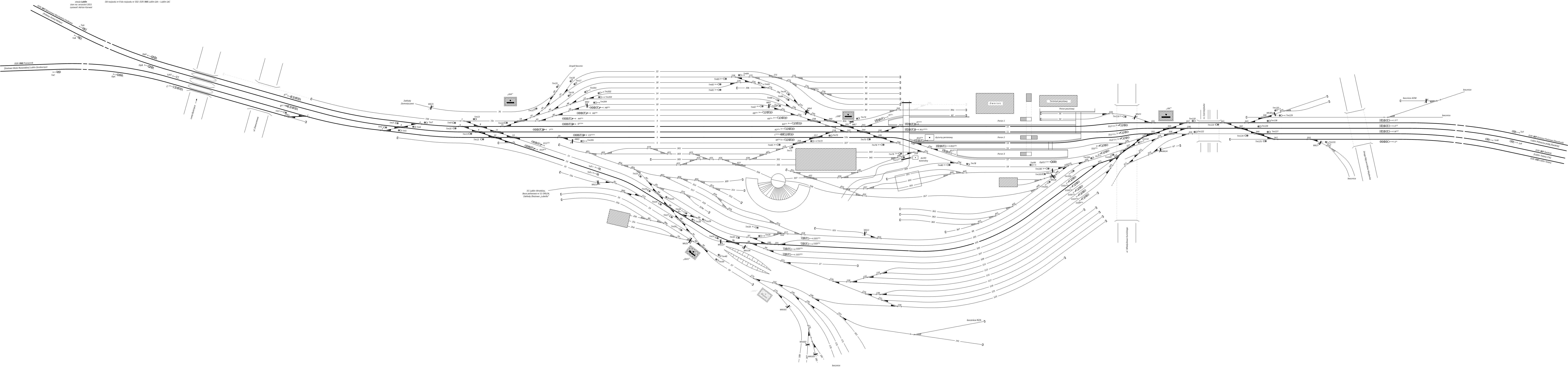
The station is remarkable for having a vast amount of tracks. "The train for Szklarska Poręba calling at Warsaw is standing on Platform 1, Track 52. The train from Warsaw arrives at Platform 3, Track 57." Gulp! Apparently, many tracks are now defunct, ripped up or for freight only, but from the passenger's point of view, this numeration system is madness.Click on the scheme below to see just how complex Lublin station is - but surely there's a better way of numbering tracks? [click here to see the whole picture]. Plus, it's a long walk from the station to town. 


Lublin is well worth a visit. It's cheaper than Warsaw and easy to get to. Now it has its own (and remarkably busy) airport with connections to London Stansted and London Luton, and later this year to Sheffield-Doncaster and Glasgow. The rail journey to Warsaw takes a little over two hours and there's also a good PolskiBus.com service.


* Fara or Farna - archaic term for 'parish'. Kościół farny = Parish church. Ul. Ku Farze = Towards the Parish (Church) Street; Pl. Po Farze = After (or the Remains of) the Parish (Church) Square (or Place).

This time two years ago:
70th anniversary of the Warsaw Ghetto Uprising

This time three years ago:
Tarkovsky's Stalker: a zone of my own

This time four years ago:
Warsaw's big billboards

This time five years ago:
Pace of development falters

This time eight years ago:
Strange days indeed