Wednesday, 9 November 2011

Bad news for Jeziorki rat-runners

As I've written ad nauseam, ul. Puławska is one barely-moving parade of steel, glass and rubber, trying desperately to disgorge tens of thousands of suburban and exurban Varsovians into their place of work - and failing. It is, then, only natural that drivers should seek alternatives to this near-stationary three-lane highway (traffic lights every two hundred metres).

The alternative route is marked on the map below (click to enlarge).

The yellow route, between ul. Karczunkowska to ul. Poleczki and its business parks is all well and good - except it's been severed by the ongoing roadworks (S2 southern Warsaw bypass between Węzeł Lotnisko and Węzeł Puławska). It's been like this for two years now. No problem for the all-terrain cyclist or pedestrian-in-wellies, but motorists must detour the road closure with a zig-zagging 2.3km detour over some of the worst roads in any EU capital. From Ludwinowska to Krasnowolska is a mere 900m.

To make things worse, this week, ul. Ludwinowska (marked in red running horizontally from the end of ul. Jeziorki towards the railway line) has been well and truly cut by some sewerage pipe-laying (below), marked as a black line on the map above.


This leaves two options open for those who use this way to work: put up with the frustration of Puławska, or chance it over Poloneza's potholed surfaces and take a risk over the almost- but-not-quite completed viaduct. No work has actually occurred here since July, its still waiting for final layers of asphalt, one bit of pavement and some minor finishing off.

Locals have taken matters into their own hands and have forced the viaduct open by pushing apart the concrete barriers at the north end (below) and dismantling the no-entry signs at the south end.

But I wouldn't chance in a car without high ground clearance, there are big jumps where the road surface changes. Still, as it is, I can cycle the 5.6km from Karczunkowska to Poleczki faster than a car taking the long route.

This time last year:
Death on the tracks

This time four years ago:
From Łady to Falenty

Monday, 7 November 2011

Polish "right" splits. Again.

For casual observers of the Polish political scene, you may be interested that for the third time there's been a split in Poland's main "right"* wing party - Prawo i Sprawidliwość (PiS - Law and Justice). This time angry young man, former justice minister, Zbigniew Ziobro has marched off with 15 other newly-elected PiS deputies to form a new party (tentatively 'Solidarna Polska' - er... translation anyone? Poland of Solidarity? Loyal Poland? Joint and Several Poland?).

This is yet another schism in Poland's "right". The last one was when 15 PiSite deputies left Jarosław Kaczyński's party to form PJN - Polska Jest Najważniejsza (literally 'Poland Is Most Important') in November 2010. These splitters promptly achieved 2% in the latest parliamentary elections.

Before that? Marek Jurek. Remember him, readers? Former Speaker of the Sejm. He got upset that PiS was not religiously reactionary enough for his tastes, so he formed Prawica Rzeczpospolitej (The Right of the Republic) taking six PiS deputies with him in April 2007. Like PJN after him, his party got absolutely nowhere in subsequent parliamentary elections.

Why is it that PiS keeps fragmenting? Is it because of a conviction that under its leader (and co-founder, along with his late twin brother Lech) PiS will never regain power? Or because of Jarosław's authoritarian manner, his inability to placate competing egos, his sense of absolute conviction in the rightness of his argument? Or, indeed both?

What if things were different? Many commentators have said that PiS's 30% at the recent parliamentary election was a good showing, and that the party couldn't have hoped to have squeezed any more votes. But look at Hungary's Fidesz - a party that occupies the same quadrant of the political chart. Patriotic, traditional yet not a party to yield up the commanding heights of the economy to free enterprise. And yet it enjoys a constitution-changing two-thirds majority in the Hungarian parliament. So it is possible to win elections in this part of Europe with a PiSite world-view.

Meanwhile, Ruch Poparcia Palikota (UK readers - imagine a party called something like 'The Movement to Support Mandelson' and you'll not be far off) has finally realised it's time to shed the one-man band image, being the third-largest party in the lower house, and seeks a new name - in a nationwide contest. An ad agency asked by TVN news to devise one came up with '665' - as in 'the lesser evil'. Nice. We shall see what the people dream up...

And so, with the "right" divided, the SLD parliamentary club run by opportunist Leszek Miller, (changing parties as often as PiS has splintered, premier when Poland was at its most corrupt) rendering the post-communist party unelectable, Donald Tusk effectively has no opposition.

He MUST take the opportunity to force through badly-needed fiscal reforms, improve Poland's business environment, speed up delivery of infrastructure projects, or face his only real threat to political power - the markets.

* Why "right" in inverted commas? Because unlike American Republicans or British Conservatives, PiS is not a free-market party. It believes in a large state and mistrusts entrepreneurs.

This time last year:
Tesco vs. Auchan

This time four years ago:
My father's house

Sunday, 6 November 2011

Town planning and the Sublime Aesthetic

Are we in New Mexico? Is this Aquacaliente? Or Iridium Springs in Arizona? No, this is Warsaw's new exurbs, a new estate being built in Nowa Wola, in the fields between Zgorzała and Nowy Podolszyn.

(The mud-spattered walls, lack of pavement and asphalt are typical of Polish town planning: build the houses, and in a few years the infrastructure will follow).

In terms of the architecture, this I like. Bold, moderne, flashing me back to the near-past yet into the future - the essence of the Sublime Aesthetic - the sunset helps too. This is ul. Plonowa ('harvest street'), formerly nothing more than a track running through fields between Nowa Wola and Zamienie.

Looking west towards the setting sun; we can see the radio transmission tower at Raszyn (well, Łazy actually). Note how flat the landscape is. Agriculture as far as the eye can see.

Question is though, for how long? Google Earth's current image for this area (dated April 2009) shows no sign of development here whatsoever. Zumi.pl (from this year) does. Now, six houses are complete (one's a show house) with a further eight in various stages of construction. Another development is going up on ul. Plonowa nearer Zamienie.

The pros and cons of living here? The pros - it's far from the madding crowd. The cons - it's far from the madding crowd. To get from here to Jeziorki in the morning would take 15-20 minutes by car (assuming dry dirt-track road and the level crossing gates not being down). Right now, it's all fields (left, look at that cabbage in the foreground). Trouble is, with the economy as it is, it's unlikely there will be much by way of infrastructure any time soon.

This time last year:
On the long road from Zero to One

This time two years ago:
Łódź Rising

Saturday, 5 November 2011

Vapour trails after sunset

The sun now sets just before 16:00, rising at 06:40. Waking up at 05:40 each weekday morning, I have little benefit from the extra daylight in the morning and lose an hour in the evening. Bleh! Time to demand the scrapping of winter time; let's have summer time the year round.

Anyway, some 20 minutes after sunset today, I saw this magnificent sight (below), which thanks to Flightradar24.com, I ascertained as an Emirates Boeing 777 flying from New York to Dubai.

The starboard wing and the vapour trail brightly illuminated by the sun, which, at 36,000ft, had still not disappeared below the horizon. Just beneath it, another vapour trail, dissipating, from a four-engined jet that had been heading in the opposite direction. Quite a sight!

This time last year:
Autumnal blues

Friday, 4 November 2011

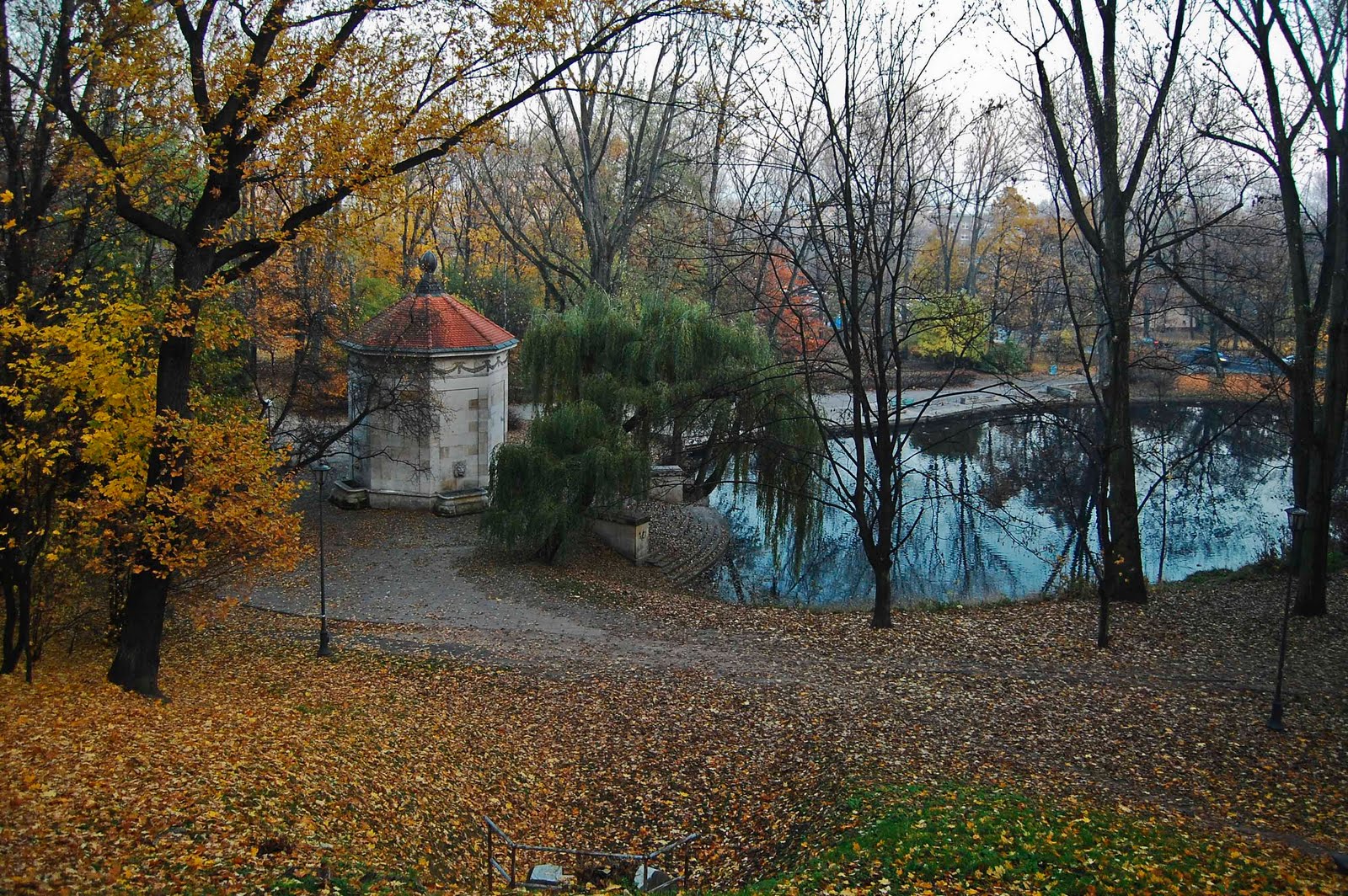
Skarpa in autumn

A week away from Powiśle, and yet it beckons me back... above: Park na Książęcem, looking down the Vistula escarpment. The park, named after Prince Kazimierz Poniatowski, is part of a larger complex of public open space, the Marszałek Edward Śmigły-Rydz Park, which forms the western border of Solec.
   
Beautiful cloudless blue skies, trees clad in autumnal gold that also carpets the ground. This time last year, the trees had lost all their leaves. I must say, the clocks going back last weekend is becoming a pretty senseless exercise. As it is, even with the time change, I wake up in darkness (at 05:40 weekdays), so all that's happened is that I lose an hour of daylight in the evening. Time to scrap wintertime - summer time all year round for me, please! 

This time three years ago: 
A town called 'Tunnel'

Three years ago today, also: 

Thursday, 3 November 2011

New office - first impressions

Well, the place reeks of fresh paint, and working in a 19th C. building (even if refurbished to meet the requirements of the 21st C.) takes a bit of getting used to, what with small, separate, rooms rather than one large open space for all.

So then - here we are - ul. Nowogrodzka 12 (the stretch between ul. Krucza and Marszałkowska). A more central location would be hard to find. The new office is six minutes away from the platforms at Centrum Metro station. A huge number of buses and trams pass by, along Marszałkowska, Al. Jerozolimskie, ul. Marszałkowska, and even one (the 107) going up and down ul. Krucza. Below: it's the middle building on the other side of the street. Looming out of the mist - the Novotel Centrum hotel, located at the very epicentre of Warsaw.

Food-wise, there's a heap more choice than around the old office, located in Solec, the southern end of Powiśle. My favoured lunchtime haunt there was Qchnia, a Viet-Pol place. And R20 on Rozbrat, a quality restaurant if too pricey for regular visits. Around Centrum, there's enough bars and cafés within a five-minute walk of my new office to ensure that I could eat somewhere different every day for a month. So far, I've tried Namaste India across the road and the Nam Sajgon on Bracka - both very good. Beef noodle soup at the latter is good value (but I preferred the same dish at the Asia-Tasty in Hala Gwardii.

Above: Step off the main street and through the entrance. Below: the courtyard of the kamienica ('tenement' - the official translation of kamienica does not reflect the flavour of the building). A bit run-down, but plenty of character, klimat.


These doorways (left)beautifully reflect the ambience of a Warsaw (indeed Polish) kamienica. Zapuszczone, zapyziałe, podrapane, zaniedbane are some of the kinder descriptions - and you can imagine that smell that greets the nostrils as you go through into the stairwell - a mixture of dankness, cheap cleansing fluid, cooking odours, cat-pee. But step through into the apartments - new furniture, 72" flat-screen TVs and all mod-cons. Signs ban ball-games and warn of falling plasterwork.

This time last year:
The topography of dreams

This time two years ago:
A regular interchange

Wednesday, 2 November 2011

South Warsaw transport hub

Today was my first day in our new offices on ul. Nowogrodzka 12. I will write more about the place soon, once its platzgeist or genus locii becomes more bedded down. In the meantime...

Wilanowska - known by older Warsaw residents as Dworzec Południowy (analogous to W-wa Zachodnia and Wschodnia) - is a massive transport hub through which those heading south out of Warsaw must pass to move from Metro or tram to bus. Indeed, there used to be a narrow-gauge railway terminus here, for trains coming up from Góra Kalwaria and Grójec (UPDATE: November 2017 - see this post for more history of that line).

The Metro is excellent at delivering Ursynauers to Ursynów. But for residents of Piaseczno and their wealthier brethren living in Konstancin, you've got to get around Las Kabacki somehow. The forest is a huge obstacle, enclosing Ursynów from the south and funnelling southbound traffic either down Puławska (west of the forest) or Przyczółkowa -Drewny -Warszawska to the east.

Above: Wilanowska bus terminal. Between 17:00 and 18:00, a bus leaves here every three minutes down Puławska alone. In total, 23 different day buses, three night buses and five tram lines pass through or terminate at Wilanowska. Plus long-distance PKS and PolskiBus.com coaches. The volume of buses leaving here is very high - if only there were a bus lane along Puławska and Przyczółkowa and buses could move swiftly past jams of stationary motorists rather than being stationary too. UPDATE 2022: Bus lane installed, journey times from Jeziorki almost halved.

Above: the bar with the tree sticking out of its roof - a bit of Slavic whimsy to add character to the place. A recent arrival to this rather bizarre row of booths, kebaberies, kiosks and bars is a cash-only ticket office for PolskiBus.com.

Above: looking north-east at the bus terminal. Between the buses and the distant blocks of flats - a three-level park+ride for 290 cars. Assuming they each take 1.5 occupants (which I doubt), the car park full holds cars for as many people as just three articulated buses could carry.

Park+Rides this close to the city centre make little sense. The cost of building the Wilanowska P+R could have bought dozens of new buses with enough money to paint a line down Puławska.

This time two years ago:
Powiśle on a cold, clear autumn morning

This time three years ago:
Okęcie "to remain Warsaw's only airport"

This time four years ago:
Searching for autumnal perfection

Tuesday, 1 November 2011

Miraculous no-gear landing of SP-LPC

Half past two in the afternoon just gone; after lunch; time for a walk to the cemetery to photograph the graves in their All Saints' Day finery. But what's this? A Boeing 767 is coming into land - but where's the undercarriage?

Below: the plane, a LOT Polish Airlines Boeing 767-300ER, SP-LPC, at its closest to our house. I have never seen a plane this close to the runway threshold (a mere 4,500 metres away) with flaps fully extended but landing gear still in.

The plane passes over, getting ever-nearer the runway... and - no still sign of the wheels... Note the tail skid extended (click on photo above to see in detail).

Below: rapidly disappearing from view. I race indoors to switch on Flightradar24.com; by the time the page is live, there's no sign of the plane. So I assume there was no go-round; maybe the gear came out at the last minute? At this stage, the plane must be 2,000 metres or less from the threshold and 200 metres or less above the ground.

En route to the cemetery, the sky was filled by the roar of fast jets. I could just make out the shape of an F-16 flying south-west. At this stage, I had not put one and one together. A pair of F-16s had been called out of Łask air force base to check visually whether or not the gear was out.

Later, Moni called me on the mobile to say that a plane had landed gear-up at Okęcie and everybody safe - thank God! Putting down an aircraft like the 767 without wheels is incredibly difficult.

The part of the aircraft that must touch the ground first is the rear fuselage. If the angle of attack is too shallow, the first things that touches the ground are the engines; as soon as that happens, the nose flips down instantly. If the angle of attack is too great, the plane is in danger of stalling and literally falling out of the sky onto its tail. So - quite rightly, LOT's Captain Tadeusz Wrona must be lauded as the hero of the day.

[Amazing photo here]

[BBC news report here]

Looking at the pics again - spooky. Fill me with dread - and yet huge relief that a tragedy had been averted.

Forty-eight years ago, nearly to the day, my father photographed a Douglas DC-8 that had crash-landed wheels-up near Heathrow Airport. Pics and story here. (Incidentally, after a similar landing, that DC-8 lived to fly again, only to crash again, this time with fatal results.)

This time three years ago:
Where's the daylight gone?

This time five years ago:
All Saints' Day - Wszystkich Świętych