So far, so good. No mass outbreaks of mass violence to pique the prurient interest of the British media (the strongest report thus far has been this one in the Daily Telegraph; note the lack of detail and reliance on hearsay).
But tomorrow all this may change; Poland plays Russia at home, in Warsaw - the enmity between Scotland and England ('the Auld Enemy') is as nothing to this.
Amid the flotillas of Polish cars sporting Polish flags, I saw today the first vehicles from Russia. All of them black, all of them with darkened windows, all of them with a showroom price of at least €60,000. We are talking Lexus, Range Rover, BMW 7-series. Friends of Putin or honest entrepreneurs who have worked hard to achieve? A bit of both, most probably.
Given the Czechs' 4:1 thrashing at the hands of the Russians in Wrocław last Thursday, I think it highly unlikely that Poland will manage to even hold the Russians to a draw. In the likely eventuality of a Polish defeat, the streets of Warsaw tomorrow night will not be a safe place to exhibit a black Audi Q7 on Moscow plates. In fact, central Warsaw - from the National Stadium to the Palace of Culture and for many blocks around - will not be a pleasant place to be, full-stop.
Of course, I hope I am proved wrong by events.
It would be nice to see cheerful, sober Polish fans thronging westwards along Most Poniatowskiego politely exclaiming "Tough luck, Russia, jolly good show old chaps, better luck next time," (or even "Well done, Russia, it was indeed the better team that won it"). Nice, but it won't happen. There's too much historical animosity; the Russian boot has stamped down on the Polish face too often to let bygones be bygones on the football field. Especially if the Russian fans then insist on rubbing it in.
Meanwhile, the public face of the city of Warsaw is holding up. The public transport system is working perfectly. The threatened beer drought has not materialised (Guinness at 4.99 zlotys a can at Lidl while stocks last). The atmosphere around the fan zone, less than half a kilometre from my office, remains entirely good natured. Warsaw's Roma mendicant community has withdrawn from visibility, leaving lucrative pitches to Polish beggars, most of whom have a significant alcohol problem. Today I saw one such fellow asleep atop a rubbish bin outside Dworzec Centralny, hand still clutching an empty cola cup containing petty alms.
I can only hope for a positive outcome. If there's one day of this entire tournament that could go badly wrong - it's tomorrow. May the Good Lord, who has provided for Poland so well over the past years, see that somehow, all goes well on the day.
This time last year:
Era becomes T-Mobile
This time two years ago:
Warsaw-Góra Kalwaria-Pilawa rail link closed
This time three years ago:
Marsh harrier, golden airliner over Jeziorki
This time four years ago:
Bus blaze on way to town
This time five years ago:
A beautiful, stormy twilight
Monday, 11 June 2012


Friday, 8 June 2012
There's no pleasing some people...
Moni returned to Warsaw with a suitcase weighing more than her, so I met her at Dworzec Centralny, now looking (and smelling) very decent. The two of us manhandled the baggage to the bus station above, and heaved it onto a 131 bus which would drop of off at Metro Politechnika. Easier than dragging the thing to Metro Centrum. The Poland-Greece match, kicking off the long-awaited Euro 2012 football championship, was in full swing. It was on Wednesday, 18 April 2007 that Michel Platini announced that Poland and Ukraine would jointly host the 2012 UEFA football championships - and here we are! It has happened.
The fan zone, at the foot of the Palace of Culture, was less crowded than I anticipated, but even so, the centre of town was totally focused on football. The next bus stop, Centrum, has been renamed Centrum - Strefa Kibica (Fan Zone). Ul. Marszałkowska has been closed between Rondo Dmowskiego and ul. Świętokrzyska. As our bus drove south along Marszałkowska, we could see fleets of buses ready to take fans home after the match. Buses with numbers like 'F31' and 'F34' - F for football, F for fans. We take the Metro to Wilanowska, and get to a taxi. Moni leaves me with the suitcase and skips off to meet up with friends in Ursynów.
The taxi driver is one of life's moaners. First - the football. Fatalism and pessimism - it's always like this - so much promise, then disappointment. Like life. "Never mind the football," I say. "Just look at how much has been done! The A2 links Warsaw to Berlin, there's a new station at Okęcie airport, Dworzec Centralny and Wschodni have both been thoroughly renovated..." "So what," he replies. "Ul. Wołoska is still a mess after 11 years..." He's not wrong there - I remember driving Moni to primary school on ul. Bełska and thinking that Wołoska will be sorted in a year or two - and now she's at university, that middle section remains single carriageway. The taxi driver went on about the tunnel under the railway at ul. Dźwigowa, the bankrupt stadium subcontractors, the indolence of the city's highway authority, the obscene amount of money paid to the guy who got Poland's sports infrastructure ready for the championships - and of course the Polish football team and its trainer. And then the fact that Puławska around ul. Karczunkowska floods whenever there's a downpour (as there was today).
After a while, I switched off. Yes, of course one can find fault. But surely optimism trumps pessimism every time. Why not take time out every now and then to celebrate achievements, to mark milestones of progress, to share recognition that things are getting better, rather than to trot out a litany of woes? What good does it do? What does moaning achieve?
Anyway, we reach Jeziorki and "Ah! I forgot to switch on the meter. That'll be 30 złotys..." A eminently reasonable price for the 9km/6 mile journey - but the taxman has missed out on his 23%.
This time two years ago:
Lessons for our local policy-makers
This time four years ago:
Recycling for fun and profit
The fan zone, at the foot of the Palace of Culture, was less crowded than I anticipated, but even so, the centre of town was totally focused on football. The next bus stop, Centrum, has been renamed Centrum - Strefa Kibica (Fan Zone). Ul. Marszałkowska has been closed between Rondo Dmowskiego and ul. Świętokrzyska. As our bus drove south along Marszałkowska, we could see fleets of buses ready to take fans home after the match. Buses with numbers like 'F31' and 'F34' - F for football, F for fans. We take the Metro to Wilanowska, and get to a taxi. Moni leaves me with the suitcase and skips off to meet up with friends in Ursynów.
The taxi driver is one of life's moaners. First - the football. Fatalism and pessimism - it's always like this - so much promise, then disappointment. Like life. "Never mind the football," I say. "Just look at how much has been done! The A2 links Warsaw to Berlin, there's a new station at Okęcie airport, Dworzec Centralny and Wschodni have both been thoroughly renovated..." "So what," he replies. "Ul. Wołoska is still a mess after 11 years..." He's not wrong there - I remember driving Moni to primary school on ul. Bełska and thinking that Wołoska will be sorted in a year or two - and now she's at university, that middle section remains single carriageway. The taxi driver went on about the tunnel under the railway at ul. Dźwigowa, the bankrupt stadium subcontractors, the indolence of the city's highway authority, the obscene amount of money paid to the guy who got Poland's sports infrastructure ready for the championships - and of course the Polish football team and its trainer. And then the fact that Puławska around ul. Karczunkowska floods whenever there's a downpour (as there was today).
After a while, I switched off. Yes, of course one can find fault. But surely optimism trumps pessimism every time. Why not take time out every now and then to celebrate achievements, to mark milestones of progress, to share recognition that things are getting better, rather than to trot out a litany of woes? What good does it do? What does moaning achieve?
Anyway, we reach Jeziorki and "Ah! I forgot to switch on the meter. That'll be 30 złotys..." A eminently reasonable price for the 9km/6 mile journey - but the taxman has missed out on his 23%.
This time two years ago:
Lessons for our local policy-makers
This time four years ago:
Recycling for fun and profit
Thursday, 7 June 2012
Visitors fly in for the football
As expected, the impending football championships have created increased air traffic over Jeziorki. The three countries playing qualifying matches along with Poland here in Warsaw are the Czech Republic, Greece and Russia. Below: while Aeroflot usually serves the Moscow-Warsaw route with an Airbus A320, here's a much larger Airbus A330, VQ-BQY. The aircraft is registered in... Bermuda.
 Below: a most unusual visitor from Greece - SX-FAR, a Raytheon Hawker 800, privately owned and registered in Greece.
 And bringing the Czech fans in - something entirely normal - a scheduled flight served by an ATR 42 belonging to CSA Czech Airlines.
 A new sight this season - Bombardier Dash 8 Q400 NextGen, newly delivered (late last month) to Eurolot for internal and short-distance flights. Eurolot will be replacing the ATR 42s and -72s with the Bombardiers.
 The football starts tomorrow; let's hope the championships pass off without undue violence, terrorism, crime, pandemics, general mishaps or any other untoward occurrences.
 Above: Fanzone Warsaw stands ready to receive. "Experience the sensation of verisimilitude to residence within your own place of abode" - feel at home, like.
This time last year:
Cara al Sol - part II
This time two years ago:
Still struggling with the floodwaters
This time three years ago:
European elections - and I buy used D40
[my Nikon D40 still proving utterly reliable]
The time four years ago:
To the Vistula, by bike
This time five years ago:
Poppy profusion
 Below: a most unusual visitor from Greece - SX-FAR, a Raytheon Hawker 800, privately owned and registered in Greece.
 And bringing the Czech fans in - something entirely normal - a scheduled flight served by an ATR 42 belonging to CSA Czech Airlines.
 A new sight this season - Bombardier Dash 8 Q400 NextGen, newly delivered (late last month) to Eurolot for internal and short-distance flights. Eurolot will be replacing the ATR 42s and -72s with the Bombardiers.
 The football starts tomorrow; let's hope the championships pass off without undue violence, terrorism, crime, pandemics, general mishaps or any other untoward occurrences.
 Above: Fanzone Warsaw stands ready to receive. "Experience the sensation of verisimilitude to residence within your own place of abode" - feel at home, like.
This time last year:
Cara al Sol - part II
This time two years ago:
Still struggling with the floodwaters
This time three years ago:
European elections - and I buy used D40
[my Nikon D40 still proving utterly reliable]
The time four years ago:
To the Vistula, by bike
This time five years ago:
Poppy profusion
Wednesday, 6 June 2012
Classic British cars - Jabłonna
Time prevented me from posting these pics last week; this was the BPCC's British Motor Show and Classic Car Rally, starting and finishing at the palace in Jabłonna, some 12 miles north of Warsaw.

Above: a brace of 1949 limousines: left - a Bentley Mark VI, right - a Rolls-Royce Silver Wraith. Both belong to a British Pole, both are available for hire (CultCars.pl). Standing next to the limos a classic British sports car - the mid-engined, wedge-shaped Lotus Esprit S1, from 1978 (below). The Giugaro-designed Esprit first saw light of day in 1976. The modern aesthetic matured very quickly between the late '40s and mid '70s, after which change slowed down to the point where cars today change shape for marketing reasons rather than aesthetic or engineering ones. Look at the shape below: it's 32 years old, but just 27 years younger than the stately limos seen above.

Below: an Austin-Healey 3000 Mk I from 1960, a rally replica of the car in which Pat Moss (Stirling's sister) won the Liège-Rome-Liège and finished second in the Coupe des Alpes.

Below: my personal favourite of the day: a 1953 Aston Martin DB2/4. Impeccably restored, under the bonnet as well as inside the cockpit, a glorious car that oozes gentlemanly character.

 As well as the oldtimers, there were modern cars from Jaguar, Land-Rover, Lotus and Aston Martin; these somehow did not attract my attention. Today's cars for me lack character. A classic that has passed the test of time, driven infrequently and cherished by its owner, is an object of great value and beauty. Without character, a car is but a commodity, a functional box on wheels for getting one from here to where public transport does not go or for doing the weekly shop. I like cars that have a lot more charisma than a washing machine or fridge-freezer.
 One of three 'E'-Type Jaguars to take part, a US-spec (no headlamp farings). Note the yellow zabytkowe ('heritage') number plates. Assuming your car is over 25 years old and out of production for over 15 years, original and in good mechanical condition, with zabytkowe plates you can insure your classic car for peanuts. However, by having yellow plates, you relinquish some of your freedoms as the owner; you cannot, for example, re-export it without the permission of the Polish state.
It was wonderful seeing this many excellently maintained British classics - cars that impressed me since my childhood - in the stately surroundings of a Polish palace. This is what Britishness is all about - quality engineering, thoroughbred tradition, classic style - a language understood the world over.
This time last year:
Cara al Sol - a short story
This time two years ago:
Pumping out the floodwater
This time three years ago:
To Góra Kalwaria and beyond
This time four years ago:
Developments in Warsaw's exurbs

Above: a brace of 1949 limousines: left - a Bentley Mark VI, right - a Rolls-Royce Silver Wraith. Both belong to a British Pole, both are available for hire (CultCars.pl). Standing next to the limos a classic British sports car - the mid-engined, wedge-shaped Lotus Esprit S1, from 1978 (below). The Giugaro-designed Esprit first saw light of day in 1976. The modern aesthetic matured very quickly between the late '40s and mid '70s, after which change slowed down to the point where cars today change shape for marketing reasons rather than aesthetic or engineering ones. Look at the shape below: it's 32 years old, but just 27 years younger than the stately limos seen above.

Below: an Austin-Healey 3000 Mk I from 1960, a rally replica of the car in which Pat Moss (Stirling's sister) won the Liège-Rome-Liège and finished second in the Coupe des Alpes.

Below: my personal favourite of the day: a 1953 Aston Martin DB2/4. Impeccably restored, under the bonnet as well as inside the cockpit, a glorious car that oozes gentlemanly character.


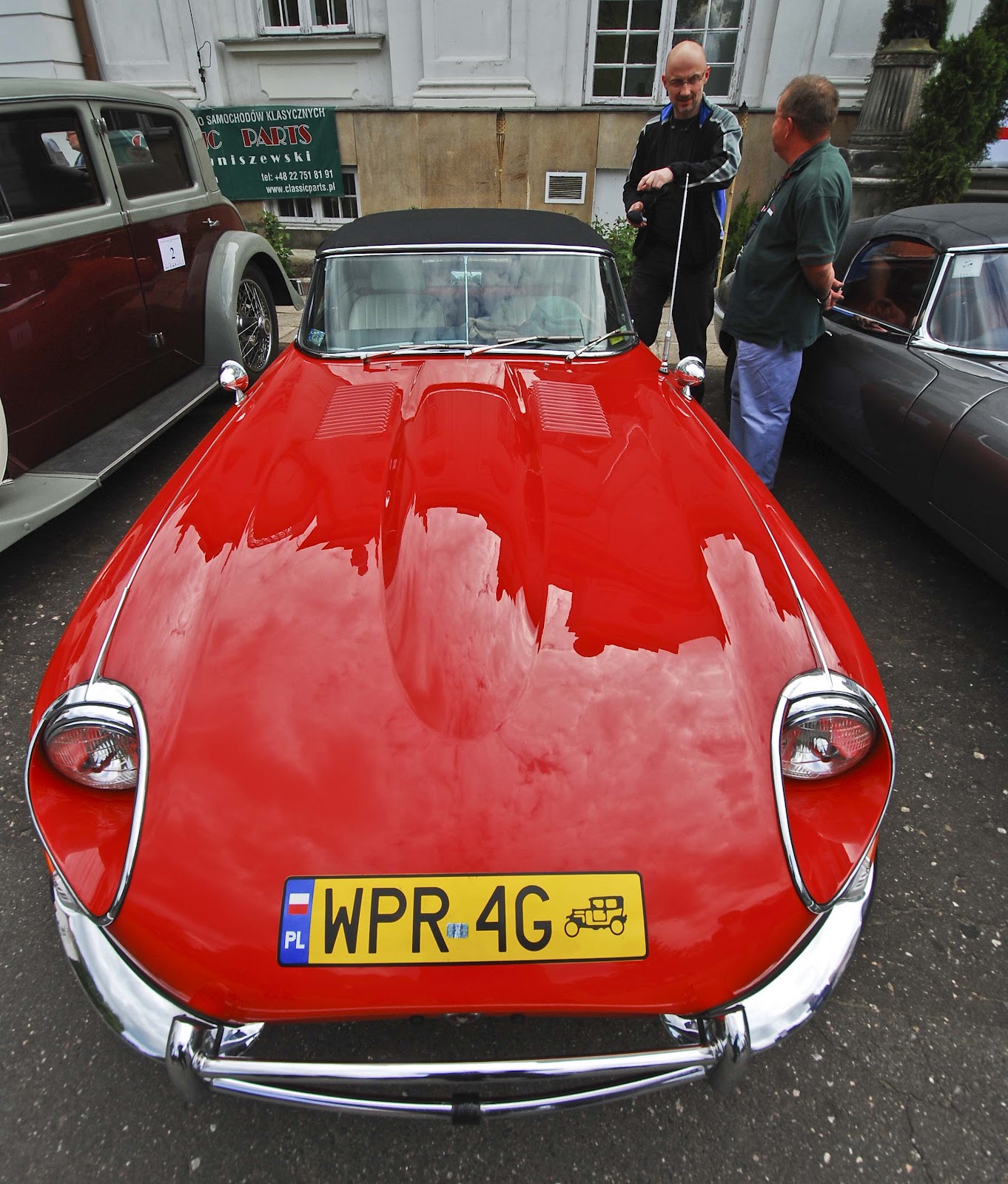 One of three 'E'-Type Jaguars to take part, a US-spec (no headlamp farings). Note the yellow zabytkowe ('heritage') number plates. Assuming your car is over 25 years old and out of production for over 15 years, original and in good mechanical condition, with zabytkowe plates you can insure your classic car for peanuts. However, by having yellow plates, you relinquish some of your freedoms as the owner; you cannot, for example, re-export it without the permission of the Polish state.
It was wonderful seeing this many excellently maintained British classics - cars that impressed me since my childhood - in the stately surroundings of a Polish palace. This is what Britishness is all about - quality engineering, thoroughbred tradition, classic style - a language understood the world over.
This time last year:
Cara al Sol - a short story
This time two years ago:
Pumping out the floodwater
This time three years ago:
To Góra Kalwaria and beyond
This time four years ago:
Developments in Warsaw's exurbs
Monday, 4 June 2012
Transport - Poland's development
Flying back from Rysiek's wedding, Adam observed that for most of the time he's been living in Poland, the country has been one great work-in-progress. Finally, he says, it's starting to come right, with the balance of the work now having been completed and only the minority of work still ongoing. An insight worthy of sharing.
The stark deadline for the completion of major infrastructure projects - the first match of the Euro 2012 football championships this coming Friday - has spurred Poland to unprecedented deeds when it comes to infrastructure provision. To my amazement, the A2 motorway has connected Poznań and Łódź to Warsaw. Okęcie airport finally gets a rail link. I've heard this - but don't believe it having been there just a few weeks ago - that Wrocław's main station is reopened, it's remont complete. As is W-wa Wschodnia. And W-wa Zachodnia, my tip for the worst railway station in Poland - now has new electronic signage, shelters and other cosmetic improvements that have dramatically improved user-friendliness.
Below: the new terminal at Gdańsk airport. Google Earth currently has imagery of the terminal from April last year - a muddy building site.
 My first flight with OLT Express. I'm impressed. For 149.50 złotys, I'm in Warsaw in 40 minutes (another 40 minutes for check-in, plus 25 minutes bus from town, and 25 mins from Okęcie to Warsaw city centre). This compares to PKP InterCity fares - 122.50 złotys second class, or 160.50 złotys first class, for a journey of five and half hours. You get to chose your seat (not the elbow-bruising rush for best seats on other low-costs) and (!) you get a sandwich and drink on board - for free! Plus - the plane took off and landed on time. How long this will last, I can't say. But my first impressions of OLT Express were extremely favourable.
 Below: flying out of Gdańsk; the ribbon in the foreground is the S6 expressway that forms the backbone of the Tri-City and now connects it with the A1 motorway, and down to Toruń, eventually through Łódź and on to Silesia and the Czech Republic. Eventually.
 Yes, while much has been achieved, there's still much to be done. The S2 Warsaw Southern Bypass, visible on final approach to Warsaw Okęcie airport. Look at it! How puny, how thin - a mere two lanes! What were the planners thinking? Warsaw's a city the size of Birmingham (UK) - the M6 motorway that runs through it is one solid traffic jam for much of the working day and that carries three lanes in each direction and has a by-pass. The S2 is the main road linking Berlin and Moscow! And going through Warsaw, the largest city in 900km - just two lanes...
 Below: another success - re-opened last week, Warsaw's Wschodnia (Eastern) station. The contrast between the old one - full of beggars and reeking of kebab, stale sweat, urine and cheap disinfectant - is just staggering. Suddenly, this part of Warsaw becomes modern and civilised, travel becomes more comfortable.
 Below: finally, a shot from Warsaw Central station (looking up at Platform Two from the underground passage linking it to W-wa Śródmieście station). Behold; and worship at The Electrick Tabernackle of Modernitee. Time to stop and contemplate Time itself.

The stark deadline for the completion of major infrastructure projects - the first match of the Euro 2012 football championships this coming Friday - has spurred Poland to unprecedented deeds when it comes to infrastructure provision. To my amazement, the A2 motorway has connected Poznań and Łódź to Warsaw. Okęcie airport finally gets a rail link. I've heard this - but don't believe it having been there just a few weeks ago - that Wrocław's main station is reopened, it's remont complete. As is W-wa Wschodnia. And W-wa Zachodnia, my tip for the worst railway station in Poland - now has new electronic signage, shelters and other cosmetic improvements that have dramatically improved user-friendliness.
Below: the new terminal at Gdańsk airport. Google Earth currently has imagery of the terminal from April last year - a muddy building site.
 My first flight with OLT Express. I'm impressed. For 149.50 złotys, I'm in Warsaw in 40 minutes (another 40 minutes for check-in, plus 25 minutes bus from town, and 25 mins from Okęcie to Warsaw city centre). This compares to PKP InterCity fares - 122.50 złotys second class, or 160.50 złotys first class, for a journey of five and half hours. You get to chose your seat (not the elbow-bruising rush for best seats on other low-costs) and (!) you get a sandwich and drink on board - for free! Plus - the plane took off and landed on time. How long this will last, I can't say. But my first impressions of OLT Express were extremely favourable.
 Below: flying out of Gdańsk; the ribbon in the foreground is the S6 expressway that forms the backbone of the Tri-City and now connects it with the A1 motorway, and down to Toruń, eventually through Łódź and on to Silesia and the Czech Republic. Eventually.
 Yes, while much has been achieved, there's still much to be done. The S2 Warsaw Southern Bypass, visible on final approach to Warsaw Okęcie airport. Look at it! How puny, how thin - a mere two lanes! What were the planners thinking? Warsaw's a city the size of Birmingham (UK) - the M6 motorway that runs through it is one solid traffic jam for much of the working day and that carries three lanes in each direction and has a by-pass. The S2 is the main road linking Berlin and Moscow! And going through Warsaw, the largest city in 900km - just two lanes...
 Below: another success - re-opened last week, Warsaw's Wschodnia (Eastern) station. The contrast between the old one - full of beggars and reeking of kebab, stale sweat, urine and cheap disinfectant - is just staggering. Suddenly, this part of Warsaw becomes modern and civilised, travel becomes more comfortable.
 Below: finally, a shot from Warsaw Central station (looking up at Platform Two from the underground passage linking it to W-wa Śródmieście station). Behold; and worship at The Electrick Tabernackle of Modernitee. Time to stop and contemplate Time itself.
Once upon a time, there was Gdańsk
I arrived in Gdańsk on Saturday at 11:00 (for those of you who think that Warsaw to Gdańsk by train takes seven hours - I'll let you into a secret - you can do it in 4hrs 40mins via Kutno and Bydgoszcz rather than directly). The wedding's not until six, so plenty of time to see the sights. And in Gdańsk, these are plentiful. [I'll be updating this post on the fly, so keep popping back:)]
Below: Gdańsk station and in front of it, a statue commemorating the kindertransports - Jewish children sent by their parents to England by train (often alone) just before the outbreak of WWII to escape their impending fate.
 Below: in the Middle Ages, Gdańsk was a world-class high-rise city. Most of the kamienice (tenements) in the old town are five to nine stories high. The Basilica of the Assumption of the Blessed Virgin Mary, completed in 1502, is the world's largest (though not tallest) brick church. (Four days earlier, I visited the world's largest wooden church.)
 Through the old town's gates (below) on ul. Chlebnicka, and we get to the Motława river and the mediaeval port on the Długie Pobrzeże ('long foreshore').
 Below: the żuraw (pron. ZHOOruv, meaning crane - as in mechanical lifting device, and indeed large bird of the order Gruiformes in both languages) on the Motława. The żuraw was originally built in 1444. In the distance, the SS Sołdek, a ship built in Gdańsk in 1948 and named after a Stakhanovite shipyard worker.
 The weather on Saturday was a mix of sunny intervals and intense, cold showers. After seeing the Old Town, I took myself by tram to the seaside. I've been to Gdańsk many times over the years, but I never visited the city's beaches. The Number 8 tram from Gdańsk Główny tram stop terminates at both ends by a beach. The north-western end of the line is at Jelitkowo (lit. 'Little Bowelly'), and this is the beach that I visit first. Below: the tram loop, some 400m from the sea.
 Below: a shelter from the coming storm - a solidly constructed beer tent, of typical construction to be found all along the Polish Baltic coast. Here I could sit and have lunch while a rain storm lashed the beach mercilessly for about 20 minutes.
 I finish lunch, return to the tram loop to catch a Number 8 from Jelitkowo to Stogi Plaża (that's as in the French plage, not the Spanish plaza), through the city centre again, and out the other side to the sea. The weather is still inclement.
 Above: the classic view of Gdańsk, the association with the cradle of the Solidarity movement, shipyard cranes standing sombre and immobile against a brooding sky.
 Above: Stogi beach, looking east. Turn around to face west, and you will see the gigantic DCT (Deepwater Container Terminal) port (below). The beach itself is impeccably clean.
 The clock is ticking away, time to board a tram back into town and catch a Number 6 to Oliwa for the wedding from Gdańsk Główny tram stop. Below: the Stogi Plaża tram loop is situated amid a forest, less than 300m from the sea.
 Below: the High Gate (Brama Wyzynna), seem from the tram heading back into the city centre. A map of Gdańsk is essential, as is a 24-hour bus/tram ticket (12 złotys) which - unlike Warsaw - is not valid for the city's SKM trains. Verily, Gdańsk is Newcastle-upon-Tyne (shipbuilding), Southampton
(ports), Oxford (historic buildings) and Bournemouth (beaches) all
rolled into one.
Below: the High Gate (Brama Wyzynna), seem from the tram heading back into the city centre. A map of Gdańsk is essential, as is a 24-hour bus/tram ticket (12 złotys) which - unlike Warsaw - is not valid for the city's SKM trains. Verily, Gdańsk is Newcastle-upon-Tyne (shipbuilding), Southampton
(ports), Oxford (historic buildings) and Bournemouth (beaches) all
rolled into one.

Below: Gdańsk station and in front of it, a statue commemorating the kindertransports - Jewish children sent by their parents to England by train (often alone) just before the outbreak of WWII to escape their impending fate.
 Below: in the Middle Ages, Gdańsk was a world-class high-rise city. Most of the kamienice (tenements) in the old town are five to nine stories high. The Basilica of the Assumption of the Blessed Virgin Mary, completed in 1502, is the world's largest (though not tallest) brick church. (Four days earlier, I visited the world's largest wooden church.)
 Through the old town's gates (below) on ul. Chlebnicka, and we get to the Motława river and the mediaeval port on the Długie Pobrzeże ('long foreshore').
 Below: the żuraw (pron. ZHOOruv, meaning crane - as in mechanical lifting device, and indeed large bird of the order Gruiformes in both languages) on the Motława. The żuraw was originally built in 1444. In the distance, the SS Sołdek, a ship built in Gdańsk in 1948 and named after a Stakhanovite shipyard worker.
 The weather on Saturday was a mix of sunny intervals and intense, cold showers. After seeing the Old Town, I took myself by tram to the seaside. I've been to Gdańsk many times over the years, but I never visited the city's beaches. The Number 8 tram from Gdańsk Główny tram stop terminates at both ends by a beach. The north-western end of the line is at Jelitkowo (lit. 'Little Bowelly'), and this is the beach that I visit first. Below: the tram loop, some 400m from the sea.
 Below: a shelter from the coming storm - a solidly constructed beer tent, of typical construction to be found all along the Polish Baltic coast. Here I could sit and have lunch while a rain storm lashed the beach mercilessly for about 20 minutes.
 I finish lunch, return to the tram loop to catch a Number 8 from Jelitkowo to Stogi Plaża (that's as in the French plage, not the Spanish plaza), through the city centre again, and out the other side to the sea. The weather is still inclement.
 Above: the classic view of Gdańsk, the association with the cradle of the Solidarity movement, shipyard cranes standing sombre and immobile against a brooding sky.
 Above: Stogi beach, looking east. Turn around to face west, and you will see the gigantic DCT (Deepwater Container Terminal) port (below). The beach itself is impeccably clean.
 The clock is ticking away, time to board a tram back into town and catch a Number 6 to Oliwa for the wedding from Gdańsk Główny tram stop. Below: the Stogi Plaża tram loop is situated amid a forest, less than 300m from the sea.
 Below: the High Gate (Brama Wyzynna), seem from the tram heading back into the city centre. A map of Gdańsk is essential, as is a 24-hour bus/tram ticket (12 złotys) which - unlike Warsaw - is not valid for the city's SKM trains. Verily, Gdańsk is Newcastle-upon-Tyne (shipbuilding), Southampton
(ports), Oxford (historic buildings) and Bournemouth (beaches) all
rolled into one.
Below: the High Gate (Brama Wyzynna), seem from the tram heading back into the city centre. A map of Gdańsk is essential, as is a 24-hour bus/tram ticket (12 złotys) which - unlike Warsaw - is not valid for the city's SKM trains. Verily, Gdańsk is Newcastle-upon-Tyne (shipbuilding), Southampton
(ports), Oxford (historic buildings) and Bournemouth (beaches) all
rolled into one. 
Rysiek and Blanka's wedding, Gdańsk
After the best part of the day sightseeing (see separate post) in Gdańsk, I headed off by tram towards Oliwa and its famous cathedral, for the wedding of Rysiek and Blanka. (Rysiek's another old harcerz from West London's Błękitna Trójka, who I've known for the best part of half a century). As I approach the park situated behind the cathedral, I espy a triple rainbow! (click to enlarge). A double rainbow (ROYGBIVROYGBIV*), the two touching, plus a fragment of a third above and to the right. An auspicious sign!

 Left: Oliwa Cathedral, looking towards its famous organ. An impressive place for a wedding. I was last here in 1977 on Montserrat - two coachloads of 15-20 year-old boys and girls of Polish parentage going to the fatherland for a religious pilgrimage organised by the Polish parish in Ealing. How different it all looked back then, the cathedral an oasis of splendour amid the drab shabbiness of everyday communist reality.
Below: bride, groom, family and friends on the cathedral steps. Over 140 guests, including 100 or so who made it all the way from England. Mercifully, it didn't rain on the group photo nor on the greeting of the guests. Interestingly, meeting many old friends of my generation living in Britain or in Poland, I was struck by the diversity of ages of their children - from two to 29.
 Below: Bride and groom meeting the guests. Outside the cathedral it was chilly for this time of year; just across the Baltic, Stockholm shivered in temperatures of just +6C, a record for early June.
 Below: the wedding reception took place in Stara Cegielnia in Rzucewo, near Puck, some 60km away from Oliwa. This beautifully restored brickworks was next door to Zamek Jan III Sobieski, which I suspect had more to do with the area's former Prussian rulers than with the Polish king who saved Europe's bacon at the Battle of Vienna.
 To kick off the night's celebrations, Rysiek dons folk costume and with his bride performs a traditional Polish dance (left) before leading off all the guests in a Polonaise.
 I wish Rysiek and Blanka a long and happy marriage, full of love, companionship, shared interests and - a trio of little ones.
 Above: the view from Rzucewo. In the distance, the Hel peninsula. The celebrations went on until five in the morning, by which time it's broad daylight.
*The mnemonic Richard Of York Gave Battles In Vain = Red Orange Yellow Green Blue Indigo Violet
This time last year:
Wetlands in late-spring
This time last year:
Jeziorki's flood of floods: Puławska and Pozytywki
Jeziorki's flood of floods: Sarabandy and Karczunkowska
Jeziorki's flood of floods: Trombity and Kórnicka
This time two years ago:
Another time, another place

 Left: Oliwa Cathedral, looking towards its famous organ. An impressive place for a wedding. I was last here in 1977 on Montserrat - two coachloads of 15-20 year-old boys and girls of Polish parentage going to the fatherland for a religious pilgrimage organised by the Polish parish in Ealing. How different it all looked back then, the cathedral an oasis of splendour amid the drab shabbiness of everyday communist reality.
Below: bride, groom, family and friends on the cathedral steps. Over 140 guests, including 100 or so who made it all the way from England. Mercifully, it didn't rain on the group photo nor on the greeting of the guests. Interestingly, meeting many old friends of my generation living in Britain or in Poland, I was struck by the diversity of ages of their children - from two to 29.
 Below: Bride and groom meeting the guests. Outside the cathedral it was chilly for this time of year; just across the Baltic, Stockholm shivered in temperatures of just +6C, a record for early June.
 Below: the wedding reception took place in Stara Cegielnia in Rzucewo, near Puck, some 60km away from Oliwa. This beautifully restored brickworks was next door to Zamek Jan III Sobieski, which I suspect had more to do with the area's former Prussian rulers than with the Polish king who saved Europe's bacon at the Battle of Vienna.
 To kick off the night's celebrations, Rysiek dons folk costume and with his bride performs a traditional Polish dance (left) before leading off all the guests in a Polonaise.
 I wish Rysiek and Blanka a long and happy marriage, full of love, companionship, shared interests and - a trio of little ones.
 Above: the view from Rzucewo. In the distance, the Hel peninsula. The celebrations went on until five in the morning, by which time it's broad daylight.
*The mnemonic Richard Of York Gave Battles In Vain = Red Orange Yellow Green Blue Indigo Violet
This time last year:
Wetlands in late-spring
This time last year:
Jeziorki's flood of floods: Puławska and Pozytywki
Jeziorki's flood of floods: Sarabandy and Karczunkowska
Jeziorki's flood of floods: Trombity and Kórnicka
This time two years ago:
Another time, another place
Friday, 1 June 2012
Warsaw's airport served by rail at last
Until half past four this morning, Warsaw was probably the only capital in the developed world whose airport lacked a rail connection to the city centre. As of today, Warsaw has jumped up several notches in urban sophistication with the opening of W-wa Lotnisko Chopina station. The first train pulled into the brand new underground station early today. On my way between meetings, I took a detour and arrived at the airport via W-wa Służewiec around eleven. The new line is very impressive. Once the Euro's out of the way and the timetables have been fine-tuned, it will serve as a huge improvement to public transport in this part of town.
 Above: a Koleje Mazowieckie train enters the station (left), while a Szybkie Koleje Miejskie train stands on the opposite platform. Two different operators, two different tickets. SKM is run by the city transport authority, ZTM, and takes standard bus tickets. The one-day, weekly, monthly and quarterly travel cards can be used on both KM and SKM trains.
Below: the station entrance emerges at street level by the domestic terminal, so there's a 300 metre-walk to the main international terminal.
 While Warsaw cheers the opening of its first new line in decades, spare a thought for people passing through W-wa Służewiec, the station at which the airport spur runs off the main Warsaw-Radom line, and an important communications hub for the sprawling office developments of lower Mokotów. The newly-rebuilt tram loop as yet has no passenger access to the station. You must either take a 500m detour via the pedestrian crossing by ul. Taśmowa, or risk a 90m trespass through a muddy building site, then over the railway line, to the platform.
And the temporary ticket booth is still where it was before the new platform was open (below). To get to it, you must either make a long detour, or simply hop across the tracks. Not much fun for mums with prams, babcie with shopping trolleys or the disabled.
 To the left, in the distance, a group of people en route to the platform from the tram loop are crossing the line (a tram is visible behind the ticket booth).
Using this station is still massively inconvenient. However, it is now served by three times as many trains an hour from town as was previously the case - in peak hours six up from two, off-peak five up from one.
This is my first blog post on 1 June - nothing from last year, 2010, 2009, 2008 or indeed 2007 on this day.
 Above: a Koleje Mazowieckie train enters the station (left), while a Szybkie Koleje Miejskie train stands on the opposite platform. Two different operators, two different tickets. SKM is run by the city transport authority, ZTM, and takes standard bus tickets. The one-day, weekly, monthly and quarterly travel cards can be used on both KM and SKM trains.
 Below: the station entrance emerges at street level by the domestic terminal, so there's a 300 metre-walk to the main international terminal.
 While Warsaw cheers the opening of its first new line in decades, spare a thought for people passing through W-wa Służewiec, the station at which the airport spur runs off the main Warsaw-Radom line, and an important communications hub for the sprawling office developments of lower Mokotów. The newly-rebuilt tram loop as yet has no passenger access to the station. You must either take a 500m detour via the pedestrian crossing by ul. Taśmowa, or risk a 90m trespass through a muddy building site, then over the railway line, to the platform.
And the temporary ticket booth is still where it was before the new platform was open (below). To get to it, you must either make a long detour, or simply hop across the tracks. Not much fun for mums with prams, babcie with shopping trolleys or the disabled.
 To the left, in the distance, a group of people en route to the platform from the tram loop are crossing the line (a tram is visible behind the ticket booth).
Using this station is still massively inconvenient. However, it is now served by three times as many trains an hour from town as was previously the case - in peak hours six up from two, off-peak five up from one.
This is my first blog post on 1 June - nothing from last year, 2010, 2009, 2008 or indeed 2007 on this day.
Subscribe to:
Posts (Atom)


 Posts
Posts


