The defining politician of my life in England (1957-97); a prime minister who believed what she was doing was right, and stuck to her guns. A conviction politician, not one (like so many after her in the UK, in Poland - in any political system) who bends with the wind.
Casting my mind back to that spring day in 1979 when she became Britain's first female prime minister, I remember thinking that the Tories will be in power for a long, long time. And indeed they were - under her leadership (three election victories) to 1990, and under John Major's (a further Tory election victory) through to May 1997.
Margaret Thatcher changed the way I - and millions of others - thought about the role of the State. Like a household, the government should be solvent, spending less money that it brings in. A state should do the minimum - protect the citizen against threats internal (crime, ill-health, ignorance) and external (foreign aggression), and leave the private sector to get on with as much of the rest as possible. A slim bureaucracy.
I've pondered long and hard over how conservatism differs between the UK and Poland (here and here) and have come up with the following explanation. There has to be something worth conserving. Britain's magnificent economic history - driven by private initiative and the steam engine, created wealth that was passed on from generation to generation. It was preserved in good measure by social trust (a gentleman's word being his bond - the essence of free trade), politeness and fair play. This is worth conserving. Anything worth conserving in the system concocted by Karl Marx and V.I. Lenin and imposed on Poland by Stalin's Red Army?
Rather than point readers to various obituaries, I'd prefer to let her own words speak for themselves. So please - take time to read her most famous quotes here on Wikiquotes.
Polish conservatives are all for conserving national traditions, the importance of religion, the role of the family - shared values with UK and indeed US conservatives - but many of their economic views would bring about an apoplectic rush in Mrs Thatcher. A Big State, handing out money skimmed from hard-working entrepreneurial individuals and redistributed to those less willing to take responsibility for their own economic well-being, had no place in her conservatism.
If I were to define Thatcherism it is the notion that the wealth of nations is built by millions of hard-working, thrifty and entrepreneurial individuals rather than by the State. Famously misquoted as saying 'there's no such thing as society', she was an individualist not a collectivist. The notion of Solidarity - people supporting one another - was only of interest to her in the context of a trade union movement poised to bring down communism. She would have no truck with tax-and-spend top-down redistributionism. The Good Samaritan could only do good work if he had his own money with which to do it.
Is there anyone of her stature here in Poland? The only person who I've met and who suffuses me with the same feeling that here is a conviction politician in Jarosław Gowin. A social conservative who's bent on taking on the Big State, the vested interests of rent-seeking professional corporations and bureaucrats.
It will be very interesting to see how Margaret Thatcher's passing will be reflected in the PiSite media - in particular with regard to her stance regarding the trade unions and her policy of privatisation.
This time three years ago:
Katyń as genocide
This time four years ago:
Blazing bus, Trasa Łazienkowska
Monday, 8 April 2013


Sunday, 7 April 2013
Sunshine and snow, April
At long last - some sunshine. It's been well over a week since Warsaw last enjoyed sunshine - and much longer than that since the temperature has been well into positive figures. And as soon as it happens - out come the crowds. And where more popular than Łazienki park. By early afternoon, the thermometer at Warsaw University's Physics Institute read +8C; nowhere near t-shirt weather, but for a city so starved for sunlight and warmth, a wonderful outcome.
Although there was an anomalous snowfall on the evening of 3 May 2011, (and one-off snowfalls on 13 April 1997 and 9 April 2001), I cannot recall persistent snow lying on the ground this long into April in past years.

Above: the recently restored Temple of Diana overlooking the Vistula escarpment. Below: the main avenue crossing the park, linking the entrances on ul. Gagarina on the south side to Agricola on the north side.
Below: Varsovians took the park in vast numbers, mostly dressed sensibly given the snow. Footwear, though, still needed to be stout and waterproof; although the main pathways were clear of snow, many of the lesser ones were a muddy, slushy morass and leather shoes were quickly soaked through.

Below: the controversial vista overlooking the Belvedere palace; the Pl. Unii Lubelskiej office and retail development now looks down over the president's residence, perched atop the Vistula escarpment. The new development stands a full half-kilometre behind the palace.

Below: the new orangery, now home to the Belvedere restaurant, one of Warsaw's poshest. A single peacock graced the façade where usually gaggles of the species strut around.

 Left: the west side of southern façade of the Palace on the Water, with iced-over canal. Turning through 180 degrees, one would have observed crowds of sunbathers, still dressed in heavy winter coats, extending their faces into the warm afternoon sun.
Indeed, wherever there was a bench, people were taking the opportunity to catch some rays (below). With a bit of luck within a week it will be t-shirt weather, and once again, that miracle of returning life will make itself felt in Our City.

Time to appreciate a beautiful afternoon, made the more so by the long wait for spring sunshine this year.
This time last year:
Shopping habits in the wake of Lidl's opening
This time two years ago:
In vino veritas
This time three years ago:
Are we getting more intelligent?
This time four years ago:
Lenten recipe No. 6
This time five years ago:
Coal trains, Konstancin-Jeziorna
This time six years ago:
Jeziorki from the air
Although there was an anomalous snowfall on the evening of 3 May 2011, (and one-off snowfalls on 13 April 1997 and 9 April 2001), I cannot recall persistent snow lying on the ground this long into April in past years.
Above: the recently restored Temple of Diana overlooking the Vistula escarpment. Below: the main avenue crossing the park, linking the entrances on ul. Gagarina on the south side to Agricola on the north side.
Below: Varsovians took the park in vast numbers, mostly dressed sensibly given the snow. Footwear, though, still needed to be stout and waterproof; although the main pathways were clear of snow, many of the lesser ones were a muddy, slushy morass and leather shoes were quickly soaked through.

Below: the controversial vista overlooking the Belvedere palace; the Pl. Unii Lubelskiej office and retail development now looks down over the president's residence, perched atop the Vistula escarpment. The new development stands a full half-kilometre behind the palace.

Below: the new orangery, now home to the Belvedere restaurant, one of Warsaw's poshest. A single peacock graced the façade where usually gaggles of the species strut around.


Indeed, wherever there was a bench, people were taking the opportunity to catch some rays (below). With a bit of luck within a week it will be t-shirt weather, and once again, that miracle of returning life will make itself felt in Our City.

Time to appreciate a beautiful afternoon, made the more so by the long wait for spring sunshine this year.
This time last year:
Shopping habits in the wake of Lidl's opening
This time two years ago:
In vino veritas
This time three years ago:
Are we getting more intelligent?
This time four years ago:
Lenten recipe No. 6
This time five years ago:
Coal trains, Konstancin-Jeziorna
This time six years ago:
Jeziorki from the air
Friday, 5 April 2013
Dziadzio Bohdan's 90 today!
A great day, a day for celebration. My father, Bohdan Dembiński, reaches the grand old age of 90 today - which is amazing, given what he has lived through - German invasion of Poland, the four-year Nazi occupation of Warsaw, 63 days of the Warsaw Uprising, seven months in prisoner-of-war camp Stalag X-B. Time to thank the Lord for good luck and good genes. Time to be truly grateful.
My father has always been an active man, never one to lounge in front of the telly watching football, beer in hand. The garden calls, there's always work to be done. And a healthy diet... breakfast of porridge oats with ground walnuts and half a banana, and a glass or two or red wine of an evening. And loving companionship - my parents live for one another, as is visible from the photo below. Combined age - 175 years!

Sto lat, Dziadzio, and then some more! (I'm thinking Henry Allingham and Harry Patch). Given the fact that my father is as hale and hearty as he was five years ago, mentally on tip-top form and not using a walking stick, the prognosis is good! And let's also raise a glass to Britain's National Health Service - much to be thankful for here too.

Above: more than half a life time ago - my father, then aged 41, with my brother, one and half; August 1964, Isle of Wight. Below: my father, aged 41, with my brother, two and half, August 1965, Seaford, East Sussex.

There's another error on the copy of the certificate (made in 1957 in the parish of All Saints, ul. Grzybowska 3-5); it spells out in letters my grandparents' address at the time my father was born as 'ul. Łucka, number one thousand, one hundred and fifty five'. Now, ul. Łucka before the war, as it does today, runs from ul. Żelazna to ul. Towarowa, and the numbers on the odd side range from one to 25. The number '1155' is clearly '1/55', Łucka 1 flat 55 (Łucka 11 was the Ostrowski Brothers' factory making horse-drawn carriages before the war). Today, Łucka 1 is a brick-built post-war factory that replaced the tenement that stood there previously.
UPDATE AUGUST 2017: Thanks to reader Alojzy, the mystery of the address is settled. The number '1155' is the numer hipoteczny - mortgage number - of the property, which corresponds with Łucka 16.
My grandfather, Tomasz Dembiński, worked for PKO (which happens to be the institution I bank with), and in 1926, he was allocated a flat in a new building on ul. Filtrowa in Warsaw's Ochota district, where my aunt and her family live to this day.
It gives me great pride that I live and work, that my children schooled, in the city where my father was born. I feel a sense of continuity regained after more than half a century's hiatus.
This time last year:
An independent Scotland - what if?
This time two years ago:
Królikarnia - Warsaw's 'rabbit house'
This time five years ago:
Happy 85th, Dziadzio Bohdan!
My father has always been an active man, never one to lounge in front of the telly watching football, beer in hand. The garden calls, there's always work to be done. And a healthy diet... breakfast of porridge oats with ground walnuts and half a banana, and a glass or two or red wine of an evening. And loving companionship - my parents live for one another, as is visible from the photo below. Combined age - 175 years!

Sto lat, Dziadzio, and then some more! (I'm thinking Henry Allingham and Harry Patch). Given the fact that my father is as hale and hearty as he was five years ago, mentally on tip-top form and not using a walking stick, the prognosis is good! And let's also raise a glass to Britain's National Health Service - much to be thankful for here too.

Above: more than half a life time ago - my father, then aged 41, with my brother, one and half; August 1964, Isle of Wight. Below: my father, aged 41, with my brother, two and half, August 1965, Seaford, East Sussex.

While in London last month, my father showed me a hand-written copy of his baptismal certificate, originally dated 8 April 1923. There was some confusion as to whether he was born on 5 March (date on baptismal certificate) or 5 April; my paternal grandmother recalls the date of birth as 5 April - not something a mother would ever forget in a hurry.
There's another error on the copy of the certificate (made in 1957 in the parish of All Saints, ul. Grzybowska 3-5); it spells out in letters my grandparents' address at the time my father was born as 'ul. Łucka, number one thousand, one hundred and fifty five'. Now, ul. Łucka before the war, as it does today, runs from ul. Żelazna to ul. Towarowa, and the numbers on the odd side range from one to 25. The number '1155' is clearly '1/55', Łucka 1 flat 55 (Łucka 11 was the Ostrowski Brothers' factory making horse-drawn carriages before the war). Today, Łucka 1 is a brick-built post-war factory that replaced the tenement that stood there previously.
UPDATE AUGUST 2017: Thanks to reader Alojzy, the mystery of the address is settled. The number '1155' is the numer hipoteczny - mortgage number - of the property, which corresponds with Łucka 16.
My grandfather, Tomasz Dembiński, worked for PKO (which happens to be the institution I bank with), and in 1926, he was allocated a flat in a new building on ul. Filtrowa in Warsaw's Ochota district, where my aunt and her family live to this day.
It gives me great pride that I live and work, that my children schooled, in the city where my father was born. I feel a sense of continuity regained after more than half a century's hiatus.
This time last year:
An independent Scotland - what if?
This time two years ago:
Królikarnia - Warsaw's 'rabbit house'
This time five years ago:
Happy 85th, Dziadzio Bohdan!
Thursday, 4 April 2013
Trams in the snow
It was another snowy day in Warsaw, anomalous weather for early April. But unlike some other European capitals I could mention, no traffic chaos, no stranded motorists, no broken-down public transport systems. In fact, at work no one even mentioned the snow, other than in reference to a wish for winter to end and for spring to burst forth. Out in the streets, it was business as usual. Below: snow clearing, corner of Al. Ujazdowskie and ul. Piękna.

Below: a northbound 16 makes its way up Al. Niepodległości. Now the 13N trams have disappeared from regular passenger-carrying services, the square-cut Konstal 105N trams are the oldest in the fleet, some dating back to the early 1980s. They have a high-floor design, making them inconvenient to get in and out of.

Below: two trams pass on ul. Marszałkowska between Pl. Unii Lubelskiej and Pl. Zbawiciela. On the left a south-bound 18, on the right a north-bound 35. This stretch of Marszałkowska is one-way for road traffic (two lanes heading north into the city centre) but trams run in both directions.

Below: looking west along Al. Jerozolimskie, traffic moving smoothly. On the left a Konstal 105N2, a modernised version of the 105N; still high-floored and slab-sided, but with updated electronics and new-style cab. Behind it a PESA Swing, the latest additions to Warsaw's tram fleet (from 2010). We should be getting many more during the course of this year, replacing some of the oldest 105Ns.

The PESA Swing is low-floor, articulated so one can walk through its entire length. Definitely the tram of the future, well-liked by passengers. Below: a Swing stands at Nowowiejska tram stop on Al. Niepodległości.


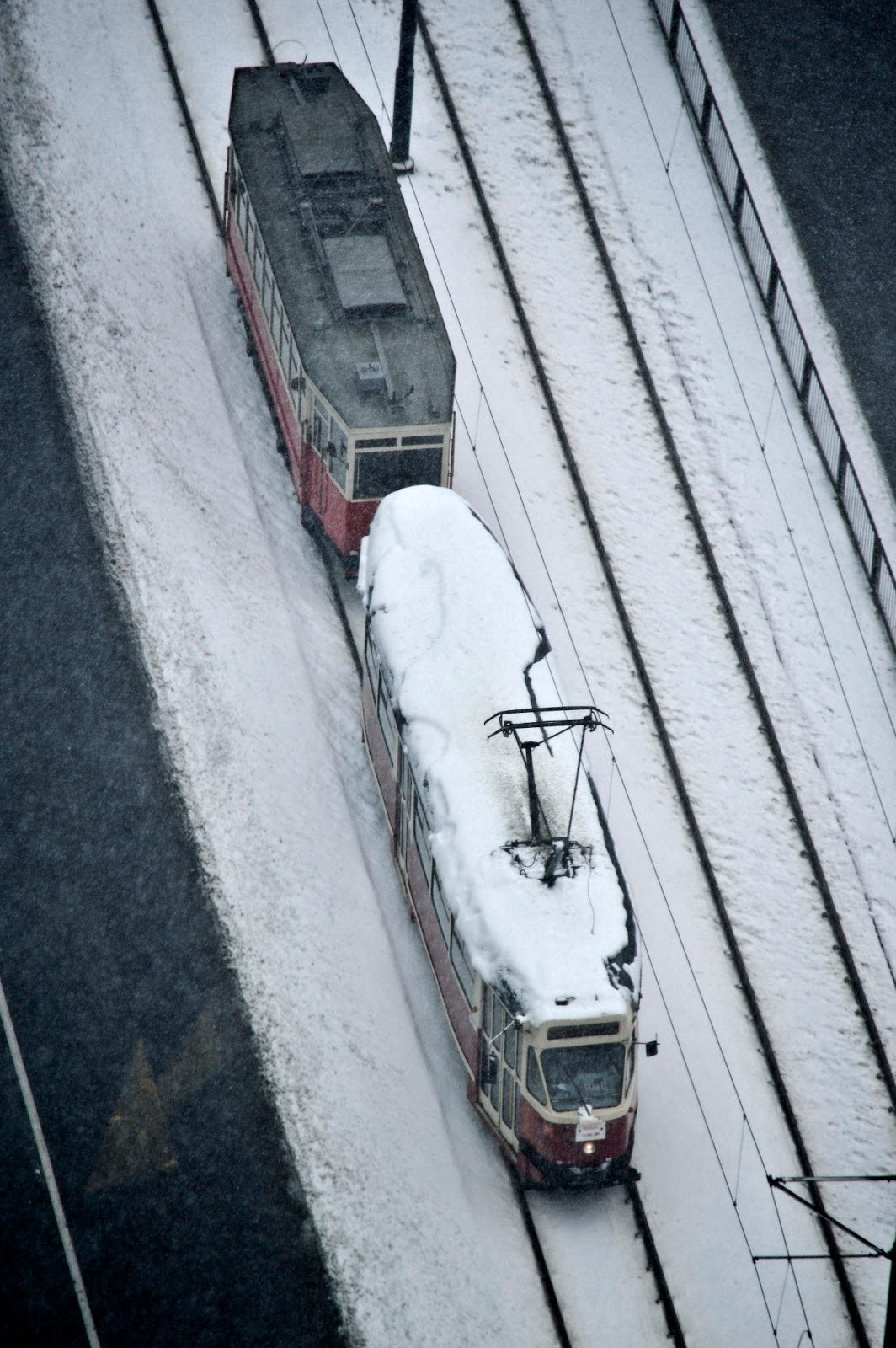
Left: a Most unusual sight! Captured from the 30th floor of the Rondo ONZ 1 building, through falling snow, a retired 13N tram coupled to a 1925-vintage Linke-Hofmann Lw, make their way northward up Al. Jana Pawła II. The sign on the front of the leading tram says 'Przejazd techniczny' - technical journey. (Can any reader come up with a better translation?)

Above and below: lack of snow on the roof of the Lw tram suggests it was garaged overnight. The trams are travelling over the diverted track that passes the underground construction work on the second Metro line.

This time last year:
Will the A2 motorway be finished for the football?
This time two years ago:
Old-school retail experience: PRL-flavoured carrot juice
This time three years ago:
Easter Sunday - Lent's over
This time four years ago:
Węzeł Lotnisko - site cleared - ready for construction work
This time five years ago:
Classic Polish automobile - the Polski Fiat 125P
This time six years ago:
Jeziorki in Google Earth

Below: a northbound 16 makes its way up Al. Niepodległości. Now the 13N trams have disappeared from regular passenger-carrying services, the square-cut Konstal 105N trams are the oldest in the fleet, some dating back to the early 1980s. They have a high-floor design, making them inconvenient to get in and out of.

Below: two trams pass on ul. Marszałkowska between Pl. Unii Lubelskiej and Pl. Zbawiciela. On the left a south-bound 18, on the right a north-bound 35. This stretch of Marszałkowska is one-way for road traffic (two lanes heading north into the city centre) but trams run in both directions.

Below: looking west along Al. Jerozolimskie, traffic moving smoothly. On the left a Konstal 105N2, a modernised version of the 105N; still high-floored and slab-sided, but with updated electronics and new-style cab. Behind it a PESA Swing, the latest additions to Warsaw's tram fleet (from 2010). We should be getting many more during the course of this year, replacing some of the oldest 105Ns.

The PESA Swing is low-floor, articulated so one can walk through its entire length. Definitely the tram of the future, well-liked by passengers. Below: a Swing stands at Nowowiejska tram stop on Al. Niepodległości.

Left: a Most unusual sight! Captured from the 30th floor of the Rondo ONZ 1 building, through falling snow, a retired 13N tram coupled to a 1925-vintage Linke-Hofmann Lw, make their way northward up Al. Jana Pawła II. The sign on the front of the leading tram says 'Przejazd techniczny' - technical journey. (Can any reader come up with a better translation?)

Above and below: lack of snow on the roof of the Lw tram suggests it was garaged overnight. The trams are travelling over the diverted track that passes the underground construction work on the second Metro line.

This time last year:
Will the A2 motorway be finished for the football?
This time two years ago:
Old-school retail experience: PRL-flavoured carrot juice
This time three years ago:
Easter Sunday - Lent's over
This time four years ago:
Węzeł Lotnisko - site cleared - ready for construction work
This time five years ago:
Classic Polish automobile - the Polski Fiat 125P
This time six years ago:
Jeziorki in Google Earth
Wednesday, 3 April 2013
O, Karczunkowska, where is thy pavement?
At times like this (indeed at any time between late October and now), ul. Karczunkowska is no street for pedestrians. You are forced to choose between walking along the asphalt, or sinking ankle-deep in snow or (worse) slush or (even worse) mud. Being able to move freely about things are just about bearable - but for an elderly person or one pushing a pushchair or pram, walking along Karczunkowska is an extremely dangerous endeavour. The other evening, walking home from PKP W-wa Jeziorki station, an oncoming car forced me to leap clear into the muddy verge, dirtying my shoes and trousers. Why do citizens of the capital of the EU's sixth-largest member state have to endure such indignities and such danger?

If you want to see the whole experience of what it's like to walk along Karczunkowska from Puławska up to the borders of Warsaw, 2.2km away, I recommend watching Jeziorak's film - a raw and intense documentary that portrays the deeply unpleasant experience of being a pedestrian in winter on this road.
The film, with Polish commentary, portrays the lack of civilised conditions with which we locals have to contend on a daily basis. Below: the guy rushing for the bus, back to oncoming traffic, is taking a risk, but he has crossed the road legally at the pedestrian crossing.

This is an intolerable state of affairs that cannot be allowed to go on for much longer. The local authorities have postponed plans to widen the road (at huge cost), and are not prepared to make a more modest investment in order to improve pedestrians' safety.
This time last year:
Architectural detail from Edinburgh
This time two years ago:
Spring explodes in Jeziorki
(+18C! Today it's around zero and snowing!)
This time three years ago:
Along the way for Warsaw's southern bypass
This time four years ago:
Quintessential Warsaw vista
This time five years ago:
Jeziorki on Google Earth

If you want to see the whole experience of what it's like to walk along Karczunkowska from Puławska up to the borders of Warsaw, 2.2km away, I recommend watching Jeziorak's film - a raw and intense documentary that portrays the deeply unpleasant experience of being a pedestrian in winter on this road.
The film, with Polish commentary, portrays the lack of civilised conditions with which we locals have to contend on a daily basis. Below: the guy rushing for the bus, back to oncoming traffic, is taking a risk, but he has crossed the road legally at the pedestrian crossing.

This is an intolerable state of affairs that cannot be allowed to go on for much longer. The local authorities have postponed plans to widen the road (at huge cost), and are not prepared to make a more modest investment in order to improve pedestrians' safety.
This time last year:
Architectural detail from Edinburgh
This time two years ago:
Spring explodes in Jeziorki
(+18C! Today it's around zero and snowing!)
This time three years ago:
Along the way for Warsaw's southern bypass
This time four years ago:
Quintessential Warsaw vista
This time five years ago:
Jeziorki on Google Earth
Monday, 1 April 2013
Swans in a changing climate
Over the past years, I've noted the swans returning to the pond at the end of ul. Trombity as they've done since 2008 around the end of March. This year they've been caught out by the weird weather. Normally at this time, przednówek, that Polish season following on from winter proper, is giving way to spring.
This portrait of a puzzled swan looking around unhappily at its partially frozen pond was taken with my new 55-300mm Nikkor zoom (more about this optic anon); click to enlarge - and note the tiny streaks of snow mixed with rain falling from the sky. It was +1C; horrible weather. One degree Celsius makes a big difference.

The local swans seem to have taken a greater liking to this part of Warsaw than nature intended; they were still around in December, walking on ice, which is, apparently, not good for them (unlike ducks, which have blood vessels in their legs that constrict in cold weather, allowing them to tread comfortably on snow and ice). Let's hope the snow soon melts and is replaced by warmer, sunnier weather.
The weather is indeed anomalous. Today, as I was shovelling tonnes of heavy, wet snow off the drive, I could hear a skylark overhead... Strange days indeed.
This portrait of a puzzled swan looking around unhappily at its partially frozen pond was taken with my new 55-300mm Nikkor zoom (more about this optic anon); click to enlarge - and note the tiny streaks of snow mixed with rain falling from the sky. It was +1C; horrible weather. One degree Celsius makes a big difference.

The local swans seem to have taken a greater liking to this part of Warsaw than nature intended; they were still around in December, walking on ice, which is, apparently, not good for them (unlike ducks, which have blood vessels in their legs that constrict in cold weather, allowing them to tread comfortably on snow and ice). Let's hope the snow soon melts and is replaced by warmer, sunnier weather.
The weather is indeed anomalous. Today, as I was shovelling tonnes of heavy, wet snow off the drive, I could hear a skylark overhead... Strange days indeed.
Bedfordshire in the snow
More photos from last week, which time prevented me from uploading. Here's an artsy sequence of photos taken from the window of an East Midlands Trains 125, en route from St Pancras to Luton Airport Parkway. London has receded into the distance, and rural Bedfordshire, cloaked in spring snow, issues a timeless resonance. I feel transported to Edwardian times, and through them back to Shakespeare's England of Poor Tom and 'poor, pelting villages'...
The monochrome is as it was; I have not tweaked colours nor lessened saturation in any way. Thus it was.


The monochrome is as it was; I have not tweaked colours nor lessened saturation in any way. Thus it was.


First town in the UK where Poles are majority
The latest data release from the UK National Census 2011 emerged from the Office of National Statistics last Tuesday. After a few days of poring over the data by the UK media, it emerged that Fulling in Lincolnshire (population 5,500) is the first town in the UK where Poles form a majority.
Census data for the AF1 postcode area (Watt-Waddle District) shows that the number of residents 'born in the EU Accession Countries - Poland' is 50.1% of the total population. The news was not surprising for locals, as the majority of the town's employers - mainly food processing and fruit & veg and flower growers - rely almost totally on Polish migrant workers.
The picturesque market town, which has been experiencing a population decline since before WW2, has witnessed the first rise in residents since the 1931 census. The past decade's influx of Poles to pick, pack and process the region's crops has spawned many Polish-owned businesses (Fulling has six Polish delis, four Polish hair-dressing salons and a Polish pub). Leader of the local Polish community and landlord of the Orzel Bialy pub Zbigniew Bzdura, has said that he will be standing as Fulling's mayor in the 2013 local elections.
Several other towns in Cambridgeshire and Lincolnshire have also been revealed as having significant Polish population approaching the 50% mark. These include Pinching, Little Itching, Legple and Finger's Cross.
Fulling has taken its new Polish-born population to heart. Local businessmen have welcomed the influx of workers and are expanding production. A French fish processing factory, Avril-Poisson, opened in Fulling last year, having moved there from Boulogne-sur-Mer because of the high taxes imposed on the owner by François Holland's government.
Today, as for the past five years, Fulling is celebrating Easter Monday the Polish way - Śmingus Dingus. The traditional Wet Monday celebrations involve throwing bucketfuls of water at passers-by in the street. Local resident Edna Codd, said "I don't mind them doing it when it's 20 degrees, but on a freezing day like today, it's enough to make any right-thinking person vote Ukip".
This time last year:
Lost legend of rock'n'roll: Johnny Kołyma
This time two years ago:
Stalin's plans to escalate nuclear Armageddon
This time three years ago:
Warsaw's favourite weekend destination
This time four years ago:
We are two
This time five years ago:
Crushed velvet dusk in my City of Dreams
This time six years ago:
My very first Jeziorki blog post
Census data for the AF1 postcode area (Watt-Waddle District) shows that the number of residents 'born in the EU Accession Countries - Poland' is 50.1% of the total population. The news was not surprising for locals, as the majority of the town's employers - mainly food processing and fruit & veg and flower growers - rely almost totally on Polish migrant workers.
The picturesque market town, which has been experiencing a population decline since before WW2, has witnessed the first rise in residents since the 1931 census. The past decade's influx of Poles to pick, pack and process the region's crops has spawned many Polish-owned businesses (Fulling has six Polish delis, four Polish hair-dressing salons and a Polish pub). Leader of the local Polish community and landlord of the Orzel Bialy pub Zbigniew Bzdura, has said that he will be standing as Fulling's mayor in the 2013 local elections.
Several other towns in Cambridgeshire and Lincolnshire have also been revealed as having significant Polish population approaching the 50% mark. These include Pinching, Little Itching, Legple and Finger's Cross.
Fulling has taken its new Polish-born population to heart. Local businessmen have welcomed the influx of workers and are expanding production. A French fish processing factory, Avril-Poisson, opened in Fulling last year, having moved there from Boulogne-sur-Mer because of the high taxes imposed on the owner by François Holland's government.
Today, as for the past five years, Fulling is celebrating Easter Monday the Polish way - Śmingus Dingus. The traditional Wet Monday celebrations involve throwing bucketfuls of water at passers-by in the street. Local resident Edna Codd, said "I don't mind them doing it when it's 20 degrees, but on a freezing day like today, it's enough to make any right-thinking person vote Ukip".
This time last year:
Lost legend of rock'n'roll: Johnny Kołyma
This time two years ago:
Stalin's plans to escalate nuclear Armageddon
This time three years ago:
Warsaw's favourite weekend destination
This time four years ago:
We are two
This time five years ago:
Crushed velvet dusk in my City of Dreams
This time six years ago:
My very first Jeziorki blog post
Subscribe to:
Posts (Atom)


 Posts
Posts


