My father's mother, Stefania Dembińska née Witkowska, came from Mogielnica, a small town 70km south-west from Warsaw. She met my grandfather Tomasz Dembiński after the First World War. My father has never been to Mogielnica, so I thought it would be a good idea to take him there, along with Moni, to trace our family's rural roots. Below: the neo-Gothic church of St. Florian.
Mogielnica I've visited a few times, a small country town of 2,500 inhabitants. My father's mother, Stefania (1893-1975) came from around here, but he has few details. He said that until the end of WW1, they had a farm which they had to sell at a low price on account of the economy. We came to the cemetery to look for traces of family history.
We find three graves bearing the surname 'Witkowski'. My father recollects having family across the river in Warsaw, visiting them in Grochów. Although his mother was an only child, she had cousins, also originally from Mogielnica, with the surname Sepczyński. It is highly likely that Stefania Witkowska's mother Teodora, who died in 1943 and is buried along with Stefania in Warsaw's Bródno cemetery, was from the Sepczyński family [indeed this was later confirmed, see comments below]. Moni scouts on ahead and finds a grave of the Sepczyński family, below.
Below: we find a few more graves of the Witkowski and Sepczyński families. The oldest contains the body of Ignacy Sepczyński, born 1805, died 1885. His wife Florentyna, 22 years his junior, died in 1917. Both reached the age of 80.
If these are indeed my father's grandmother's grandparents, it would mean that I can trace my roots back to 1805. Some genealogical digging is required!
The trip answered another question for my father. After his father's death in 1941, his mother would make trips back to Mogielnica to buy food, which she'd smuggle back into occupied Warsaw. Some she'd sell on, the rest would feed the family. How did she manage to do that, wondered my father, given the distance between Warsaw and Mogielnica? A horse-drawn wagon would take forever...
The answer was - narrow-gauge railway. Moni found the station that served Mogielnica, to the north of the town, from 1917 to 1988. The line, which ran through Grójec and Tarczyn, terminated at what is now Metro Wilanowska bus terminal, then Dworzec Południowy.
After our visit to the cemetery, we had lunch at Mogielanka, the town's only restaurant, where I paid 52 złotys (£11.17) for: cold beer, half-litre, two sparkling mineral waters, two soups and three massive main courses. My father's portion was so large, half of it served as his supper back home!
This time last year:
My father's walk around Jeziorki
This time three years ago:
What's the Polish for 'sustainability'?
This time five years ago:
Last chance to see Amber Gold's billboards in Warsaw
This time six years ago:
The Twilight Rambler
Wednesday, 2 August 2017
Tuesday, 1 August 2017
73rd anniversary of the Warsaw Uprising with my father
Back again, back to the building in which lived my father before the war and during the occupation. And the building in which General Chruściel "Monter" gave the order to launch the Warsaw Uprising. Of course my father didn't know this, but suspects that "Monter's" HQ might have been the flat in which a scout leader named Kamiński lived. Outside the building, ul. Filtrowa 68, in which my cousin's family has lived from the end of the war to this day, a wreath-laying ceremony is about to begin. The guards of honour await. The street is just how I imagined Warsaw prior to the uprising as a boy; wide, tree-lined streets, sun-dappled, with fine architecture on either side.
After the ceremony, my father becomes the focus of interest; he is unique in being a participant of the Uprising who lived in this very building, from 1926 until the morning of 1 August 1944.
Time for a family reunion; my father meets his two cousins Ala (left) and Hanna (right). Their three fathers were brothers. And see that photo on the wall? That's of my father, centre, with his brothers Jozef (left) and Zdzich (right)
Left: at Plac Narutowicza, my father is about to board the vintage tram heading up ul. Towarowa in the direction of Powązki cemetery. Two special heritage tramlines are operating on the day, T and W. Beautifully restored, they give an authentic taste of prewar public transport in the Polish capital. Respect to the guys who keep these trams going in concours condition.
Below: we reach Powązki military cemetery, where the main commemoration of 'W' Hour is to take place. A group of reenactors, wearing captured German camouflage smocks and whatever else they had to hand, are marching in step towards their assigned position.
It was a sweltering hot day, with temperatures in Warsaw exceeding 35C. Below: my father was treated as a star! Two girls stopped him to hear his story - and to get his autograph on an Uprising armband.
Below: my father met his colleagues from Batalion Odwet, by the unit's memorial. He reflects upon those who fell during the Uprising.
Below: on to the memorial of Batalion Golski, the unit with which my father fought for most of the Uprising. After the failed attempt to seize the SS barracks in Kolonia Staszica, soldiers from Batalion Odwet made their way across Pole Mokotowskie to join Batalion Golski, with whom they fought right through to the end. They were fighting in the area around the Politechnika. This is why students and graduates of that institution from the Korporacja or student fraternity (which has roots going back to 1908) tend the Golski memorial.
Below: my father gives an interview to Paddy Ney, and immediately, a small crowd on people gather to hear his testimony. The full interview can be watched online here.
The next stop was to pay respects at the grave of my father's younger brother, Jozef, who died aged 18, fighting with Batalion Miotła in Czerniaków. This time last year, Moni found the grave. Thanks to Peter Chudy for a photo that includes me in it!
On to the central Gloria Victis (glory to the vanquished) memorial in the centre of Powązki military cemetery. A great many people milling around, visiting the graves of family members who fell in the Warsaw Uprising. On the Metro heading back to Ursynów, people would shake my father's hand and thank him for their freedom - extremely touching gestures.
This time last year:
Godzina W remembered - a day of emotions
This time four years ago:
Godzina W commemorated in a more civilised way
Godzina W five years ago (2012)
Godzina W six years ago (2011)
Godzina W eight years ago (2009)
After the ceremony, my father becomes the focus of interest; he is unique in being a participant of the Uprising who lived in this very building, from 1926 until the morning of 1 August 1944.
Time for a family reunion; my father meets his two cousins Ala (left) and Hanna (right). Their three fathers were brothers. And see that photo on the wall? That's of my father, centre, with his brothers Jozef (left) and Zdzich (right)
Left: at Plac Narutowicza, my father is about to board the vintage tram heading up ul. Towarowa in the direction of Powązki cemetery. Two special heritage tramlines are operating on the day, T and W. Beautifully restored, they give an authentic taste of prewar public transport in the Polish capital. Respect to the guys who keep these trams going in concours condition.
Below: we reach Powązki military cemetery, where the main commemoration of 'W' Hour is to take place. A group of reenactors, wearing captured German camouflage smocks and whatever else they had to hand, are marching in step towards their assigned position.
It was a sweltering hot day, with temperatures in Warsaw exceeding 35C. Below: my father was treated as a star! Two girls stopped him to hear his story - and to get his autograph on an Uprising armband.
Below: my father met his colleagues from Batalion Odwet, by the unit's memorial. He reflects upon those who fell during the Uprising.
Below: on to the memorial of Batalion Golski, the unit with which my father fought for most of the Uprising. After the failed attempt to seize the SS barracks in Kolonia Staszica, soldiers from Batalion Odwet made their way across Pole Mokotowskie to join Batalion Golski, with whom they fought right through to the end. They were fighting in the area around the Politechnika. This is why students and graduates of that institution from the Korporacja or student fraternity (which has roots going back to 1908) tend the Golski memorial.
Below: my father gives an interview to Paddy Ney, and immediately, a small crowd on people gather to hear his testimony. The full interview can be watched online here.
The next stop was to pay respects at the grave of my father's younger brother, Jozef, who died aged 18, fighting with Batalion Miotła in Czerniaków. This time last year, Moni found the grave. Thanks to Peter Chudy for a photo that includes me in it!
On to the central Gloria Victis (glory to the vanquished) memorial in the centre of Powązki military cemetery. A great many people milling around, visiting the graves of family members who fell in the Warsaw Uprising. On the Metro heading back to Ursynów, people would shake my father's hand and thank him for their freedom - extremely touching gestures.
This time last year:
Godzina W remembered - a day of emotions
This time four years ago:
Godzina W commemorated in a more civilised way
Godzina W five years ago (2012)
Godzina W six years ago (2011)
Godzina W eight years ago (2009)
Monday, 31 July 2017
Ahead of the Big Day
Monday 31 July, the day before the big commemoration, and there's much to do. After a 6am wake-up call, my father and I travel by Metro to town to meet his old AK comrade from Batalion Odwet, Kazimierz Możdzonek. We are accompanied to the Warsaw Uprising Museum by three reenactors who have driven over all the way from Berlin overnight to be here for the commemorations.
Outside the museum there are speeches from Poland's president, Andrzej Duda and Warsaw's mayor, Hanna Gronkiewicz-Waltz. But the one that really gripped the nation was by 100 year-old General Zbigniew Ścibor-Rylski, the last surviving leader of the Uprising, whose speech was particularly moving. "Poles must have respect to everyone, regardless what their point of view, their nationality or their faith".
Below: after the speeches and the awarding of medals, it's time for food. The food is good, and free, laid on by the City of Warsaw. So there's a scrum. And veterans of the Rising, whose day this is, did not have an easy time getting to the front of the queue for barszcz, pierogi, kaszanka and krokiety. Fortunately, there were many young volunteers on hand to help; a girl guide managed to get hold of a bowl of barszcz for my father.
After the event, crowds of people poured out of the museum; we headed to the bus stop to catch a bus towards ul. Królewska. Lots of people, all chatting and swapping stories.
Below: corner of ul. Świętokrzyska and Jasna. This is the main post office, and it was here that my father's father, Tomasz Dembiński, worked before the war, in PKO (then Pocztowa Kasa Oszczędnościowa - the post office savings bank). My father went to school in the building on the opposite side of ul. Jasna, on the site now occupied by new offices. Funnily enough, I also worked for a while on ul. Jasna, up by Pl. Dąbrowskiego.
Below: back in Jeziorki for a walk, at the northern pond, with Moni, who took these two photographs. Beautiful hot weather, cloudless sky, in time for sunset.
My father is enchanted by Jeziorki, and how beautifully the wetlands have been turned into a park that brings people closer to nature.
This time two years ago:
Once in a blue moon
This time three years ago:
A return to Snowdon - Wales' highest peak
This time five years ago:
On the eve of Warsaw's Veturillo revolution
This time six years ago:
Getting ready for the 'W'-hour flypast
This time seven years ago:
A century of Polish scouting
Outside the museum there are speeches from Poland's president, Andrzej Duda and Warsaw's mayor, Hanna Gronkiewicz-Waltz. But the one that really gripped the nation was by 100 year-old General Zbigniew Ścibor-Rylski, the last surviving leader of the Uprising, whose speech was particularly moving. "Poles must have respect to everyone, regardless what their point of view, their nationality or their faith".
Below: after the speeches and the awarding of medals, it's time for food. The food is good, and free, laid on by the City of Warsaw. So there's a scrum. And veterans of the Rising, whose day this is, did not have an easy time getting to the front of the queue for barszcz, pierogi, kaszanka and krokiety. Fortunately, there were many young volunteers on hand to help; a girl guide managed to get hold of a bowl of barszcz for my father.
After the event, crowds of people poured out of the museum; we headed to the bus stop to catch a bus towards ul. Królewska. Lots of people, all chatting and swapping stories.
Below: corner of ul. Świętokrzyska and Jasna. This is the main post office, and it was here that my father's father, Tomasz Dembiński, worked before the war, in PKO (then Pocztowa Kasa Oszczędnościowa - the post office savings bank). My father went to school in the building on the opposite side of ul. Jasna, on the site now occupied by new offices. Funnily enough, I also worked for a while on ul. Jasna, up by Pl. Dąbrowskiego.
Below: back in Jeziorki for a walk, at the northern pond, with Moni, who took these two photographs. Beautiful hot weather, cloudless sky, in time for sunset.
My father is enchanted by Jeziorki, and how beautifully the wetlands have been turned into a park that brings people closer to nature.
This time two years ago:
Once in a blue moon
This time three years ago:
A return to Snowdon - Wales' highest peak
This time five years ago:
On the eve of Warsaw's Veturillo revolution
This time six years ago:
Getting ready for the 'W'-hour flypast
This time seven years ago:
A century of Polish scouting
Sunday, 30 July 2017
My father's return to Warsaw, 2017
My father flew into Warsaw on Thursday night, ahead of him a week spent commemorating the Warsaw Uprising and seeing a bit of Poland. After a day's rest, the first call on Saturday morning was to the Polish army museum, to see the exhibition about the Szkoła Młodszych Ochotniczek (SMO), the school which my mother attended during the war.
Below: my father is greeted by the daughter of the first commandant of the SMO, Ala Szkuta, who was instrumental in organising the exhibition at the museum.
Below: we were lucky enough to have a guided tour of the exhibition by the two women who put it all together; Julia Pronobis, on the part of the museum, and Ala Szkuta representing the association of former pupils and their families and friends. My mother was for many years a member of the association, as were most of her friends from wartime years,
Next visit was to the house on ul. Filtrowa 68 where my father lived before the war and during the occupation. His niece Marynka still lives there, she invited us over for lunch. Below: my father, his niece and grand-nieces, Magda and Dorota.
Below: back in Jeziorki, where my father has a chance to see our new park complete with footpaths, benches, picnic areas, beach and piers.
This morning we set off to Pl. Starynkiewicza/ul. Lindleya for a special mass for the soldiers of my father's Home Army unit - II Batalion Szturmowy Odwet. We arrived early, so a walk around the vicinity was in order. Below: outside Dzieciątko Jezus (Infant Jesus) hospital, where my father was born back in 1923.
Below: inside the church of the Infant Jesus on ul. Lindleya. There's a plaque commemorating my father's unit. It was here that the mass was held.
Below: Band of Brothers and Sisters - six of the seven soldiers and nurses from Odwet who came for the commemoration, first at the church, then by the monument to the unit on ul. Wawelska. My father met most of them at last year's events.
Below: my father particularly wanted to revisit the place where he escaped death on 7 August 1944. He survived this massacre, on the corner of Wawelska and Al. Niepodległości.
This time last year:
My father's first visit to Warsaw in 40 years
This time two years ago:
What's worse - unemployment, or a badly-paid job?
This time three years ago:
A return to Liverpool
This time five years ago:
Too good to last (anyone remember OLT Express airline?)
This time six years ago:
Poland's Baltic coast as a holiday destination
This time eight years ago:
The Warsaw they fought and died for?
This time ten years ago:
Floods, rainbows and hope
Below: my father is greeted by the daughter of the first commandant of the SMO, Ala Szkuta, who was instrumental in organising the exhibition at the museum.
Below: we were lucky enough to have a guided tour of the exhibition by the two women who put it all together; Julia Pronobis, on the part of the museum, and Ala Szkuta representing the association of former pupils and their families and friends. My mother was for many years a member of the association, as were most of her friends from wartime years,
Next visit was to the house on ul. Filtrowa 68 where my father lived before the war and during the occupation. His niece Marynka still lives there, she invited us over for lunch. Below: my father, his niece and grand-nieces, Magda and Dorota.
Below: back in Jeziorki, where my father has a chance to see our new park complete with footpaths, benches, picnic areas, beach and piers.
This morning we set off to Pl. Starynkiewicza/ul. Lindleya for a special mass for the soldiers of my father's Home Army unit - II Batalion Szturmowy Odwet. We arrived early, so a walk around the vicinity was in order. Below: outside Dzieciątko Jezus (Infant Jesus) hospital, where my father was born back in 1923.
Below: inside the church of the Infant Jesus on ul. Lindleya. There's a plaque commemorating my father's unit. It was here that the mass was held.
Below: Band of Brothers and Sisters - six of the seven soldiers and nurses from Odwet who came for the commemoration, first at the church, then by the monument to the unit on ul. Wawelska. My father met most of them at last year's events.
Below: my father particularly wanted to revisit the place where he escaped death on 7 August 1944. He survived this massacre, on the corner of Wawelska and Al. Niepodległości.
This time last year:
My father's first visit to Warsaw in 40 years
This time two years ago:
What's worse - unemployment, or a badly-paid job?
This time three years ago:
A return to Liverpool
This time five years ago:
Too good to last (anyone remember OLT Express airline?)
This time six years ago:
Poland's Baltic coast as a holiday destination
This time eight years ago:
The Warsaw they fought and died for?
This time ten years ago:
Floods, rainbows and hope
Friday, 28 July 2017
What makes scenery scenic?
A thought-provoking article in last week's Economist has stayed with me these past few days - I keep thinking about it and feel I should take up the theme in a blog post.
What makes a scene, a landscape, a view, a vista appealing to the human eye? What makes it 'picturesque'? We have our individual preferences, but in general, a wooded hillside with a church steeple or castle turret will be seen by most people as more appealing than an industrial estate of grey oblong buildings and wall-to-wall asphalt. The former is where people would like to visit on holiday or retire to, the latter where many of us have to work.
Driving the hire car from Heathrow to Ealing, I passed through Hayes, part of the London Borough of Hillingdon, Gold Medal Winner of the Britain in Bloom final, 2015.
Sorry, but Hayes is a dump. Victorian industry - canal, railway, overlaid with 1930s industry and 1950s industry and modern day logistics, Hayes might have the odd bit of Bricktoriana here and there, but the general view as one drives northwards along the A312, the view is of large corrugated sheds on either side of a dual carriageway, electricity pylons marching alongside. Turn off the main road and endless rows of 1930s terraced housing stretch away eastwards towards Yiewsley, northwards towards Northolt and westwards towards Southall, then onward towards Greenford. Ugliness, ugliness and more ugliness.
As London's suburbs sprawled out west in the 1930s, there was no thought to how the human beings that were meant to live and work there would respond to their surroundings. No doubt better, it was thought at the time, than the cramped Victorian terraces from which they aspired to move.
This 80 square-mile slab of sprawl (bounded to the south by the Chertsey Road/M3, to the west by the Thames/Colne Valley /Ruislip Woods, to the east by Ealing and Isleworth and to the north by the Harrow Road/A404) has very little to commend it if you're seeking spirit-lifting scenery. Yes, there's Osterley Park and Horsenden Hill. But Alperton, Ickenham, Yeading, Harlington, Hounslow, Feltham will ultimately depress.
One bright spot is the Great West Road's Golden Mile, still full of wonderful Art Deco architecture, from the end of an era when factory owners cared more about how their industrial premises looked than how much they cost. I've written before about how Spirit of Place affects my mood. Perhaps there are people whose emotional state is entirely unmoved by whether they are surrounded by fine architecture or dismal sheds thrown up for the lowest price, but for me, I will seek out the scenic and choose to live and work in an aesthetically pleasing environment.
The Victorians might have thrown up plenty of jerry-built two-up two-downs, but the reason these were torn down in the second half of the 20th century was more to do with sanitation and damp than actual ugliness. Had those old houses been built to modern standards, but still looking the same, their charm would outgun a modern house of the same size.
After three days in the UK, I'm back in Poland, and I must say that South Warsaw is just so much better than West London from the point of view of the scenery and how it makes me feel.
Happier here.
This time last year:
Theresa May flies into Warsaw
This two years ago:
Announcing the start of the Radom railway line modernisation (not even half completed today!)
This four years ago:
In praise of the (Polish-built) Fiat 500
This time five years ago:
Llanbedrog Beach and a farewell to North Wales
This time six years ago:
To the Polish seaside, by night train
This time seven years ago:
Accounting for the past - 20 years on from PRL's fall
This time eight years ago:
An introduction to fine British cheefef
This time ten years ago:
Over the Peaks by bus
What makes a scene, a landscape, a view, a vista appealing to the human eye? What makes it 'picturesque'? We have our individual preferences, but in general, a wooded hillside with a church steeple or castle turret will be seen by most people as more appealing than an industrial estate of grey oblong buildings and wall-to-wall asphalt. The former is where people would like to visit on holiday or retire to, the latter where many of us have to work.
Driving the hire car from Heathrow to Ealing, I passed through Hayes, part of the London Borough of Hillingdon, Gold Medal Winner of the Britain in Bloom final, 2015.
Sorry, but Hayes is a dump. Victorian industry - canal, railway, overlaid with 1930s industry and 1950s industry and modern day logistics, Hayes might have the odd bit of Bricktoriana here and there, but the general view as one drives northwards along the A312, the view is of large corrugated sheds on either side of a dual carriageway, electricity pylons marching alongside. Turn off the main road and endless rows of 1930s terraced housing stretch away eastwards towards Yiewsley, northwards towards Northolt and westwards towards Southall, then onward towards Greenford. Ugliness, ugliness and more ugliness.
As London's suburbs sprawled out west in the 1930s, there was no thought to how the human beings that were meant to live and work there would respond to their surroundings. No doubt better, it was thought at the time, than the cramped Victorian terraces from which they aspired to move.
This 80 square-mile slab of sprawl (bounded to the south by the Chertsey Road/M3, to the west by the Thames/Colne Valley /Ruislip Woods, to the east by Ealing and Isleworth and to the north by the Harrow Road/A404) has very little to commend it if you're seeking spirit-lifting scenery. Yes, there's Osterley Park and Horsenden Hill. But Alperton, Ickenham, Yeading, Harlington, Hounslow, Feltham will ultimately depress.
One bright spot is the Great West Road's Golden Mile, still full of wonderful Art Deco architecture, from the end of an era when factory owners cared more about how their industrial premises looked than how much they cost. I've written before about how Spirit of Place affects my mood. Perhaps there are people whose emotional state is entirely unmoved by whether they are surrounded by fine architecture or dismal sheds thrown up for the lowest price, but for me, I will seek out the scenic and choose to live and work in an aesthetically pleasing environment.
The Victorians might have thrown up plenty of jerry-built two-up two-downs, but the reason these were torn down in the second half of the 20th century was more to do with sanitation and damp than actual ugliness. Had those old houses been built to modern standards, but still looking the same, their charm would outgun a modern house of the same size.
After three days in the UK, I'm back in Poland, and I must say that South Warsaw is just so much better than West London from the point of view of the scenery and how it makes me feel.
Happier here.
This time last year:
Theresa May flies into Warsaw
This two years ago:
Announcing the start of the Radom railway line modernisation (not even half completed today!)
This four years ago:
In praise of the (Polish-built) Fiat 500
This time five years ago:
Llanbedrog Beach and a farewell to North Wales
This time six years ago:
To the Polish seaside, by night train
This time seven years ago:
Accounting for the past - 20 years on from PRL's fall
This time eight years ago:
An introduction to fine British cheefef
This time ten years ago:
Over the Peaks by bus
Saturday, 22 July 2017
My 20 years in Poland
It was on this day, 22 July, in the year 1997, that I did arrive in Poland for good. I had left Britain, my young family was to follow on a month later. A momentous day in my life. And so today marks the 20th anniversary of the beginning of my life in Poland; just over one-third of my life has been spent here. And over one-sixth of my life has been covered by this blog.
Before the end of communism, I had only visited Poland five times - twice as a child (aged three and eight), and three times on the Polish parish youth group holiday Montserrat (see here).
But once the political and economic transformation got under way in Poland I began visiting more and more regularly - visiting family and friends, fact-finding, taking part in conferences, on business. I came as an election observer on behalf of the Polish Government in Exile, to witness the first free presidential elections across southwest Poland.
Coming over with increasing frequency, I found it annoying to have to buy a visa each time; because the UK still required visas from Poles, Poland reciprocated. And so I joined the campaign organised by the Federation of Poles in Great Britain for visa-free travel between the two countries. I wrote a number of letters to the media and to MPs. I pointed out, among other facts, that Russians living in Latvia, Lithuania and Estonia who'd been part of the apparatus of repression in those countries could travel freely to the UK, while Poles who'd bravely struggled to bring down communism had to queue - and pay for - visas. The campaign was short but intense; the Foreign and Commonwealth Office gave in to pressure from the politicians. Prime minister John Major announced visa-free entry to the UK for Polish citizens in 1992. The following year, the Polish ambassador to the UK awarded me with a silver Order Zasługi from President Lech Wałęsa for my part in the visa campaign.
Now that travel to Poland became cheaper, I'd fly over more often. In early 1995, I was offered the chance for some communications consultancy work for Centertel, Poland's first, and at the time only, mobile telephone network. After four week-long assignments in 1995 and 1996, I was offered a full-time job in Warsaw as communications director for Poland's largest cable TV network, PTK (now a part of UPC). I jumped at the chance; at the end of June 1997 I left the Confederation of British Industry. After nearly 16 years there, nine of which I was managing editor of CBI News, it was time to move on.
Destiny was calling. All those Saturday mornings spent at Polish school, right through to A-level; Polish cubs and scouts, Polish youth clubs, all that Polishness would come into good use, along with my work experience in a top business organisation. Today I call it 'nation building' - helping to turn Poland into a normal, Western, European nation, ridding it of its old complexes and bad habits.
We moved to a house just across the way from Jeziorki, in nearby Pyry, renting for four and half years until our own house was ready for us to move in to, in February 2002. For the first month I slept on a mattress in a completely unfurnished empty house, waiting for our belongings to turn up with the family. I say 'completely empty', but this was the summer of floods; terrific rainfall and mosquitoes everywhere. Biting me. I'd splat them with whatever came to hand, and soon there were literally hundreds of splashes of my blood decorating the newly painted white walls and ceiling of my empty room.
I'd cycle to work each day that first month - to an office on Konstruktorska. It was a moist, humid late-July and early-August; the smell of ripening fruit - wild mirabelle plums in the air. And there was much rain. Many of the roads around here were not asphalted back then; when it rained heavily, much of ul. Baletowa was under water between Farbiarska and Sarabandy.
For my first weekend in Poland I decided to get out of Warsaw by train and explore. On my fold-up Brompton bike I cycled to Warszawa Centralna, took a look at a large railway map of Poland, and decided to take a train to Nałęczów, on the line to Lublin, for no other reason than the fact that there was a narrow-gauge train from there to Opole Lubelskie - an interesting thing to see.
By 1997, Warsaw was starting to look modern. There were foreign banks, cash machines, supermarkets (Rema 1000, Billa, Géant - remember them?), mobile phones that no longer required a briefcase-sized battery; but there were still many hangovers from the old days, not least in people's thinking.
The human development I've witnessed in 20 years in Poland has been akin to what happened in the UK over a far longer period. Poland has really done well, all things considered. No country's perfect; most countries have better and worse patches in their history. But strong countries are those that can weather those tricky times and emerge the stronger for them.
After 20 years, I've no regrets about having moved from the UK to Poland. None. Zero.
This time last year:
PiS, Brexit, Trump and cognitive bias
This time four years ago:
Portmeirion, revisited, again
This time five years ago:
Beach day, Llyn Peninsula
This time six years ago:
Down with cars in city centres!
This time seven years ago:
8am and 26C already
Before the end of communism, I had only visited Poland five times - twice as a child (aged three and eight), and three times on the Polish parish youth group holiday Montserrat (see here).
But once the political and economic transformation got under way in Poland I began visiting more and more regularly - visiting family and friends, fact-finding, taking part in conferences, on business. I came as an election observer on behalf of the Polish Government in Exile, to witness the first free presidential elections across southwest Poland.
Coming over with increasing frequency, I found it annoying to have to buy a visa each time; because the UK still required visas from Poles, Poland reciprocated. And so I joined the campaign organised by the Federation of Poles in Great Britain for visa-free travel between the two countries. I wrote a number of letters to the media and to MPs. I pointed out, among other facts, that Russians living in Latvia, Lithuania and Estonia who'd been part of the apparatus of repression in those countries could travel freely to the UK, while Poles who'd bravely struggled to bring down communism had to queue - and pay for - visas. The campaign was short but intense; the Foreign and Commonwealth Office gave in to pressure from the politicians. Prime minister John Major announced visa-free entry to the UK for Polish citizens in 1992. The following year, the Polish ambassador to the UK awarded me with a silver Order Zasługi from President Lech Wałęsa for my part in the visa campaign.
Now that travel to Poland became cheaper, I'd fly over more often. In early 1995, I was offered the chance for some communications consultancy work for Centertel, Poland's first, and at the time only, mobile telephone network. After four week-long assignments in 1995 and 1996, I was offered a full-time job in Warsaw as communications director for Poland's largest cable TV network, PTK (now a part of UPC). I jumped at the chance; at the end of June 1997 I left the Confederation of British Industry. After nearly 16 years there, nine of which I was managing editor of CBI News, it was time to move on.
Destiny was calling. All those Saturday mornings spent at Polish school, right through to A-level; Polish cubs and scouts, Polish youth clubs, all that Polishness would come into good use, along with my work experience in a top business organisation. Today I call it 'nation building' - helping to turn Poland into a normal, Western, European nation, ridding it of its old complexes and bad habits.
We moved to a house just across the way from Jeziorki, in nearby Pyry, renting for four and half years until our own house was ready for us to move in to, in February 2002. For the first month I slept on a mattress in a completely unfurnished empty house, waiting for our belongings to turn up with the family. I say 'completely empty', but this was the summer of floods; terrific rainfall and mosquitoes everywhere. Biting me. I'd splat them with whatever came to hand, and soon there were literally hundreds of splashes of my blood decorating the newly painted white walls and ceiling of my empty room.
I'd cycle to work each day that first month - to an office on Konstruktorska. It was a moist, humid late-July and early-August; the smell of ripening fruit - wild mirabelle plums in the air. And there was much rain. Many of the roads around here were not asphalted back then; when it rained heavily, much of ul. Baletowa was under water between Farbiarska and Sarabandy.
For my first weekend in Poland I decided to get out of Warsaw by train and explore. On my fold-up Brompton bike I cycled to Warszawa Centralna, took a look at a large railway map of Poland, and decided to take a train to Nałęczów, on the line to Lublin, for no other reason than the fact that there was a narrow-gauge train from there to Opole Lubelskie - an interesting thing to see.
By 1997, Warsaw was starting to look modern. There were foreign banks, cash machines, supermarkets (Rema 1000, Billa, Géant - remember them?), mobile phones that no longer required a briefcase-sized battery; but there were still many hangovers from the old days, not least in people's thinking.
The human development I've witnessed in 20 years in Poland has been akin to what happened in the UK over a far longer period. Poland has really done well, all things considered. No country's perfect; most countries have better and worse patches in their history. But strong countries are those that can weather those tricky times and emerge the stronger for them.
After 20 years, I've no regrets about having moved from the UK to Poland. None. Zero.
This time last year:
PiS, Brexit, Trump and cognitive bias
This time four years ago:
Portmeirion, revisited, again
This time five years ago:
Beach day, Llyn Peninsula
This time six years ago:
Down with cars in city centres!
This time seven years ago:
8am and 26C already
Friday, 21 July 2017
Local democracy, winners and losers
After winning bigly in the 2015 participatory budget (budżet partycypacyjny), the finished results of which are our splendid park, this year saw Jeziorki missing out. The results were announced a week ago. The top three projects voted for by residents of Zielony Ursynów (green Ursynów - the part of the district west of ul. Puławska) were all to the extreme north - on ul. Kłobucka. The projects garnered between 700 and 900 votes; the project everyone in Jeziorki was rooting for - comprehensive traffic calming measures - got just 420 votes.
In previous years, 400 votes was enough for one of our local projects to get through. Since then, the urbanisation of Kłobucka - a formerly run-down industrial part of Ursynów - has moved on apace. Google Maps satellite view shows the area as a massive building site. But now the work's completed, people have moved in, and they're voting for pavements and parking bays. And winning. Next year, more people will have moved in, and no doubt because of the housing density (flats rather than houses set in large gardens), they will continue to win projects for themselves. In a few years' time, the notion of Kłobucka being a part of Zielony Ursynów will become patently untrue. It would be fairer to apportion a part of the overall Ursynów budget for the new blocks to the north of ul. Poleczki. Different specifics, different needs.
Still, their need for pavements are greater than ours down here in Jeziorki Południowe. Full list of projects, the winners and the losers, here.
Our greatest need is traffic calming measures. Far too many drivers use the local roads as rat-runs to avoid the notorious Puławska traffic jams. And far too many of those drivers drive too fast. In an area where pavements are few, they have little idea of how stressful it is to walk as a vulnerable pedestrian faced with cars zooming past, not separated from you by a kerb. Sitting protected by a ton or more of metal, it is easy to ignore the fragile human beings walking, or pushing prams, or cycling. And far too many drivers are using their phones while at the wheel.
The answer is more signs limiting speeds to 30km/h, and more speed bumps. Don't like it? Use Puławska. Keeping speed down to 30km/h, massively reduces the chances of injury should a pedestrian get hit.
In the meanwhile, I am deeply thankful for our lakeside park. It is beautiful, it's wonderful for walks, for birdwatching, for exercising, for relaxing. Below: bench and bin, marked with the cogwheel-and-circle logo of Warsaw's Budżet Particypacyjny.
Next year, I'll make a greater effort to mobilise neighbours to suggest and vote for projects. It's worth doing. Just look at that lovely lake...
Below: bonus shot - new industrial premises on ul. Baletowa. Nice neo-moderne architecture.
Finally - a pleasant surprise this evening soon after taking the above shot. I turned into ul. Sarabandy and was warmly greeted by a young man and his mother who are regular readers of this blog. They said how funny it is that the only regular source of local news about Jeziorki happens to be in English!
This time three years ago:
The Second Summer of Cider
This time four years ago:
North Wales in the sun
This time five years ago:
Back at Penrhos
This time seven years ago:
A farewell to Dobra
In previous years, 400 votes was enough for one of our local projects to get through. Since then, the urbanisation of Kłobucka - a formerly run-down industrial part of Ursynów - has moved on apace. Google Maps satellite view shows the area as a massive building site. But now the work's completed, people have moved in, and they're voting for pavements and parking bays. And winning. Next year, more people will have moved in, and no doubt because of the housing density (flats rather than houses set in large gardens), they will continue to win projects for themselves. In a few years' time, the notion of Kłobucka being a part of Zielony Ursynów will become patently untrue. It would be fairer to apportion a part of the overall Ursynów budget for the new blocks to the north of ul. Poleczki. Different specifics, different needs.
Still, their need for pavements are greater than ours down here in Jeziorki Południowe. Full list of projects, the winners and the losers, here.
Our greatest need is traffic calming measures. Far too many drivers use the local roads as rat-runs to avoid the notorious Puławska traffic jams. And far too many of those drivers drive too fast. In an area where pavements are few, they have little idea of how stressful it is to walk as a vulnerable pedestrian faced with cars zooming past, not separated from you by a kerb. Sitting protected by a ton or more of metal, it is easy to ignore the fragile human beings walking, or pushing prams, or cycling. And far too many drivers are using their phones while at the wheel.
The answer is more signs limiting speeds to 30km/h, and more speed bumps. Don't like it? Use Puławska. Keeping speed down to 30km/h, massively reduces the chances of injury should a pedestrian get hit.
In the meanwhile, I am deeply thankful for our lakeside park. It is beautiful, it's wonderful for walks, for birdwatching, for exercising, for relaxing. Below: bench and bin, marked with the cogwheel-and-circle logo of Warsaw's Budżet Particypacyjny.
Below: bonus shot - new industrial premises on ul. Baletowa. Nice neo-moderne architecture.
Finally - a pleasant surprise this evening soon after taking the above shot. I turned into ul. Sarabandy and was warmly greeted by a young man and his mother who are regular readers of this blog. They said how funny it is that the only regular source of local news about Jeziorki happens to be in English!
This time three years ago:
The Second Summer of Cider
This time four years ago:
North Wales in the sun
This time five years ago:
Back at Penrhos
This time seven years ago:
A farewell to Dobra
Thursday, 20 July 2017
And did Her feet...?
William Blake's And Did Those Feet In Ancient Time (known also as Jerusalem) postulates that Jesus visited England during His lifetime, when England was indeed heavenly, prior to the Industrial Revolution, whose mills Blake described as 'satanic'.
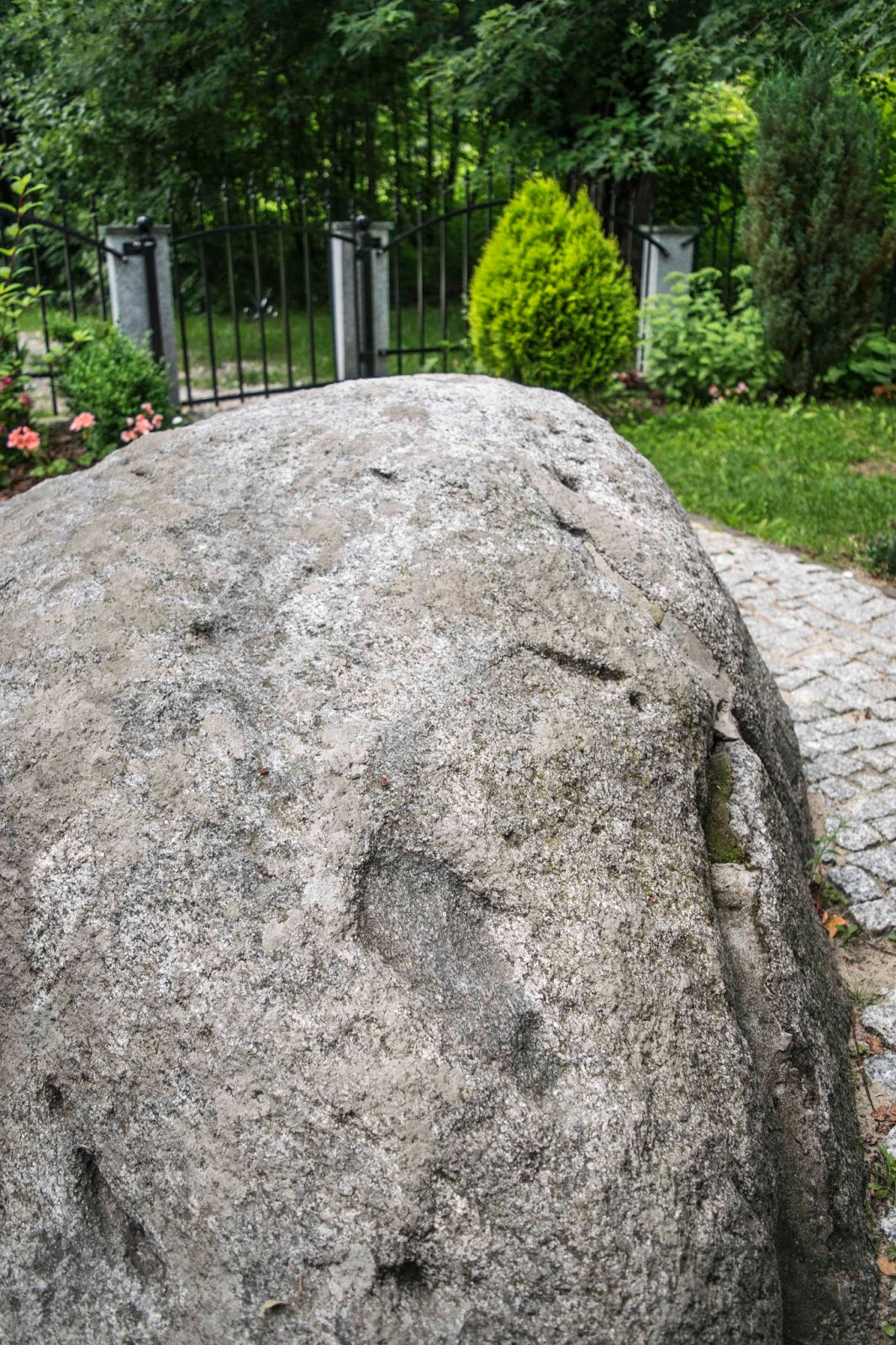
And here in Mazowsze, 33km (21 miles) south of Warsaw, is the village of Pieczyska, which, local tradition has it, was visited by the Blessed Virgin Mary. On an erratic boulder, deposited here at the end of the Ice Age, can be seen three indentations shaped like footprints. Around this boulder, a shrine was erected, half a kilometer from the church which dates back to 1452.
At the site of the boulder, a small shrine has been erected, below.
Below: the shrine, the boulder. To the right, you can make out one of the foot-shaped indentations.
Left: the most foot-shaped of the indentations is at the rear of the boulder, facing the shrine. There are over 1,000 erratic boulders across Poland with monument status; many of these have a religious significance.
Below: there is good signage for pilgrims seeking the boulder. 'Boulder so-called Foot of the Holy Mother of Pieczyska'; 'Place of Cult' and simply 'To the boulder'.
Below: view from the west. A good photo opportunity for one of my bikes.
This time last year:
40 years ago - Montserrat, holiday that would shape my life
This time two years ago:
Last night's storm
This time three years ago:
Drifting south with the sun: bicycle hobo
This time five years ago:
Royal Parks in the rain
This time six years ago:
Storm clouds over Warsaw, Dolinka under water
This time seven years ago:
Round-up of pics from Dobra
This time eight years ago:
Conservatism - UK or Polish style?
This time nine years ago:
Wheat and development
This time ten years ago:
A previous visit to London
And here in Mazowsze, 33km (21 miles) south of Warsaw, is the village of Pieczyska, which, local tradition has it, was visited by the Blessed Virgin Mary. On an erratic boulder, deposited here at the end of the Ice Age, can be seen three indentations shaped like footprints. Around this boulder, a shrine was erected, half a kilometer from the church which dates back to 1452.
At the site of the boulder, a small shrine has been erected, below.
Below: the shrine, the boulder. To the right, you can make out one of the foot-shaped indentations.
Left: the most foot-shaped of the indentations is at the rear of the boulder, facing the shrine. There are over 1,000 erratic boulders across Poland with monument status; many of these have a religious significance.
Below: there is good signage for pilgrims seeking the boulder. 'Boulder so-called Foot of the Holy Mother of Pieczyska'; 'Place of Cult' and simply 'To the boulder'.
Pieczyska itself. A village of just over 100 souls. The church below has two parts, a Gothic presbytery dating back to the mid-15th century, and a neo-gothic main part, built in the early 20th century to replace the original wooden part which burnt down in 1836. View from the south.
Below: view from the west. A good photo opportunity for one of my bikes.
40 years ago - Montserrat, holiday that would shape my life
This time two years ago:
Last night's storm
This time three years ago:
Drifting south with the sun: bicycle hobo
This time five years ago:
Royal Parks in the rain
This time six years ago:
Storm clouds over Warsaw, Dolinka under water
This time seven years ago:
Round-up of pics from Dobra
This time eight years ago:
Conservatism - UK or Polish style?
This time nine years ago:
Wheat and development
This time ten years ago:
A previous visit to London
Subscribe to:
Posts (Atom)


