Sunday, 5 May 2013

By bike, south of Jeziorki

The last day of the great Majówka (extended May bank holiday) and finally the sun comes out. A lovely warm day, with temperatures topping  23C, the highest all week. An ideal opportunity to get out into the countryside by bike. From Jeziorki, the nearest countryside lies south of Piaseczno ('Setchno or Sand City), a town with which Warsaw has a similar relationship that London has with Slough. The sooner through it the better. Not an easy town to navigate through, I always get lost here.

Below: I passed hundreds of cyclists today; here I'm at Zalesie Dolne station. Now, you may have heard of Zalesie Górne station, south of Piaseczno on the line to Radom, but Zalesie Dolne is on the touristy narrow-gauge line from Piaseczno to Tarczyn.


Below: am I on the Mazurian lakes? Have I cycled all the way to Wigry? No, this is one of the fish ponds between Żabieniec and Zalesie Górne. I spent a while here sunning myself and watching the myriad wildlife, including a swimming grass snake (grey with a white stripe behind its neck, like this one). No midges, gnats or mosquitoes whatsoever - thanks to the dragonflies darting about.


I cycled back through Żabieniec, Siedliska, Chylice and Julianów. Żabieniec, a village full of działki (summer-houses) was already in summer holiday mode. Disco-polo music was blasting out of tinny speakers, bare-chested young men riding in the back of pick-up trucks; Pan Heniek and Pan Żiutek were staggering to the sklep wielobranżowy for another flaszka, while scores of cyclists were riding up and down ul. Główna, Żabieniec's main drag.

Below: Half a kilometre east of the level crossing on ul. Julianowska, there's a man-made hill, created by developers who've been filling the area south of Las Kabacki forest and Chylice with houses during the boom years, 2003-2008. This hill, some six-seven metres high, affords splendid views of the surrounding countryside. The railway line is the one that carries the coal trains from Okęcie sidings to the sidings at Konstancin-Jeziorna and on to Siekierki power station.


Below: a convertible Cadillac from the late '60s/early '70s; a splendid sight. If I were minister of transport I'd limit motorists to a 1-litre hatchback and 10,000km a year. If they wanted anything else, such as this magnificent vehicle, they'd have to provide me with an essay stating their aesthetic, historical and ideological reasons for wanting to own such a machine. If their essay gushes with sufficient enthusiasm, permission to own would be granted. The owner would be obliged to maintain the vehicle in showroom-style splendour for the pleasure of future generations of admirers.


Back home I find I overdid the sunshine; I will no doubt have a red nose and peeling skin on my forehead. For the record, I covered 38.6km by bike today, all but 2km of it on asphalt. My commuting bike, built over 20 years ago, is good for this kind of cycling; with an upright riding position, I can appreciate the scenery, the skinny tyres are good for tarmacked roads.

This time two years ago:
Functionalist architecture in Warsaw

This time three years ago:
What's the Polish for 'to bully'?

This time four years ago:
Making plans

This time five years ago:
The setting sun stirs my soul

This time six years ago:
Rain ends the drought

Saturday, 4 May 2013

Classic Jeziorki

Let's forget about politics, religion, biology and philosophy for a while and take a walk to the end of ul. Trombity, cross the railway tracks to catch that Jeziorki klimat, that mid-spring atmosphere that made me want to blog about my home suburb in the first place. The trees all seem to be in bloom. Below: ul. Kórnicka - the section between ul. Trombity and the railway, which is a footpath rather than a street.


Below: a Koleje Mazowieckie EN57 three-car set heading into town, the KM livery of green, white and yellow reflecting the colours of the landscape.


Below: across the tracks. A little spring rain and the fields are in flood. A KM train heads south towards Piaseczno and Radom. Further away from the railway line, and the air is full of the sound of skylarks' song. So many, indeed, that I'm wondering whether such numbers are sustainable.


The closure for the whole summer of Okęcie airport's Runway 15/33 for maintenance means  that planes are now using Runway 11/27, and fly in from over Ursynów. This affords a fine view of Warsaw's skyline as a backdrop to the aircraft on final approach. In the foreground, the more rural construction of Dawidy. Below: a Ryanair Boeing 737-800 comes in to land.


Jeziorki is a great place to live, rus in suburbe, countryside in the suburbs, yet well connected by public transport with the city and by air with the outside world.

Access to zones is getting more limited

The other day, I came across this excellent website, opuszczone.com (those last four letters before the top-level domain, 'zone', by happy coincidence), with photos of abandoned places in Poland and indeed around the world. Here on Warsaw's southern fringes, there are fewer and fewer such places to explore. It's that time of year when the atmosphere (klimat) of the Andrei Tarkovsky film Stalker is strongest in my mind.

Below: until Poland joined NATO and the EU, air traffic control for Okęcie airport was still conducted along Soviet military lines. In 2004, this military radio beacon station, just off ul. Karczunkowska, to the west of ul. Kurantów, stopped transmitting. The radio towers have long since come down; the land is still owned by the state. Looking at Google Earth maps of this area from 2002 to the present, one can see how much land has been developed. Not here however; an asset as precious as land just sitting, guarded, useless... A security guard is sitting outside the low grey building in the distance.


Below: the south-west corner of the base. I poke my lens through the perimeter fence. The place beckons me to explore, but it is well enclosed with barbed wire and thick thorn bushes. What lies inside? I'd love to find out...


I proceed from here, Dawidy Poduchowne, via Zgorzała, to Zamienie. I've posted about Zamienie before; back in communist times this was the BIOMED vaccine factory (Zakład Wytwórni Surowic i Szczepionek „BIOMED”) surrounded by houses for workers. To see how it looked a few years after it was abandoned, click here.


Above: Zamienie in 2002. Just Biomed, nothing more. By 2012 (below), the factory's long gone, many new houses have appeared here, and most of the old factory buildings have been torn down.


Left: a neoclassical colonnade; in the front of the building that houses the electricity generator for the the plant. This is still working, producing power for the remaining cottages that are found in the central area of the old Zakład. I rather suspect this is social housing, where the city evicts non-rent-paying families to, but I might be wrong.

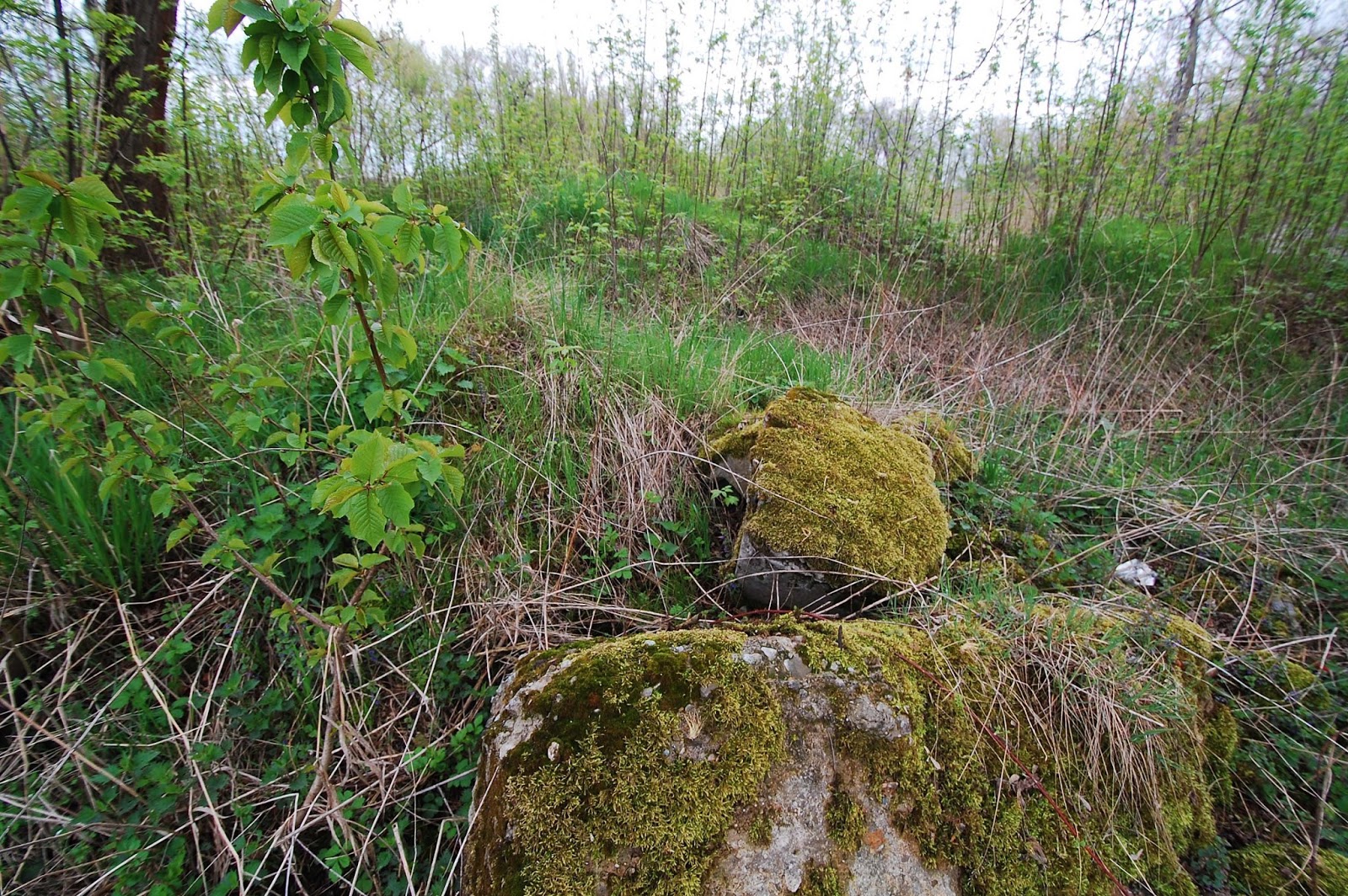
Below: some mossy stonework is all that's left of the row of buildings on the southern side of the Zakład. Developers had hoped to fill this area with hundreds of houses, but the recession came along. Having said that, I noticed today that a new development is springing up to the north of Zamienie.


Below: pond in Zamienie, harking back to pre-war days when this was a family-owned estate.


This part of Warsaw's southern fringes is becoming increasingly civilised, without any great abandoned zones worthy of exploration any more. This has happened at PGR Mysiadło and the old Lamina factory in Piaseczno. Which is good, but kind of sad too. [Click on the label Zamienie below for more posts from here, dating back to 2007.]

This time two years ago:
I awake to snow, on 4 May

This time six years ago:
This is not America. No?

Friday, 3 May 2013

Much still left to do before S2-S79 opens

Bank holiday, and rain... a good opportunity to check progress along the S2/S79 (the 'Elka') which one day will link southern Warsaw to the outside world. But - from what I saw - not for some time yet. A few weeks ago, an article in Gazeta Stołeczna suggested that the S2 will connect ul. Puławska with the A2, the motorway to Berlin, in September. In other words, 15 months after the original date for completion, June 2012. And three months after the previous promised opening date (June 2013).

Looking at how much there's still to do, and how fast the work has progressed so far, I'd rather bet on a late-November ribbon-cutting ceremony. If this project had been a public-private partnership, it would have opened last June. UK experience on PPPs shows that nearly 90% of projects are completed on time - because the private sector operator doesn't earn dime one until the infrastructure is made available to the public. From the road user's point of view, a toll-road is a toll-road; whether one's money goes to a public-sector operator (behind schedule and over budget) or to a private sector one (UK experience is that they complete on time and within budget) is not an issue. What is an issue is the ability to deliver. Poland's infrastructure is delivered in an exceedingly slow way.

Remember that good infrastructure builds rich nations, and that new roads boost local GDP, creating new job opportunities (for example, unemployment in Stryków, north of Łódź, fell from 13% to just 5%, when the A1/A2 motorways finally met there last year).

So - how's the S79 looking? Below: looking north from Węzeł Lotnisko towards the city centre. That's Warsaw Trade Tower on the horizon. Crash barriers are in place, but the final layers of asphalt are still needed. Lighting stanchions are low over the road surface as this is right under the flightpath for the runway at Okęcie airport.


Below: the S2 - Warsaw's southern bypass, and part of the Berlin-Moscow motorway, crossing under the S79 and the Warsaw-Radom railway line. Still much to do here, to fill the so-called wanna ('bath') and lay the tarmac. Connecting this bit of road to ul. Puławska, 2km to the east, will take many months.


Below: "Can we get to Puławska from here?" asks the cyclist on the left. "Not on a bike" is my answer. The slip-roads aren't ready, there are too many muddy or water-filled sections. It's hard going for a man in wellies. I purposely came here on foot knowing that it's still impassable to bicycles.


Below: looking east towards Puławska. The first viaduct carries the slip road linking the S79 northbound (currently a slip road from nowhere - see beneath) with the S2 westbound. The second viaducts carry the Warsaw-Radom main railway line and the Okęcie-Siekierki coal line. The third viaduct, just about visible, carries the line connecting Warsaw's Metro to the outside rail network.


Below: the S79 crossing over the S2, looking west. Note how much water is on the ground. We've had a few wet days, but nothing cataclysmic. Pumps are working in the underpass to remove surplus water.


Below: steps for maintenance workers leading from the S2 up to the S79 crossing over it. Work here is nearly ready; just a few more barriers to erect.


Below: looking north along the S79, from the southern end of the contract. The road stops suddenly here. To the left, the slip-road from the S2, for traffic coming in from the west. A road to nowhere. To the right, the slip-road to join the S2 - a road from nowhere.


Below: I turn around 180 degrees from where I took the above photo. In the distance - ul. Baletowa. One day, the S79 will continue from where it left off; it will cross Baletowa and head south through Dawidy, Zamienie, Zgorzała, Lesznowola and eventually connect up with the S7, helping to relieve congestion around Janki. But I guess this will all happen sometime after the EU's 2014-2020 budget money has to be spent by -  2022? Until then, the above stump of expressway will stand as a monument to Bad Planning.


A similar situation exists east of Puławska. Warsaw's southern bypass will, for the time being, end there. No tunnel under Ursynów, no new bridge to carry the S2 across the Vistula, no connection to the A2 Minsk Mazowiecki bypass, no A2 onwards to the Belarusian frontier. Not until 2022.

Poland deserves better infrastructure. The blame can be laid at the feet of successive governments since 1990 who failed to understand the influence that good infrastructure has on a nation's economy.


Above: a rare moonlit shot from Google Earth - the latest image available, dated 20 November 2012, clearly showing Węzeł Lotnisko and the abrupt end of the S79 in a muddy field.

This time last year:
Looking at progress along the S79 (how little has been achieved!)

This time two years ago:
Snow on 3 May

This time three years ago:
Two Polands

This time four years ago:
A delightful weekend in the country

This time five years ago:
The dismantling of the Rampa

This time six years ago:
Flag day

Thursday, 2 May 2013

Pozytywki ponds after the refurbishment

A first post-winter look at the newly-deepened flood retention ponds along ul. Pozytywki. Below: a panoramic shot of the pond on the corner of Pozytywki, Katarynki and Czarkowskiego. This is Jezioro Wąsal; surrounding trees and shrubs have been cut down, the banks re-profiled and a new sluice gate fitted (foreground). At present it looks bare and uninviting; no doubt it will regain some of its semi-rustic charm when grass grows back on the banks. At the far end, a newly-deepened and widened channel linking this pond to the one further up Pozytywki (bottom picture).


Left: Wąsal looking west from ul. Czarkowskiego. The houses fronting onto ul. Pozytywki ('Music-Box Street') have had little wooden platforms built out overlooking the pond. I wonder whether this has been done as part of the refurbishment, or whether the home-owners took the initiative to construct them. It's quarter past seven in the evening, this, the southernmost extreme of Warsaw is silent and still, with just some light traffic noise coming from Puławska behind me.

Incidentally, ul. Katarynki means 'Barrel-Organ Street' or 'Hurdy-Gurdy Street'. From here, right up to ul. Poleczki six kilometres north, most streets that have appeared after 1951 when the area became part of Warsaw, have musically-themed names, with folk instruments and folk dances predominating.


Above: Jezioro Pozytywki, on ul. Pozytywki. Here, the loss of trees is more apparent; the pond has lost much of its charm. [Click on the relevant labels below to see how the area looked before it was revitalised.] Grass will return, but it was all the surrounding greenery that gave the area its now lost appeal. But it's still a pleasant area for an evening's stroll.

This time last year:
May Day in the heat [31C!]

This time two years ago:
Bike ride across rural Poland

This time six years ago:
Mazovian landmark from the air

Monday, 29 April 2013

Regrets at the departure of Mr Gowin from the justice ministry

Premier Tusk's mid-term blues get worse. Sacking one of the three most critical ministers in his government, Mr Tusk will have lost a lot of latent support. Jarosław Gowin may not have seen eye-to-eye with the PO rank and file, but he was a doer, an achiever, someone with a mission to reform.

Poland's number one problem is not Smolensk, in-vitro fertilisation or gay marriage - it is slimming down and reforming its bloated and inefficient public administration. Poland's public debt and deficit could be significantly reduced if the numbers employed at central and local government level matched those found in well-functioning EU member states - and if those working were as efficient as public servants in those countries.

It should be something that unites left and right, conservative and socialist, libertarian and collectivist - the desire to see a well-functioning public administration, one that serves the public rather than itself.

And yet, over the 23 years of democracy in Poland, no government has managed to get to grips with the rent-seekers, working at their bureaucratic travails at an exceedingly slow pace, acting as a handbrake on an otherwise vigorous economy.

It is, as Depeche Mode observed 30 years ago, a competitive world. Most governments around the globe are conducting reforms - some quicker, some slower; but with an eye on foreign direct investment, which generally means jobs, innovation, technology transfer and a move upward on the ladder of value-added.

The World Bank has over the years looked at how easy it is to do business around the world. Doing Business, which ranks 185 countries on ten criteria, has in its most recent report (published in October 2012), cited Poland as the world's fastest reforming country. Yes! (Read the following sentence out loud. It is from the World Bank.)

Key findings:
  • Poland was the global top improver in the past year. 

How can this be, you ponder?

Poland jumped 19 places up the rankings from 74th to 55th in terms of ease of doing business. OK, so the UK's number seven in the world and number two in the EU behind Denmark, but a 19-place jump is a great achievement. Keep reforming at this pace and Poland will have made it to 36th this year, 17th the year after and will be vying for the best place to do business anywhere on earth by 2015. But we all know that won't happen...

Let's look at why Poland did so well last year.

Is it because it's so easy to obtain planning permission? No. In this category, Poland is 161st (out of 185 countries remember) and slipped four places compared to the previous survey. Is it because it's so easy to hook up your business to mains electricity? Not here either (Poland is 137th, and down a shameful seven places).

No - the answer's here - again I cite the World Bank:
[Poland] enhanced the ease of doing business through four institutional or regulatory reforms, making it easier to register property [up 25 places], pay taxes [up 10 places], enforce contracts [up 28 places], and resolve insolvency [up 54 places]. 
Step forward the ministers who are making it happen. Taxes - that's Jacek Rostowski. But the remaining three criteria - where Poland made the biggest progress - fell under the remit of Cambridge scholarship student Mr Gowin. The first justice minister in democratic Poland not to have been a lawyer, who said he'd take an axe, not a scalpel, to the court system. And now he's gone. The judges and court administrators can breathe a sigh of relief tonight - and return to the quiet life in the morning.

And why? Because of a tiff about in-vitro and gay weddings. Which in the Big Scheme of Things don't matter anywhere near as much as getting a decently functioning court system for the country.

Tusk's government, I fear, will drift, directionless, into the next elections (due autumn 2015).

This time four years ago:
The cycle-to-work season starts

Sunday, 28 April 2013

Spring in full flood, Jeziorki

The rain forecast for today came as predicted (meteo.pl's computer model is getting increasingly accurate), with some heavy downpours overnight. It kept raining all morning; by the early evening it was dry enough to put on my wellies and go for a walk to see how the new retention ponds had coped with the rainfall. Below: a short (13 second) film from the top of the heap of soil on the east side of the main pond, panning from north to south. To the left, ul. Dumki. I hope this hill I'm standing on will be retained once the work's complete, though I doubt it. It does offer a good view.

I wonder if the total area of the pond now exceeds Gocław's Balaton? Until the area shows up on Google Maps/Google Earth, it's hard to tell...


I'm worried that the new flood alleviation project may not be up to the task. Some of the surrounding fields had water in the lower-lying parts; more drainage ditches may be needed and the retention ponds deepened.

Further on up ul. Dumki, on the section between the new flood defence works, the central part of the reed-beds have been left untouched. This is home to thousands of black-headed gulls (mewy śmieszki). When roosting as they do in large numbers, they can be heard half a kilometre away; approaching the reed-beds is like approaching a football stadium full of roaring fans. From up close, it's deafening (below)!


I'm glad this part of the area between ul. Dumki and Trombity has been left in its existing state as it is a rare natural habitat for Warsaw, a haven for wildlife and place to get away from urban reality.

Below: the sky is full of gulls screeching aggressively at the human intruder (me). The occasional individual takes a swoop in my direction as though to warn me away from their nesting area.


Below: the field at the junction of ul. Trombity and ul. Kórnicka, with the railway line behind me. The bottom end of this field, usually planted with potatoes, is flooded again, despite the recent amelioration work. More drainage ditches are needed around here if these fields are to stay productive after heavy rainfall.


Just before sunset, the clouds passed, as the weather forecast said they would. The blossom on these fruit trees is picked out by the rays of the evening sun.


Spring is finally here in Jeziorki, we've waited since late-October.

This time two years ago:
I need a new laptop. But which one?

This time four years ago:
In search of the sublime aesthetic

This time five year ago:
Ducks in Ogród Saski

This time six years ago:
Should I stay or should I go?

Saturday, 27 April 2013

Toyah's latest book reviewed

First, a disclosure; I have know the author and blogger Krzysztof Osiejuk since the summer of 1996; we met on holiday with our families in Penrhos, North Wales and became firm friends - Krzysztof has introduced me to much excellent music and great movies, and many's the single malt whisky we've enjoyed together while watching outstanding films or just chatting about life. Sadly, the Smolensk disaster has left a major division between us, much as it has within Polish society as a whole. For Krzysztof, it was the deliberate assassination of President Lech Kaczyński; for me, an accident that resulted from sloppy procedures in the air and on the ground. I fear that this new status quo will remain for years to come.

Anyway, on with the narrative. Krzysztof's first book, O siedmiokilogramowym liściu i inne historie, written under the Toyah pseudonym, is a collection of his pre-Smolensk blog posts, written during the glory days when he was Polityka's political blogger of the year (2009). Sadly, the posts are not dated, which would have been useful to future historians. Because this is the pre-Smolensk, there's less rancour, a lighter tone; those early years of PiS in parliamentary opposition with a PiS president in office now seen strangely exotic.

Toyah's second book, Twój pierwszy elementarz, written in the style of an ABC primer, was written after April 2010. Essentially, it stands as a who's who of Polish politics and blogging (even I get an entry!); with everyone neatly categorised into nasi ('ours') or else as tools of 'the system' (system), witting or otherwise. Many famous Poles, we learn, are or have been agents (of Moscow, of the security services, of the system) or are (as in my case), 'lemmings' (lemingi), who passively accept today's reality. An excellent guide to the works of the PiS mindset.

Krzysztof's first book published under his own name is Marki, dolary, banany i biusztonosz marki Triumph, is a much-needed first hand account of Poland's transition from communism to what we have today. An autobiography that moves from childhood and adolescence in Katowice (or indeed Stalinogród, which is what the city was called when Krzysztof was born), through his student days, Martial Law and the political and economic transformation to today's Poland - which he doesn't much care for.

Cover art by Marek Kamieński
For those of my readers who did not experience daily life in Poland under communism, a time of "endless waiting," he recalls, this book makes for an educational, and indeed entertaining, read. In particular the relationship between the citizen and the authorities, and the consumer and the market. Two anecdotes from the book merit recounting in full.

One was a taxi ride from Katowice to Sosnowiec. As his taxi was approaching the destination, the driver recognised a militia-man (milicjant) at traffic lights and began chatting to him. The militia-man got into the front passenger seat and continued the conversation with the driver in the stationary car, who was ignoring his passenger as the taxi-meter continued to spin. Krzysztof did not dare butt in to remind the driver that he was still in the car. After a while, the militia-man turned around to Krzysztof and announced that he didn't like his hair-cut. Krzysztof maintained a polite tongue, explained why he was going to Sosnowiec (to register for his studies), but was noted down anyway. The taxi ride turned out to be extremely expensive - and there was nothing - nothing at all - that he could do about it.

The other concerns his first job. He was directed to work at the Zenit department store in Katowice as a junior radio and TV sales assistant. This was in the mid-1970s, when Edward Gierek was First Secretary of the Polish United Workers' Party, and sought to buy popularity by borrowing money from the West and spending it on the production of consumer goods, to create the illusion of prosperity. Krzysztof recalls, however, that none, literally none, of the radios (Śnieżka and Jubilat brand) worked. It was a similar case with televisions, but unlike the radios, there was demand for TVs. When anyone wanted to buy one, it would be plugged into the mains - and would not function. It was repacked, put into a store-room, and when the store-room was full, men from the Unitra factory would turn up, fix them, and place a sticker on each one saying 'Pre-sale repair' (naprawa przedsprzedażna).

As a citizen, as a consumer, in PRL you had next to no rights whatsoever. And yet if things were so bad back then, why is everything today so bad? There is a note of nostalgia running through the book, in particular to his childhood; Krzysztof was blessed with wonderful parents. And to times when you could spend blissful hours with friends, listening to music, talking about life, drinking, smoking, not worrying about the future.

Harbingers of the transformation to come - the introduction of democracy and the free market - were Krzysztof's journeys to 1980s West Germany, and for him the smell of fresh products. For me, my memories of trips to communist Poland are also connected with smell - the aroma of cheap newsprint by a Ruch kiosk, the smoke from Sport and Popularne cigarettes, that tantalising blend of damp, disinfectant and stale cooking smells of a tenement staircase

A note of mortality creeps in every now and then - so many of Krzysztof's friends have passed on; far more than would have been the case for a similar age cohort in the west. Better healthcare, healthier lifestyles, more to live for. And that sense of injustice - the children of the old communists went on to achieve wealth, those that fought for freedom live in relative poverty.

Marki, dolary, banany i biusztonosz marki Triumph is a worthwhile read for those interested in recent Polish history; an eyewitness testimony to bygone times that have changed beyond recognition in less than a quarter of a century. [It is available online for a mere 30 złotys or six quid plus postage] There is room in the English language for accounts of day-to-day life before, during and after transformation from communism to market democracy; I'm sure these will help future generations understand better this particular moment in human history, and its early 21st-century fallout.

I learn from the book that Krzysztof reckons he's got another three books inside him. I look forward to reading them all!

This time last year:
The Shard changes London's skyline

This time two years ago:
In praise of Warsaw's trams

This time three years ago:
Plans for the railway line to Radom
[three years on: what's changed?]