Tuesday, 5 August 2014

The architecture of the Birkenhead Tunnel

As promised, more architectural detail from Liverpool, with a focus on the buildings of the Birkenhead Tunnel. I've mentioned it before (here and here), time then for some close-ups.

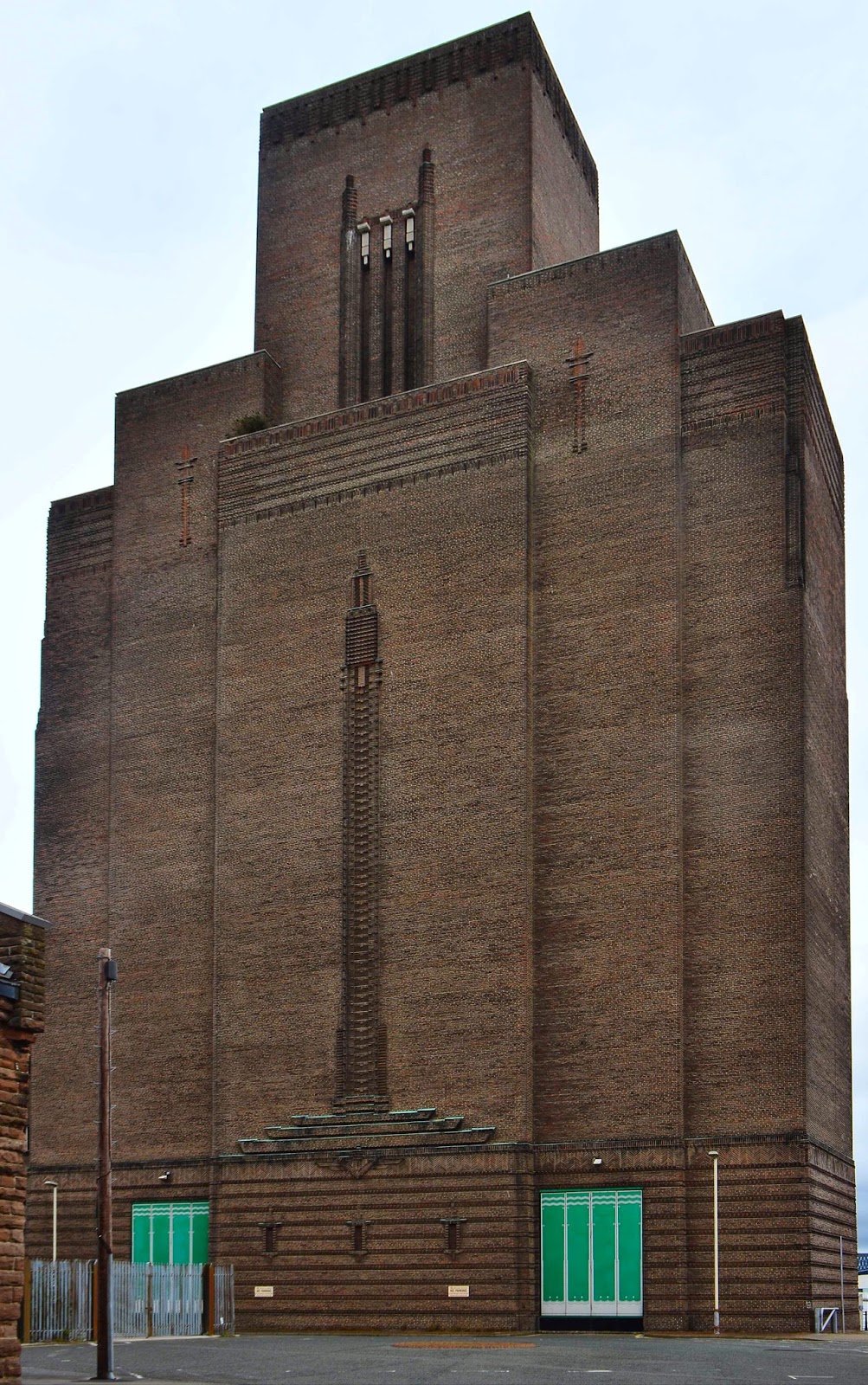
Let's start on the Birkenhead waterfront. The magnificent brick-built Woodside Ventilating Station (left) looks like a pre-war cathedral. But the decoration (by Edmund Thompson) is quite un-Christian; pre-Christian indeed, referencing Mesopotamia and ancient Egypt.

There are six tall ventilation chimneys pumping foul air out of the tunnel, three on the Liverpool side, and three (including a double one at Sydney St) on the Birkenhead side. Most of the chimneys are over 200ft (62m) high, housing ventilation fans between 40ft and 50ft in diameter.

Below: the George's Dock Ventilating Station, across the Mersey on the Liverpool waterfront. Another tall chimney, but around this one, five storeys of offices were built. The contractor for the project was Edmund Nuttall; yet another Edmund (born over 60 years after the tunnel's opening) stands in shot.


Let's zoom in on some of that lovely Art Deco ornamentation on the upper half of the ventilation chimney. Jazz-age Mesopotamia - electric, wireless and sacred birds. In Portland Stone.


Below: one of the original toll booths, rescued and restored, stands beside the George's Dock Ventilating Station. Green and gold are the colour scheme.


Below: two of the figures that sit, lotus-legged in alcoves - Afro-Asian, transcendental. Sentinels of Empire - or more mystical in meaning?


Below: detail from the railing around the ventilating station. Geometric snakes zig-zag around a flaming staff/spearhead, surrounded by waves. Golden Egyptian wings hover above.


Eddie in a doorway - this could just as easily be a 1930s cinema, department store or luxury hotel. Symmetry, modernity - and antiquity. Crazy, hot jazz played by a Sumerian priesthood along the shores of the River Mersey, broadcast over the radio.

We were delighted that so much of this wonderful architecture has survived to see our day. Most of the Mersey (Queensway) Tunnel is Grade II listed, so it should now last a whole lot longer.

Liverpool is, after London and Edinburgh, Britain's third 'must-see' city - and is now connected by air to Warsaw via low-cost carrier WizzAir.

This time last year:
Behold and See - short story, part II

This time two years ago:
Signs of progress along the S2 - Lotnisko to Puławska

This time five years ago:
Warsaw's walls bear witness

Monday, 4 August 2014

Over the hill at Harrow

Of late, Eddie and I have made it our habit, when returning from the Midlands to London's suburbs, to make the journey more palatable by diverting via Harrow-on-the-Hill en route to my parents' house in West Ealing. Described by Sir John Betjeman as 'a rocky island' amid the Wembleys, Kentons and Perivales - that endless sprawl of 1930s suburbia - Harrow-on-the-Hill is a beautiful outcrop of tradition, centred around the famous school that dates back to 1572 (somewhat younger than Poland's oldest school, the Małachowianka in Płock, established in 1180). Incidentally, Wikipedia states that 'the other place', Eton College (est. 1440), has far more famous Old Boys than Harrow - 19 British prime ministers schooled at Eton, only seven at Harrow.

Nevertheless, it's the location that makes Harrow more special - location and architecture. Eton, situated on meadowlands across the River Thames from Windsor Castle doesn't quite have the same visual appeal.

Left: The Old School, deserted in the summer holidays. School buildings are scattered all over the Hill, with pupils boarding and studying in disparate locations. Between the houses, distant views of central London, and the skyscrapers of the City.

Below: looking up the hill, the school just out of sight. Eddie  is peering westwards at suburban Middlesex.

Views like this make Harrow-on-the-Hill so special. Strip away the cars, and you could be back in Victorian England. Walk too far down the hill, however, towards Sudbury Hill, Roxeth, South Harrow, Northwick Park, and the charm soon evaporates.

Below: St Mary's Church, Harrow-on-the-Hill. Lord Byron used to visit the churchyard often when he was a pupil at Harrow School. The church dates back to 1094, though the spire is some 350 years younger. Tall trees surrounding the church have made it harder to spot from a distance.


Harrow-on-the-Hill is worth a visit should you be in north-west London - indeed, unlike 'the other place' across the Thames from Windsor - there's little else worth seeing in north-west London.

This time last year:
Behold and See - the Miracle of Lublin - Pt 1.

This time two years ago:
Quiet afternoon in the bazaar

This time three years ago:
The politics of the symbol

Thursday, 31 July 2014

A return to Snowdon

It was a soft day yesterday - slight drizzle, cloud - not beach weather. So Eddie and I headed up Snowdon as we did last year, this year taking a slightly more challenging path - the Watkin Path. Named after Sir Edward Watkin, Victorian railway entrepreneur, chairman of the Great Central Railway, the man who attempted to build London an Eiffel Tower where Wembley Stadium now stands, the man who had a crack at building a Channel Tunnel in the early 1880s. This ascent up Snowdon is the highest in terms of climbing (over a kilometre), the start of the track not too far above sea level.

The Watkin Path starts on the A478 by Plas Gwynant, not far from Sir Edward's summer chalet. After ascending through pleasant woodland, we come to a gate, which doubled for the North West Frontier in the British film comedy, Carry On Up The Khyber. Eddie is looking for the plaque marking this film location - sadly, someone must have half-inched it.


Below: After an hour and half's climbing, we're looking down on a helicopter flying over Llyn Glaslyn lake. The first part of the walk was not too bad.


The track started to get steep beyond this point, and we found ourselves scrambling with hands and feet over loose scree - not the best of surfaces for climbing. At the same time, the mist descended on the mountain top - you can see the visibility in the photo (below). The fact that several other people were also journeying up the Watkin Path made it easier for us. Plus, we'd done it before, last year, coming up the Rhyd Ddu Path, which joins the Watkin Path some 400m before the summit. Today I stand atop the highest peak in Wales - yesterday I was swimming in the sea. Góry i morze, panie, w jednym urlopie.


After dining on Cornish Pasty and Welsh cider ('Taffy Apple' brand - very good) at the restaurant on top of Snowdon, we had a good rest, visited the summit, and turned to make our descent. Below: the mist began to clear as we set off down. In the distance, a boulder perched on some rocks. How did it get there? We're over 800m above sea-level at this point...


It was a long walk - some eight miles there and back, at the end of the day my pedometer registered over 23,000 paces, the bulk of which was the ascent and descent of Snowdon.

It was a hard walk - not too hard, but not something to be done without experience or supplies. We started off in one layer, then donned as second as we climbed above 600m, then as we entered the mists, we put on waterproof jackets. The paths up Snowdon can be dangerous in snow and ice, with high winds or in thick fog, which can descend with very little warning. Sir Edward Watkin, devised this path in his retirement, while Prime Minister William Gladstone went halfway up the path to mark its opening in 1893. Gladstone was 83 at the time. The Victorians were a tough breed; much tougher, I fear, than the British are today. On Snowdon today, I felt the dead hand of nanny state lift for a few hours - here you take health and safety as your own responsibility.

This time two years ago:
On the eve of Warsaw's Veturillo revolution

This time three years ago:
Getting ready for the 'W'-hour flypast

This time four years ago:
A century of Polish scouting

Wednesday, 30 July 2014

A return to Liverpool

Not a day for the beach, Eddie and I decided to go up to Liverpool with Cousin Hovis. We have a good hire car - I got a free upgrade to a five-door VW Polo from which 52 miles to the gallon is easy. We set off in the rain and drive past Caernarfon and Bangor along the A55 Expressway to Flint, then turn off for Birkenhead. Leaving the Polo in a multi-storey car park, we walked down to the Mersey and took the ferry for Liverpool.

We saw the waterfront, the Albert Docks, had fish and chips, visited the Tate Gallery to see works by great 20th Century artists (surprising how many big names they have here), then went on a walking tour largely focused on architecture (in particular the splendid Art Deco Mersey tunnel infrastructure) before reaching Lime Street Station and catching the Wirral Rail train back across the Mersey to Birkenhead. We drove back to Llyn along the coast road, via Rhyl and Prestatyn.


From the pierhead we can see how busy is Liverpool's waterway, with tankers headed up the Mersey bound for Ellesmere Port and the Manchester Ship Canal. Above: the Stolt Puffin, a few minutes later we see its sister ship, the Stolt Auk. Below: our ferry, the Royal Iris.


Below: view from the Albert Docks, with a skyline of architecture from the early and late 20th Century and a lightship, now serving as a bar.


Below: A wall, a letterbox. With two slots. There's something very British about this view; it could almost have been taken in a film studio.


Below: Eddie stands in front of one of the Art Deco tollbooths (no longer functioning) at the entrance to the Birkenhead Tunnel, (or Queensway Tunnel), one of two under the Mersey. [For some reason, this spot puts me in mind of the Stranglers' song London Lady.] The Kingsway Tunnel - also known as the Wallasey Tunnel - was opened in 1971.


Below: crossing the River Dee. An industrial skyline welcomes us back into Wales. The north coast was formerly the playground of the Liverpudlian working classes, all the way up to Llandudno. Prestatyn still has some garish amusement arcades along the front, but the North Welsh riviera is more respectable than, say, Blackpool.


[More photos of Liverpool's architecture to come.]

Tuesday, 29 July 2014

A return to the Llyn Peninsula

Very limited access to mobile networks and wi-fi, so a brief holding post for the time being - on Saturday I arrived with my son in Penrhos on North Wales' Llyn Peninsula for a week. My brother and his family are staying nearby. More to follow as bandwidth permits. Photos prove good weather (for now at least!)

Below: the road winds on forever - beyond Llithfaen, the hills of the Llyn out on the horizon. It is evening, gone eight pm; the sun is setting over the Irish Sea.


Below: Porth Oer, the whistling sands. Beloved beach on the north coast of the Llyn, the tide retreating. The sea is very cold on the north coast - warmer on the peninsula's south and west-facing beaches, warm enough to swim. But not here, even on a hot day.


Below: the crash of waves, sand between the toes, the ragged, barnacle-covered rocks. At low tide, a second beach becomes accessible, a small sandy cove.


Below: seagulls getting increasingly confident on the presence of humans - a sure sign of breadcrumbs and crisps.


Below: on a training flight, an RAF Lockheed Hercules flies over a yacht race in Cardigan Bay.


Below: looking eastwards across the peninsula, The Rivals to the left, Snowdonia starting to rise on the right.


This time two years ago:
Our flight home delayed by over nine hours

Wednesday, 23 July 2014

Rondo ONZ One at twilight - the City Sublime

Once again - the crushed-velvet dusk in the City of my Dreams... Below: the setting sun from the 24th floor of Rondo ONZ One, looking north east across at the Cosmopolitan building on Twarda 44. Ghostly reflections of Złota 44 (left) and the Warsaw Financial Center (right).


Below: looking due west, along Prosta. Note the Mercedes logo atop the Ilbau building dating back to the early 1990s. It's earmarked for demolition; in its place will grow something higher.


Below: Going down in the lift , looking northwards along al. Jana Pawła II. I love this building - Warsaw's finest contemporary skyscraper. I hope it will soon have rivals - Warsaw Spire, for instance. Decade by decade, Warsaw's skyline rises, blocking out the Palace of Culture by mid-century (I hope).


Below: looking at Rondo ONZ One from ul. Pańska. The 24th floor, from which the top two photos were taken is less than two-thirds of the way to the top.


Below: Emilii Plater, between Złóte Tarasy and W-wa Śródmieście station. It's ten past nine and busy. Looking up the street, on the left we have the Lumen building, the Intercontinental hotel, Warsaw Financial Center and in the distance, the Cosmopolitan building. To the right, the base of the Palace of Culture.


Of a summer's eve, with a clear sky and warm air, Warsaw becomes the City Sublime, so far removed from the same city in late winter with grey snow piled up on the pavements' edges, it might as well be somewhere else. Cherish the summer while you can.

This time last year:
Up that old, familiar mountain

This time two years ago
More from Penrhos

[We'll be back in North Wales before the end of this week!]

Monday, 21 July 2014

The second Summer of Cider

Wow - cider is becoming big news in Poland. Last week in Auchan, looking for the cider among all the beers where it used to be, I saw none. "So much for continuity of supply," I thought before spinning round and seeing that amount of shelf space being used for displaying cider had doubled yet again. "Hello - what's this? It's Weston's Old Rosie! And this - what's this one? Why, it's Henry Weston's 2013 Vintage Oak-Aged Herefordshire Cider. And of course Polish ciders - a novelty only last year - Miłosławski, Cydr Lubelski, Warka Cider, Green Mill, Joker.

Cider - as opposed to apple-juice flavoured beer (YEEUCHH!!!) has caught on in Poland at a pace most fast-moving consumer goods companies daren't imagine. Back in January 2013, the Ministry of Finance reduced the excise duty on ciders below 5% alcohol by volume to something approximating the duty on beer (stronger ciders are still being treated as wine, excise-wise). This gave Poland's fruit wine manufacturers like Ambra and Warwin the opportunity to shift their client base from rural alcoholics to urban hipsters. At around the same time, a change in the law was made to encourage the production of artisan ciders by Polish apple-growers, though limiting production to 10,000 litres of farm-produced cider per year. The new law is so complicated in practice that out of Poland's 60,000 apple growers, only two have taken advantage of the new opportunity.

The main problem is the banderola, or excise band. By law, this has to be glued over the bottle top as proof that excise duty has been paid. A 7.8% beer is exempt from the banderola, a 4.5% cider isn't. ABSURDITY! The small, craft-cider makers have to sell their own cider, duty paid, in huge containers, to bottling plants that can affix the banderola, and then buy back their own product, now bottled and banded, for further sale. And a further absurdity is that while it is perfectly legal to advertise a 5.2% beer on a billboard or on TV, it is illegal to advertise a 4.5% cider. Can a government spokesperson explain WHY?

If the Polish government were to liberalise these foolish regulations, cider-making in Poland could take off. Scores of local craft cider makers would spring up, making (as they do in England), fine single-apple variety ciders, creating local employment and developing new skills and new markets. Poland - the world's second biggest apple exporter, and Europe's biggest apple grower, instead of shipping tanker-loads of apple-juice concentrate to England where it is converted to cider, could be making cider here instead. If only the Ministry of Finance* would treat cider exactly as it treats beer.

Please feel free to turn this into a social media campaign!

So then - Mr Dembo's Cider Sensations for the Summer of 2014...

From Poland - Cydr Ignaców. One of the 10,000-litre limited craft ciders. Splendidly balanced, semi-dry, semi-still, this is rated as the best cider made in Poland, made by enthusiasts in Ignaców, some 15km south-west of Grójec, right in the heart of Poland's apple country. Last year's vintage is available (5% abv) in small, 275ml bottles. One to savour. Already becoming available in the UK.

Next up we have Jabcok Maurera (left). Jabcok (pron. 'YUBtsok') is a slang expression for cheap apple wine; a nice touch of self-deprecating humour on this quality product selling for 13zł. I found this one in an organic restaurant in Służewiec Przemysłowy (on ul. Postępu). This one, like Weston's Old Rosie, is cloudy; naturally-occurring carbon dioxide adds slight fizz. Stronger at 7.7%, a fine cider that captures the taste of rural cider-making in England. Maurer is from southern Małopolska, not too far from juice-maker Tymbark.

Turning to English ciders available in Poland - I must say that Old Rosie (not cheap at 17 złotys for 500cl) is excellent. One of the very best I've ever tried. Other Great British ciders you can find in Poland include Sheppy's Single Variety range (Oakwood, Dabinett and Kingston Black are three I tried; all are excellent and as different from one another as a Merlot is from a Shiraz). The Westons' ciders are imported by Kamron s.c.(www.kamron.pl), the Sheppys' ciders by BRN Services (www.ciderhill.pl).

If none of these are available, I go for Cydr Miłosławski, failing that Warka's Cider and Perry are generally available, as is Cydr Lubelski. Both Warka and Lubelski are extending their brands - Warka has launched 'Double' cider and perry (both 8.5%), while Lubelski has broadened its range of one with a honey-sweetened cider.

If Poland's restrictive regulations and excise duties on cider were to be brought into line with those for beer, Poland has the potential a) to become a big importer of excellent English ciders, and b) learn how to made excellent cider for domestic pleasure plus export to all points north, east and south!

* I learn it's not the Ministry of Finance that's against liberalising cider sales further - it's the Ministry of Health, leaned on heavily by PARPA (the state agency for solving alcoholic problems) that says not one step further in the direction of making any alcoholic drink more accessible or socially acceptable.

This time last year:
North Wales in the sun

This time two years ago:
Back at Penrhos

This time four years ago:
A farewell to Dobra
Sunday, 20 July 2014

Drifting south with the sun - bicycle hobo

I woke yesterday at 03:30, had a big breakfast, packed some supplies into the panniers and set off from home at 04:55 heading south. I chose that direction to benefit from a north-easterly tailwind. The route would be a mixture of tarmac and off-road, the intention to stay close to the Warsaw-Radom railway line. Sunrise was at 04:39, so it was already broad daylight as I set off for Piaseczno along ul. Puławska. Below: outside the house, ready to go. A gorgeous morning, the air full of the scent of a summer dawn, which evaporates quickly as the sun rises.


Within less than two hours I'd passed Piaseczno and Czachówek, so far almost all of the journey along asphalt. Below: the Radomiak semi-fast train to Warsaw, approaches Czachówek. Above it, an Airbus A320 turns in for its final approach to Okęcie airport.


At Sułkowice, the next station south of Czachówek, I popped by for a baguette to go with my excellent selection of smoked meats, and a newspaper. The small village shop was crowded though it was not yet seven am. Lots of building workers in overalls; in the car park were several pickup trucks with crew cabs. On the platform of Sułkowice station there were about 15 people waiting for the train to Warsaw. Things looked busy - there was still evidence of old rural Poland - under an apple tree across the road from the shop, Pan Heniek, Pan Ziutek and a friend who looked decidedly worse for wear were enjoying a round of early-morning refreshments and commenting on local events using a loud stream of expletives. Other than this trio of lay-abouts, everyone else at Sułkowice looked purposeful and getting down to business.

South of Sułkowice, I cross the DK50, Warsaw's de facto southern bypass, and once clear of the noise of the trucks heading east-west, I find a field in which I can have a second breakfast (ham baguette, plums, dark chocolate, lots of water). I'm surrounded by apple orchards and I watch two hares gambolling about on a neighbouring field.

[LITTLE DID I KNOW THAT IN JUST THREE YEARS AND THREE MONTHS FROM THIS DAY, I'D BUY MYSELF A DZIAŁKA WITHIN A SHORT WALK OF THIS VERY POINT.]

On, on past Chynów. Time to go off-road. I'm zig-zagging - taking a path, crossing the railway track, straying too far from it, turning back towards it, crossing it, etc. I bypass Krężeł, Janów and Michałczew. Every now and then, the track is nicely asphalted, with a sign acknowledging EU funds and the province of Mazowsze as having contributed to the road's improvement. After a few hundred metres, however, the asphalt runs out; a road-sign warns that all good things must come to an end. Beyond the asphalt lie dirt 'roads' of varying quality; some stretches are fine on a mountain bike with fat tyres and deep tread, but other stretches yield up to soft sand - the cyclist's worst nightmare. The bike slows to a halt. You put your foot down; it sinks into the sand up the ankle. You dismount, and push the bike laden with panniers as you would over a dry, sandy beach. At walking pace, the insects, which do not bother you at 15km h, become an annoyance. I must have walked a good few kilometres in total between the more solid stretches.

Below: one of the better stretches of dirt-track. The sand has been compacted down by cars. In the distance comes a car, trailing a cloud of fine dust behind it. But the scenery and weather compensates for the sand. I am reminded of my early childhood 'memory' of how I expected the countryside to be, living among the sprawling brick suburbia that stretched out westward for mile after miles from Hanwell, West London.


Beyond Gośniewice, I turn onto the main road for Warka, still quite quiet at this time on a Saturday morning. I make up the pace, and soon I'm passing through the town, by now quite busy. I turn onto the bridge crossing the Pilica river (below). There's a separate footpath for pedestrians and cyclists, so I can stop to take a photo. Click to enlarge - on the right-hand side of the horizon you can see one of the arches of the railway bridge crossing the Pilica. The morning remains gorgeous.


South of Warka runs the road to Kozienice. It's narrow, heavily trafficked. I feel vulnerable as a cyclist; many drivers going way too fast. I continue along the main road to Grabów nad Pilicą, then turn right towards the railway again, mercifully few cars now pass me. By now, I'm reaching the end of my fourth hour of riding, so time for more ham baguette, water and chocolate.

Left: an idyllic spot for a break. Only one komar (midge/gnat) to bother me otherwise all is good. Time to discuss the pros and cons of using a smartphone on a journey. I'm getting increasingly aware that it's a good idea to be carrying on you as little as possible. Rather than a rucksack - panniers. In here go tools, spare tyre tube, waterproofs, food, water, sun-cream, kitchen paper - everything. Not wishing to carry a half-kilo camera around my neck, I settle for my Samsung Galaxy S3 instead. It has a built-in 8 megapixel camera (my old Nikon D40 has 6 megapixels). However, it's difficult to see the screen when composing in strong sunlight. The bridge photo was taken by guesswork - I couldn't see anything on the screen with the sun directly behind me. But as you can see, the photos taken are entirely acceptable.

The other big problem with the smartphone is battery life. Fully charged at 5am, there was less than 12% charge left at midday. Because mobile telephony coverage is patchy out here in southern Mazowsze, the phone is using power to hunt for signals. Taking photos (I took over 30) also drains power, as does using the Google map facility (extremely useful when there's a mobile signal). Plus, I'm using Strava to record my ride - a very informative app, though not as user-friendly as it could be.

I reach Dobieszyn just before noon, having cycled 83.9km in seven hours, including two rests of around half an hour each. At half past twelve, a Warsaw-bound train takes me back to Jeziorki.

The line back to Warsaw is single-track most of the way up to Warka, doubling at stations. Looking at the map tracing my journey on Strava, I count that I've crossed this line (by bridge or level crossing) no fewer than 15 times.

The journey home costs me 11zł 57 gr. The ticket, bought at a splendid new ticket machine, informs me that the direct rail route is 56km. That's £2.20 for a 34-mile journey. By comparison, the cheapest ticket for a single ticket from Ealing Broadway to Tilehurst, a distance of 33 miles, will cost you £15.40. That's exactly seven times more expensive. Yet average salaries in Poland are only three times lower than in the UK. So are British trains more than twice as good?

The journey from suburban Ealing to Tilehurst, beyond Reading, takes 56 minutes, with the train stopping at 13 intermediary stations along the way. The journey from suburban Jeziorki to Dobieszyn, takes 1hr 17 mins, with the train stopping at 14 intermediary stations. Not bad, considering the appalling condition of the track infrastructure on the Warsaw to Radom line.

[UPDATE 2022:  post-modernisation of the line, the journey from W-wa Jeziorki to Dobieszyn now takes a mere 51 minutes - one-third of the old journey time shaved off!]

This time two years ago:
Royal Parks in the rain

This time three years ago:
Storm clouds over Warsaw, Dolinka under water

This time two years ago:
Round-up of pics from Dobra

This time three years ago:
Conservatism - UK or Polish style?

This time four years ago:
Wheat and development

This time five years ago:
A previous visit to London
