Monday, 6 March 2017
Self-discipline, habits and growth
Lent 2017, Day 6
One can flop through life following the path of least resistance, doing only what's required. But the purpose of life is to fulfil one's potential, and that requires self-discipline. This, sadly, is not something I understood or appreciated until I was in my late 20s. And today, several months away from my 60th birthday, I realise I could have pushed myself a lot harder to make the most of the cards that I was dealt by nature and nurture.
But life is not about striving for perfection. One will never attain perfection by anyone's measure; aiming for it only brings about disappointment after disappointment. Rather, life is about continuous improvement, incremental change that can, over time, lead to significant improvements in outcomes. Across any field of human endeavour, and starting at any age. It's Never Too Late To Mend!
Introducing good habits and weeding out bad ones, incrementally. And not giving up.
Biggest bad habit: Procrastination. Putting things off - the things you have to do.
[There. At this stage, I know I've been putting off my morning exercise, so I just took a break and did 31 push-ups. A record for this year. I re-started on 1 January with just ten; twenty push-ups is what the US Army expected of its soldiers in WW2 whilst airborne units expected 30 of their paratroopers. Just cracked it!]
Procrastination gets us all, we give into it, some of us are better than others, but for nearly all human beings, the struggle against procrastination is a lifelong battle.*
Obsessive behaviour can be turned into a tool for implementing good habits. It's been three years, two months and five days since I started logging my fitness and diet every day in a spreadsheet. Friends and family say that this is nerdish, but like my father, I like filling in spreadsheets and looking at the data making a good trend. More walking, more exercises, less alcohol, more fresh fruit and veg. Some self-disciplined people can achieve much without having to use this prop - but for me, it helps.
If there's one arch procrastination thing out there for me, it's Twitter. Times are so infuriatingly interesting! I wake up in the morning and reach for Twitter just to see what that Trump person has done overnight, the Russian war effort in Ukraine, or any Brexit latest. I need to be up-to-date with news, analysis and opinion and Twitter is good for this - but it's a real devourer of time. It's difficult to discipline oneself on Twitter, because you feel that the next significant Tweet will either appear at the bottom or at the top of your Twitter feed. Bad habit.
Good habits need working on, and IT helps. Since the New Year, I've been using Todoist to keep track of all the things I need to do in the working day. Very useful. And from America, home of self-improvement, I'm getting on Medium.com every few days or so some useful articles about Human Growth and Good Habits, some of which are practical and worthy of consideration.
Observing Lent, at first as nothing more than a 46-day period of self-denial, but building up year by year as a time of self-reflection about body, mind and spirit. Making each Lent more significant as a learning and growth time than the year before. Self-denial is but the first stage. The Will Not To Do Something is easier to exercise than the Will To Do Something Hard. I could not have done 31 push-ups just now had I not done 29 push-ups yesterday. And 10 push-ups on 1 January.
Let's all agree that we'll never reach perfection. But we can make today better than yesterday - but that improvement should be remembered and celebrated, even if it's only numbers on a spreadsheet.
*Read this piece about procrastination - it's long, but one of the best, and most humanly written articles about our shared human weakness I've ever read.
This time three years ago:
Putin - tactical genius, strategic failure
[I had - the West had - evidently underestimated the man.]
This time four years ago:
Socialist Realist architecture in late winter sun
This time six years ago:
The Cripple and the Storyteller - part II
This time seven years ago:
The station with no name
[update: W-wa Dawidy station got its sign last autumn]
This time eight years ago:
Lenten thoughts on motoring
This time nine years ago:
Flowers, spring - already


Sunday, 5 March 2017
The atoms in us
Lent 2017 - Day 5
The universe is so amazing we can hardly get our human brains around it. Both at the macro level - all those billions of galaxies, each containing billions of stars, and at the micro level - what goes on within the atom - it's all incredibly hard to grasp from our scale. Yes, there are scientists that know the physics and the maths, but intuitively, the idea that electrons are forming a cloud of possible positions and velocities around their protons for ever - literally, since shortly after Big Bang in the case of hydrogen atoms - is beyond the comprehension of most of us. Big Bang was that moment when the macro - the entire universe - and the micro - the atomic - were One.
An incredible thought, given the currently estimated span of the known universe is some 91 billion light years in diameter. This figure, agreed by a consensus of astrophysicists, is puzzling, because they also agree that the Big Bang happened 13.8 billion years ago and that nothing travels faster than light - so one would think that it would be impossible for the universe to be more than 27.6 billion light years from edge to edge.
But let's return to the atom.
There are 7,000,000,000,000,000,000,000,000,000 (7 x 10 to the power of 27, or seven billion billion billion) in your body. Each of these atoms was once part of a star. Two-thirds of those atoms are hydrogen atoms, and they have been around for over 13 billion years. And whatever happens to you, to this planet, to this solar system, to this galaxy - these atoms are going to be around for billions more years to come. And for the tiniest fraction of that eternity they came together to form - you. You. The conscious being reading these words right now. A combination of atoms brought together by physics, chemistry, evolutionary biology, electrons and nuclei dancing around one another in coordinated motion - by accident? Or on purpose?
The basics of the atom we learnt at school - a nucleus composed of a positively charged proton and a chargeless neutron, orbited by shells formed of negatively charged electrons. But science is delving ever-deeper into that nucleus and finding every stranger subatomic particles. And it's here that our understanding and imagination breaks down. It's easy enough to read and remember the names of these exotic particles - quarks, leptons, gluons, bosons, hadrons - it's harder to truly understand what they mean, what they do, and what properties they possess.
By 'understand' I mean 'have an intuitive grasp' in the same way that we all intuitively grasp that force is mass times velocity. But what about the quantum chromodynamics of the hadronization process?
Without getting supernatural at this point, I do wonder whether the atom contains something other than just mass and energy. Can it carry memory, for instance (as in quantum computing). Could they interact with our consciousness? Atoms in us right now, apart from their birth within stars, have also been present in other life forms on earth; they could have been in trilobites, coelacanths, lobefins, giant horsehair ferns 50m high, Carboniferous dragonflies with 75cm wingspans, cave-dwelling hominids, finally our more recent human ancestors.
This continuity of life links us through our atoms with what's been before, and with that which is yet to come.
This time three years ago:
Our house gets connected to the town drains
This time four years ago:
No more revelations
This time six years ago:
Free will vs. destiny
The basics of the atom we learnt at school - a nucleus composed of a positively charged proton and a chargeless neutron, orbited by shells formed of negatively charged electrons. But science is delving ever-deeper into that nucleus and finding every stranger subatomic particles. And it's here that our understanding and imagination breaks down. It's easy enough to read and remember the names of these exotic particles - quarks, leptons, gluons, bosons, hadrons - it's harder to truly understand what they mean, what they do, and what properties they possess.
By 'understand' I mean 'have an intuitive grasp' in the same way that we all intuitively grasp that force is mass times velocity. But what about the quantum chromodynamics of the hadronization process?
Without getting supernatural at this point, I do wonder whether the atom contains something other than just mass and energy. Can it carry memory, for instance (as in quantum computing). Could they interact with our consciousness? Atoms in us right now, apart from their birth within stars, have also been present in other life forms on earth; they could have been in trilobites, coelacanths, lobefins, giant horsehair ferns 50m high, Carboniferous dragonflies with 75cm wingspans, cave-dwelling hominids, finally our more recent human ancestors.
This continuity of life links us through our atoms with what's been before, and with that which is yet to come.
This time three years ago:
Our house gets connected to the town drains
This time four years ago:
No more revelations
This time six years ago:
Free will vs. destiny
Friday, 3 March 2017
Health - duty of care
Lent - Day 3
I see health and the trajectory of our lives - which all end in death - in the following metaphor: the glider. Every glider flight has to end back on the ground. But but every glider flight has a different profile. In some cases, when the tow-rope is dropped, the glider pilot will catch a thermal and will soar to great heights before gently descending on a long and shallow trajectory. In other cases, the glider pilot will not be so lucky and the flight will end quickly.
In each case, it's a question of managing decline. Once you've passed your physical peak, you will never return there. All you can do henceforth is to consciously work on making that glidepath as gradual as possible. But the starting points for that decline can be very different.
Some of us are blessed with great luck; others, sadly, are not.
But whether you've inherited healthy genes or not, there is much that all of us can do knowingly to make the most of that health capital so we can extend the trajectory. Essentially, this revolves around diet and exercise. But also around attitude and will. Regardless of how close to the ground you are, the power of a positive mind will keep you aloft longer than the person who's admitted defeat. Stubborn resilience and a reason to keep on going - the children/grandchildren, the art, the science - if we are the creative type, there's always an answer to why wake up in the morning.
Earlier on in life, before the onset of thoughts of mortality, we tended to take less care of ourselves. I say this in the past tense, because the young people in their 20s and early 30s that I work with are far more health-conscious than my colleagues and I were when we were that age. When I started work, some people smoked at their desk; many would have a lunchtime drink; very few visited the gym or watched what they ate.
Among the better-educated young today, healthy living is not a fad but a conscious choice to invest in that health capital for later life. Below: a very simplistic, purely illustrative, model. The horizontal axis is human lifespan starting from an assumed biological highpoint of optimal physiological functioning; the vertical axis is health capital (a mix of physical and mental well-being); it's the glider's altitude in my starting metaphor. Taking good care of your health will extend your lifespan to the maximum that your inherited genes have predetermined.

As I wrote, for me the observance of Lent, which began in 1992, was at first a health-driven thing. Only in recent years have I come to realise the importance of the unity of healthy mind in a healthy body and the spiritual aspect to a fulfilled life.
Lent - in its most basic aspect of giving up some regular pleasure - is a bit of a challenge, a bit of building up one's will power. The spiritual quest is equally important; the two go well together.
Cutting back on alcohol (not entirely, mind, as death comes sooner to the totally abstemious than those who drink moderately) makes sense from the point of view of improved health plus stronger will power; twice-daily exercise is also entirely beneficial. Building muscular strength to I have now made Lenten exercising more of a year-round thing. Starting in the New Year, I power my way up to the beginning of Lent, then all the way through to Easter - and then as far onward from Easter as possible, using the previous year's result as a target to beat. I keep a daily score of units of alcohol consumed, paces walked, portions of fresh fruit and veg eaten, and the sit-ups, push-ups, chin-ups and weights on an Excel spreadsheet. And I have done this for the past 38 months.
If we are conscious of what we have, what we are, how we live, eat and breathe, discipline coming from within rather than imposed upon us, we will be able to make the most of our lives. And fulfilling our human potential is the greatest commandment.
This time last year:
Cognitive bias in the search for God
This time two years ago:
A spiritual frame of mind
This time three years ago:
Sunday in the City
This time four years ago:
God's teachings
This time eight years ago:
A week into Lent
Thursday, 2 March 2017
Mindfulness - more to it than breathing exercises?
Lent - Day 2
Everybody's talking about mindfulness - mindfulness's a popular word... (worth reading this article on Wikipedia by way of background). What is it? Meditation? Breathing exercise? Can it even help you live longer? Looking up 'mindfulness' on Google's Ngram Viewer, we can see how the word has increased in usage since the 1970s, and the data only goes up to 2008, after which its rise in popularity has been far more rapid (click to enlarge).

[Update 2019 - use of the word 'mindfulness' has continued to surge.]
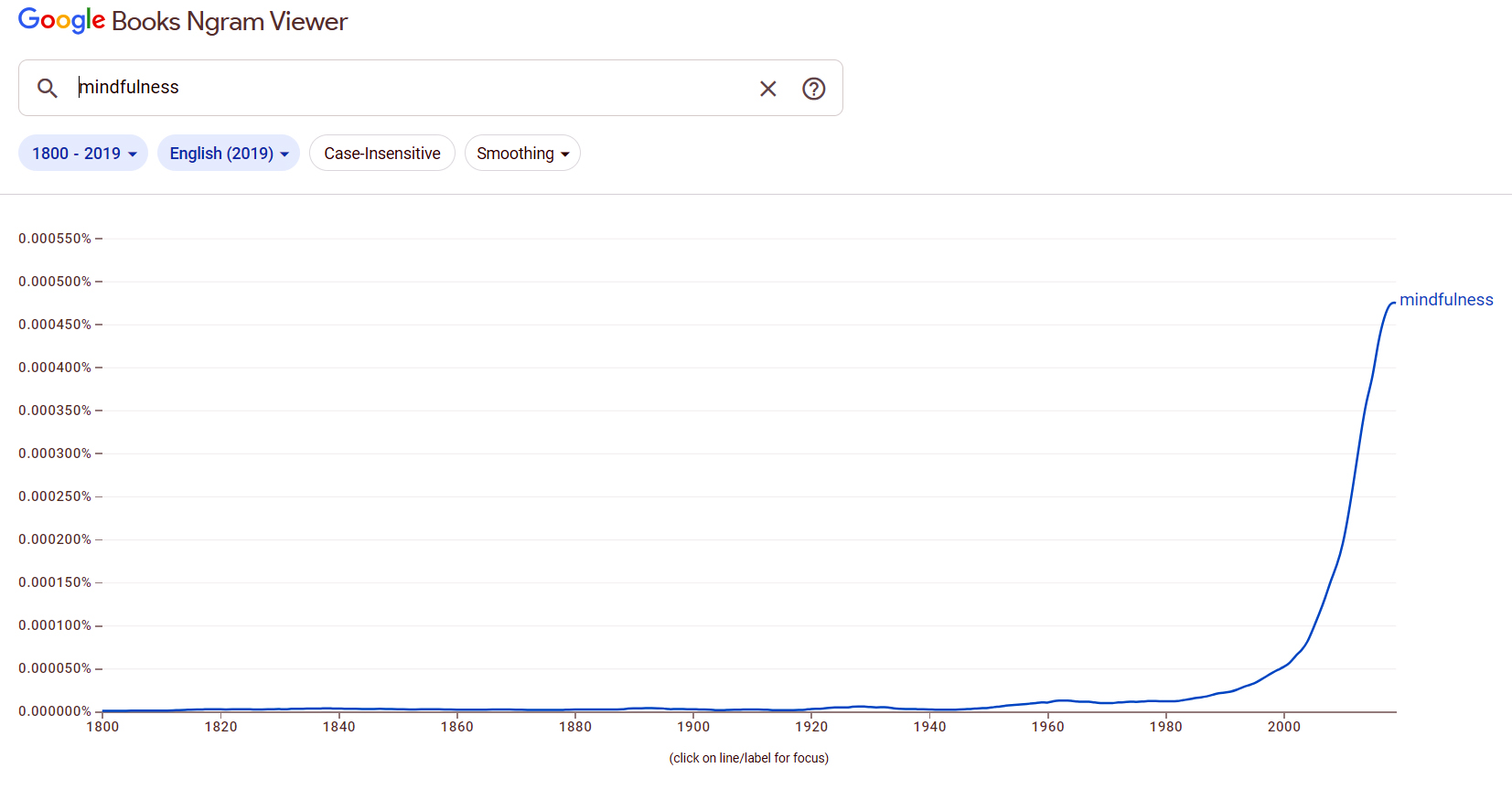
There are now so many books, courses, programmes and seminars on mindfulness - in business, in psychiatry, sport, healthcare, education. Have we reached peak mindfulness? Probably not yet. Has this fad, with its roots in Eastern spirituality, which spread to the West in the 1980s through the work of Jon Kabat-Zinn, reached Poland? Not to any noticeable degree, not compared to the UK.
Google gives the definition of mindfulness as 'a mental state achieved by focusing one's awareness on the present moment, while calmly acknowledging and accepting one's feelings, thoughts, and bodily sensations, used as a therapeutic technique'. Google Translate gives the Polish for mindfulness as uważność, which simply means 'attentiveness'. Yes, there are a few courses on offer, but my cursory googling reveals that around a quarter of Polish-language mindfulness courses available are currently on offer in the UK. There is a Polski Instytut Mindfulness, focused principally on using the technique for stress reduction. But using mindfulness simply as a tool to reduce stress is to reduce in importance everything else that mindfulness is useful for.
Breathing exercises apart, to me mindfulness is common sense; the more I contemplate it, the more I realise I've been doing this for most of my life, namely having that heightened sense of where I am, what's happening, what I'm feeling; a sense of presence - simply stated - an awareness of being. Conscious existence. And in such a state, connected with the eternal and the infinite. Something far more than a stress-reduction tool.
We can drift through life bumbling on from day to day; we can waste time on irrelevant thoughts or rumination or worry; or we can become aware that we are alive - and simply enjoy that feeling of existing, of breathing, of being aware.
I have written before about this piece of research, linking mindfulness meditation to the extension of telomeres - the protective caps at the ends of our DNA. The suggestion is that we can live longer and healthier lives by abandoning worry and concentrating on the state of being alive and conscious.
Tomorrow - more about physical health.
This time last year:
Pascal's Wager dissected with Occam's Razor
This time two years ago:
Speaking to God, listening to God
This time three years ago:
D3200 shoots X100
This time four years ago:
Weekend with the Fuji X100
This time eight years ago:
Sublime sunset, Jeziorki
This time nine years ago:
Dramatic sunset, Jeziorki
Google gives the definition of mindfulness as 'a mental state achieved by focusing one's awareness on the present moment, while calmly acknowledging and accepting one's feelings, thoughts, and bodily sensations, used as a therapeutic technique'. Google Translate gives the Polish for mindfulness as uważność, which simply means 'attentiveness'. Yes, there are a few courses on offer, but my cursory googling reveals that around a quarter of Polish-language mindfulness courses available are currently on offer in the UK. There is a Polski Instytut Mindfulness, focused principally on using the technique for stress reduction. But using mindfulness simply as a tool to reduce stress is to reduce in importance everything else that mindfulness is useful for.
Breathing exercises apart, to me mindfulness is common sense; the more I contemplate it, the more I realise I've been doing this for most of my life, namely having that heightened sense of where I am, what's happening, what I'm feeling; a sense of presence - simply stated - an awareness of being. Conscious existence. And in such a state, connected with the eternal and the infinite. Something far more than a stress-reduction tool.
We can drift through life bumbling on from day to day; we can waste time on irrelevant thoughts or rumination or worry; or we can become aware that we are alive - and simply enjoy that feeling of existing, of breathing, of being aware.
I have written before about this piece of research, linking mindfulness meditation to the extension of telomeres - the protective caps at the ends of our DNA. The suggestion is that we can live longer and healthier lives by abandoning worry and concentrating on the state of being alive and conscious.
Tomorrow - more about physical health.
This time last year:
Pascal's Wager dissected with Occam's Razor
This time two years ago:
Speaking to God, listening to God
This time three years ago:
D3200 shoots X100
This time four years ago:
Weekend with the Fuji X100
This time eight years ago:
Sublime sunset, Jeziorki
This time nine years ago:
Dramatic sunset, Jeziorki
Wednesday, 1 March 2017
Lent - Day 1 - the big questions
ASH WEDNESDAY
We are conscious beings, moving upon the face of our planet, we are born, we live, we die - what then? Why?
Is there purpose to our consciousness, which observes, infers, discerns, likes, dislikes - processes removed from those belonging to our intellect?
On the micro scale there’s us - you, me, them, everybody - each one of us brought into existence by a mind-boggling sequence of coincidences going back to the dawn of life on our planet. And on the macro scale, there’s this physical universe of ours that’s formed of a billion-plus galaxies each of a billion-plus stars (I simplify). This universe began with a Big Bang. It is expanding. That’s pretty much all we know. Will it keep expanding? Will it one day contract?
I’m sure I’m not alone in living a life that’s driven by a quest to understand, to find reason, so seek a purpose.
So far, as I approach the end of my fifth decade of this life, I’ve learned that no one single organised religion has all of the answers, although most organised religions have some of the answers, along with a whole baggage of falsehoods. Nor has science got all the answers. Science is in a state of realisation of knowing just how much it doesn't yet know.
Do I believe in God? I do believe in a reason, a purpose and a goal to this universe, a spiritual goal. So yes. Not a man with a long white beard, but God - yes. Asking us humans to define that God is like asking an mouse to define a human. Religions have used concepts such as ‘omnipotent’, ‘omniscient’ and ‘omnipresent’, and have used complex intellectual arguments to explain how they have reached such conclusions.
Yet instinct, rather than reason is, I believe, the better route to reach a higher awareness of what it’s all about.
Instinctively, then, I feel that the universe is a journey with a purpose, a journey from Zero to One, towards a total consciousness; an awareness of all things, towards being one with all things. Is one human life long enough to move more than the tiniest fraction of the way along that continuum? This leads me to posit that it isn’t. To quote Woody Allen, ‘eternity’s a very long time - especially the last bit’.
I can understand why organised religions hit their believers with the following deal: "follow these rules in this one short lifetime, and you will be rewarded by an eternity in paradise".
Not good enough for me. We must strive harder than that in the quest for understanding of the purpose. Most people tend to ignore it as they go about their daily duties, earning money to pay for food, shelter and pleasures. And as civilised life becomes less of a grind, and day-to-day survival for us privileged rich-world folk fades into atavistic memory, perhaps it’s too easy to seek out pleasure rather than meaning.
Here on earth, in this life, we should strive to do our bit to evolve as a species from the bestial towards the angelic, from barbarism towards civilisation.
Organised religion offers its followers the chance to participate in communal acts of worship that depend on the recitation of prayers, the singing of hymns and the performance of sacred rituals. This fills many people’s spiritual needs, but how many of those participating attain a higher state of enlightenment as a result? Not I - I get distracted, unable to focus, my train of thought broken by my surroundings. I seek a different form of worship through which I can reach a state of spiritual communion with the universe.
If you’ve got this far, I’d say that like me, you are seeking. Actively seeking You won’t find any answers here - only a vague signpost saying ‘me, I think it’s somewhere over there, roughly in that direction.’
If this year's Lenten explorations will have a theme, it will be mindfulness - not in the 'breathe deeply and focus' fad, but an older and deeper concept of awareness, that can help across all aspects of our lives.
This time two years ago:
How does God speak to us?
This time three years ago:
Spring makes itself felt in Ealing
This time four years ago:
Waiting for the warmth to return to Warsaw
This time five years ago:
Remembering Poland's 'Accursed Soldiers'
This time six years ago:
Getting the balance right between work and play
This time eight years ago:
Sublime Jeziorki sunset
This time nine years ago:
Sunrise getting earlier
Tuesday, 28 February 2017
Lent starts at midnight - make the most of it
SHROVE TUESDAY
After an evening of whisky, wine, beef, more whisky and a Red IPA (Ruda Maruda from Browar Waszczukowe) to sip while writing, it'll be time for Abstinence with a Capital A. For 46 days, as usual. My first proper Lent - giving up alcohol from Ash Wednesday to Easter Sunday - was in 1992. Since then, more and more things have been added to the 'giving it up' list (alcohol always there), the apogee coming in 2008, when I gave up meat and dairy and fish and existed on a totally vegan diet for the duration. Nothing so harsh this year.
I'll be giving up alcohol and meat (the hard ones), plus the easy ones (which hardly get a look-in to my daily diet anyway) confectionery, cakes, biscuits, salt snacks, and added salt from the shaker. Coffee - one cup a day, in the morning.
Plus exercise - since 1 January, I've rigorously (with one week's remission while in London) been exercising; now I'm up to 25 press-ups plus 100 sit-ups plus six chin-ups plus three lots of weights twice a day. This will continue for as long as possible, the aim being to beat last year's record.
More importantly, over the past few years, I've taken this time of year to go into greater depth into the mind and spirit. Expect more posts about the unity of body, brain and soul. And health - of body, mind and spirit. And mindfulness with a lowercase 'm'. Yes, it's that time of year when my blog's readership halves; the 20,000-plus page views a month fall away to less than 10,000 by Easter.
Tough.
This is what I want to write about - I want to ask questions about what we are, why we are, where we are heading, what we are made of. What is it all about? What do we expect of life? What is expected of us? What's the purpose? Why wake up in the morning?
Life should be a series of questions, a long and tiring trudge with many true insights and many false trails along the way - but at the end - are we any wiser? Człowiek całe życie się uczy, ale głupi umiera ('man learns all his life, but dies stupid') is a very fatalist (and if I may say so, a very Polish) mindset, with which I entirely disagree.
Life is for learning. Developing continually, expanding what we know, what we understand (do you really understand, say - electricity, like truly?)... The quest for knowledge has become so much easier. Google and Wikipedia have given mankind access to tens of thousands of libraries of knowledge. If you really want to know about anything - it's now available by pressing a few dozen keys. But it's about turning the knowledge into wisdom. That does take a lifetime of active seeking, of chance insights and putting it all together in one synthesis.
Yet though we progress, our lives are short - what's our 100 years in the 13.8 billion year history of our universe - and when we die, what of that learning that's been acquired? It needs to be encoded and communicated to the future [Partially, a deep reason why I blog.] Are we wiser as a species than we were 1,000 years ago? 2,000 years ago? Yes, I think we are.
I do want to return to those supernatural aspects - yearnings - longings - that many of us have - are we souls embodied in flesh and bone, or are we flesh and bone with souls - or are we just flesh and bone that imagine we have souls? I firmly believe the former, but Lent is a time of examination, of sincere questioning, of planting footholds on the mountainside ready to propel ourselves upward - and hoping we'll not slip and tumble back down.
Lent happens at that magic time of year in the Northern Hemisphere, when winter is approaching its end and the miracle of spring is waiting for happen. With empty, unsated stomachs, our spirits should be keen and open to receive the light of truth.
For the next 46 days, this blog will focus on the body, mind and spirit as a singular whole. Join me for another Lenten quest, the challenging search for another step in the direction of universal truth - we will not get there in our current bodies, but get there we will.
[PAFF! Madame Blavatsky - like, where did that thought suddenly pop up from? Those eyes...]
This time last year:
Coincidence and survival
This time four years ago
The Book of Revelations
This time five years ago:
Strong late-winter sunshine
This time six years ago:
Best pics from February 2011
This time seven years ago:
Kensington
This time nine years ago:
End of the line
Saturday, 25 February 2017
Winter's short return
Overnight frost, snow flurries in the morning. The ponds have frozen over again, the surface covered in a thin layer of ice, below which is water, below which is a thick layer of ice.
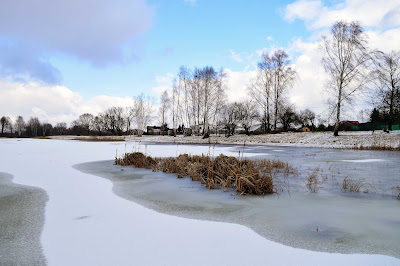
Below: gingerly, I took a few steps out onto the new ice. My wellingtonned feet went straight through the thin layer, but underneath, all was still solid. This is the 54th day of ice cover on the ponds.

Below: what's this I see? Looks like a viewing platform is being built; wooden piles are being driven into the pond. The workmen are happily stomping all over the ice - although nearer the shore it is melting. A fitness park with apparatus will be erected over to the right, plus car parking.

Below: up on Ballast Mountain to catch an Okęcie-bound train of empty biofuel wagons heading back from Siekierki power station.

Below: a Polish Air Force CASA C295 coming in to land at Okęcie. Trains and planes = Jeziorki.

Below: a new development - a row of six houses (the sixth is out of frame to the left) emerges between ul. Trombity and the railway line.

Below: a lovely, unretouched photo of trees. Trees which are now no longer protected by the Polish state - the owners can come and cut them down as and when they please.

On the one hand - good - less bureaucracy. "It's my land, the trees are on my land, I decide what happens on my land." Fine. But at the higher, longer-term level, urban Poland is going to lose hundreds of thousands of trees, trees that give oxygen back to the atmosphere.
The afternoon was sunny, temperature got up to +3C. But tomorrow it will rain, and by Tuesday the temperature will be in double digits. Spring still is a long, long way off.

Below: gingerly, I took a few steps out onto the new ice. My wellingtonned feet went straight through the thin layer, but underneath, all was still solid. This is the 54th day of ice cover on the ponds.

Below: what's this I see? Looks like a viewing platform is being built; wooden piles are being driven into the pond. The workmen are happily stomping all over the ice - although nearer the shore it is melting. A fitness park with apparatus will be erected over to the right, plus car parking.

Below: up on Ballast Mountain to catch an Okęcie-bound train of empty biofuel wagons heading back from Siekierki power station.

Below: a Polish Air Force CASA C295 coming in to land at Okęcie. Trains and planes = Jeziorki.


Below: a lovely, unretouched photo of trees. Trees which are now no longer protected by the Polish state - the owners can come and cut them down as and when they please.

On the one hand - good - less bureaucracy. "It's my land, the trees are on my land, I decide what happens on my land." Fine. But at the higher, longer-term level, urban Poland is going to lose hundreds of thousands of trees, trees that give oxygen back to the atmosphere.
The afternoon was sunny, temperature got up to +3C. But tomorrow it will rain, and by Tuesday the temperature will be in double digits. Spring still is a long, long way off.
Ten years of digital photography
It was ten years ago today, Sunday 25 February 2007, that I bought my first proper digital camera (mobile phone doesn't count!). The Nikon D80 was a mid-range digital single-lens reflex (DSLR) camera, with a 12.1 megapixel sensor. I traded in the kit lens it came with (an 18-135mm zoom) for a more useful 18-200mm zoom, which broke in December 2012 after five and half years of almost-daily use.
Not long after, the D80 body itself packed up. Now it's worthless - a collection of partially-working bits that could theoretically be used to repair another D80, which in any case would be worth little, being worse in every possible way than what's what's on the market today. [Movie prop?] So, unlike old film cameras, which will keep on working for as long as film is produced, this former digital wonder is fit only for recycling.
Below: museum piece, unused for over four years. Shutter still works, but card reader no longer 'sees' SD card; menu on rear screen works, but playback doesn't.

I replaced the D80 as my principal DSLR with a newer, smaller, lighter, better specced but bottom-of-the-range D3200 at that time, which itself replaced by the even more compact D3300 in December 2014. Now, my D3300 (24 megapixels) shares time around my neck with a compact Nikon CoolPix A and a superzoom bridge camera, the Nikon CoolPix P900. Each of the three has a specific purpose - the CoolPix A is a lightweight travel camera, great for the bike, great for landscapes; the P900 is for clear-skies shooting of distant objects - aircraft, wildlife, the moon. But the D3300 is the most universal, the fastest operating, the best all-round camera. The cheapest of Nikon's DSLRs, I can totally recommend it; the newer D3400 is a few grams lighter and can transfer images direct to your phone, but prices on the D3300 are some 500zł/ £100 lower.
The D80, which introduced me to digital photography, was much heavier (body-only 630g compared to 455g for the D3300) and together with the heavy (though universal) zoom lens it was quite a weight to carry around all day. But it did prove revolutionary. Before I bought the D80, my principal camera for many years was a Leica M6 rangefinder, sitting unused now since 2007, alongside my M2, M3 and Nikon FM2 (all owned since the 1980s). Shooting film might today seem cool, retro and hipsterish, but spending lots of money on film and processing, and waiting days to see the results is why digital beats film hands-down.
Over the 10 years since I bought the D80, four times as many photographs have been taken as during the entire course of human history, since Nicéphore Niépce took the first photograph 1826 or 1827. It was only 25 years ago that the first photograph was posted on the internet. 2015 was the first year in which humans took more than one trillion photographs, up from 380 billion in 2011. How many will still be available to look at in 100 or 1,000 years time remains to be seen.
In the meantime, with over two billion mobile phones around the planet already boasting good cameras, the ability to capture images has reached pretty much every person that wants to capture images of the world around them. My first proper camera, a Nikon EM, cost £118 back in 1979, the equivalent to two week's pay in those days. The vastly more capable Nikon D3300 is currently available in the UK for £336, equivalent to three day's pay.
Having photos displayed on a computer screen is better than looking at paper prints, and of course with Photoshop you can adjust exposure, colour balance, perspective, as well as being creative. I do miss making those big 16" x 20" black and white prints, but for that you need a darkroom with smelly chemicals, a tall enlarger and space for large trays - developer, stop bath, fixer and water.
Less than six weeks after buying the D80, I took the decision to start a blog, but more about that on 1 April. Without that camera, I would not have started blogging.
I bought the camera at a Dixons Duty Free shop - can't remember whether it was at Heathrow or Luton - returned home, charged up the battery, read the manual while waiting, took a few test snaps in my room, long deleted, and went to sleep.
The next morning, I took the photo below from my window. Taken at 200 ISO (the fastest speed the D80 could go), f4.2 at 1/50th sec, lens at 31mm (46mm in 35mm/full-frame equivalent).

Below: Ten years after my first foray into digital. See the tree how big it's grown. Note also the new houses (under construction) to the left of the photo. Taken on my D3300 at 200 ISO, f4.2, but for some reason the shutter fired at 1/120th sec.

'Proper' camera sales are falling as the cameras in our phones get better optically and operationally. In 2013, nearly 14 million DSLRs were sold globally; by last year this had fallen to a little over 8 million. And sale of 'mirrorless' cameras (interchangeable lens but non-reflex, such as the Leica M10 or Sony A7) has remained static at 3 million units sold over those past four years.
My dream camera would be a full-frame mirrorless Nikon that will still be able to take Nikon F-mount lenses with a body that's much lighter and smaller than current DSLR bodies. The excellent Nikon D810, with its 36 megapixel sensor, weighs a mighty 965g (more than double the weight of the D3300 body). A full-frame body weighing around 500g would be perfect, thanks. Will buy.
This time last year:
Between atheism and creationism
This time two years ago:
A peek into the Afterlife
[the best piece I've written about my spiritual quest]
This time three years ago:
The new dupes of Moscow
This time four years ago:
Late-winter commuting, Jeziorki
This time five years ago:
My Nikon D80 five years on
This time six years ago:
My Nikon D80 four years on
This time eight years ago:
Nikon D80 two years on
This time nine years ago:
Nikon D80 one year on
Not long after, the D80 body itself packed up. Now it's worthless - a collection of partially-working bits that could theoretically be used to repair another D80, which in any case would be worth little, being worse in every possible way than what's what's on the market today. [Movie prop?] So, unlike old film cameras, which will keep on working for as long as film is produced, this former digital wonder is fit only for recycling.
Below: museum piece, unused for over four years. Shutter still works, but card reader no longer 'sees' SD card; menu on rear screen works, but playback doesn't.

I replaced the D80 as my principal DSLR with a newer, smaller, lighter, better specced but bottom-of-the-range D3200 at that time, which itself replaced by the even more compact D3300 in December 2014. Now, my D3300 (24 megapixels) shares time around my neck with a compact Nikon CoolPix A and a superzoom bridge camera, the Nikon CoolPix P900. Each of the three has a specific purpose - the CoolPix A is a lightweight travel camera, great for the bike, great for landscapes; the P900 is for clear-skies shooting of distant objects - aircraft, wildlife, the moon. But the D3300 is the most universal, the fastest operating, the best all-round camera. The cheapest of Nikon's DSLRs, I can totally recommend it; the newer D3400 is a few grams lighter and can transfer images direct to your phone, but prices on the D3300 are some 500zł/ £100 lower.
The D80, which introduced me to digital photography, was much heavier (body-only 630g compared to 455g for the D3300) and together with the heavy (though universal) zoom lens it was quite a weight to carry around all day. But it did prove revolutionary. Before I bought the D80, my principal camera for many years was a Leica M6 rangefinder, sitting unused now since 2007, alongside my M2, M3 and Nikon FM2 (all owned since the 1980s). Shooting film might today seem cool, retro and hipsterish, but spending lots of money on film and processing, and waiting days to see the results is why digital beats film hands-down.
Over the 10 years since I bought the D80, four times as many photographs have been taken as during the entire course of human history, since Nicéphore Niépce took the first photograph 1826 or 1827. It was only 25 years ago that the first photograph was posted on the internet. 2015 was the first year in which humans took more than one trillion photographs, up from 380 billion in 2011. How many will still be available to look at in 100 or 1,000 years time remains to be seen.
In the meantime, with over two billion mobile phones around the planet already boasting good cameras, the ability to capture images has reached pretty much every person that wants to capture images of the world around them. My first proper camera, a Nikon EM, cost £118 back in 1979, the equivalent to two week's pay in those days. The vastly more capable Nikon D3300 is currently available in the UK for £336, equivalent to three day's pay.
Having photos displayed on a computer screen is better than looking at paper prints, and of course with Photoshop you can adjust exposure, colour balance, perspective, as well as being creative. I do miss making those big 16" x 20" black and white prints, but for that you need a darkroom with smelly chemicals, a tall enlarger and space for large trays - developer, stop bath, fixer and water.
Less than six weeks after buying the D80, I took the decision to start a blog, but more about that on 1 April. Without that camera, I would not have started blogging.
I bought the camera at a Dixons Duty Free shop - can't remember whether it was at Heathrow or Luton - returned home, charged up the battery, read the manual while waiting, took a few test snaps in my room, long deleted, and went to sleep.
The next morning, I took the photo below from my window. Taken at 200 ISO (the fastest speed the D80 could go), f4.2 at 1/50th sec, lens at 31mm (46mm in 35mm/full-frame equivalent).

Below: Ten years after my first foray into digital. See the tree how big it's grown. Note also the new houses (under construction) to the left of the photo. Taken on my D3300 at 200 ISO, f4.2, but for some reason the shutter fired at 1/120th sec.

'Proper' camera sales are falling as the cameras in our phones get better optically and operationally. In 2013, nearly 14 million DSLRs were sold globally; by last year this had fallen to a little over 8 million. And sale of 'mirrorless' cameras (interchangeable lens but non-reflex, such as the Leica M10 or Sony A7) has remained static at 3 million units sold over those past four years.
My dream camera would be a full-frame mirrorless Nikon that will still be able to take Nikon F-mount lenses with a body that's much lighter and smaller than current DSLR bodies. The excellent Nikon D810, with its 36 megapixel sensor, weighs a mighty 965g (more than double the weight of the D3300 body). A full-frame body weighing around 500g would be perfect, thanks. Will buy.
This time last year:
Between atheism and creationism
This time two years ago:
A peek into the Afterlife
[the best piece I've written about my spiritual quest]
This time three years ago:
The new dupes of Moscow
This time four years ago:
Late-winter commuting, Jeziorki
This time five years ago:
My Nikon D80 five years on
This time six years ago:
My Nikon D80 four years on
This time eight years ago:
Nikon D80 two years on
This time nine years ago:
Nikon D80 one year on
Subscribe to:
Posts (Atom)


 Posts
Posts


