Remember, dear reader, that 14 units of alcohol is the upper limit of 'safe drinking' set by Britain's Chief Medical Officer early last year. Once upon a time it used to be 28 units for men, 21 for women, then it was reduced to 21 units for men, 14 for women, now 14 units for men and women.
It is the run-up to Xmas, the days are short; darkness and cold reign. What better time of year than to meet up with old friends, and raise a cheering glass or five to celebrate a time of Peace and Goodwill to All. But those 14 units...?
Since 1 January 2014, I've been keeping a health and fitness log, entering - literally - every unit of alcohol consumed into the spreadsheet, along with my daily walking and exercising, and portions of fresh fruit and vegetables consumed. If you can measure it, you can manage it.
Here's a sample entry (from Saturday's get-together in Shoreditch):
=(5,4*1,33)+(13*0,15)
That's four bottles of Forest Road Work IPA at 5.4% alcohol by volume, each of 330ml, plus one glass (150ml) of red wine at 13% abv. Total = 9.1 units of alcohol. [One unit is equivalent to 250ml of 4% beer, for example.]
Now the social evenings are coming thick and fast at this time of year. Last night a do at the Polish Embassy in London, tonight the PBlink mixer in London, night before last meeting up with old school-friends down the Kent. In each case several beers or wines - hard to avoid and not appear a party-pooper. Plus alcohol is a great social lubricant, making you more garrulous, confident and amiable - of course, up to a point. The trick is to know exactly where that 'point' lies; when you can feel you're starting to lose the logic of your statements, when you're choosing the wrong words. With me, this starts to occur after 10 units, spaced out over an evening. Over 13 units, the helicopters start. And then there's the hangover, which is a combination of factors, including how much water you're taking in alongside the alcohol to prevent nocturnal dehydration, the mixing of grape and grain, and the hangover-generating quality of the alcohol consumed. Plus the last thing one wants to to when crawling towards bed is to do one's evening portion of exercises - weights, press-ups etc.
So ten units is what I can handle and remain sensible, with consciousness working normally. Last night it was 8.1 units - five small glasses of red wine with food consumed over two and half hours. No slurred speech, no hangover, a good memory of the many people I talked to and the conversations engaged in (blockchain, investment in Poland's regions, ethnic food in Poland, business succession and investment, Brexit and the new Polish premier).
But five such evenings over a week equals 40+ units; 50 units according to Public Health England is the dangerous drinking level. And Public Health England discourages us from 'hoarding' our drink-free days so that we can binge-drink and still stay within overall limits.
Looking back over the first 11 months of this year, I consumed an average of 19.1 units a week (below the old 21-unit limit, but much more than the current 14-unit one). And I had 179 alcohol-free days, more than every second day. Two alcohol-free days in a row is recommended by Public Health England, which I generally abide by. And then of course there's Lent (26 years now) during which I touch not a drop. The New Year is a time of resolution, and after Christmas excesses, I treat January as a gentle run-up to the rigours of Lent, slowing down alcohol intake considerably.
Past Decembers look like this:
2014: 56.1 units a week (DANGER!)
2015: 39.8 units a week
2016: 35.2 units a week (still 2.5 times over 'safe' level)
It goes without saying that December is the most intensive month for drinking by far; the most important thing is to be aware of this, monitor it carefully and go for a liver recovery programme in the New Year.
This time last year:
Emilia comes down
This time two years ago:
On being rich in Poland
This time five years ago:
The link between health and happiness explored
This time six years ago:
The black SUV, the black SUV... (with the darkened rear windows)
This time seven years ago:
Atonement
This time ten years ago:
Where I'm from, and why
Friday, 8 December 2017


Tuesday, 5 December 2017
Milton Keynes
Apologies for not updating sooner, have been very busy in London these past few days. I'd like to share my impressions of Milton Keynes, a town I visited on Monday. It stands as testimony to a bold social-engineering experiment begun half a century ago - to create a brand new modern city around a grid pattern of roads running north-south and east-west, each grid being roughly a square kilometre.
Roads are named 'H' for horizontal (east-west) 'Ways', and 'V' for vertical (north-south) 'Streets'. Built for the car, the Ways and the Streets intersect at roundabouts (no traffic lights on the grid) to allow for high-speed travel. But the cyclist and pedestrian were not ignored at the planning stage; there are plenty of cycle paths augmenting the road network.
An urban area of nearly a quarter of a million population, larger than say, Radom or Częstochowa, or for that matter Northampton, Norwich or Ipswich, Milton Keynes has a prosperous air about it.
Below: Milton Keynes Central railway station (to the left), one of six stations serving the town, and the only one to have either 'Milton' or 'Keynes' in its name. The station itself is busy and extremely well connected with London, with up to eight trains an hour. Buying an off-peak return ticket on Saturday for a Monday journey cost me a mere £12.

Work to build Milton Keynes - a central business district surrounded by six existing villages - began in the late 1960s, and some of the architecture looks decidedly passé and shabby. The Old Bus Station has now become a car park. Given that the fastest journey time to London Euston is 30 minutes, the average is 38 minutes (48 miles/77 km), Milton Keynes is also an attractive dormitory town for the capital. It would be interesting to know how many people commute into London from here.

Housing in Milton Keynes is rather attractive - a kind of neo-vernacular Brookside Close, with tightly controlled architectural designs ensuring a harmonious visual environment. Features such as gabled dormer windows, decorative brickwork and traditional materials hark back to local history.

The interface between parkland, footpaths and roads. Below: this is H6 Childs Way crossing over a footpath that links Tear Drop Lakes to the housing estate shown in the above photo. Note the exposed concrete (béton brut) used for the ramparts - a very 1960s feature, now disappearing under ivy.

One of the Tear Drop Lakes (below) reminds me of Jeziorki - can you see the grey heron? It allowed me to get far closer to it that ones back home do. The wooden pier has been cordoned off for safety reasons. This tranquil scene is less than 500m from Milton Keynes Central station, and shows how closely nature can sit beside a thriving urban centre.

Back to catch my train, I glimpse the future as it was seen in my childhood; mirrored glass buildings set amid manicured landscapes, intersected by fast roads and railways (this footbridge crosses both).

It would be valuable to spend more time in Milton Keynes (preferably on a day of longer daylight duration) to get a better idea of the town's character; my first impressions were curiously positive; there's already an air of nostalgia about a vision of the future as seen from the not-to-distant past.
This time last year:
Warsaw by night, early winter
This time four years ago:
Burn less gas and do Ukraine a favour
This time seven years ago:
Early evening atmosphere
This time nine years ago:
Toponyms - how many names has Jeziorki?
This time ten years ago:
On the road to Białystok
Roads are named 'H' for horizontal (east-west) 'Ways', and 'V' for vertical (north-south) 'Streets'. Built for the car, the Ways and the Streets intersect at roundabouts (no traffic lights on the grid) to allow for high-speed travel. But the cyclist and pedestrian were not ignored at the planning stage; there are plenty of cycle paths augmenting the road network.
An urban area of nearly a quarter of a million population, larger than say, Radom or Częstochowa, or for that matter Northampton, Norwich or Ipswich, Milton Keynes has a prosperous air about it.
Below: Milton Keynes Central railway station (to the left), one of six stations serving the town, and the only one to have either 'Milton' or 'Keynes' in its name. The station itself is busy and extremely well connected with London, with up to eight trains an hour. Buying an off-peak return ticket on Saturday for a Monday journey cost me a mere £12.

Work to build Milton Keynes - a central business district surrounded by six existing villages - began in the late 1960s, and some of the architecture looks decidedly passé and shabby. The Old Bus Station has now become a car park. Given that the fastest journey time to London Euston is 30 minutes, the average is 38 minutes (48 miles/77 km), Milton Keynes is also an attractive dormitory town for the capital. It would be interesting to know how many people commute into London from here.

Housing in Milton Keynes is rather attractive - a kind of neo-vernacular Brookside Close, with tightly controlled architectural designs ensuring a harmonious visual environment. Features such as gabled dormer windows, decorative brickwork and traditional materials hark back to local history.

The interface between parkland, footpaths and roads. Below: this is H6 Childs Way crossing over a footpath that links Tear Drop Lakes to the housing estate shown in the above photo. Note the exposed concrete (béton brut) used for the ramparts - a very 1960s feature, now disappearing under ivy.

One of the Tear Drop Lakes (below) reminds me of Jeziorki - can you see the grey heron? It allowed me to get far closer to it that ones back home do. The wooden pier has been cordoned off for safety reasons. This tranquil scene is less than 500m from Milton Keynes Central station, and shows how closely nature can sit beside a thriving urban centre.

Back to catch my train, I glimpse the future as it was seen in my childhood; mirrored glass buildings set amid manicured landscapes, intersected by fast roads and railways (this footbridge crosses both).

It would be valuable to spend more time in Milton Keynes (preferably on a day of longer daylight duration) to get a better idea of the town's character; my first impressions were curiously positive; there's already an air of nostalgia about a vision of the future as seen from the not-to-distant past.
This time last year:
Warsaw by night, early winter
This time four years ago:
Burn less gas and do Ukraine a favour
This time seven years ago:
Early evening atmosphere
This time nine years ago:
Toponyms - how many names has Jeziorki?
This time ten years ago:
On the road to Białystok
Thursday, 30 November 2017
Viaduct takes shape in the snow, W-wa Jeziorki
November 2017 is approaching an end. And how's the viaduct that one day will take ul. Karczunkowska over the railway line at W-wa Jeziorki coming on? Snow's falling hard and fast, warm enough to stick to vertical surfaces. Between the electrified lines and the non-electrified coal train line, an excavator digs out the soil between the retaining walls. Here will one day appear the central pillar supporting the new bridge.

Below: down in the pit, the work goes on. Note the people walking down the coal train tracks; there's no direct route from the west side of the line to the 'up' platform; you can choose to walk a muddy 200m detour or walk the line.

 Left: I arrive at W-wa Jeziorki, delighted that the temperature here is one degree lower than in the centre of Warsaw, and that the snow here is settling on the ground. I'm greeted by a little snow station-master, who causes some amusement to the train's conductor.
Below: now the trains have passed, I check how the foundations look in the dark.

Bonus shot from yesterday; the snow was falling but not settling, as a Freightliner PL Newag Dragon locomotive passes through W-wa Jeziorki with a rake of full coal wagons. The Freightliner Dragons are dual-power electric locos with auxiliary diesel power, allowing them to work in non-electrified shunting yards.

This time three years ago:
No in-work benefits for four years?
This time four years ago:
This time six years ago:
Snow-free November
This time seven years ago:
Krakowskie Przedmieście in the snow
This time eight years ago:
Ul. Poloneza closed for the building of the S2

Below: down in the pit, the work goes on. Note the people walking down the coal train tracks; there's no direct route from the west side of the line to the 'up' platform; you can choose to walk a muddy 200m detour or walk the line.


Below: now the trains have passed, I check how the foundations look in the dark.

Bonus shot from yesterday; the snow was falling but not settling, as a Freightliner PL Newag Dragon locomotive passes through W-wa Jeziorki with a rake of full coal wagons. The Freightliner Dragons are dual-power electric locos with auxiliary diesel power, allowing them to work in non-electrified shunting yards.

This time three years ago:
No in-work benefits for four years?
This time four years ago:
This time five years ago:
Another November without snowThis time six years ago:
Snow-free November
This time seven years ago:
Krakowskie Przedmieście in the snow
This time eight years ago:
Ul. Poloneza closed for the building of the S2
Tuesday, 28 November 2017
50th Anniversary of the Polski Fiat 125p
On this day fifty years ago, the very first Polski Fiat 125p rolled off the production line at the Fabryka Samochodów Osobowych (FSO) in Warsaw's Żerań. The licence-built copy of the Italian saloon car was in continuous production until 1991, with more than 1.4 million made. A common (though not as common as its small brother, the Polski Fiat 126p) sight on Poland's roads right through to the late 1990s. Today considered a classic, well-preserved examples are highly sought after by collectors.
To mark the half-century that's passed since the start of production, a small exhibition has been staged in a tent outside the Palace of Culture (Plac Defilad, facing ul, Marszałkowska), which I visited today.

Poland had had a licence-building relationship with Fiat since before WW2; from 1935 to 1939, the Polski Fiat 508 III (below) was produced at the PZInż factory in Warsaw (from 1932 to 1935 the Polski Fiat 508 I and 508 II were assembled there.)

At the time, the Fiat 125 (below) represented sharp, modern European styling, a far cry from the lumpy Warszawa 223 that was produced in parallel at FSO until production of the that type ceased in 1973, by which time the Warszawa was a complete anachronism. The Polski Fiat 125p was a simplified, lower-cost version of the Italian 125, with engines from the discontinued Fiat 1300 and 1500 saloons, while the Italian cars had new 1600 and 1800cc engines and square headlamps.

Below: an estate version (kombi) was produced, and successfully exported too. This is the ambulance version. I had a ride in one of these in 1979; the ambulance driver was moonlighting as a taxi outside a railway station somewhere in western Poland, from where he drove me to a lakeside chalet resort where I was meeting my group of young Poles from London on our Montserrat holiday. The journey (around 25km) cost me $10, I remember.

This is a prototype 4x4 version of the estate; with mechanicals based on the Soviet Lada Niva, it was never put into production because of difficulties in obtaining those Soviet parts.

After Martial Law was imposed in December 1981, the FSO factory lost many of its key workers, and soldiers were drafted in to keep the machines running. Quality plummeted. Fiat was upset that its brand was attached to products of such execrable reliability that it insisted the 125p was renamed the FSO 125p. The car continued to be sold under the FSO brand until production ceased in 1991.
This exhibition runs until next Monday, 4 December, if you can't make it but like the Fiat 125p, there are usually a handful available for hire for retro-style tours of central Warsaw, based in front of the Palace of Culture.

Another view, in the sunlight, yesterday morning.

Bonus shot - a 1972 Ford Capri 1600 GT at the DESA Unicum auction house on ul. Piękna. The auction takes place this Saturday (2 December) and the car is expected to fetch up to 80,000 złotys (£17,000). My father had one like this (1600, but not GT), in bright red, with maroon upholstery. Says it was his favourite car ever, in over 60 years of driving.

This time last year:
Fidel Castro's death divides the world
This time two years ago:
London to Edinburgh by night bus
This time four year ago:
The Regent's Canal, London
This time six years ago:
An end to the entitlement way of thinking
This time seven year:
West Ealing - drab and sad suburb
This time eight years ago:
To Poznań by train
This time ten years ago:
Late autumn drive-time
To mark the half-century that's passed since the start of production, a small exhibition has been staged in a tent outside the Palace of Culture (Plac Defilad, facing ul, Marszałkowska), which I visited today.

Poland had had a licence-building relationship with Fiat since before WW2; from 1935 to 1939, the Polski Fiat 508 III (below) was produced at the PZInż factory in Warsaw (from 1932 to 1935 the Polski Fiat 508 I and 508 II were assembled there.)

At the time, the Fiat 125 (below) represented sharp, modern European styling, a far cry from the lumpy Warszawa 223 that was produced in parallel at FSO until production of the that type ceased in 1973, by which time the Warszawa was a complete anachronism. The Polski Fiat 125p was a simplified, lower-cost version of the Italian 125, with engines from the discontinued Fiat 1300 and 1500 saloons, while the Italian cars had new 1600 and 1800cc engines and square headlamps.

Below: an estate version (kombi) was produced, and successfully exported too. This is the ambulance version. I had a ride in one of these in 1979; the ambulance driver was moonlighting as a taxi outside a railway station somewhere in western Poland, from where he drove me to a lakeside chalet resort where I was meeting my group of young Poles from London on our Montserrat holiday. The journey (around 25km) cost me $10, I remember.

This is a prototype 4x4 version of the estate; with mechanicals based on the Soviet Lada Niva, it was never put into production because of difficulties in obtaining those Soviet parts.

After Martial Law was imposed in December 1981, the FSO factory lost many of its key workers, and soldiers were drafted in to keep the machines running. Quality plummeted. Fiat was upset that its brand was attached to products of such execrable reliability that it insisted the 125p was renamed the FSO 125p. The car continued to be sold under the FSO brand until production ceased in 1991.
This exhibition runs until next Monday, 4 December, if you can't make it but like the Fiat 125p, there are usually a handful available for hire for retro-style tours of central Warsaw, based in front of the Palace of Culture.

Another view, in the sunlight, yesterday morning.

Bonus shot - a 1972 Ford Capri 1600 GT at the DESA Unicum auction house on ul. Piękna. The auction takes place this Saturday (2 December) and the car is expected to fetch up to 80,000 złotys (£17,000). My father had one like this (1600, but not GT), in bright red, with maroon upholstery. Says it was his favourite car ever, in over 60 years of driving.

This time last year:
Fidel Castro's death divides the world
This time two years ago:
London to Edinburgh by night bus
This time four year ago:
The Regent's Canal, London
This time six years ago:
An end to the entitlement way of thinking
This time seven year:
West Ealing - drab and sad suburb
This time eight years ago:
To Poznań by train
This time ten years ago:
Late autumn drive-time
Sunday, 26 November 2017
Roadblock and railfreight pics
What could such a sign... mean? It's Friday morning, and I'm walking to W-wa Dawidy station, when I see a no-through road sign on the corner of ul. Trombity and ul. Dumki (below). Now, these temporary signs usually mean a road closure, but as I've written in the past, drivers can never be sure whether the sign is to be taken seriously or not.

Rather than walk to the station alongside the ponds, I continue along Trombity to find out. The road is totally closed, with fencing from one side to the other. Pipes are being dug up in the road, again. Pedestrians can squeeze through, risking muddy feet. But drivers (this shot is taken from the north end) are forced to turn around and do a 3km diversion via ul. Sarabandy.

However... how is it looking on Saturday morning? I go. No sign of the digger and its crew, and the road is now only partially closed. Cars can squeeze through the gap, below. Shot taken from the south. But the road signs are still in place, no different from the previous day, when it would have been impossible to squeeze through. Upshot - drivers don't take the signs seriously when they do appear. Better communication between builders and drivers is needed (such as 'road closed Mon-Fri 6am-6pm' or the like).

So - drivers, if you use Trombity as your regular short-cut to and from work - forget it. The road will be closed for some time to come.
There's works going on along ul. Kórnicka and Dumki too. All along the northern and western sides of the ponds, new trees are being planted. Here's a crew of landscape gardeners working (on a Saturday) to install a line of birches. On Kórnicka, a volleyball court is being built, replacing the long-defunct football pitch, and more trees are going up there too. Good to see the local authorities continuing to invest in beautifying the area.

Now for rail fans - two pics of locomotives running light through Jeziorki. Below: a DB-liveried ET21 (3E/1) 'Sputnik' hustles up the electrified line towards Okęcie showing a surprising turn of speed, possible after the recent track modernisation. Not having had to slow down for an island platform or for ungated level crossings, the engine was blasting along.

Below: a PKP Cargo ST44 Gagarin proceeds across the temporary level crossing by ul. Gogolinska at a far more leisurely pace, also en route for the Okęcie sidings along the non-electrified line.

Below: bonus pic from last Tuesday - a pair of Skoda-build 57E (181) locos owned by Lotos pull a rake of oil cisterns southbound through W-wa Choszczówka station.

The electric engines are from the 1960s and still working usefully, the Skodas being from 1961 and the Sputnik from 1968. The diesel-engined Gagar is somewhat newer, built in 1980.
This time last year:
Sunny morning, Hyde Park and Kensington Gardens
This time two years ago:
Brentham Garden Suburb
This time three years ago:
Ahead of the opening of the second line of the Warsaw Metro
This time four years ago:
Keep an eye on Ukraine...
This time five years ago:
Płock by day, Płock by night
This time six years ago:
Warning ahead of railway timetable change
This time ten years ago:
Some thoughts on recycling

Rather than walk to the station alongside the ponds, I continue along Trombity to find out. The road is totally closed, with fencing from one side to the other. Pipes are being dug up in the road, again. Pedestrians can squeeze through, risking muddy feet. But drivers (this shot is taken from the north end) are forced to turn around and do a 3km diversion via ul. Sarabandy.

However... how is it looking on Saturday morning? I go. No sign of the digger and its crew, and the road is now only partially closed. Cars can squeeze through the gap, below. Shot taken from the south. But the road signs are still in place, no different from the previous day, when it would have been impossible to squeeze through. Upshot - drivers don't take the signs seriously when they do appear. Better communication between builders and drivers is needed (such as 'road closed Mon-Fri 6am-6pm' or the like).

So - drivers, if you use Trombity as your regular short-cut to and from work - forget it. The road will be closed for some time to come.
There's works going on along ul. Kórnicka and Dumki too. All along the northern and western sides of the ponds, new trees are being planted. Here's a crew of landscape gardeners working (on a Saturday) to install a line of birches. On Kórnicka, a volleyball court is being built, replacing the long-defunct football pitch, and more trees are going up there too. Good to see the local authorities continuing to invest in beautifying the area.

Now for rail fans - two pics of locomotives running light through Jeziorki. Below: a DB-liveried ET21 (3E/1) 'Sputnik' hustles up the electrified line towards Okęcie showing a surprising turn of speed, possible after the recent track modernisation. Not having had to slow down for an island platform or for ungated level crossings, the engine was blasting along.

Below: a PKP Cargo ST44 Gagarin proceeds across the temporary level crossing by ul. Gogolinska at a far more leisurely pace, also en route for the Okęcie sidings along the non-electrified line.

Below: bonus pic from last Tuesday - a pair of Skoda-build 57E (181) locos owned by Lotos pull a rake of oil cisterns southbound through W-wa Choszczówka station.

The electric engines are from the 1960s and still working usefully, the Skodas being from 1961 and the Sputnik from 1968. The diesel-engined Gagar is somewhat newer, built in 1980.
This time last year:
Sunny morning, Hyde Park and Kensington Gardens
This time two years ago:
Brentham Garden Suburb
This time three years ago:
Ahead of the opening of the second line of the Warsaw Metro
This time four years ago:
Keep an eye on Ukraine...
This time five years ago:
Płock by day, Płock by night
This time six years ago:
Warning ahead of railway timetable change
This time ten years ago:
Some thoughts on recycling
Friday, 24 November 2017
Edinburgh from Warsaw made easier
For the first time in my eight trips to Edinburgh, I managed to fly direct from Warsaw (if one can consider a flight from Modlin 'direct'). To get to Modlin, I took the Metro from the office to Dworzec Gdański, from there a Koleje Mazowieckie train to Modlin station, and from there a bus to the airport. Now that I'm over 60, I can get a 35% discount on the KM tickets, and with my Zone 1 quarterly pass, my travel to W-wa Choszczówka is free. And so I end up paying 12.82zł (£2.70) for the journey.
From Modlin to Edinburgh, and that's Edinburgh Airport, in the city of Edinburgh and not 50km away as some low-cost airports can be. The flight is entirely in hours of darkness, so I have an aisle seat for a quick getaway. Tickets from Warsaw to Edinburgh can be bought for peanuts if booked well in advance and outside of school holidays. Below: boarding the flight.

Arriving in Edinburgh, I take the opportunity to take the tram into town. Opened three years ago, it is now fully operational and has become an integral part of Edinburgh's public transport. Now, the fare structure of the tram system (just one line - airport to York Place in the centre) is controversial. You can travel nearly the entire route, from York Place to Ingliston Park+Ride (one stop short of the airport), for just £1.60. But go that one stop further, and you pay £5.50. Clearly a mechanism to get the tourists to pay more than their fair share towards the upkeep of the tramway. If you want to save £3.90, you can walk from the airport terminal to Ingliston P+R, it's around 1.5km (1 mile or around 1,800 paces).
The trams were built in Spain specially for the Edinburgh contract to meet the city's specific requirements. They are bi-directional, with a driver cab at either end and doors on both sides.

Below: Gogarburn tram stop, for the huge Royal Bank of Scotland campus. At the edge of town. Trams during the rush hours are frequent, one every seven minutes, and heavily used.

 Left: West End Princes Street tram stop, with the Charlotte Chapel in the background.
Another point to note with the tram fares; you need to buy your ticket before boarding; there are two ticket machines at each stop. Banknotes aren't accepted and change is not given; minimum credit card transaction is £3.00. So if you want to buy a £1.60 ticket, best have that exact amount in cash. I didn't so I ended up paying for an unnecessary £3.20 return ticket just that the transaction would come to over the £3.00 minimum.
Coming back to Warsaw, my flight at 19:25 from Edinburgh left and arrived on time, I was at Modlin groundside at 23:20, the Modlin Bus (33zł) left at 23:40 and arrived outside the Palace of Culture at 00:20; I caught the last Metro from Centrum towards Kabaty at 00:27 and a taxi from Wilanowska home (35zł), where I arrived just before 01:00.
All of which goes to show that Edinburgh and Warsaw now have excellent connections, all the more reason for Varsovians to visit Edinburgh and Edinburgers to visit Warsaw!
This time two years ago:
Stuffocation: the rich-world problem of dealing with too many things
This time five years ago:
Heroes on the wall
This time seven years ago:
Tax dodge or public service?
This time eight years ago:
Warsaw's woodlands in autumn
This time nine years ago:
Still here, the early snow
This time ten years ago:
Another point of view
From Modlin to Edinburgh, and that's Edinburgh Airport, in the city of Edinburgh and not 50km away as some low-cost airports can be. The flight is entirely in hours of darkness, so I have an aisle seat for a quick getaway. Tickets from Warsaw to Edinburgh can be bought for peanuts if booked well in advance and outside of school holidays. Below: boarding the flight.

Arriving in Edinburgh, I take the opportunity to take the tram into town. Opened three years ago, it is now fully operational and has become an integral part of Edinburgh's public transport. Now, the fare structure of the tram system (just one line - airport to York Place in the centre) is controversial. You can travel nearly the entire route, from York Place to Ingliston Park+Ride (one stop short of the airport), for just £1.60. But go that one stop further, and you pay £5.50. Clearly a mechanism to get the tourists to pay more than their fair share towards the upkeep of the tramway. If you want to save £3.90, you can walk from the airport terminal to Ingliston P+R, it's around 1.5km (1 mile or around 1,800 paces).
The trams were built in Spain specially for the Edinburgh contract to meet the city's specific requirements. They are bi-directional, with a driver cab at either end and doors on both sides.

Below: Gogarburn tram stop, for the huge Royal Bank of Scotland campus. At the edge of town. Trams during the rush hours are frequent, one every seven minutes, and heavily used.


Another point to note with the tram fares; you need to buy your ticket before boarding; there are two ticket machines at each stop. Banknotes aren't accepted and change is not given; minimum credit card transaction is £3.00. So if you want to buy a £1.60 ticket, best have that exact amount in cash. I didn't so I ended up paying for an unnecessary £3.20 return ticket just that the transaction would come to over the £3.00 minimum.
Coming back to Warsaw, my flight at 19:25 from Edinburgh left and arrived on time, I was at Modlin groundside at 23:20, the Modlin Bus (33zł) left at 23:40 and arrived outside the Palace of Culture at 00:20; I caught the last Metro from Centrum towards Kabaty at 00:27 and a taxi from Wilanowska home (35zł), where I arrived just before 01:00.
All of which goes to show that Edinburgh and Warsaw now have excellent connections, all the more reason for Varsovians to visit Edinburgh and Edinburgers to visit Warsaw!
This time two years ago:
Stuffocation: the rich-world problem of dealing with too many things
This time five years ago:
Heroes on the wall
This time seven years ago:
Tax dodge or public service?
This time eight years ago:
Warsaw's woodlands in autumn
This time nine years ago:
Still here, the early snow
This time ten years ago:
Another point of view
Wednesday, 22 November 2017
Edinburgh - walking the Water of Leith
My eternal guide to Edinburgh is Miroslav Sasek, the Czech illustrator whose This is... series of travel books for children gave me a grounding in the great cities of the world as a small boy. This is Edinburgh (1961) ranked Scotland's capital alongside London, Paris, Rome, Hong Kong, Venice or New York when it comes to visual amazingness. My father would borrow the large-format picture books from Ealing public library and I would love to read them.
I have been to Edinburgh eight times over the past ten (blogged) years; the city never fails to appeal to my aesthetic sensibilities; it's certainly a place everyone with an interest in history, culture and architecture should see at least once.
Squeezing in some sightseeing around business trips as I do, however, Edinburgh requires repeat visits to get in all of its main attractions. I've already been to the castle, seen Holyrood Palace and the Scottish Parliament, walked down the Royal Mile, climbed Arthur's Seat and Calton Hill, and explored the New Town. But I haven't yet done the Water of Leith walk, which my childhood memories of Sasek focus on a picture of a spectacularly high, arched brick bridge with double-decker buses on it. This is the Dean Bridge, carrying the Queensferry Road over the Water of Leith.
So with two afternoon meetings ahead of me, I set off on a rainy morning to take in that corner of Edinburgh that I've never yet been to. And seeing it in late November, there were few tourist and only a handful of hardy local dog-walkers and strollers out and about in this weather.
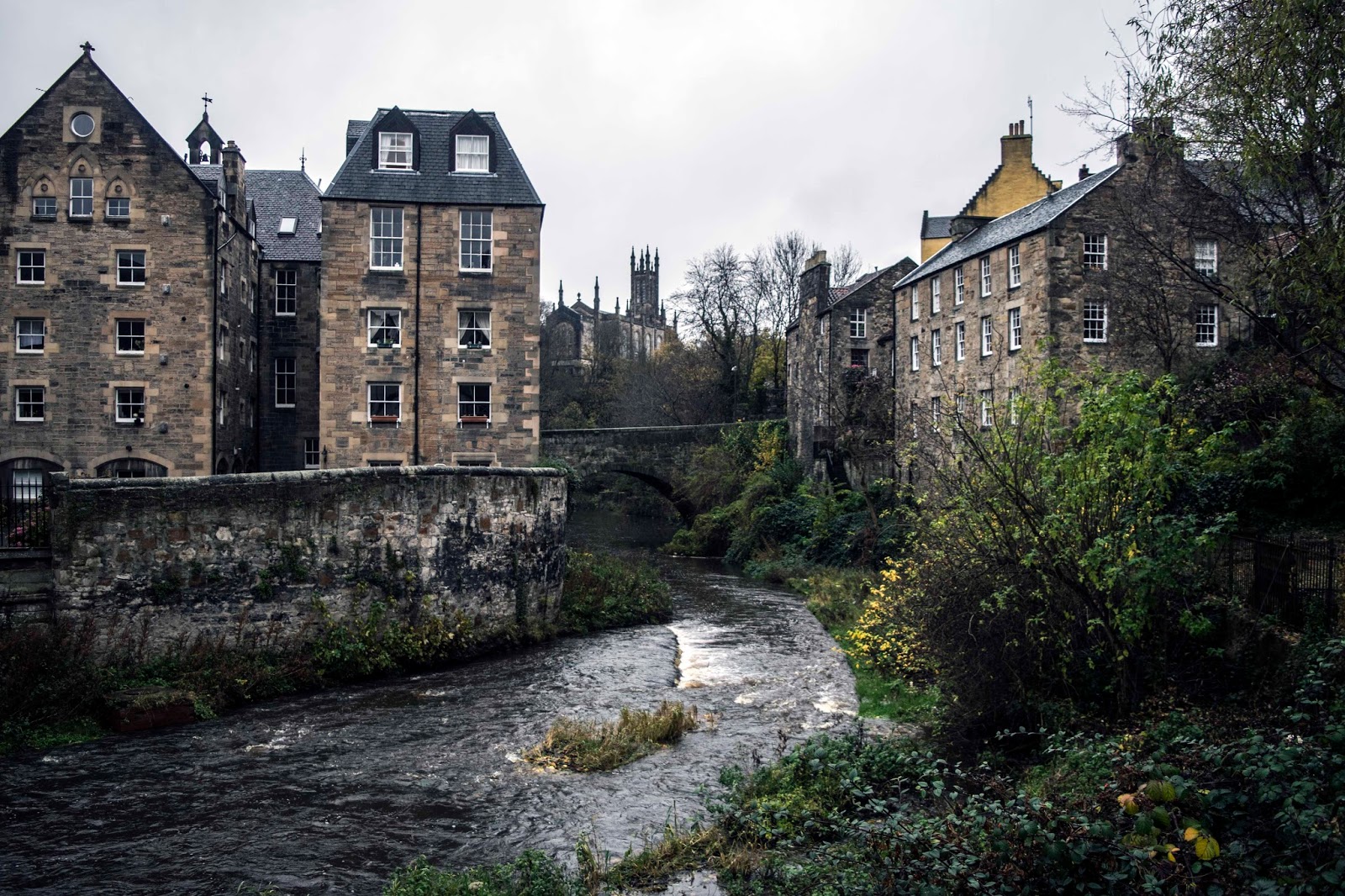
The Water of Leith is the river that rushes tumultously through Edinburgh, with many weirs and waterfalls along the way, skirting north of the New Town on its way to the Firth of Forth at Leith. Passing through the Dean Village, the river is at its most picturesque, adding yet another must-see area to the agenda of anyone visiting Scotland's capital.

The Water of Leith disappears over a waterfall. One thing I'm not too keen on is the mustard-and-custard colour schemes of non stone-faced houses.

Classic MGB GT, echoing this picture from another capital city's riverside...

Dean Bridge; not as spectacularly tall as Sasek had led us to imagine, but with a bus on top.

Dean Bridge, seen from Miller Row. According to Sasek, the bridge is 106ft over the river.

Here's Sasek's take on the views above - a slight exaggeration of vertical scale, though I guess he'd have set up his easel higher up than my camera's eyepoint.

And his view (turned some 30 degrees to the left of my photo below).

Stone tenements, church tower, bridge and rushing waters.

And maybe sweep to the left to bring in that courtyard...

Below: on through the next section of the Water of Leith, where I espy St Bernard's Well. Risking a slip. I edge out over exposed rocks to get this shot from (almost) midstream.

Below: St Bernard's Well, this time from the footpath.

Below: the bridge linking India Place and Dean Terrace; note the solid and ornate construction of the steps from the riverside up to the bridge.

Below: looking west along the Water of Leith from the bridge above. Rain on the cobblestones adds the appeal.

Below: a curious clock tower perched on a building on the north side of the bridge taking Kerr St over the Water of Leith.

 Left: flights of steps, a stone-clad retaining wall, a pillar-box, and umbrellas in the rain. North West Circus Place at the junction of India St.
It rained solidly all day; after walking for the best part of two hours, I was drenched and had to return to my hotel (the eminently reasonable Frederick House Hotel) to dry my outerwear with a hair dryer! I cannot remember having been so wet in many decades!
This time last year:
Poland's north-west frontier
This time two years ago:
Cars must fade from our cities
This time four years ago:
Unnecessary street lighting wastes money
This time five years ago:
Warsaw's heros on the walls
This time six years ago:
Tax dodge or public service?
This time eight years ago:
Warsaw's woodlands in autumn
This time nine years ago:
Still here, the early snow
This time ten years ago:
Another point of view
I have been to Edinburgh eight times over the past ten (blogged) years; the city never fails to appeal to my aesthetic sensibilities; it's certainly a place everyone with an interest in history, culture and architecture should see at least once.
Squeezing in some sightseeing around business trips as I do, however, Edinburgh requires repeat visits to get in all of its main attractions. I've already been to the castle, seen Holyrood Palace and the Scottish Parliament, walked down the Royal Mile, climbed Arthur's Seat and Calton Hill, and explored the New Town. But I haven't yet done the Water of Leith walk, which my childhood memories of Sasek focus on a picture of a spectacularly high, arched brick bridge with double-decker buses on it. This is the Dean Bridge, carrying the Queensferry Road over the Water of Leith.
So with two afternoon meetings ahead of me, I set off on a rainy morning to take in that corner of Edinburgh that I've never yet been to. And seeing it in late November, there were few tourist and only a handful of hardy local dog-walkers and strollers out and about in this weather.
The Water of Leith is the river that rushes tumultously through Edinburgh, with many weirs and waterfalls along the way, skirting north of the New Town on its way to the Firth of Forth at Leith. Passing through the Dean Village, the river is at its most picturesque, adding yet another must-see area to the agenda of anyone visiting Scotland's capital.

The Water of Leith disappears over a waterfall. One thing I'm not too keen on is the mustard-and-custard colour schemes of non stone-faced houses.

Classic MGB GT, echoing this picture from another capital city's riverside...

Dean Bridge; not as spectacularly tall as Sasek had led us to imagine, but with a bus on top.

Dean Bridge, seen from Miller Row. According to Sasek, the bridge is 106ft over the river.

Here's Sasek's take on the views above - a slight exaggeration of vertical scale, though I guess he'd have set up his easel higher up than my camera's eyepoint.

And his view (turned some 30 degrees to the left of my photo below).

Stone tenements, church tower, bridge and rushing waters.
And maybe sweep to the left to bring in that courtyard...

Below: on through the next section of the Water of Leith, where I espy St Bernard's Well. Risking a slip. I edge out over exposed rocks to get this shot from (almost) midstream.

Below: St Bernard's Well, this time from the footpath.

Below: the bridge linking India Place and Dean Terrace; note the solid and ornate construction of the steps from the riverside up to the bridge.

Below: looking west along the Water of Leith from the bridge above. Rain on the cobblestones adds the appeal.

Below: a curious clock tower perched on a building on the north side of the bridge taking Kerr St over the Water of Leith.


It rained solidly all day; after walking for the best part of two hours, I was drenched and had to return to my hotel (the eminently reasonable Frederick House Hotel) to dry my outerwear with a hair dryer! I cannot remember having been so wet in many decades!
This time last year:
Poland's north-west frontier
This time two years ago:
Cars must fade from our cities
This time four years ago:
Unnecessary street lighting wastes money
This time five years ago:
Warsaw's heros on the walls
This time six years ago:
Tax dodge or public service?
This time eight years ago:
Warsaw's woodlands in autumn
This time nine years ago:
Still here, the early snow
This time ten years ago:
Another point of view
Tuesday, 21 November 2017
First snow, first frost of winter 2017/18
Just for the record, nothing really to get excited about. Yesterday, Monday 20 November, it snowed briefly in the morning in Warsaw. I wasn't expecting this, but here was the view outside my bedroom window...
 Childhood memories of Warsaw
But the temperature never fell below zero (it dropped to +1C for about two hours around dawn). By the time I got to the bus stop just after 8am, the snow had turned to rain, the slush on the road surface was dreadful. As was the traffic. My bus journey to Metro Stokłosy which, according to the timetable, should take 21 minutes, actually took 45 minutes - it arrived at my destination 24 minutes late. In town, there was no sign of any snow.
Just for the record, I'd like to point out that the first snow in 2009 was as early as 14 October, while in 2012 on 29 October it snowed copiously and stayed put for a while.
This morning, Tuesday 21 November, the temperature fell below zero for about two hours before dawn, and then promptly shot up to +3C. The short subzero spell was enough to put the thinnest skim of ice onto puddles and to lay down the lightest touch of frost onto the vegetation.
Looking ahead, the temperature is expected (by Meteo.pl) to reach 9C on Thursday and on Friday, so this cold snap is passing very quickly. Long term, it does seem that Warsaw's winters are starting later and are generally milder - although these trends need to be averaged out over the long term.
I'm in Edinburgh for the next few days, here it's mild with a warm westerly wind and the smell of sea air in the city's streets.
This time seven years ago
Childhood memories of Warsaw

But the temperature never fell below zero (it dropped to +1C for about two hours around dawn). By the time I got to the bus stop just after 8am, the snow had turned to rain, the slush on the road surface was dreadful. As was the traffic. My bus journey to Metro Stokłosy which, according to the timetable, should take 21 minutes, actually took 45 minutes - it arrived at my destination 24 minutes late. In town, there was no sign of any snow.
Just for the record, I'd like to point out that the first snow in 2009 was as early as 14 October, while in 2012 on 29 October it snowed copiously and stayed put for a while.
This morning, Tuesday 21 November, the temperature fell below zero for about two hours before dawn, and then promptly shot up to +3C. The short subzero spell was enough to put the thinnest skim of ice onto puddles and to lay down the lightest touch of frost onto the vegetation.
Looking ahead, the temperature is expected (by Meteo.pl) to reach 9C on Thursday and on Friday, so this cold snap is passing very quickly. Long term, it does seem that Warsaw's winters are starting later and are generally milder - although these trends need to be averaged out over the long term.
I'm in Edinburgh for the next few days, here it's mild with a warm westerly wind and the smell of sea air in the city's streets.
This time seven years ago
Childhood memories of Warsaw
Subscribe to:
Posts (Atom)


 Posts
Posts


