Tuesday, 29 July 2014

A return to the Llyn Peninsula

Very limited access to mobile networks and wi-fi, so a brief holding post for the time being - on Saturday I arrived with my son in Penrhos on North Wales' Llyn Peninsula for a week. My brother and his family are staying nearby. More to follow as bandwidth permits. Photos prove good weather (for now at least!)

Below: the road winds on forever - beyond Llithfaen, the hills of the Llyn out on the horizon. It is evening, gone eight pm; the sun is setting over the Irish Sea.


Below: Porth Oer, the whistling sands. Beloved beach on the north coast of the Llyn, the tide retreating. The sea is very cold on the north coast - warmer on the peninsula's south and west-facing beaches, warm enough to swim. But not here, even on a hot day.


Below: the crash of waves, sand between the toes, the ragged, barnacle-covered rocks. At low tide, a second beach becomes accessible, a small sandy cove.


Below: seagulls getting increasingly confident on the presence of humans - a sure sign of breadcrumbs and crisps.


Below: on a training flight, an RAF Lockheed Hercules flies over a yacht race in Cardigan Bay.


Below: looking eastwards across the peninsula, The Rivals to the left, Snowdonia starting to rise on the right.


This time two years ago:
Our flight home delayed by over nine hours

Wednesday, 23 July 2014

Rondo ONZ One at twilight - the City Sublime

Once again - the crushed-velvet dusk in the City of my Dreams... Below: the setting sun from the 24th floor of Rondo ONZ One, looking north east across at the Cosmopolitan building on Twarda 44. Ghostly reflections of Złota 44 (left) and the Warsaw Financial Center (right).


Below: looking due west, along Prosta. Note the Mercedes logo atop the Ilbau building dating back to the early 1990s. It's earmarked for demolition; in its place will grow something higher.


Below: Going down in the lift , looking northwards along al. Jana Pawła II. I love this building - Warsaw's finest contemporary skyscraper. I hope it will soon have rivals - Warsaw Spire, for instance. Decade by decade, Warsaw's skyline rises, blocking out the Palace of Culture by mid-century (I hope).


Below: looking at Rondo ONZ One from ul. Pańska. The 24th floor, from which the top two photos were taken is less than two-thirds of the way to the top.


Below: Emilii Plater, between Złóte Tarasy and W-wa Śródmieście station. It's ten past nine and busy. Looking up the street, on the left we have the Lumen building, the Intercontinental hotel, Warsaw Financial Center and in the distance, the Cosmopolitan building. To the right, the base of the Palace of Culture.


Of a summer's eve, with a clear sky and warm air, Warsaw becomes the City Sublime, so far removed from the same city in late winter with grey snow piled up on the pavements' edges, it might as well be somewhere else. Cherish the summer while you can.

This time last year:
Up that old, familiar mountain

This time two years ago
More from Penrhos

[We'll be back in North Wales before the end of this week!]

Monday, 21 July 2014

The second Summer of Cider

Wow - cider is becoming big news in Poland. Last week in Auchan, looking for the cider among all the beers where it used to be, I saw none. "So much for continuity of supply," I thought before spinning round and seeing that amount of shelf space being used for displaying cider had doubled yet again. "Hello - what's this? It's Weston's Old Rosie! And this - what's this one? Why, it's Henry Weston's 2013 Vintage Oak-Aged Herefordshire Cider. And of course Polish ciders - a novelty only last year - Miłosławski, Cydr Lubelski, Warka Cider, Green Mill, Joker.

Cider - as opposed to apple-juice flavoured beer (YEEUCHH!!!) has caught on in Poland at a pace most fast-moving consumer goods companies daren't imagine. Back in January 2013, the Ministry of Finance reduced the excise duty on ciders below 5% alcohol by volume to something approximating the duty on beer (stronger ciders are still being treated as wine, excise-wise). This gave Poland's fruit wine manufacturers like Ambra and Warwin the opportunity to shift their client base from rural alcoholics to urban hipsters. At around the same time, a change in the law was made to encourage the production of artisan ciders by Polish apple-growers, though limiting production to 10,000 litres of farm-produced cider per year. The new law is so complicated in practice that out of Poland's 60,000 apple growers, only two have taken advantage of the new opportunity.

The main problem is the banderola, or excise band. By law, this has to be glued over the bottle top as proof that excise duty has been paid. A 7.8% beer is exempt from the banderola, a 4.5% cider isn't. ABSURDITY! The small, craft-cider makers have to sell their own cider, duty paid, in huge containers, to bottling plants that can affix the banderola, and then buy back their own product, now bottled and banded, for further sale. And a further absurdity is that while it is perfectly legal to advertise a 5.2% beer on a billboard or on TV, it is illegal to advertise a 4.5% cider. Can a government spokesperson explain WHY?

If the Polish government were to liberalise these foolish regulations, cider-making in Poland could take off. Scores of local craft cider makers would spring up, making (as they do in England), fine single-apple variety ciders, creating local employment and developing new skills and new markets. Poland - the world's second biggest apple exporter, and Europe's biggest apple grower, instead of shipping tanker-loads of apple-juice concentrate to England where it is converted to cider, could be making cider here instead. If only the Ministry of Finance* would treat cider exactly as it treats beer.

Please feel free to turn this into a social media campaign!

So then - Mr Dembo's Cider Sensations for the Summer of 2014...

From Poland - Cydr Ignaców. One of the 10,000-litre limited craft ciders. Splendidly balanced, semi-dry, semi-still, this is rated as the best cider made in Poland, made by enthusiasts in Ignaców, some 15km south-west of Grójec, right in the heart of Poland's apple country. Last year's vintage is available (5% abv) in small, 275ml bottles. One to savour. Already becoming available in the UK.

Next up we have Jabcok Maurera (left). Jabcok (pron. 'YUBtsok') is a slang expression for cheap apple wine; a nice touch of self-deprecating humour on this quality product selling for 13zł. I found this one in an organic restaurant in Służewiec Przemysłowy (on ul. Postępu). This one, like Weston's Old Rosie, is cloudy; naturally-occurring carbon dioxide adds slight fizz. Stronger at 7.7%, a fine cider that captures the taste of rural cider-making in England. Maurer is from southern Małopolska, not too far from juice-maker Tymbark.

Turning to English ciders available in Poland - I must say that Old Rosie (not cheap at 17 złotys for 500cl) is excellent. One of the very best I've ever tried. Other Great British ciders you can find in Poland include Sheppy's Single Variety range (Oakwood, Dabinett and Kingston Black are three I tried; all are excellent and as different from one another as a Merlot is from a Shiraz). The Westons' ciders are imported by Kamron s.c.(www.kamron.pl), the Sheppys' ciders by BRN Services (www.ciderhill.pl).

If none of these are available, I go for Cydr Miłosławski, failing that Warka's Cider and Perry are generally available, as is Cydr Lubelski. Both Warka and Lubelski are extending their brands - Warka has launched 'Double' cider and perry (both 8.5%), while Lubelski has broadened its range of one with a honey-sweetened cider.

If Poland's restrictive regulations and excise duties on cider were to be brought into line with those for beer, Poland has the potential a) to become a big importer of excellent English ciders, and b) learn how to made excellent cider for domestic pleasure plus export to all points north, east and south!

* I learn it's not the Ministry of Finance that's against liberalising cider sales further - it's the Ministry of Health, leaned on heavily by PARPA (the state agency for solving alcoholic problems) that says not one step further in the direction of making any alcoholic drink more accessible or socially acceptable.

This time last year:
North Wales in the sun

This time two years ago:
Back at Penrhos

This time four years ago:
A farewell to Dobra

Sunday, 20 July 2014

Drifting south with the sun - bicycle hobo

I woke yesterday at 03:30, had a big breakfast, packed some supplies into the panniers and set off from home at 04:55 heading south. I chose that direction to benefit from a north-easterly tailwind. The route would be a mixture of tarmac and off-road, the intention to stay close to the Warsaw-Radom railway line. Sunrise was at 04:39, so it was already broad daylight as I set off for Piaseczno along ul. Puławska. Below: outside the house, ready to go. A gorgeous morning, the air full of the scent of a summer dawn, which evaporates quickly as the sun rises.


Within less than two hours I'd passed Piaseczno and Czachówek, so far almost all of the journey along asphalt. Below: the Radomiak semi-fast train to Warsaw, approaches Czachówek. Above it, an Airbus A320 turns in for its final approach to Okęcie airport.


At Sułkowice, the next station south of Czachówek, I popped by for a baguette to go with my excellent selection of smoked meats, and a newspaper. The small village shop was crowded though it was not yet seven am. Lots of building workers in overalls; in the car park were several pickup trucks with crew cabs. On the platform of Sułkowice station there were about 15 people waiting for the train to Warsaw. Things looked busy - there was still evidence of old rural Poland - under an apple tree across the road from the shop, Pan Heniek, Pan Ziutek and a friend who looked decidedly worse for wear were enjoying a round of early-morning refreshments and commenting on local events using a loud stream of expletives. Other than this trio of lay-abouts, everyone else at Sułkowice looked purposeful and getting down to business.

South of Sułkowice, I cross the DK50, Warsaw's de facto southern bypass, and once clear of the noise of the trucks heading east-west, I find a field in which I can have a second breakfast (ham baguette, plums, dark chocolate, lots of water). I'm surrounded by apple orchards and I watch two hares gambolling about on a neighbouring field.

[LITTLE DID I KNOW THAT IN JUST THREE YEARS AND THREE MONTHS FROM THIS DAY, I'D BUY MYSELF A DZIAŁKA WITHIN A SHORT WALK OF THIS VERY POINT.]

On, on past Chynów. Time to go off-road. I'm zig-zagging - taking a path, crossing the railway track, straying too far from it, turning back towards it, crossing it, etc. I bypass Krężeł, Janów and Michałczew. Every now and then, the track is nicely asphalted, with a sign acknowledging EU funds and the province of Mazowsze as having contributed to the road's improvement. After a few hundred metres, however, the asphalt runs out; a road-sign warns that all good things must come to an end. Beyond the asphalt lie dirt 'roads' of varying quality; some stretches are fine on a mountain bike with fat tyres and deep tread, but other stretches yield up to soft sand - the cyclist's worst nightmare. The bike slows to a halt. You put your foot down; it sinks into the sand up the ankle. You dismount, and push the bike laden with panniers as you would over a dry, sandy beach. At walking pace, the insects, which do not bother you at 15km h, become an annoyance. I must have walked a good few kilometres in total between the more solid stretches.

Below: one of the better stretches of dirt-track. The sand has been compacted down by cars. In the distance comes a car, trailing a cloud of fine dust behind it. But the scenery and weather compensates for the sand. I am reminded of my early childhood 'memory' of how I expected the countryside to be, living among the sprawling brick suburbia that stretched out westward for mile after miles from Hanwell, West London.


Beyond Gośniewice, I turn onto the main road for Warka, still quite quiet at this time on a Saturday morning. I make up the pace, and soon I'm passing through the town, by now quite busy. I turn onto the bridge crossing the Pilica river (below). There's a separate footpath for pedestrians and cyclists, so I can stop to take a photo. Click to enlarge - on the right-hand side of the horizon you can see one of the arches of the railway bridge crossing the Pilica. The morning remains gorgeous.


South of Warka runs the road to Kozienice. It's narrow, heavily trafficked. I feel vulnerable as a cyclist; many drivers going way too fast. I continue along the main road to Grabów nad Pilicą, then turn right towards the railway again, mercifully few cars now pass me. By now, I'm reaching the end of my fourth hour of riding, so time for more ham baguette, water and chocolate.

Left: an idyllic spot for a break. Only one komar (midge/gnat) to bother me otherwise all is good. Time to discuss the pros and cons of using a smartphone on a journey. I'm getting increasingly aware that it's a good idea to be carrying on you as little as possible. Rather than a rucksack - panniers. In here go tools, spare tyre tube, waterproofs, food, water, sun-cream, kitchen paper - everything. Not wishing to carry a half-kilo camera around my neck, I settle for my Samsung Galaxy S3 instead. It has a built-in 8 megapixel camera (my old Nikon D40 has 6 megapixels). However, it's difficult to see the screen when composing in strong sunlight. The bridge photo was taken by guesswork - I couldn't see anything on the screen with the sun directly behind me. But as you can see, the photos taken are entirely acceptable.

The other big problem with the smartphone is battery life. Fully charged at 5am, there was less than 12% charge left at midday. Because mobile telephony coverage is patchy out here in southern Mazowsze, the phone is using power to hunt for signals. Taking photos (I took over 30) also drains power, as does using the Google map facility (extremely useful when there's a mobile signal). Plus, I'm using Strava to record my ride - a very informative app, though not as user-friendly as it could be.

I reach Dobieszyn just before noon, having cycled 83.9km in seven hours, including two rests of around half an hour each. At half past twelve, a Warsaw-bound train takes me back to Jeziorki.

The line back to Warsaw is single-track most of the way up to Warka, doubling at stations. Looking at the map tracing my journey on Strava, I count that I've crossed this line (by bridge or level crossing) no fewer than 15 times.

The journey home costs me 11zł 57 gr. The ticket, bought at a splendid new ticket machine, informs me that the direct rail route is 56km. That's £2.20 for a 34-mile journey. By comparison, the cheapest ticket for a single ticket from Ealing Broadway to Tilehurst, a distance of 33 miles, will cost you £15.40. That's exactly seven times more expensive. Yet average salaries in Poland are only three times lower than in the UK. So are British trains more than twice as good?

The journey from suburban Ealing to Tilehurst, beyond Reading, takes 56 minutes, with the train stopping at 13 intermediary stations along the way. The journey from suburban Jeziorki to Dobieszyn, takes 1hr 17 mins, with the train stopping at 14 intermediary stations. Not bad, considering the appalling condition of the track infrastructure on the Warsaw to Radom line.

[UPDATE 2022:  post-modernisation of the line, the journey from W-wa Jeziorki to Dobieszyn now takes a mere 51 minutes - one-third of the old journey time shaved off!]

This time two years ago:
Royal Parks in the rain

This time three years ago:
Storm clouds over Warsaw, Dolinka under water

This time two years ago:
Round-up of pics from Dobra

This time three years ago:
Conservatism - UK or Polish style?

This time four years ago:
Wheat and development

This time five years ago:
A previous visit to London


Thursday, 17 July 2014

A tragedy foretold

Minutes after receiving a newsflash on my smartphone that a Malaysian airline flying from Amsterdam to Kuala Lumpur had been shot down over eastern Ukraine, I checked FlightRadar24.com. The area was now being given a wide berth by planes flying east-west...

Below: Malaysian Airbus A380 flight MH3 flying from London to Kuala Lumpur diverts south, presumably alerted as to the fate of flight MH17.


Below: Thai Airways flight TG916 from Bangkok to London Heathrow swings south of Mariupol before reverting to a western course once clear of the danger zone


What the world should be asking is why the civil aviation authorities did not take urgent steps on Monday night, after the shooting down of the Ukrainian transport plane, to divert passenger flights crossing east-west over this troubled part of the world.

Utterly dreadful and needless loss of human life; unspeakable pain in the hearts of the victims' loved ones.

And who fired the ground-to-air missile - and whether it was intended as a provocation.

Looks like FlightRadar24.com's server's can no longer cope with traffic.


Tuesday, 15 July 2014

High over eastern Ukraine

Yesterday's news that long-range anti-aircraft rockets, apparently fired from Russia, downed a Ukrainian transport plane flying at 21,000ft, is worrying. Today, a Ukrainian jet bombed alleged 'separatists' in Snizhne, near Donetsk. Take a look at eastern Ukraine on FlightRadar24.com, and you'll see a procession of civilian aircraft flying along an air corridor between Luhansk, Donetsk, Horlivka, Kramatorsk - places where battles are raging and people are being killed. Yet blithely oblivious to what's happening on the ground, some of the world's largest civilian airliners are criss-crossing the area at 38,000ft.

Below: a Pakistan International Airlines Airbus A330, followed by a Singapore Airlines Airbus A380, flying over the battlefields below. Other planes from India, Malaysia, Qatar, Austria, Germany are also overflying this area (click to enlarge). Son Eddie reminds me of the shooting down of Iran Air Flight 655 by a guided missile from the USS Vincennes over the Persian Gulf in 1988 resulting in the death of 290 people.


Below: let's take a closer look at the flight path of that A380... I don't think flying over a warzone in a passenger jet with several hundred people on board is a good idea. Incidentally, Russian airlines flying to Simferopol in Russian-occupied Crimea, as well as other Black Sea airports to the east, are skirting around eastern Ukrainian today - something they weren't doing yesterday. Before the shoot-down of the transport plane, they'd fly directly over Ukraine, the shortest air route from the Black Sea to Moscow and St Petersburg. Today, they are avoiding Ukrainian airspace east of Dnepropetrovsk and Kharkiv.


Shouldn't there be a no-fly zone for civilian passenger jets? Ukraine has maintained a ground exclusion zone around Chernobyl since independence - should it not, for the sake of the safety of tens of thousands of passengers flying overhead each day, close off the airspace around the conflict zone?

A look at eastern Ukraine and southern Russia shows other interesting things. Plenty of Russian airliners flying holidaymakers to the sun. Russian carrier Transaero, for example, is flying Boeing 747s to resorts like Antalaya or Paphos, each carrying 400+ passengers. The scale of this movement suggests that Russia's new middle class is taking to the air in huge numbers to enjoy itself - spending its money on the Med. These well-off, liberal, cosmopolitan people, meshed into the global economy, are the the counter-balance to the nationalists baying for Putin to invade 'Novorossiya'.

The airline industry is global; to be a member, you need to follow its established rules, which are principally related to safety. (As I pointed out the other day, air travel is 50 times safer than driving, twice as safe as going by train.) And looking at Russia on FlightRadar24.com, I see hardly any aircraft built in Russia or indeed the USSR. Maybe the old kit isn't equipped with modern transponders and thus doesn't show up on FlightRadar24.com. I spotted the occasional Tupolev, Antonov, Yakovlev or Ilyushin - but even over Russia, these are rarities.

To stay solvent in a competitive world, Russian airlines need to fly planes that their customers will not feel uneasy about - and that narrows the choice down to Airbus or Boeing. In a world such as this, there's little room for economic nationalism. Good. If there were ever to be an economic embargo on Russia, these planes would soon be grounded for lack of spare parts.

Below: apropos of Tupolevs, I caught this one over my house this morning, flying the Slovakian president to Warsaw. Now a very rare sight over Jeziorki.


Below: noisy and dirty, the TU-154 (first flight 1968) is a relic of a passing age where environmental standards were last in a list of the design bureau's considerations.


I wonder whether I'll see one again... In the meanwhile, (and totally off-topic) here's an even older design, a Fokker 50 (OO-VLS, City of Antwerp), essentially a modernised Fokker Friendship, which first took to the skies in 1955. Now that Air Baltic has stopped using these, it's another rare visitor to Okęcie. I caught it over my house yesterday evening from my bedroom window.


Incidentally, today 21 Muscovites were killed in an accident on the Moscow Metro. It will be interesting to see what the cause of the accident was - officially a 'power surge'.

This time last year:
From shouted slogans to practical policy

This time two years ago:
Who should pay for railways?
[A good question to ask any would-be politician]

This time four years ago:
Grunwald - the big picture

This time five years ago:
"Take me right back to the track, Jack"

This time seven years ago:
The summer sublime

Monday, 14 July 2014

How the other half lives

Taking my bike home by train yesterday, I travelled from Pilawa to W-wa Wschodnia and then changed for the Radom train, which would take me back to W-wa Jeziorki. Tired, hungry and thirsty after a 66km ride, I was looking forward to an uneventful journey through Warsaw and out to its southern suburbs. It was not to be.

For some reason, the rear compartment (now designated for cyclists) of the Radom train attracts a specific clientele. Sunday evening was no exception. Despite the no smoking and no drinking alcohol signs, the compartment fills up with men insisting they do both. A guy joins me in the empty compartment at W-wa Śródmieście, sitting on the bench next to me (the compartment has room for ten or so bikes but has seating for two).

He immediately cracks open a tin of Żubr beer and engages in unbidden conversation with me about the weather. Every other word is an expletive. It then transpires that he's heading back to Radom where he lives with his mother, a stroke victim in her seventies. On Wednesday she sent him out to buy (expletive) raspberries and he got his (expletive) shoes (expletive) wet (expletive) in the (expletive) rain. On Thursday, she sent him out to buy (expletive) plums. Again he got his (expletive) shoes (expletive) wet. Same thing happened on Friday. By Saturday all his (expletive) shoes were (expletive) soaked through.

His life is a catalogue of woe. Why does he live in Radom? Because he lives with his mother, who he has to look after. She's doubly incontinent. Why does he work in Warsaw? Because he can find work on building sites that pay cash in hand without too much effort. There's no work in Radom. To get to Warsaw, he has to take the train, which takes over two and half hours. And he has to get to the station, which takes another 40 minutes.

He wakes up at 4am to get to work in Warsaw for 8am, works till four or five in the evening, gets home after eight, well hammered on the train after consuming several tins of beer, to clean up after his mother who's dirtied the floor again after eating apples.

His mother gets no help from social services because he's meant to be her carer (which suggests he's paid by the state and instead of doing that, he's off in Warsaw working in the grey economy). Father probably dead, wife probably left him because of his drinking.

This guy, in his late-thirties or early-forties is trapped in a spiral of misfortune from which there is no way out. Other passengers join the compartment, at W-wa Służewiec and at W-wa Okęcie, also heading to Radom, also ready to crack open a beer and light up. One other cyclist gets on, clearly none too thrilled by his fellow travellers. Who launch into a diatribe about why there's nothing wrong with having two beers and getting into a car and driving. "Only in Poland," they opine, "does the police stop anyone who's even had one beer, and treat them like criminals." Nothing wrong with driving fast either. One can only guess in what technical state these guys cars are in.

The journey was to become much worse as the electric overhead power cable on the 'up' line had just come down between W-wa Dawidy and W-wa Jeziorki. Our train stood in a field, the S79 expressway to the right, rows of coal wagons at Okęcie sidings to the left. No means of getting out and cycling home. The train stood there for 50 minutes while two railway policemen (SOKists) set off on foot to investigate (below). Three town-bound 'up' trains were diverted onto the 'down' line while we waited.

The guard moved through the train explaining the situation after about ten minutes. He said there'd be a ten minute wait. But at least with him in the rear compartment, the beer-swilling and smoking ceased and the language moderated (the respect these Radomites have for authority surprised me). And we were kept informed up to the minute as to what was going on. Out in the distance, I could see a yellow power-line repair train inching forward, and the lights of oncoming 'up' trains changing tracks to avoid the damaged section.

I arrived home just before nine pm, grateful for just about everything. I reflected once again on the huge civilisational gulf between Warsaw and other major Polish cities and the rest of the country. Radom is a particular sad place. The town itself (pop. 220,000 - bigger than Newcastle-upon-Tyne or Portsmouth) suffers from unemployment of 21.7%, while the surrounding district's jobless rate is 28.8%. Warsaw's, by comparison, is a mere 4.6%. [Source: GUS, May 2014.]

While EU membership has done a lot to improve the lot of farmers working on the land in Poland's villages (CAP subsidies in particular), there is still glaring inequality between big cities and the second league cities, where joblessness continues to be a stubborn blight. Because Radom's in the same province (voivodship) as Warsaw (Mazowsze), it's not eligible for the extra EU money targeting the so-called 'eastern wall' provinces and their cities, Białystok, Lublin, Kielce and Rzeszów. I've advocated for ages separating Warsaw off from the much poorer rest of Mazowsze and targeting with the sort of measures that stimulate local enterprise.

This time last year:
On guard against complacency

This time two years ago:
Ready but not open - footbridge over Puławska

This time three years ago:
Dusk along the Vistula

This time four years ago:
Mediterranean Kraków

This time five years ago:
Around Wisełka, Most Łazienkowski, Wilanowska by night

This time six years ago:
Summer storms

This time seven years ago:
Golden time of day

Sunday, 13 July 2014

Let us get across our river!

From Most Siekierkowski down to Góra Kalwaria, there's nowhere to cross the river. These days, when Poles are getting more mobile, more active than ever, this is a getting to be a problem. Today, I intended to cycle to Pilawa, south-east of Warsaw, which I did, though crossing the Vistula was not easy. I crossed the Las Kabacki, cycled through Okrzeszyn City (każdy obcy będzie bity)* to reach the river at Obory. Hundreds of cyclists tearing up the asphalt around here.


An article I'd recently read in the local press suggested that at Gassy there'd be a ferry that's now taking pedestrians and cyclists across the river to Karczew. No such luck. I got down to the riverbank to find a lot of people puzzling over why there's no ferry. Apparently, I hear it's because of the ekolodzy, (ecologists) who are blocking the permission to open the service. From here, it's 25km to the other side by road. And it's not a safe road, either.  Below: a sign warns drivers of a Thelma and Louise moment that might befall them in 150m time.


Onward then. From Gassy to Góra Kalwaria, the best part of the trip. The Wał of Silence. No one around but me and the occasional cyclist or pedestrian. No bloody quad riders to spoil the quiet.


Approaching Góra Kalwaria, there's the railway bridge. One or two freight trains an hour at most. Can you get your bike across? Can you stroll across? Not unless you want the SOK (railway police) to slap you with a 50zł mandat for making an unauthorised crossing. Again, lots of cyclists around, below.


Onwards. Beyond Góra Kalwaria (after a kebab and beer), I decide to look for an alternative to the road bridge taking the DK50 across the Vistula. Is there a ferry downstream? Same story as at Gassy. Huge crowds on both banks expecting a boat to take them across. Nothing doing.


So I back-track to the bridge, looking for a route that avoids the dangerous ramp leading up to it. There is none. I'm forced - as anyone on foot or on bike wanting to cross the river - to share a narrow road with international trucks and speed-limit breaking drivers. This is dangerous. Finally, I get to the bridge, where there is a separate bike and footpath. But it's too narrow and too short. Below: the view looking south from the Góra Kalwaria bridge. You can see the two piers that the ferry should be serving in the middle foreground.


At the other end, cyclists and pedestrians are forced to dash across both carriageways to make it to the stairs down from the bridge to the safety of the embankment (when the quads are not howling along it).


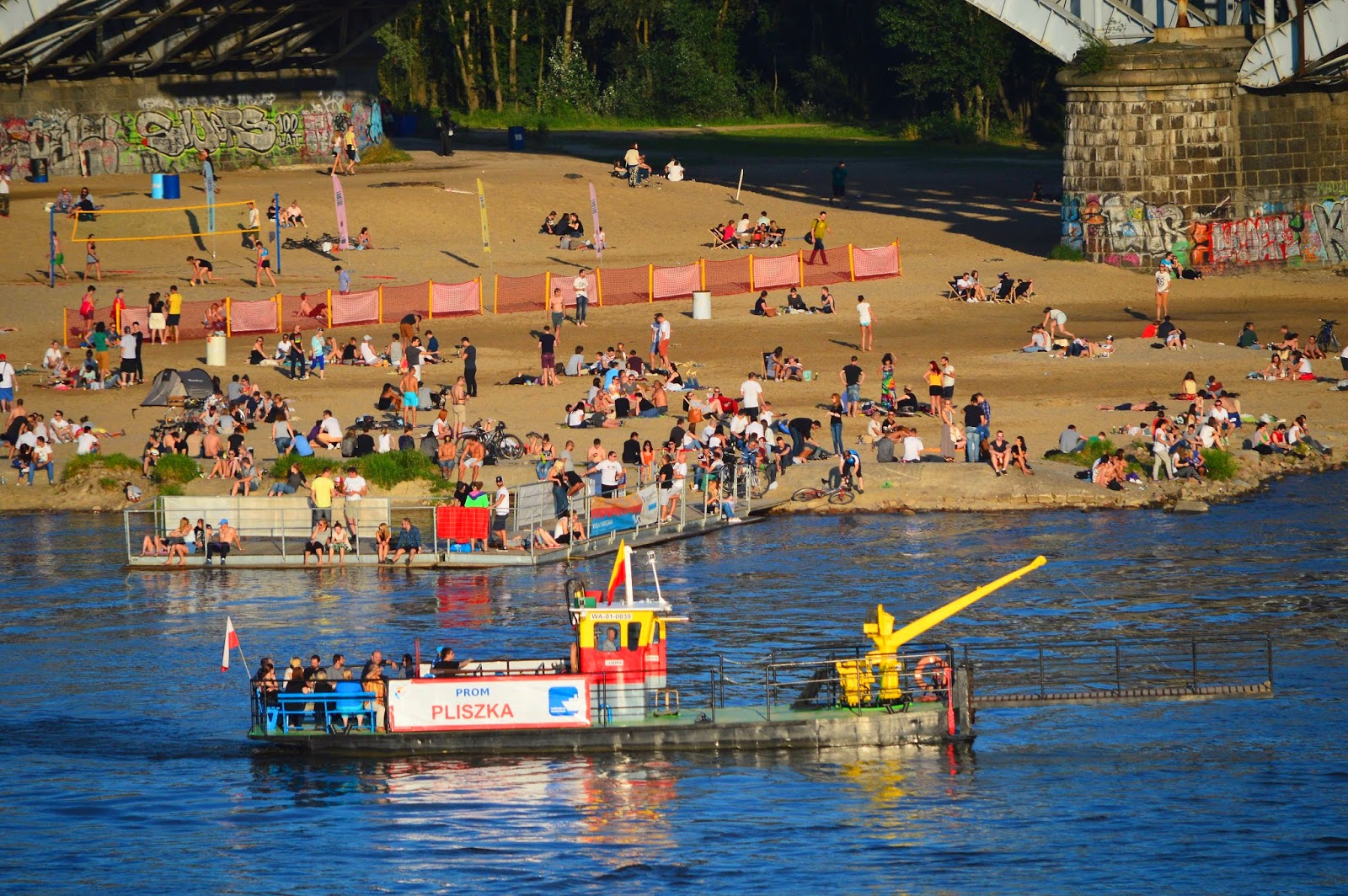
Whoever is responsible for this bridge - it falls a long way short of the safety standards considered the norm in western Europe. If the bridge can't be re-engineered for pedestrians and cyclists - then open the railway bridge for foot traffic and bikes. Or allow ferries to take pedestrians and cyclists from one bank to the other. Like they do in Warsaw. Below: the ferry in Warsaw serving the beaches. Something like this is needed at Gassy and at Góra Kalwaria too. Chewing out a rhythm on my bubble gum/The sun is out and I want some/It's not hard not hard to reach/We can hitch a ride to Rockaway Beach.


Poland's local authorities (outside of its major cities) need to sharpen up their act when it comes to the demands of a fast-changing society and deliver social amenities at low cost. The value to local communities of letting hundreds of cyclists and walkers cross the river using ferries and (safely segregated) rail bridges would be hugely beneficial for communities on both sides of our river.

Sorry - can't get over the Ramones - since hearing of Tommy's untimely demise, it's been full-volume Ramones all weekend. Below: updated lyrics of Commando, from Ramones Leave Home.
They do their best
They do what they can
They get them ready for Vietnam
From old Hanoi to East Ukraine
Commando - involved again
First rule is - the laws of Germany
Second rule is - be nice to mommy
Third rule is - don't talk to commies
Fourth rule is - eat Kosher salami
Those commentators who question the Ramones' talent should listen to the chord progression in this song - complex yet simple, melodic, catchy, heavy, fast - and those lyrics - as true today as at the height of the Cold War.

* Każdy obcy będzie bity = 'Every stranger will be beaten"

This time last year:
S2 update (nearly ready, as it happened)

This time two years ago:

Progress on S2 bypass - photos from the air

This time four years ago:
Up Śnieżnica

This time seven years ago:
July continues glum (2007 - a rainy summer)