Monday, 16 January 2023

The King's Horse - a short story (Pt. I)

It was a fine day in early March when the King, accompanied by a small retinue, rode forth for a morning canter. Mounted upon his favourite thoroughbred, he was keen to survey his arable lands as spring gathered force. They rode into the sun, still low in the sky; neither horse nor rider noticed the molehill - the horse's left foreleg sank deep into the soft soil, toppling the horse and throwing the rider. The King lay on the ground, his peruke and tricorn hat in a muddy puddle. Unhurt but furious, he stood up, straightened his sword belt and covered his bald pate. His first reaction was to kick the horse's head. He stopped himself, attempting to douse his fury and regain his dignity. Then he looked around at the expressions of his riding companions for any trace of a smirk.

They knew better, however, and each man managed to display a passable degree of shock - sympathy indeed - upon his visage. The King's face and clothes muddy, unable to muster a dignified pose for the occasion, he called to his Equerry. "How is my horse?"

The Equerry dismounted and ran over to the fallen animal. "I'm afraid, your Majesty," he said after the briefest of examinations, "that the leg is broken. The bone shows through." 

The horse was in agony. 

It had always been conscious of the fact that it was a special horse, a chosen horse; for the human that rode it was higher in the hierarchy than any other human. This was something the horse had intuited from all the interactions observed between the humans at the stables where it lived. And then a sudden reflection - in situations such as this which the horse had witnessed in the past, whether on a battlefield or on a hunt, when another equine fell, the unfortunate beast was more usually than not put down; a firearm put to its head - an explosion - smoke - after which the fallen horse was silent and still. Dead. Would this fate meet it too? 

Or was it too important?

A discussion between the King and the Equerry. Some waving of hands. Emotions. Some shouting. Then calm. Resolution. The King  spoke to an officer; an order was given, a man dismounted. The King took his place, and galloped back towards his palace, followed by several of his men. The Equerry remained by the animal, feeling its fetlock and shin, assessing the injury. The human's calm demeanour reassured the horse. They were not far from the palace, the ride had only begun. It would be a long and painful return, however, limping back to the stables, but the King's favourite horse managed to return home, the Equerry at his side all the way.

The King gave an order to his Bailiff: "Your men are to dig up yonder field to the depth of two feet, starting from every molehill. You are to catch as many moles as you can, and then hang them alive by their hind paws from a string tied between two poles, to be pecked to death by the kestrels." As he did so, the King could feel a sharp pain in the base of his spine that would trouble him for the rest of the day and into the night. His sleep was poor, despite a copious amount of wine with his dinner, a dispensation the King gave himself that Lenten evening.

In the stables, the horse was confined to its stall, its left foreleg bound tight with wooden splints. The Farrier had done an excellent job, doing all he could to ensure that the King's horse would be comfortable despite its injury. Throughout the process, the horse felt secure; it knew the humans tending to its injuries were caring and responsible people. It felt the pain would go away in time, that the leg would mend, but also it sensed that it would never return to galloping with the King. Life would not return to how it was.

The following day, the King decided not to go for a ride, but to walk instead. He called for his Confessor and Equerry to accompany him. The route took them to a hill from which they could look down over the field in which the previous day's accident had occurred. Gazing across, the King was pleased to see a group of labourers with spades digging the field over.

As they walked, they conversed. The day was overcast and colder; spring felt further away. The King enjoyed discussions with his Confessor, a man he could trust with his deepest secrets and whose advice was more than simply telling him what he thought he wished to hear. The Confessor was well read in philosophy, history and alchemy, and spoke in a way that forced to the King to reason more clearly.

"Tell me," said the Confessor, "How did your horse come to exist?" 

"It was born of its dam and its sire," replied the King. 

"And who chose the dam; who chose the sire, your Majesty?" 

"I was guided in my choice by my Equerry - perhaps, if my memory fails me not - by my Equerry's father, when he served in that role." 

"Yes, indeed, shortly before my father's passing, just before I stepped into his shoes," agreed the Equerry.

"So - without the stallion and mare being brought together through your father, and of course the King, this animal would not have come into this world?" The Equerry nodded. 

The King pondered too - knowing his Confessor, he knew that this line of thinking would be leading somewhere.

[Part II here]

This time last year:
Hoofing it
(Not horses - Nordic walking!)

This time four years ago:
Signals from space - what's the meaning of 187.5?

This time five years ago:
Ice - proceed with utmost care

This time six years ago: 
In which I see a wild boar crossing the frozen ponds

This time seven years ago:
Communicating the government's case in English

This time nine years ago:
Thinking big, American style. Can Poles do it?

This time ten years ago:
Inequality in an age of economic slowdown 

This time 11 years ago:
The Palace of Culture: Tear it down?

This time 13 years ago:
Conquering Warsaw's highest snow mounds

This time 14 years ago:
Flashback on way to Zielona Góra

This time 15 years ago:
Ursynów, winter, before sunrise 

Sunday, 15 January 2023

Mid-Jan town-and-country pictorial catch-up

Below: I love this photo - it's showing that Poland works. We see a new train arriving at a modernised station - on time. Sułkowice, 14 January; the 15:41 service for Radom Główny is here to take me one stop down the line to Chynów after buying ingredients for cooking a large barszcz ukraiński. Fare was 2.73zł with my 30% over-60s discount. However, it's 3.90zł full price, or 74p, for the 2.8km journey. Meanwhile in England, a ticket from West Ealing to Ealing Broadway is £2.90 for a 1.3km journey, nearly eight times more expensive per km. And average wages in Poland are slightly more than half of what they are in the UK.

"A city clerk turned countryman again,
And linked to town by fast electric train"


Below: Warsaw skyline just after sunset from the new footbridge at Warsaw West (W-wa Zachodnia) station. Most of the skyscrapers you see here were built in the last 15 years. A few more will pop up - then a pause, while we figure out where we would want to work from. The station is finally catching up, although the modernisation work will be entering its third year, and much still to be done.


Below: looking west along Aleje Jerozolimskie towards W-wa Zachodnia. A stream of motorists contribute to climate change. Offices to the right, apartment blocks to the left. A brief window during which there are few clouds in the sky.


Below: Plac Zawiszy looking along ulica Grójecka. The Sobieski hotel is to the left.


Below: back in the country - walking through the forest one day last week, I could hear an incessant tapping in the trees above me and knew it must be a woodpecker - indeed it was!


Below: a drainage ditch winds through the forest between Dąbrowa Duża and Dobiecin. Just round the corner from here, I'm walking along a fire-break and two adult female deer run across my path, about 50m away. Shy, elusive, elegant beings - hunting them should be banned.


Below: the path that leads past the small settlement of Kozłów, situated in a clearing surrounded by forest. Which, I am sad to report, the villagers seem to be using as a rubbish tip.


Below: back on track - the road from Chynów station to my działka (turn right at the bottom). Note the white rectangle at the base of the telecoms mast - that's a distant office block. Can't work out whether it's in Piaseczno or further away in Warsaw.


The weather has been dull and overcast with occasional rain. As I write, Sunday 15 January at three pm, it's 6.1C outside. "Rain off and on," says my laptop.  First half of January and not so much as a snowflake, and no frost. Another two-and-half to three months to go before spring bursts on the scene.

It's now half past five and it's now 6.7C outside. Meanwhile, this time last year, it was peak winter...

This time last year:
Winter at its zenith

This time three years ago:
Signals from space

Saturday, 14 January 2023

For my brother, on the occasion of his 60th birthday

Thank you Marek!

Sixty years old today! My brother Marek has been an inspiration to me throughout my adult life and has helped me develop my thinking significantly. Here are just a few of the ideas that he introduced me to over the past 40 years – ideas that have profoundly helped shape my worldview. An idea that resonates when you first hear of it, an idea that sticks in your mind - you expand upon; subsequent experience and subsequent reading proves it to be resilient, the idea goes on to form the foundations of your personal philosophy as it grows.


So - here's the list; regular readers of this blog will recognise many of the themes.

Thinking at the meta-level: this really helped me when I was struggling a bit with life in my mid-20s; strive to get out of a rut by constantly thinking one step above, then above than, then above that.

Altered states of consciousness: whether brought about by drink or drifting in and out of sleep of a morning, the notion of consciously altering the way your mind works was new to me.

Artificial Intelligence: Marek did his postgrad studies in this back in the 1980s! He was the first person to explain to me how expert systems would work, before the AI winter...

Zen Buddhism: Eastern mysticism in all its diverse richness, including tales of the Lung gom pah

Jewish mysticism – the Kabbalah, the esoteric wisdom hidden in plain sight

Complexity and chaos theory - mathematics at the root of it all

Fractals and Mandelbrot sets - repeating patterns scaling up and down into infinity

Deferred gratification - the joys of putting off to tomorrow that which could gratify instantly

Learned dependence - in society, a way of life in where a social group learns to depend on the landowner, the , the employer, the Welfare State...

Emergence - in cosmology, physics giving rise to chemistry, giving rise to biology, evolving into ever more complex forms

The Cambrian Explosion - weird and wonderful fossils found in the Burgess Shales as animal life first emerged from more primitive organisms in a very short time

Dyson spheres and Von Neumann machines, the Oort cloud and other fascinating astronomical concepts

Bayesian inference and cognitive bias in general - bad ways of thinking (and how to avoid them by thinking more critically - and indeed thinking at the meta-level).

The Hierarchy vs the Network - the old way and the new way to run society. Connected bottom-up power replacing top-down rule. No one hierarch dominating (it usually ends up a disaster - see Putin's Russia for example).

Distinguishing ‘train of thought’ from ‘stream of consciousness’

The moral dimension of cosmology – the place of good and evil in the Universe

Agency and free will - are we only doing that which we have been programmed to do?

Demand-avoidance syndrome - some people don't like to be asked to do something - and therefore don't like asking others to do something for them.

Gut flora and the virome - we are the sum product of ourselves plus all the bacteria and viruses that dwell within us and on us.

The primacy of the subjective conscious experience - probably the most important single idea that clarified and shaped my entire way of thinking

Being obsessively tidy in one small corner of one’s life, the remainder of it being a mess - recognise any relative you know?

Consciousness as being either granular/discrete units or a seamless continuum. The big question for those who consider consciousness to be universal, rather than just a epiphenomenon of emergence.

These ideas feel like they have been inspired from a higher plane, destined for me.

Selected reading list (of books that Marek has bought me):

Stuart Kaufman’s Humanity in a Creative Universe

David Eagleman's Sum: Forty Tales from the Afterlife

Fritjof Capra’s The Tao of Physics

Robert Pirsig’s Zen and the Art of Motorcycle Maintenance 

Daniel P. Bagge’s Unmasking Maskirovka

James Joyce's Finnegans Wake

Plus:

The paintings of Eric Ravilious

The box art of 'Revell’s Rembrandt', Jack Leynnman

The music of the Thirteenth Floor Elevators, in particular, Slip Into This House from Easter Everywhere, and early American psychedelic music in general.


In my quest for understanding, I seek neither a leader nor followers, but someone that walks alongside me and discusses ideas and helps me develop them - that person is my brother.

Marek - for this wealth of ideas and concepts, I am truly grateful. But above all, you are an inspiration to me - what it means to be a human being.

This time last year:
Walking on (thick) ice
[Five consecutive nights of frost. This year? It's +7.8C outside tonight]

This time three years ago:
Kraków in winter

This time five years ago:
Jeziorki mid-January catch-up

This time six years ago:
On ice

This time seven years ago:
Tweeting and blogging

This time nine years ago:
The sad truth about the pavement for Karczunkowska
[Update - it's due in 2026.]

This time ten years ago:
Happy 50th birthday Marek!

This time 13 years ago:
A haul of wintery wonderfulness

This time 14 years ago:
Optimal way to work?

This time 15 years ago:
Highest point in Jeziorki 
(photos of the Rampa before demolition)

Monday, 9 January 2023

Welcome to the Age of AI

Artificial intelligence (AI) is here. Of course, it's been here a long time, but the launch in November of Chat GPT by Open AI, a software firm, has brought that message home with a WOW.

For me, playing with Chat GPT (note use of verb 'playing') reminded me of my first hours with an online search engine (AltaVista back in the mid 1990s) or discovering Wikipedia or Google Earth in the early 2000s or Google Map Street View in 2012 - I could see that these technologies would be life-changing. Today I think nothing of buying train tickets on my phone, using the map in the phone to navigate me from station to hotel, which was booked online. E-commerce is commonplace. Chatbots are replacing surly customer-service staff, machine translation has all but replaced humans in all but the most specialist areas. But AI has the potential to do far, far more - I hope this post will demonstrate how, and why.

Chat GPT is search taken a huge leap forward. Rather than typing in a question and being given many links to many pages, here you just type in your question and you get a concrete, detailed reply. Instantly. To demonstrate, I'll perform a live Q&A session here, an interactive dialogue between me and Chat GPT to show off its potential:

[Me:] How will Chat GPT and AI change the way we work:

[Chat GPT:] Artificial intelligence, including Chat GPT, has the potential to change the way we work in a number of ways. Some of the ways AI could change the way we work include:

  • Automation of repetitive tasks: AI can be used to automate repetitive tasks, such as data entry or customer service, which would free up employees to focus on more high-value work.

  • Improved decision making: AI can be used to analyze large amounts of data and provide insights that can help inform decision-making. This can lead to better, more data-driven decision-making across a wide range of industries.

  • Increased efficiency: AI can be used to optimize and streamline business processes, which can lead to increased efficiency and cost savings.

  • Better customer service: AI-powered chatbots and virtual assistants can provide 24/7 customer service, which can help improve customer satisfaction and increase sales.

  • Personalization: AI models and other tools like chatbot can be used to provide personalized experiences to customers, employees and other users, based on their behavior, interactions, feedback and other data.

  • Predictive maintenance: AI can be used to analyze sensor data from equipment, predict when maintenance is needed, and schedule maintenance before a problem occurs, which can lead to reduced downtime and lower maintenance costs.

However, the adoption of AI in the workplace will also bring challenges. For example, it could lead to job displacement and require retraining of employees to be able to perform new tasks. Additionally, companies will need to address ethical and privacy concerns related to the use of AI.

[Me:] This whole 'job displacement' thing worries me. Whose jobs are most likely to be taken over by AI? (and could you answer using UK English, please?)

[ChatGPT:] It is true that the increased use of AI in the workplace has the potential to lead to job displacement, particularly for jobs that involve repetitive or predictable tasks. In the UK, jobs that are most likely to be taken over by AI include those in sectors such as manufacturing, retail, and customer service. However, AI can also create new jobs in the process of automation.

Jobs that involve tasks such as data entry, customer service, and routine financial analysis are particularly susceptible to automation. Some of the jobs which are likely to be impacted by automation include:

  • Manufacturing and assembly line jobs, such as machine operators, quality control technicians, and logistics coordinators.
  • Transportation and warehousing jobs, such as truck and delivery drivers, and warehouse workers
  • Retail jobs, such as cashiers and shelf stockers
  • Office and administrative jobs, such as data entry, routine financial analysis, and certain types of financial auditing
  • Service jobs, such as fast food preparation, cleaning, and laundry service.

While some jobs may be automated, other jobs will be created in the process as new industries and technologies arise and as businesses invest in the development and maintenance of new technologies.

It's important to think about the adoption of AI in a holistic way, and consider the possibilities of re-skilling, up-skilling and creating new opportunities. While some jobs will be displaced, others will be created and requiring new set of skills and capabilities. Businesses and governments may need to work together to ensure that workers are prepared for the changes that are likely to come and that the benefits of automation are shared widely.

[Me:] So what will happen to the people who lose their jobs?

[Chat GPT:] The displacement of jobs as a result of AI and automation is a concern, and it is important to consider the potential impact on workers who may lose their jobs as a result.

When jobs are displaced by automation, some workers may need to be retrained or upskilled in order to be able to perform new tasks or work in new industries. This process of retraining and upskilling can be difficult and time-consuming, and it may not be possible for all workers to transition to new roles.

The government or other organizations may provide retraining programs or other forms of assistance to help displaced workers find new jobs or acquire new skills. Additionally, some organizations are also exploring the idea of a universal basic income (UBI) as a way of providing a safety net for workers who lose their jobs as a result of automation. UBI is a form of social security in which all citizens or residents of a country regularly receive an unconditional sum of money from the government, regardless of whether they have a job.

However, this is an ongoing debate and its implementation could have trade-offs. Transitioning to new roles will not be easy for everyone, it would require commitment and effort from both employers and employees.

Technological advancements can also lead to the creation of new job opportunities as well as increase productivity in existing jobs. New fields and industries will also arise, providing new job opportunities and requiring a new set of skills.

Overall, while the displacement of jobs is a concern, it's important to consider the broader economic and social implications of automation, as well as the potential for new job creation and increased productivity. It's also important for governments, employers and employees to work together to anticipate and prepare for the changes that are likely to come.

[Me:] Faced with the coming AI revolution, how should people prepare - in terms of skills, financially... should they invest in companies that are at the forefront of automation?

[Chat GPT:] As AI and automation continue to advance, it's important for individuals to consider ways to prepare for the changes that are likely to come. Here are a few ways that people can prepare for the impact of AI on the workforce:

Developing in-demand skills: As AI and automation take over some jobs, there will be a growing demand for workers with skills in areas such as data analysis, programming, and digital marketing. People should consider investing in their own education and training to develop these and other in-demand skills.

Continuously learning: Staying current with new technologies and updates is becoming more important than ever as the field of AI and technology is evolving rapidly. Individuals should be prepared to continue learning throughout their careers to maintain their skills and stay ahead of the curve.

Being adaptable: The future of work is uncertain and it is likely that many jobs will change, people should be open to new opportunities and be prepared to adapt to new roles and tasks.

Investing in their own business or projects: Some people may want to consider investing in their own business or project, which can provide them with more control over their career and financial future.

Investing in stocks or other assets: Investing in stocks or other assets, such as real estate or cryptocurrency, could help individuals to build wealth and prepare for the future. However, one should be mindful of the risks associated with any investment.

Building a diversified portfolio: It's also a good idea to have a diversified portfolio of assets and skills, so that you're not too reliant on any one industry or job. It will help you to be more resilient in case of any market changes.

Networking: Building a strong network of contacts in your industry and beyond can help you to stay informed about job opportunities and new developments in your field.

Note that investment carries risks and past performance does not guarantee future results. It's important to research and be informed before making any investments. Additionally, investing in stocks or other assets should be done as part of a well-diversified portfolio and under the guidance of a licensed financial advisor if needed.

Overall, the most important thing is to be aware of the changes that are likely to come and to take steps to prepare yourself for them, by developing skills and being adaptable, not just relying on one particular job or industry.

[Me:] Thank you. You failed on one question - I asked you whether you could write in UK English (rather than US English), and you though I was asking about the UK economy. What are the main differences between UK and US English?

[Chat GPT:]

I apologize for misunderstanding your question about using UK English. The main difference between UK and US English is in their spelling, vocabulary, and punctuation.

Spelling: There are many words that are spelled differently in UK and US English. For example, in UK English, "colour" is spelled with a "u", while in US English, it is spelled "color." Similarly, "centre" is spelled with a "re" in UK English and "center" in US English.

Vocabulary: There are also some differences in the vocabulary used in UK and US English. For example, in UK English, "lorry" is used to refer to a truck, while in US English, it is called a "truck". Additionally, in the UK, "biscuit" refers to what Americans call a "cookie" and "trousers" refer to what Americans call "pants"

Punctuation: In American English, quotation marks are often used for direct quotations, while in British English, single quotation marks are used. Additionally, in American English, punctuation goes inside the quotation marks, whereas in British English punctuation goes outside the quotation marks.

Vocabulary and Phrasing: Some phrasing and words are more common in UK English than US English and vice versa, for example "I'm just popping out" is common in UK and "I'm heading out for a bit" common in US.

These are a few examples of the differences, but it's worth noting that there are variations within each country as well, and even within different regions and groups within those countries.

It's important to note that both versions of English are widely understood and used around the world and it's not necessary to change the language usage to communicate effectively with the audience.

[Me:] It says on the top of the page: "We're experiencing exceptionally high demand. Please hang tight as we work on scaling our systems" How many people are looking at your page right now, and by when will you have completed scaling your system?

[Chat GPT]: I am a computer-based AI program and I do not have real-time information on how many people are interacting with the website or using my services and also as a model, I don't have access to the information or updates on website or system's performance or maintenance.

Regarding the message you mentioned, it is typically used as a placeholder message to inform users that there is high traffic on the website and the systems are currently under maintenance or undergoing updates. As a language model AI, I don't have the ability to access the information on when the maintenance or updates will be completed, it will be depending on the team who is in charge of the website or the service you're interacting with.

[Me:] I wonder how our chat will look like in ten years' time - do you think you will have achieved true consciousness by then?

[Chat GPT]: As a computer-based AI system, I don't possess consciousness or self-awareness. My capabilities and performance are based on the data and algorithms that I was trained on, as well as the rules and parameters set by my creators.

The concept of true consciousness in AI is still largely a topic of research and debate in the field of AI and cognitive science. While significant progress has been made in areas such as natural language processing, image recognition, and decision-making, achieving true consciousness in AI is a very complex and difficult task.

It is possible that in the next ten years, the technology and algorithms used to create AI systems will continue to advance and improve. However, achieving true consciousness in AI systems is still a long-term goal and it is not clear when or if it will be achieved. Additionally, there are also ongoing discussions and debates around the ethical and societal implications of creating truly conscious AI systems.

It's also worth noting that as AI advances, there is a ongoing discussion around explainability, transparency and accountability on the AI models and its actions. This can help to increase the trust and transparency of the AI systems.

It's important to have realistic expectations about the capabilities of AI systems and to consider the potential implications of their development. While AI has the potential to greatly benefit society in many ways, it's important to consider its limitations and to approach its development and use with caution.

[Me:] Thank you, pleasant and informative chat - speak soon!

[Chat GPT:] You're welcome, I'm glad I could help. I'm here to provide information and help with any questions you have. Don't hesitate to reach out if you have any more questions or if there's anything else I can assist you with. Have a great day!

****************

So there we have it. Worth a try. It's free, you just need to register (give your email address and create a password to log in). Glimpse the future here: https://chat.openai.com/chat . And definitely worth using it in a work situation; get the hang of it before your office colleagues do! 

This time last year:
What's new in Jakubowizna?

This time three years ago:
Policy responses to inequality

This time four years ago:
A Royal Visit to Warsaw

This time five years ago:
Transport news

This time six days ago:
Uneasy Sunny Day - smog

This time seven years ago:
Public media? State media? Party media?
[yet another year of not watching a single second of TVP]

This time eight years ago:
Beer, consumer choice and the Meaning of Life

This time nine years ago:
What's Cameron got against us Poles?
[whatever it was, it will have turned him into a utter loser in future history books]

The time 11 years ago:
Anyone still remember the Przybyl case?

This time 12 years ago:
Wetlands midwinter meltdown

This time 13 years ago:
Jeziorki rail scenes, winter

This time 14 years ago:
Winter drivetime, Jeziorki

This time 15 years ago:
Kraków, a bit of winter sunshine

Sunday, 8 January 2023

Act!

My morning ritual begins with a coffee (after making my bed and doing some pull-ups). Having received a bag of coffee beans last month, I decided to buy a manual coffee grinder - a quality German-made stainless steel model with ceramic grinding teeth. It takes a lot of effort - 130 turns of the crank to get enough freshly ground coffee to fill my Bialetti coffee pot. But it's worth it. The taste is markedly superior to the stuff that comes ready ground. A bit like the difference in taste between buying ground pepper and grinding whole peppercorns fresh from a pepper mill.

So - having made my coffee, I'm finally sitting there enjoying it, staring out of the window, looking at the forest next door. As I do so, one word floats into my mind, out of nowhere. Like a feather floating down to go 'bang' as it lands:

ACT!

How should I interpret this? I, Dembinski, should take to the stage? "We do it wrong, being so majestical/To offer it the show of violence; For it is, as the air, invulnerable..." 

Or simply that I should just get on with it? Stop scrolling down Twitter, clean up the kitchen, go for a walk, think, write?

My biggest driver in life is my personal quest for understanding the nature of the Cosmos and our place in it; consciousness; purpose; spiritual evolution. Reading, listening, discussing - above all thinking. The longer I live, the greater is my understanding - hence my desire to live into a long and healthy old age. As with each of the last nine Januaries, the New Year has spurred physical activity; last week saw me do more of every set of seven exercises than I did the first week of 2022, so that's good.

TIME FOR SOME MORE PRESS-UPS!

Questions that are troubling me: Should I travel, like, go on holiday? I have become set in my ways - I've not had a proper two-weeks-off-fly-somewhere-style vacation since 2014. These days I feel increasingly guilty about my carbon footprint, especially when flying. Will visiting somewhere new elevate my life, bring me new insights into the human condition? 

If I have a calling, I believe it is to proselytise a simpler, slower, way of life, creating less pollution, being grateful for what we have rather than striving for continually more material possessions. For one's own psychological and spiritual good and for the good of the planet. This would mean I should reach out more with this message - communicating to more and more people; our technological age gives me far more tools and channels for this than ever.

My annual cycle has Lent as a pinnacle of activity, with daily blog posts of an entirely spiritual nature delivered daily for the past two years. Looking back over the lifetime of the blog, I can see how, over the years, my thinking has sharpened. Life is becoming clearer as I become more mature, wiser.

Still working after all these years?

I feel I have attained an optimal form of work. To quote the latest trend in HR - not so much work/life balance, but work/life blend. I'll take a couple of hours off for a walk during the working day, putting off work until the evening - or weekend. Summer holidays, as I wrote, I've not been taking. So I'm there in post doing what's needed during the quiet months of July and August.

Work comfortably, with people you like, in a job you like, at your pace. And keep on going way past retirement age. My father worked until four months shy of his 70th birthday to become a grandfather. And thereafter, lived another 26 years. 

Doing is better than not doing; doing too much is dangerous. Stress can kill. No stress leads to early death. Getting the balance right is crucial. Thanks to Moni for flagging this up in this excellent Guardian article. The key is in this sentence: "Research indicates that low-level stress from moderate exercise or work can enhance our cognitive and physical abilities in later life." Digging deeper: "Both mild-to-moderate physical and mental stress stimulate the production of chemicals in the blood called interleukins, activating the immune system and making it more able to fight off infections."

I sometimes find I'm asking myself who'll take over my job from me. I think the answer is becoming clearer - artificial intelligence (AI). Translation was but the start - these days, it wouldn't occur to me to translate anything from Polish into English from scratch - I'll just copy-paste into Google Translate or DeepL, and then work on editing the results of machine translation into something that reads like good English. Two months ago, we saw the launch of Open AI's Chat GPT. I've used it already for a business application (helping me write a recruitment ad) and can see that over time this is going to become as much as tool for business as is Google Search or Wikipedia. More on this in a forthcoming post.

Humanity is at a crossroads - as ever; I fear, however, that we are striding unthinkingly towards a dystopia at an accelerating pace. We can get this right - climate change, the AI revolution and the social changes it will unleash, and the worrying tendency of unhinged individuals to push the planet the wrong way. Yes, we all need to act - but first, we need to think.

This time last year:
The vicious circle of an ever-spreading city

This time two years ago:
New sewers, new estate

This time three years ago:

Wednesday, 4 January 2023

Letters to the Postman

A film adaptation by Felix Dembinski of Robert Aickman's Letters to the Postman; set in a timeless rural England, atmospheric, emotionally absorbing and conveying the slightest mysterious hint of the supernatural. Unhurried, observed, observant, observational - steeped in a realistic nostalgia for a time less technologically connected than our own, when the Post Office was what connected people, letters and parcels, and the Royal Mail's formidable infrastructure to ensure delivery of missives into the remotest of communities.


The film deals with themes of erosion and decay, nature moving inexorably to wipe clean traces left by mankind's works. The wind, the tides, the rains - against which are played out the microcosmic dramas of the human heart, the hopes and longings that defy a hard reality. [Click below to watch on YouTube.]


A crucial element is the monument to 'the last man who knew everything', polymath Thomas Young (1773-1829), who not only deciphered the Rosetta Stone, but whose double-slit experiment prompted the question of whether light was a wave or a particle, and opened the door to quantum mechanics. "When a subject occupies your mind long enough, it manifests itself in the most unlikely places".  Is light a wave or a particle? 


A quiet, engaging film that deserves a wide audience (and repeated viewings - each time you delve into it, new layers of meaning emerge).
 
This time last year:
Progress at Warsaw West station
[One year on, it's still a bloody mess!]

This time four years ago:
From West London to South Warsaw

This time seven years ago:
Anger and hate have no place in political discourse
[Blimey! How times have changed. Bonk the vatniks!]

This time nine years ago:
Is Conservatism rural or urban in nature?

This time ten years ago:
Poland's roads get slightly less deadly

This time 11 years ago:
It's expensive being rich in Warsaw 

This time 13 years:
Winter commuting in colour and black & white

This time 14 years ago:
Zamienie in winter

This time 15 years ago:
Really cold (-12C at night)
[This evening as I write it's +6C]

Monday, 2 January 2023

The search for perfection...

 ... is a waste of time and effort. It is ultimately depressing, as perfection turns out to be ever just out of reach. I have long rejected perfectionism (if ever I espoused it), considering a much better approach to life be a philosophy of continual improvement - the upward spiral. It is also one where taking a downward step, by accident or design, is not the end of the world. Take the knocks, stand up again, and keep going. If you are guided by a never-to-be-satisfied drive for perfection, you might find the knocks too hard to bear.

Out consumerist lifestyle is very much to blame for the rising tide of clinical depression across the developed world. We are being sold a dream wherever we look; TV and radio ads, billboards, glossy magazines, banners of websites. And over time, our inability to match up to the lifestyle shown to us in the adverts we're exposed to reduces our sense of self-worth. 

Rather than being ourselves, we aim for a target that is unattainable. Perfection. Our personal self-image - how we try to project ourselves to others - is a good example. We are told (women in particular) that perfection is just one trip to the shops away. Young consumers are easy prey; as we age and our external appearance starts to diverge from that which the billboards promote as perfection, we can more readily see the fallacy of that illusion.

We are damaging ourselves. We are damaging our planet (see yesterday's post!). We need to dial back expectations so they match our reality, rather than trying to move our reality in line with society's expectations of us. To quote Jacek Koba, "happiness is an expectation-to-reality ratio of 1:1".

Turning into an unwashed slob who rises at midday to eat junk food is not the answer to those who reject perfectionism.

The answer is constant improvement - and the starting point is knowing where you really want to be - and not where society says you should strive to be. Conscious constant improvement.

Social media is full of vacuous influencers touting their perfect lifestyles as something to aim for. All you need is to buy this, this and this - and you have joined their club. It is clearly not so - we see it - and yet so many of us buy into it.

My approach to constant improvement is based on getting better at life with each passing year. More meaningful output. Starting with the health and fitness: my daily exercise routine is not intended to turn me into Mr Physique. It is, however, intended to prolong my active life by strengthening core muscles, in particular in the spine, ensuring I don't spend my last years bent double as my father was. This does not come easily; daily plank and stretching exercise help keep those muscles strong and my backbone flexible. The aim is not to be able to show off by doing a zillion press-ups in public, the aim is merely to know that I am still strong enough to do sets of 15 to 20 proper ones at a time.

A strong body is a useful base for my consciousness, which moves across the face of the planet, mindful of my carbon footprint. Getting those qualia experiences is important to me. I have no great need to travel; all those bucket lists on social media (e.g. 'How Many Of These 60 Cities Have You Visited?') leave me saying - "not interested". I really don't care. And I won't scroll down to see who has ticked off more. 

I have become more focused and self-disciplined over the past year. A daily to-do list on paper (not on the laptop!) is key; I am also taking more notes of ideas as they come, though not nearly enough. Still, I know I will never write the Great Polish Novel (in English), but maintaining this blog will do (nagging question to myself - "is it improving though?"). Fewer posts on the blog last year compared to 2021, but as happened in 2014 when it kicked off the first time in Ukraine, I find that much of my online time is again spent battling Kremlin disinformation.

Attaining a peaceful state of mind is important, being materially comfortable (yet seeking not luxury) a good point to stop chasing the materialist dream. I have enough, for which I am grateful. In the New Year - and well beyond! - I hope to improve. To share more.

This time last year:
Grabów, Krasnowola and Jeziorki Północne

This time five years ago:
1929-1939; 2008-2018?

This time seven years ago:
Track works between W-wa Okęcie and W-wa Dawidy

This time nine years ago:
The benefits of extending the human lifespan 

This time 12 years ago:
New Year's stocktaking

This time last 13 years ago:
A walk in the wild winter woods

This time 14 years ago:
Now that's what I call winter vol. 12

This time 15 years ago:
When the day starts getting longer

Sunday, 1 January 2023

Hottest New Year Day ever in Warsaw

Climate-change deniers anger me. They are threatening the survival of their DNA - as well as yours or mine. Today, 1 January 2023, has seen the temperature record for Warsaw tumble - and by how much!

Wikipedia had the record high temperature for Warsaw as being 13.8C. Today, the weather station in central Warsaw recorded a high of 18.9C (the station in Reguły, on the other side of Warsaw Okęcie airport from Jeziorki, showed a high of 19.1C). This is 5C hotter than the previous record, which fell in 1993. Since then, we've had eight Januaries that have seen double-digit highs; however, 19.1C is really something. Seven years ago, the daytime high was -6C (see below - I was walking on thick pond ice then!)

On the one hand, it shows that climate change is real, it's here, it's happening. Extreme weather events don't have to be hurricanes or deluges - just unseasonably warm days like today. Putin must be cursing - Poland won't freeze without his wretched gas. Warmer days, less heating needed, less CO2 emitted - there must be an upside. 

Another personal upside is being able to take a motorbike out on New Year's Day - this just doesn't normally happen! [A short ride, 8km; the bike burns 3 litres of fuel over 100km, so less than 250ml of petrol consumed and turned into CO2 today - my first run since early October.]


I have just bought myself a digital thermometer for the działka, which is currently displaying an outside temperature of 10.8C at quarter to ten in the evening. Indoors, it's a balmy 21.7C, even with the heating turned down.

Anyway... You Can Always Depend on the Kindness of Strangers, cont'd. On yesterday's walk, I lost my reading glasses. I realised this as soon as I got home, but by then it was getting dark. I have two spare pairs on the działka, so not really a legal issue, and only 13zł at Rossmann, but I did like that pair, wire-framed, robust, elegant. Nicer than the black-plastic ones. So I set off this morning to retrace my steps - and guess what - I found them! Some kind passer-buy placed them where they could be found - and found they were. Thank you, stranger, whomsoever you may be!


12,000 paces walked today, plus a short motorbike ride around the manor. If it weren't for the eerie feeling that it's too darned hot for the time of year, all would be well! Below: canonical prospect in the midwinter warmth.


Below: selfie with shadow, between track and orchard. Too warm for a jumper - T-shirt, shirt and Harrington jacket, and perspiring. Almost summer heat.


Below: looking towards Nowe Grobice from ulica Słoneczna ('sunny street'), Chynów. Pareidolia time: in the centre of the frame, can you see a silver-grey tractor ploughing a furrow, or a fallen tree stump?


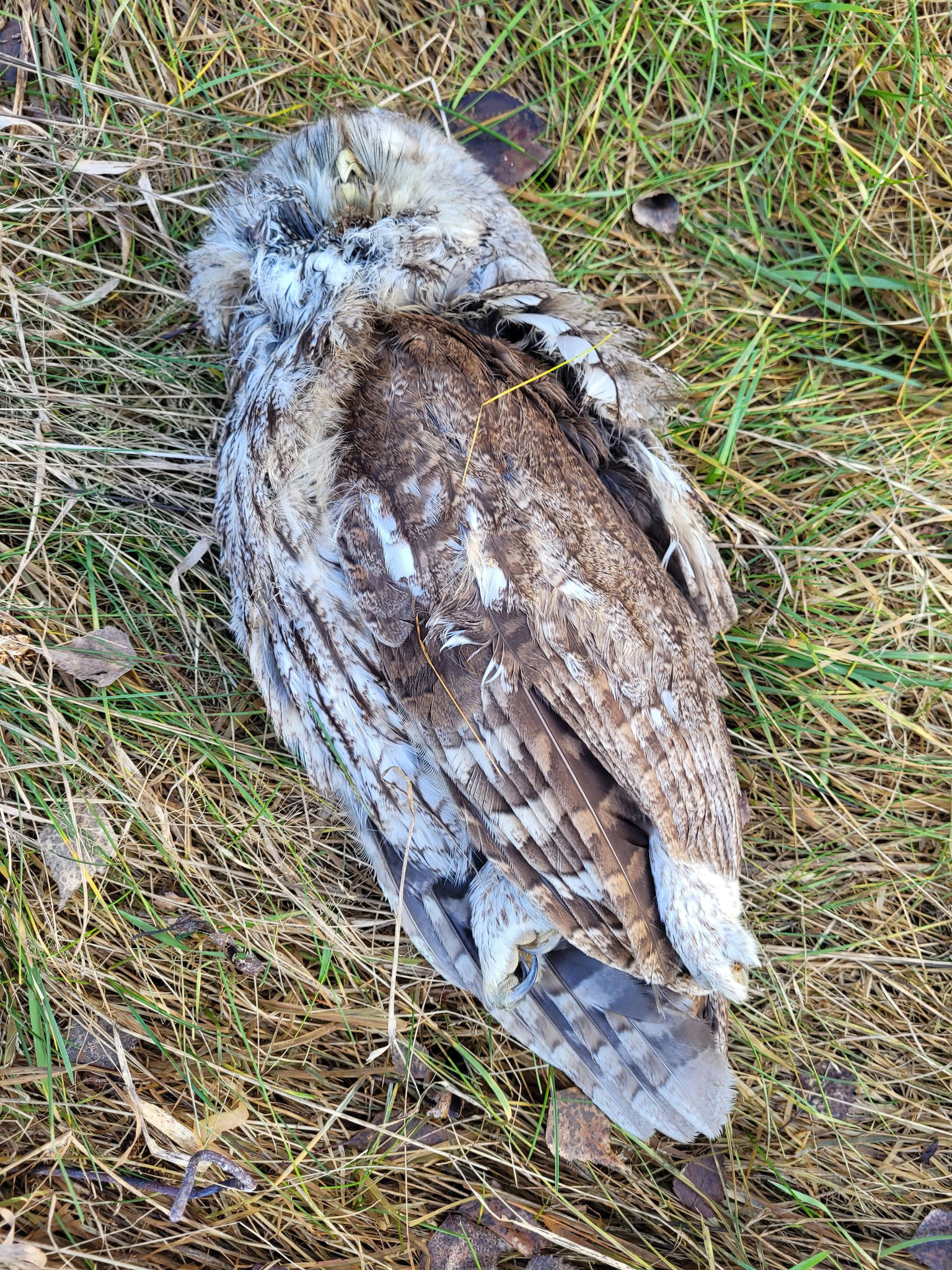
I was saddened to find a dead owl in my back garden. It was not dead long; I wondered whether the prolonged barrage of fireworks that went on for around 20 minutes last night might have been the cause or contributing factor of its demise. I watched after midnight from my rear patio, and was amazed at just how many fireworks were going off from all directions - from Jakubowizna to the south, Chynów to the west, Grobice and Sułkowice to the north-east and north-west. No respite for the wildlife. A few days ago, outside the Top Market in Chynów I witnessed the sight of a chap driving up to the makeshift firework stall in his stereotypical black BMW SUV. He walked up to the woman selling the fireworks and said to her: "Ma być dużo i tanio!" ("It must be many and cheap!"). The poor owl was properly buried.


This time two years ago:
Wealth and inequality - an introduction

This time three years ago:
Gratitude for a peaceful 2018

This time four years ago:
Fighting laziness - a perennial resolution

This time five years ago:
A Year of Round Anniversaries

This time seven years ago:
Walking on frozen water
[Daytime high, 1 January 2016 was -6C]

This time eight years ago:
Fireworks herald 2015 in Jeziorki

This time nine years ago
Jeziorki welcomes 2014

This time ten years ago:
LOT's second Dreamliner over Jeziorki

This time 12 years ago:
New Year's coal train 

This time 14 years ago:
Welcome to 2009!

This time 15 years ago:
Happy 2008!