Monday, 7 December 2020

The Darkest is upon us...

Today, 7 December, the sun sets in Warsaw at 15:23, the earliest in the year. And for the next nine days, it will also set at 15:23. From 7 December right through to 17 December, each day - 15:23. [Now, if you live in London, the earliest sun set will be tomorrow (at 15:51) and then at the same time for just eight days (until 16 December). There are probably some rounding errors at play here.]

You'd think, in the interests of symmetry that the shortest day of the year (21 December, seven hours, 42 minutes and 10 seconds between sunrise and sunset in Warsaw) would also be when the earliest sunset and the latest sunrise occur. Not so. The year's latest sunrise in Warsaw doesn't happen until 27 December (at 07:45), and it stays there at that time until 3 January. If one wants to be pedantic and seek the earliest sunset down to the second, then it falls either on 12 December or 13 December, while the latest sunrise is either on 29 December or 30 December.

So winter solstice itself - the moment when the North Pole is tilted furthest away from the sun, and we have the shortest day in the Northern Hemisphere - neither corresponds to the earliest sunset (it happens eight/nine days later, by which time sunset occurs two minutes later), nor to the latest sunrise (that happens eight/nine days after solstice, again the difference is two minutes, the other way).

So we have just entered the Plateau of Darkness - a plateau rather than a peak. From today, 7 December, to 3 January. From the first day with Earliest Sunset, to the last day with Latest Sunrise.

There should, therefore,be a Plateau of Light, from the first day with Earliest Sunrise, to the last day with Latest Sunset. This occurs between 11 June and 28 June. Note the asymmetry. The Dark Plateau is 28 days long, while the Light Plateau is only 17 days long. The sun rises in Warsaw at 04:14 for 11 days (from 11 June to 22 June), and sets at 21:01 for seven days (from 21 June to 28 June). And unlike the Winter Solstice, there is an overlap here - and thus there is an actual peak, occurring on 21 or 22 June. And then the slow shortening of the day, bearable into early autumn, but mentally painful after the clocks go back at the end of October. That pain is now easing.

Because of Covid, I'm working from home, so I have no need to wake up in darkness! I can be at my workstation at 9am, come what may. As I result, the time at which the sun rises is entirely academic. Gone (and not mourned) are the days when I'd wake at 03:30 to leave home at 04:30 to catch a train at W-wa Jeziorki so I could catch at train around 05:15 from W-wa Zachodnia to, say, Poznań, Katowice or Kraków in time for the start of a conference there at 09:00. Zoom meetings have said goodbye to all that. [Today's event for Polish exporters about Brexit linked Warsaw, Lublin, London and the Midlands; I took part from home. There were 200 participants. Can't do that in face-to-face format!]

Quarter of an hour after sunrise, 1 December, Jeziorki

The photo above shows that the arc drawn in the sky by the winter sun is less steep than in midsummer. The photo was taken at 07:40, sunrise that day was at 07:23.

Sunrise may have become a theoretical concept for me, but sunset most definitely is not. I strive to break up my working day to ensure I get my walk in before it gets dark. Sunset, therefore, is a natural part of my daily activity, a measure, a benchmark.

The fact that we've already hit that day when we know that sunset is not going to keep on getting earlier and earlier is the moment we can begin to celebrate the start of the Sol Invictus festival of the Unconquered Sun. By 25 December it is clear (later sunrises notwithstanding) that the day is getting longer; by the New Year the sun in Warsaw sets a noticeable ten minutes later than it does between 7-17 December.

The Hammer of Darkness is lifting; some sunny days of late have helped. However, it is the subconscious knowledge that a) things are not getting any worse and b) that soon things will start getting better that lifts the spirit.

The Darkness is upon us now, but we can see reason for hope.

This time last year:
The Body - A Guide for Occupants

This time five years ago:
Extreme weather and the British climate

This time seven years ago:
Cheaper public transport for Varsovians

This time eight years ago:
Swans on ice

This time nine years ago:
Cars

This time ten years year:
What's the English for kombinować?

This time 12 years ago:
The demographics of jazz

This time 13 years ago:
A day in Poznań

Sunday, 6 December 2020

Kitten logic

Felusia is usually a high-energy bundle of playfulness, chasing around the house. But not today. She has been sitting by the patio doors, staring outside. What's up? I take time to observe her. She is intently watching the garden. It's windy; pl.meteopost.com gives windspeed right now as gusting at up to 16 metres a second. The trees - usually still - are moving, their tops swaying to and fro. The lawn is shimmering, in waves. Most interestly, a leaf cartwheels across the lawn, and then another brown one scuttles across the patio like a turbo-boosted mouse. And that noise out there - not predictable machine-made sounds like that of the washing machine or a passenger jet coming in to land overhead, but a low, strong, sustained rushing moan that rises and falls.

Watching the wind and its works

To the cat mind, everything that moves is potentially an animal, and animals are prey. Stationary things, such as plants or furniture, are inedible. Suddenly the entire outdoors - all that stands on the other side of the windows - has become animated. Those leaves need to be investigated and chased! 

Felusia will remain indoors for her kittenhood and will finally be allowed out in the spring. She will have had her vaccinations, noted in her 'National certificate of cat' (as her książeczka zdrowia kota is helpfully translated on its cover).

In the meanwhile, Felusia observes and learns. She is curious, and I can see her mind putting two and two together. The sink in the food room is used to clean the humans' flattened food-bowls and those metal things they use to eat with, that compensate for their lack of sharp claws. There is a room up the stairs with a huge sink which humans use to immerse their entire body in, after removing their coats! And under their shoes they have body parts that look like their hands, only more elongated with shorter fingers! The wetness in this sink tends to smell of chemicals and unnatural things. The human house is full of puzzles that the cat mind has to put into place. 

Felusia could not be more different to her predecessor Papusia. Felusia is vastly more intelligent - intelligence based on curiosity and observation. She is more sociable, and will generally choose to be in a room with a human than one without. The feline soul is visible to the human sensitivity.

This time five years ago:
Automatic writing - England, 1912

This time eight years ago:
Poland's progress up Transparency International's ranking

This time 13 years ago:
A day in Poznań


Saturday, 5 December 2020

Mole control

The builders moving my fence the other week said this would happen - all that commotion, digging, removing posts, excavator rumbling up and down, boots walking across the orchard - will upset the talpine community living under my garden - the moles.

There were moles aplenty in the orchard, not bothering anyone; but the intervention of a team of builders plus their equipment had the effect of disturbing them. And so they started moving west, tunnelling under my drive. Today was to be their day of reckoning.

The collective noun for moles is a labour - a labour of moles. And labour they do, for an animal that's only six inches (15cm) long, throwing up all that spoil is a lot of effort. Note that the new molehills are aligned in a straight(ish) line, between the parallel tracks left by wheeled vehicles, which have compacted the soil beneath. As well as being unsightly, molehills and the tunnels between them make for uneven walking (with a recuperating left ankle this is problematic - you can't see where the tunnels are, but you feel it when you step on one).

A delivery of half a hectolitre of my effective mole deterrent (lant) was shipped in today. The soil from the molehills was scooped up by the bucketful and used to fill the holes left by the fence posts in their original position. And I hope the moles will be headed back eastwards where they came from, back on the other side of the row of cypresses.

And such a lovely day today! The temperature touched 11C, plenty of sunshine and Vitamin E. A southwesterly wind reminded Mazowsze of the Adriatic, a thousand kilometres away. Once the molehills were sorted, it was time for a walk and make the most of the such a day in December. Sunshine - and warmth - at this time of year is a real bonus, and lifts the spirit.

Disappointed to find that neither the entrance to Chynów station nor the level crossing at Widok have been finished, although workers were toiling away at both this afternoon.

This time last year:
Poland's education paradox

This time two years ago:
What I was going to say at COP 24 (but didn't)

This time three years ago:
Milton Keynes

This time four years ago:
Warsaw by night, early winter

This time seven years ago:
Burn less gas and do Ukraine a favour

This time ten years ago:
Early evening atmosphere

This time 12 years ago:
Toponyms - how many names has Jeziorki?

This time 13 years ago:
On the road to Białystok

Friday, 4 December 2020

Minding my step

Can't remember when it was - August? September? I'd had a pleasant (three glasses of Primitivo and one of Prosecco) evening in town and returned to Jakubowizna by train. And then the current problem - the direct route to my działka from Chynów station was closed because of the ongoing and never-ending remont. Rather than go round the long (850m detour) and dangerous (unlit road) route, I decided to jump off the end of the platform onto the track. And I sprained my left ankle doing so. 

Experience says - when the horse throws you, get back on. Work through it. So I carried on walking. Ouch at first. And by the time I'd got to the działka, the pain had indeed eased.

The injury reminded itself to me over the next two or three days, and then it subsided. But ever since then, every so often on my walks, I'd stick my left foot into a hole or else it would slip on uneven paving, or catch at large stone, and the pain would shoot back again. This happens when the left foot suddenly twists sideways through more than 30 degrees. It's happened four or five times since that fateful jump. 

On an uneven kerb on ulica Klarnecistów while on my way to the post office. Another day, on a earthen footpath on ul. Sporna on my way back from the post office. Where the asphalt joins the dirt track between Biedronka and ul. Żmijewska. In each case, a sudden stab of pain, anger, hobbling, and a determination to 'get back on the horse'. In each case, by the time I'd got home, the ankle would be a bit sore, but basically all right. It's still not healed 100% though; I can feel that injury when I stretch my left foot clockwise. Ouch again.

What to do?

Doctor A would say: "Mr Dembinski - you are no longer young. If you want your ankle to heal properly, take a break from your daily walks. Six weeks - eight weeks - by then, your torn muscles will have rebuilt. And - you take one of these. Dietary supplement. It will help."

Doctor B would say: "Mr Dembinski - walking is important to your health. Normal walking, that is. Carry on by all means, but avoid risky situations. Walk only on pavements or on asphalt, but not on dirt tracks or uneven surfaces. And don't walk at night. And don't walk so briskly."

Doctor C would say: "Mr Dembinski - keep right on walking. At night, off road - but... BE MINDFUL. Concentrate on what you're doing. Focus on the path ahead. Don't get distracted - no looking at the phone while walking, especially off road. Don't look round at other things while walking off road. Think. Be aware of the risk. You are always walking on the edge of chaos."

I'm listening to Doctor C. Three and half years ago, Doctor A told me to take blood pressure pills for the rest of my life. Three and half years on, my blood pressure remains optimal.

Mindful walking involves constant awareness of potential uneven surfaces. What my eye sees two metres ahead of me, my left foot steps into a second later. Stones, broken pavement, potholes, dog poop. Try this exercise - it's fascinating how your brain coordinates what your eyes see and where your feet land. Walk normally, but look to one side for several seconds. Disconcerting! So focus all the time. Like when you are doing the plank. Your 'tail bone' should be wound down under you. Pelvis at the correct angle, ensuring you are straight from the heel to the shoulder. With every breath in, you reestablish your pose. Continual awareness. [My record - holding the plank for four minutes and 12 seconds today!] 

My mother's advice to us as children was "Quidquid agis, prudenter agas, et respice finem" (whatever you do, do so prudently, and respect/consider the outcome/end) becomes clearer as I get older. Stay mindful, focus on everything you do. Even the simple act of placing one foot in front of the other -something I'm doing on average 11,000 time a day - needs to be done consciously. Otherwise, ouch.

There's something going on here.

It's the same with the plague. Step outside? Yup. With a mask on. Two masks in fact. One (medical) inside another (cloth). Two metres from thoughtless buggers who might be carrying it asymptomatically. With my magic little bottle of spirytus rektyfikowany to wash my hands with should I touch something on which a SARS Cov-2 virus might be lurking.

All I can be sure of is this: Four days ago, I didn't catch Covid. And when the guys from PGE came to chop down trees on my działka last Friday, some in masks, some without.  Might I have caught it today? Yesterday? I don't know YET. But I do know that I am grateful for not having caught it last week. Gratitude is a fundamental part of awareness.

If I should sprain my ankle again, or be swept away by some vulgar little virus, I shall let you know here.

This time five years ago:
I have trod the upward and the downward slope

This time seven years ago:
Giving to charities - in the UK and in Poland

This time ten years ago:
Birdlife in winter


Tuesday, 1 December 2020

Solar-powered home

Well, here they are - the solar panels. In place, just waiting for electricity supplier Innogy to hook up the inverter to the grid. In the meantime, sunny days (like today) come and go and the panels lay there, idle. One day, Innogy will give a date when an installer will come and switch meters, and make the final connection. From then on, electricity bills will become a thing of the past - there will only be a nominal charge (around 40 zlotys/£8 incl. VAT a month) for grid connection.

How does it work? The key thing is to know how many kilowatt hours of energy your house consumes. Polish law on renewable energy sources prevents the selling of power that's surplus to a home's requirements, so if you put too many panels on the roof and over a year you end up producing more electricity than you use, you lose. You give electricity to the grid for free. And if you put up too few panels, you pay the difference between what they produce from the sun and what you have to pull down from the grid, again over a period of a year.

Other than the panels, your house needs two additional bits of kit. One is the inverter, which sits by the junction box, between the grid and all your household appliances. The second is a WiFi-connected smart meter, which gathers data from the panels and informs you (and your electricity supplier) how much power the panels are generating, or if they are not generating, how much power you're pulling down from the grid, so as to work out the balance.

If your installer has done the sums correctly, you will have exactly as many panels as you need. Too many, and you end up sending surplus back to the grid, having paid for the panels and their installation. Too few, and the sum doesn't balance the other way, and you pay for the kilowatt hours that have to be drawn down from the grid to make up the difference.

Here, it's ten panels, facing south-west. Alignment (azimuth) and zenith angle are crucial. On my działka, the roof could not be aligned worse - it's exactly east-west. Optimal is a roof with a south-facing slope. A flat roof is useless too, as the panels need to be angled up towards the sun so that the rays can fall as close as possible to the perpendicular. 

The cost of the installation was around 21,500 złotys; half paid upfront, the other half after grid connection. And then comes the magic bit - once hooked up, your energy supplier applies for a 5,000 złotys government grant, which will be paid back directly to me. Plus, you can offset the investment against your tax bill. All in all, we worked out with the installation company, Stilo Energy, that in the case of our house, the investment will be fully paid off in just over six years - assuming the price of electricity doesn't go up over that time - which it will.

The government incentive is a package called Mój Prąd ('My Current') announced in July 2019; the bad news is that it the scheme coming to an end this month. It has been very popular. On my motorbike rides around southern Mazowsze and into Świętokrzyskie and Lubelskie provinces this summer, I could see plenty of rural households that have taken it up. All households consuming between 2kW and 10kW are eligible. In some cases, the panels were installed on rickety old barns that happened to have optimally aligned and angled roofs. Others, having poor roof alignment, have build car ports or other structures that exist primarily so as to have a roof in which panels can be optimally mounded.

Installing photovoltaic panels on an existing roof is called BAPV - Building-Applied Photovoltaics. This is today. The future will be BIPV - Building-Integrated Photovoltaics. Architects designing new houses should already be doing so around solar panels, planning roofs so that the zenith and azimuth angles are optimal for a given latitude, and that the panels fit flush with the roof for aesthetic purposes.

A huge breakthrough will be the eventual replacement - or conjunction of conventional silicon-based panels with perovskite film. The process, invented by Polish scientist Olga Malinkiewicz, takes perovskite - a transparent crystal, which generates electricity when light shines on it, and ink-jet prints it onto rolls of plastic film, many times thinner than a human hair. As you can imagine, this can be stuck onto office windows to turn office buildings into power stations. The Polish company that is commercialising this process is called Saule Technologies, and I hope you will be hearing about it in the future.

If you work in the construction sector (architect, civil engineer, developer, contractor/subcontractor) or in real estate (investor, consultant, agent), pop into this  free webinar this Thursday (3 December) to learn more about how BAPV and BIPV will revolutionise our buildings.

This time last year:

Jeziorki's ponds are drying up
[Happy to report the water level's slightly higher today]

This time four years ago:
Jeziorki - second track, second platform

This time five years ago:
Pitshanger Lane wins London's High Street of the Year award

This time seven years ago:
Trouble ahead in Ukraine.

This time ten years ago:
Jeziorki, dawn, winter

This time 13 years ago:
Tuwim's Lokomotywa in English

Sunday, 29 November 2020

Tall and awesome

On my walk yesterday, I looked towards the city centre from Dawidy and was stunned to see a blazing tower on the horizon. So I scrambled up onto the railway embankment to get a better look - my God! My first reaction was that this is something akin to the Grenfell Towers tragedy in London in June 2017, when 72 people died. I whipped out my 70-300mm lens and zoomed in - no smoke above it, no smoke - no fire. So what was it?

A live railway line is not the place for pondering such questions. I did so at home, posting the photo on Skyscraper City, the very best resource for anything to do with Poland's built environment. 

[It's a global site, but Poland has one of the most active Skyscraper City communities in the world, with more posts and page views than Albania, Armenia, Azerbaijan, Belarus, Belgium, Bosnia-Herzegovina, Czechia, Denmark, Estonia, Finland, France, Georgia, Greece, Hungary, Ireland, Latvia, Lithuania, North Macedonia, Norway, Slovakia, Slovenia, Sweden, Switzerland and the UK all put together!]

Within minutes, I had my answer - that 'flaming tower' is the Warsaw Spire. Yes indeed. Such was the angle of the sun that the south-west facing glass reflected it so awesomely. It was quite a sunset, too... (turn through 180 degrees...) On the horizon, the Raszyn radio mast (a misnomer, as it's in Łazy, 9km from Raszyn. When completed in 1962, it was the second-tallest structure in the world and the tallest in Europe. And 93m miles beyond, the sun. Shining onto Warsaw's Spire.


Left: my father and my son in front of the Spire, 31 July 2019. The Spire has two curved glass 'walls', and between them a vertical row of windows - and it was these that reflected that sunset yesterday. 

One Skyscraper City commentator remarked that the Spire from this angle looks like a frankfurter between two hot-dog buns; another commentator reminded us of the time that sunlight reflecting off the mirrored roof above the entrance was strong enough to set fire to two motorcycles parked outside. 

Today's walk took place on a heavily overcast day, but at least it didn't rain - or as had been forecast - it didn't snow. A standard 10,000 paces to Nowa Iwiczna and back, and on the way, a snap of the electricity pylons marching through Zgorzała and Nowa Wola on their way to Piaseczno and Konstancin. These are high-tension M52 pylons (!) carrying 220kV cables all the way from the coal-fired Kozienice power station. Standard height, 40m.


One development worthy of note - ulica Gogolińska, which runs parallel to the railway line on the west side, is currently asphalted only as far as Warsaw's border, from there on it's a muddy dirt track that serves the housing estates like the ones above. Today I saw evidence that asphalt is currently being extended southwards towards Nowa Iwiczna. Good news for local residents!

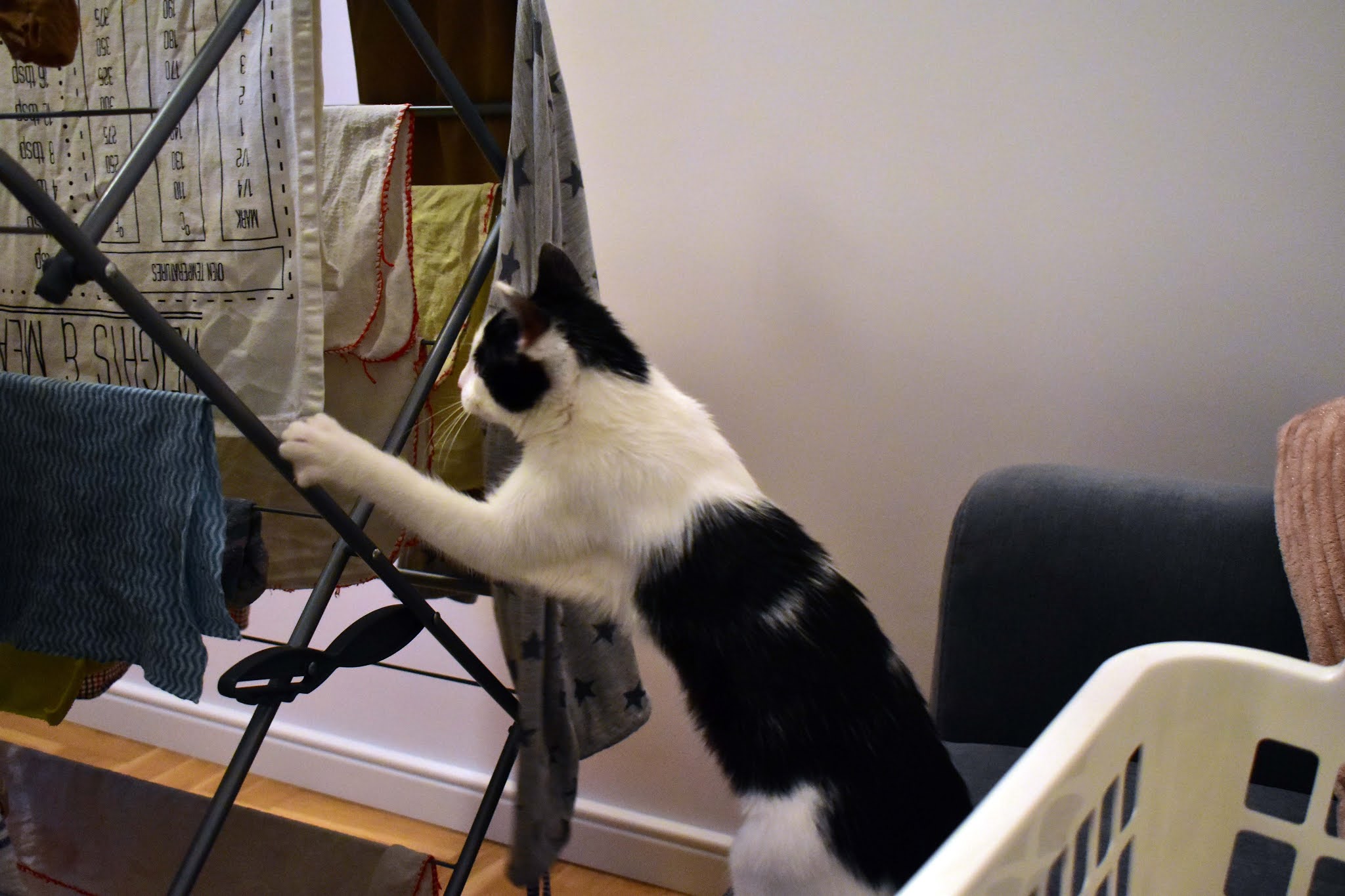
Bonus picture: domesticated cat helps out around the house.


This time five years ago:

This time seven years ago:
Crumbling King Coal, Katowice

This time eight years ago:
Street cries of Old Poland

This time nine years ago:
The gorgeousness of Warsaw at dusk

This time ten years ago:
I'm so glad I'm living in Warsaw

This time 11 years ago:
Candid photography

This time 12 years ago:
Archival photos of Jeziorki's Rampa in action

This time 13 years ago:
Red sky in the morning...


Saturday, 28 November 2020

In praise of the Nikon D3500

The camera in your mobile phone is OK, but taking a photo takes time - you can't just press the shutter and instantaneously capture the moment. Nor can you change lenses for a long telephoto or ultra-wide angle. I have been in the habit of having a camera around my neck for the past 40 years, in the film era, with a succession of Leica rangefinders mainly, and since 2007, digital Nikons. 

The most recent - bought two years ago, is a D3500. The newest 'entry-level' Nikon digital single-lens reflex (DSLR) does everything I need, has a high pixel count (24.2 million of them), and above all is so light I don't notice it when out walking for a couple of hours. Weight is one of my main considerations along with excellent image quality (especially when light levels are low), long battery life (good for a month's typical use), ability to take my old film-era Nikon lenses (see further down) and good ergonomics give me everything I need in a camera. 

I'd like a larger FX-format Nikon for the higher image quality, but even the new mirrorless ones are much bigger and heavier than the D3500 (which is the smaller DX format). Convenience trumps image quality for the time being. Now, the FX-format sensor is 36mm x 24mm; the same size as a 35mm film frame. DX is 24 x 16mm, two-thirds of FX and 35mm film size. For putting photos on my blog, DX is enough. 

Then there are are the more expensive, more feature-laden Nikon DX cameras, but I don't feel the need to advance beyond the entry-level (starting with the old D40, then D3200, now D3500). Can you name any features of an upmarket model costing around double (D5600) or even four times (D7500) the price of the D3500, that give value for that money? Many of these features give you the ability to do things in-camera that I tend to do with Photoshop and its .RAW editor. And while the D5600 weighs the same as the D3200, the D7500 weighs a full 50% more. 

So here it is - my favourite, my best all-round camera of all time, great value, seen below with standard kit lens. (Nikon's lenses are branded 'Nikkor', by the way.)

Tip to self: give the filter a clean.

Lenses are all important. The basic, plastic kit lens that you get with the D3500 (shown above) is not just adequate, it's downright excellent. It has almost instantaneous autofocus, it's light, it's sharp, it zooms from 18mm (27mm in 35mm/FX format), wide enough for landscape and bigger interiors, out to 55mm (82mm in 35mm equivalent), a mild telephoto and portrait focal length. It's not fast (i.e. it doesn't let in too much light at the long end at f5.6), but it makes up for it with excellent vibration reduction (VR in Nikon-speak, otherwise image stabilisation), happily giving sharp shots at a tenth of a second exposure (assuming the subject's not moving).

The second lens I'll take with me (if I can only take two) is the new Nikon 70-300mm telephoto zoom that replaced my old 55-300mm. I lose a bit at the wider end (I have nothing covering the gap between 55mm and 70mm - it's not a big issue in practice), but I gain in weight and size. For zooming in, there's no alternative, such as walking backwards a bit to frame a wide subject or landscape. But to get in close you need a long lens; 300mm is the equivalent of 450mm in 35mm format, which is a big and heavy mother. 

The third lens (if I can only take three) is the new Nikon 10-20mm wide-angle zoom that replaced my old 10-24mm. Again, I lose at the longer end (covered anyway by the standard 18-55mm lens), but I gain a much lighter and pocketable lens that also boasts VR, which the older lens didn't have. The 10mm end is very wide, not quite fisheye, but handy in cramped spaces. Photoshop can iron out the fly-away diverging verticals that come with such wide-angle lenses.

These three lenses cover about 95% of daytime photography needs; when darkness falls, wider apertures come in handy. Here, I have 35mm f1.8 and 50mm f1.4 lenses (52mm and 75mm equiv.), plus a real favourite of mine, this old manual-focus, manual-mode exposure 24mm f2 (36mm equiv.) lens (see below). These get taken for twilight walks, but none have vibration reduction, so hand-holding is limited to the reciprocal of the FX-equivalent focal length (from 1/36th for the 24mm to 1/75th for the 50mm). I also have an old 55mm f3.5 micro-Nikkor for the rare close-up.

Looking good with a classic Nikkor 24mm f2 lens!

Filters - a basic skylight or UV filter for every lens, acting as a transparent lens-shield, preventing scratching of more expensive optics. Unlike a lens cap, you don't have to take it off before shooting. Just remember to give the filter a wipe every now and then! One 'effect' filter I do use, and only on the standard 18-55mm lens, is the circular polarising filter, which intensifies the blueness of the sky on a cloudless day. This effect works less well on the superwide 10-20mm lens (only partial coverage) and hardly at all on telephoto lenses, so one is enough.

Two other cameras I have; the ultra-compact Nikon Coolpix A, with its fixed focal-length 18mm lens, now my travel companion for motorbike rides (and took all the pictures on this post), and the superzoom Nikon Coolpix P900, used chiefly for snapping birds and planes on sunny days - its long lens being the equivalent of 2000mm on a 35mm film camera. The Coolpix A is a great little camera, sadly discontinued and never replaced, its DX-format sensor and tiny size prove that Nikon could make something in FX that's around one-third bigger and one-third heavier, and yet would still be eminently totable for all-day use around the neck.

But for everyday use - and I mean every day - the Nikon D3500 with its 18-55mm kit lens is the perfect companion. I highly recommend it. Should Nikon ever discontinue its entry-level DX-format DSLR line, I'll buy one to put down for the future. It'll be a classic.

Below: sample of the lens quality. This is the basic kit 18-55mm lens that comes with the body. The photo is taken hand-held at 1/13th second at f4, ISO 1400 (so it's grainy), lens zoomed in to 24mm (36mm equiv). And it's a compressed .JPEG file to accommodate the requirements of uploading to the web. Printed full-size, this image would measure 50cm x 33cm. Try doing this with your phone-cam!


Note the red lines in the bottom left corner. Lenses are generally sharper at the middle of the image than at the edges. Let's crop that fragment and blow it up... This image printed to full size would be around 10cm square, just under the width of a page of A4. [Click to enlarge.]

At this moment, the D3500 with 18-55mm VR lens costs around 1,700 złotys in Poland (around £340), with similar prices in the UK (pound currently at 5zł). That's an absolute bargain.

Consider this: the new, mirrorless DX-format Nikon Z50 boasts fewer megapixels than the D3500 (21MP vs. 24MP); it weighs more (450g vs. 415g body only); its battery life is far shorter; it doesn't take old Nikon film-camera lenses, and  despite all that, at 4,100 złotys, it's more than twice the price of the D3500!!!. It makes no sense whatsoever to buy the Z50. None, zero. If you want to move up to FX format, then yes, the larger Z6 and Z7 mirrorless Nikons do compare favourably in terms of weight with their DSLR rivals such as the D780 and D850. But the cost of moving to FX is huge; the cheapest Nikon FX body (the D750) costs two-and-half times as much as the D3500 with kit lens.

Battery charged six times since 27 July; in almost-daily use.

I have a number of Nikon lenses that are surplus to requirements. My old 55-300mm zoom, faster, longer zooming range, but more robust and therefore heavier than its 70-300 replacement; a 16-85mm general-purpose zoom that has more useful range than the 18-55mm, but is far heavier; a massive 80-400mm telephoto zoom for FX and DX cameras - this doesn't autofocus with the D3500 body (and has been replaced on supertelephoto duties by the Coolpix P900 anyway); and an old-school manual-focus 28mm f2.8 prime lens. Also for sale are a 55-200mm lens, and a manual-focus 135mm f3.5 prime telephoto lens. Let me know if you are interested.

UPDATE September 2025: My D3500 rules. In November 2021, I bought a D5600 to hang on to for the deep future, using it sparingly; the D3500 is still my principle camera for daily (and I mean daily) use. One battery charge lasts me three weeks plus. Last month I had the sensor cleaned (50 złotys/£10 at BT Foto, Aleja Armii Ludowej 12, service while-you-wait). Over the seven years I've owned the camera, I've taken 46,231 exposures.  (To check, I open last the image I took in Photoshop, then go File -> File Info -> Raw Data-> the scroll down the list, in tiny letters, until <aux:ImageNumber> 46231 </aux:ImageNumber>. That's about 18 images a day, every day, since I bought the camera. 

This time last year:
Agnieszka Holland's Mr Jones reviewed

This time two years ago:
The Earth is flat

This time three years ago:
50th Anniversary of the Fiat 125p

This time four years ago:
Fidel Castro's death divides the world

This time five years ago:
London to Edinburgh by night bus

This time seven year ago:
The Regent's Canal, London

This time nine years ago:
An end to the entitlement way of thinking

This time ten year:
West Ealing - drab and sad end of town

This time 11 years ago:
To Poznań by train

This time 13 years ago:
Late autumn drive-time 

Friday, 27 November 2020

Frustration as Chynów station nears completion

To Jakubowizna today to let in a tree-cutting team from the electricity operator, PGE, and to have my windows measured for roller blinds. On arrival at Chynów station, I could see the usual flurry of work, but I was not expecting much progress over the nine days since my last visit. On my return to the station - WOW! There's a brand new footpath to the station from east side of the tracks; the lights are on in the pedestrian underpass... and there's no gate or barrier to stop anyone from going down into the tunnel, nor signs that it's not ready - so I stroll along the new path and down the stairs into the tunnel. It's just gone 3pm and there's not a soul about on the site.

Below: down I go, and here it is! Modernity and big-town sophistication! Pictograms speak of buses and taxis waiting to take you away! The arrow pointing to the exit left suggests that street is called ul. Kolejowa, which is also the name of the street that the other exit takes you to. Either chynow.e-mapa.net and Google Maps and Jakdojade are all wrong, or Jakubowizna will have a new street name soon. Up the stairs to Platform 2...


I climb the stairs to see that access to Platform 2 has not been granted - steel barriers are still in the way. 'ATTENTION! LACK OF PASSAGEWAY' With the lights of my train back to W-wa Jeziorki approaching, I decided to force the barriers open rather than to walk the 850 metres to get to the platform the official way. This is high-level olewactwo - taking the piss out of locals by leaving this object closed to passengers without giving information at the other entrance.


Below: view from Platform 2 of the eastern entrance to the station. It never formally had one before, just a path worn into the ballast and track-side soil by people taking a short-cut to Jakubowizna, so there is progress - just that it's taken so long to get here. I hope we won't have a situation like at W-wa Okęcie station where a new footbridge stayed unopened for over year because no one came to sign it off. At least there are ramps and not lifts, which break often.


On the działka, the team from PGE Obrót cleared a number of trees which were deemed a hazard to the medium-tension power lines running across my land. Anything less than two metres from the lines was deemed a risk and cut down or pruned, including five of my apple trees, which if left unchecked would grow (rather than fall onto) the lines.


Below: of particular concern is the aspen (osika in Polish), a tree which the foreman explained to me grew tall and thin and was kruche (brittle), prone to snapping. The aspen in the adjoining forest gets cut down. A good job done, and given that I reported it on Monday and they came on Friday, good work. A downside was that power to the immediate neighbourhood was cut for about an hour and 20 minutes - not good news for those working (or studying) from home. Still, that's better than an enforced power-cut in the middle of a gale.


The foreman said that there are plans to re-lay this particular line underground, but I've been hearing this for the past three years. Uncertainty about this is a bit of a problem as I consider how to develop the plot.

This time two years ago:
London in verticals

This time three years ago:
Roadblock and railfreight

This time four years ago:
Sunny morning, Hyde Park and Kensington Gardens

This time five years ago:
Brentham Garden Suburb

This time six years ago:
Ahead of the opening of the second line of the Warsaw Metro 

This time seven years ago:
Keep an eye on Ukraine...

This time eight years ago:
Płock by day, Płock by night 

This time nine years ago:
Warning ahead of railway timetable change

This time 12 years ago:
Some thoughts on recycling