Thursday, 9 December 2010
Accident of birth
Wednesday, 8 December 2010
Atonement
However here, I have to force myself, with the goal of delivering meaningful insights into everyday life in Poland, to pass my observations through a filter of cultural sensitivity. Pointing a satirical finger at Polish phenomena may win a quick laugh from my British or North American readers, but these phenomena so often have at their core some painful historical truths.
Nor should I mock the English of people who've worked much harder to acquire the language skills than have than native speakers of English, who acquired their language skills effortlessly. And here I must also confess that my less-than-100%-perfect Polish was learnt with a lot less effort than that of those ex-pats with Polish wives who've strived extremely hard to acquire the local language.
It is said by English writers about Poland that Poles are notoriously prickly about criticism of their country by foreigners. The Economist's Edward Lucas (who knows Poland exceptionally well, and speaks Polish having studied in Poland) says he is regularly criticised by Poles for saying how good things are here ("you live in fancy Warsaw hotels and know nothing of the poverty and deprivation of small-town Poland") and for saying how bad things are here ("you know nothing of the tragic history we've endured"). Finding an objective balance is especially difficult to do for a foreign writer commenting on Poland.
Sometimes humour is a useful tool for highlighting salient features of Polish life - but beware - the joke may well fall flat and your reader mistaking gentle teasing for sarcasm and takes offence. Or the cultural references used are completely lost on our Polish readers ("Dad's Army? The Simpsons?") Or a word-play lost in translation. Tread carefully here!
Analysing the dangers of writing for a mixed Polish and non-Polish readership, I conclude that the roots of the problem lie in differences going back to our early years. Those who spent the formative part of their lives - and indeed for anyone between 40 and 90, the greater part of their lives - in the communist system, will see things differently to those who by accident of birth were born in the bountiful West.
Above all, communism was a system in which everyone was supposed to be equal - and to a great degree it was so. In 1989, inequality in Poland (defined as the difference in wealth between the poorest and richest quintile of society) was - officially - lower than any country on earth apart from Japan. And communism's message of material equality was bolstered by the Catholic church's strong message of spiritual equality. How different, then, to the notion of inequality as the norm imbibed in the dog-eat-dog, devil-take-the-hindmost secular, capitalist world!
Worldviews acquired in childhood are hard to reconfigure. I guess that there's less of a difference between the way that today's young Poles see the world and their counterparts in the West do than between the way their parents and grandparents see it compared to how middle-aged and elderly Westerners do. In particular the desirability of social equality. But then time will blur differences between Poland and the West, time will reconcile, dialogue will heal.
Education and the social divide
The good news is that Poland is making rapid progress; in the nine years that Poland has been covered in the PISA rankings, it has jumped from 'below OECD average' to 'above OECD average' - and is well above the UK.
I've mentioned many times before the social divide that splits Poland into poor rural and rapidly-enriching urban. The PISA summary confirms that education is the key to overcoming social and economic disadvantage. Giving talented children from impoverished rural communities the chance to attend a decent school that gives them the chance to realise their potential and to contribute fully to society.
Eddie's school has a scholarship fund aimed at such children. I am supporting this fund to help (in a tiny way) to reduce social imbalance in Poland, and I'd ask my readers at this time of year to consider also helping poorer children get a good education. So please chip in!
SZKOŁA PRZYMIERZA RODZIN IM. JPII
FUNDUSZ STYPENDIALNY
Nr rachunku: 87 1600 1127 0003 0122 0640 1001
My children have had a good primary and middle education - I'd like some less privileged children to have the same chance too.
Tuesday, 7 December 2010
"What's the English for kombinować?"
UPDATE: Worth dipping into Adam Smith's The Wealth of Nations, first published in 1776. For here we come face to face with 'to combine' as used in the Polish sense. In the passage below, consider the verb 'combine' as kombinować, and the noun 'combinations' as kombinowanie:
"We rarely hear, it has been said, of the combinations of masters, though frequently of those of workmen. But whoever imagines, upon this account, that masters rarely combine, is as ignorant of the world as of the subject. Masters are always and everywhere in a sort of tacit, but constant and uniform, combination, not to raise the wages of labour above their actual rate [...] Masters, too, sometimes enter into particular combinations to sink the wages of labour even below this rate. These are always conducted with the utmost silence and secrecy till the moment of execution; and when the workmen yield, as they sometimes do without resistance, though severely felt by them, they are never heard of by other people". In contrast, when workers combine, "the masters call aloud for the assistance of the civil magistrate, and the rigorous execution of those laws which have been enacted with so much severity against the combination of servants, labourers, and journeymen."
Sunday, 5 December 2010
It's about atmosphere, klimat
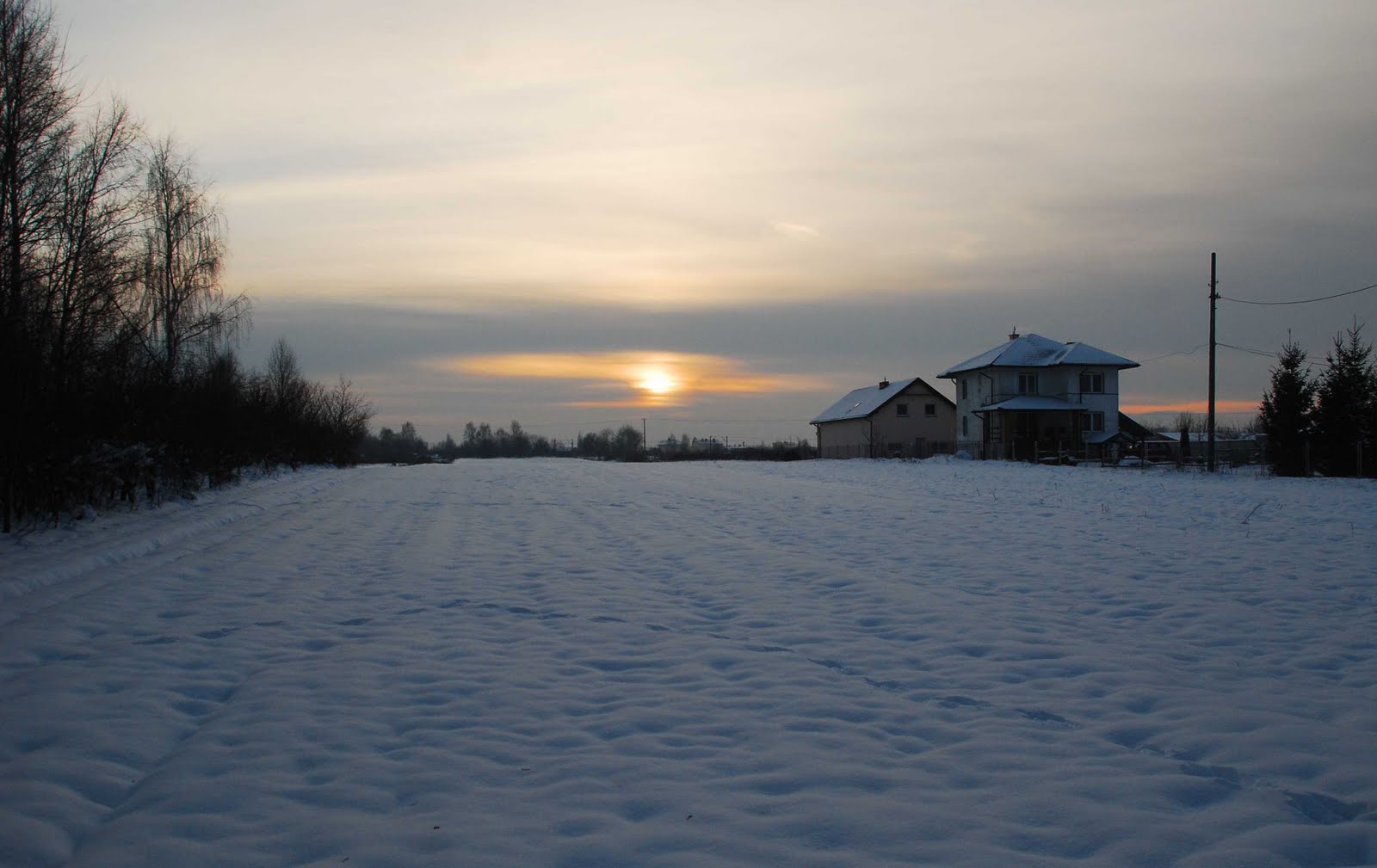
Sunset today was at 15:25, which rather cuts back walking time on a weekend afternoon after lunch. Photo below taken ten minutes after sunset, and indeed here is the klimat, that ambient mood of stillness and cold on the face.
Below: Looking towards Zamienie. It's -8C; not too cold, though you feel it when you take your gloves off!
Time to turn back and head for home. As I return, those *PAFF* moments multiply - I've been here before, yet not in this lifetime. I try to savour them as they happen, like holding my breath, keeping that feeling like the waking aftertaste of a dream. Days like this I never experienced in childhood, and yet they feel like they were experienced in childhood - yet as an adult. These experiences are regular, commonplace and familiar - and yet entirely inexplicable. One that befell me later the same evening. Driving in the snow, traffic, cold, I look left then right before turning into a main road. *PAFF!* Now, where could I ever had such a recollection from? I can't recall ever having driven in snow in the UK, yet the memory was from more than 15-30 years ago...
Saturday, 4 December 2010
Winter wildlife, Jeziorki
This chap (above) was foraging in the field next to our house; I caught him with long lens from my bedroom window this morning. A reminder to feed the birds at this time of year. Below: A flock of crows that had been hanging around the apple trees in the adjacent field take off and fly to the poplars across the road.
Thursday, 2 December 2010
Today, not so good.
Below: Room for another 20 inside? Fortunately, passengers showed plentiful reserves of social harmony, helping one another in, and putting up stoically with the crowded conditions. I met fellow blogger and near neighbour (Student SGH of Politics, Economy, Society blog fame); at the station. we both regretted not taking Puławska into town today.
Only as the train approach W-wa Centralna did I realise the scale of the chaos on Polish railways today. There were four trains backed up from Centralna (headed by one bound for Berlin with a broken-down locomotive) going nowhere. And on arriving at W-wa Śródmieście, I boarded this train (left) to take me the one stop to W-wa Powiśle. It soon became apparent it was going nowhere, already having been standing here for 90 minutes. The indicator board said Opóżniony na czas nieograniczony (delayed for an unlimited time).And so I walked from Śródmieście to my first meeting of the day, arriving over an hour late. My journey from home had taken two hours and ten minutes; one of the people I was meant to be seeing had a two-and-half hour journey in, including a 7km walk.
Wednesday, 1 December 2010
Jeziorki, dawn, winter
I have to get to Platan Park for my first meeting, five and half km from home, by 8am. It's just over an hour's walk in these conditions, so I decide instead rather than walking all the way to stroll up to Puławska, take a bus towards ul. Poleczki, and then walk to my destination.
Setting off up the path that links ul Trombity to ul. Sarabandy (below) shortly before sunrise (7:21 this morning), the temperature was -15C. And *PAFF* there's that old feeling of anomalous familiarity again!
Below: Snow lying heavy on the branches suggesting stillness of the air overnight; plenty of untrodden snow on the ground. The sun is just rising over the Las Kabacki forest.
Left: ul. Sarabandy, drainage ditch to the left. During the June floods the water blocked the road. The ditch is still fuller than usual. A snowdrift has blocked access to the continuation of the footpath between Sarabandy and Klarnecistów ('Clarinettists' Street'); I have to scramble over it, up to my knees in snow. The path (below) itself is slippery, treacherous. An icy dip awaits the incautious!
Below: ul. Drumli ('Jew's Harp Street'), approaching Puławska. Southern Warsaw's infamous artery is bad this morning, as ever. The bus takes 25 minutes to get from here to ul. Poleczki, just over 4km away.
Below: From Puławska I walk across to Poloneza via ul. Wodzireja (lit. 'Dance-leader's Street'; 'Master of Ceremonies Street'). The last bit is without asphalt. Churned up totally by trucks and four-wheel drives, it would have been impassable to pedestrians had the puddles not frozen over solidly.
I arrive at Platan Park one hour after leaving home. I could have walked the whole way and had a more aesthetically-pleasing experience, plus more exercise, had I eschewed Puławska and the frustratingly-slow bus ride.