Saturday, 8 April 2017

Conscious prayer


Lent 2017: Day 39

Mindfulness, consciousness, awareness - know what it is that you're doing. Opening the mind, in a calm, contemplative state of mind - and just listening. Applying your consciousness to being in a state of listening... acceptance... and what happens? A tumult of haphazard thoughts and worries - or a clear, single thought, unbidden, yet eminently sound?

I see prayer not as a recitation of learned phrases, rather a conscious communication with the eternal and the infinite; prayer as seeking an understanding of what is really what. Prayer at the cusp of wakefulness and sleep; lying in bed at the end of the day, I attempt to clear the mind of day-to-day concerns and try to weave my consciousness into the flowing fabric of the universe, woven from the particles and waves that can bring insight in a flash... All too often I fall asleep before reaching a state where I am in true prayer, where the communication with the infinite becomes two-way. But when it does, it is life-enhancing. It literally makes life better.

The desire to pray comes spontaneously at other times of the day; sometimes prompted by external factors - sunlight is one that works for me - being in the presence of nature; the sudden recognition of awareness and sheer joy of existence. Catch the moment; use it to align your consciousness with the boundless universe that surrounds you.

To approach prayer in a rewarding way, you should begin by being grateful. Profoundly grateful for life, for consciousness, for the here-and-now, for the moment; abandon all ruminations, all negativity, all grievances - and move on to a positive, grateful track; then quietly listen.

Meditation, focusing on breathing, all helps to bring you back to the hear and now and let go of the cares and woes. It is worth remembering that we are but discreet units of consciousness upon a planet that's part of a far greater whole; looking at the moon or stars helps with this thought.


Prayers for something - "petitioning the Lord with prayer" (to quote Jim Morrison) - should never be about wanting the material, but for what harmonises with the natural order; prayers for health, courage, security, contentment, acceptance and fortitude; they build your will; guide you and boost your determination.

The danger with learned prayers, recantations of remembered words, is that they have the effect of removing consciousness from the process. It is more meaningful to seek the quiet, listening approach. Pray not in words, but in feeling.

This time two years ago:
History repeating - or is it?

This time four years ago:
Sunshine, snow, April

This time six years ago:
In vino veritas

This time seven years ago:
Are we getting more intelligent?

This time eight years ago:
Lenten recipe No. 6

This time nine years ago:
Coal trains, Konstancin-Jeziorna

This time ten years ago:
Jeziorki from the air

Thursday, 6 April 2017

Contemplative imagery


Lent 2017: Day 37

April. With the clocks forward and sunset after seven; the clouds, driven by icy northerly winds, bringing hail like little white machine gun bullets, darken the sky or form a backdrop which the strong low sun can illuminate...

Below: sunlit blocks, Al. Jerozolimskie


Below: Forty - the trees just days away from coming into fresh leaf


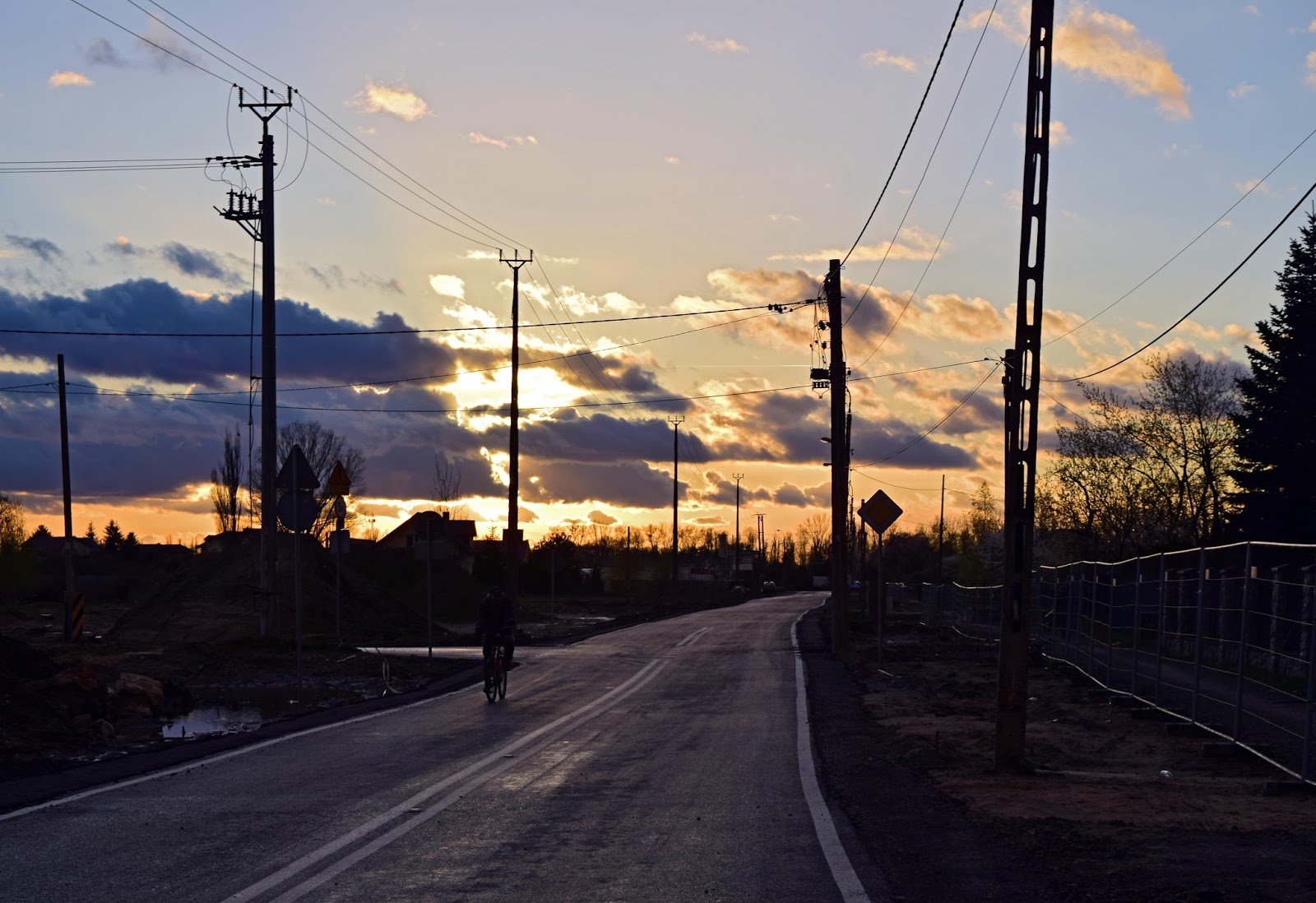
Below: early April sunset, Jeziorki


Below: dusk descends on ul. Karczunkowska's temporary asphalt


Below: my train departs in ten minutes


Below: works train stands at W-wa Okęcie station. Half past six. Three months ago, it would have been dark for three hours already at this time.


Below: bowling green sunset, Pitshanger Park.


Below: the sun's gone down over West London, but still illuminates the peaks of the highest clouds.


Click to enlarge; allow yourself to be drawn into the image, sense the klimat...

This time five years ago:
Baffled: my first visit to Jeziorki's Lidl

This six years ago:
In vino veritas?

This seven two years ago:
Are we getting more intelligent?

This eight three years ago:
Lenten recipe: tuna, chickpea and pesto salad

This time nine years ago:
Coal train sidings, Konstancin-Jeziorna

This time ten years ago:
Jeziorki from the air

Wednesday, 5 April 2017

Happy 94th Birthday to my father!

My father Bohdan Dembinski reaches the amazing age of 94 years old today, and remains in astoundingly good shape. His fortitude and resilience gives me great strength. I am full of admiration for the way he tackles the challenges of everyday life (does the car battery need changing, or is the problem with the wiring of the alarm?) - armed with patient determination, the quiet triumph of jobs done, tasks accomplished.


My father leads a healthy life, eating fresh vegetables and fruit, walking, and spending time in the garden. He also has a positive outlook on life and keeps cheerful, a source of inspiration to me. I look forward to calling him in the evening, hearing how his day has been. An amazing life, from the Nazi invasion of Poland, the occupation, the Warsaw Uprising, incarceration in Stalag X B, life as a newcomer to the British Isles, a career in civil engineering, working well into his 70th year - and still so much to do! A supercentenarian in the making! Sto lat and then a whole lot more, Dziadzio!

This time last year
HOT! 24C in Warsaw

This time two years ago:
COLD! Snowy Easter Sunday in Warsaw

This time three years ago:
Happy 91st to my father!

This time four years ago:
My father at 90

This time five years ago:
An independent Scotland - what if?

This time six years ago:
Królikarnia - Warsaw's 'rabbit house'

This time nine years ago:
My father at 85

Saturday, 1 April 2017

Ten Years of Blogging

Here it is - from ten years ago. One-sixth (nearly) of my life has been blogged, half (nearly) of my life in Poland has been blogged. My original intention was to follow Jeziorki for one calendar year, over the four seasons... but now it's been 40 seasons, and I'm sticking to it.

For me, the ideal form of communication - a mixture of the written (rather than spoken) word; and still (rather than moving) images. And - most important - the blogging format does not require the closure of narrative that novel writing or movie making requires. I'm not good at inventing endings.

I started blogging to record the changes that were going on around me in the southern edges of Poland's capital; the pace of change has been great, far greater than in the suburban West London from which I moved.

So here it is, copy'n'pasted, a pristine piece of html from 1 April 2007, my first-ever blog post on W-wa Jeziorki.
  Ul. Trombity is one of Warsaw's more fascinating streets. More than one mile/1.6km long, it is full of contrast - new houses, old houses, farmyard animals, wildlife, wetlands; airliners fly over it, trains trundle past it - there's so much to see. The end of ul. Trombity is less than seven and half miles from the very centre of Warsaw (junction of ul. Marszalkowska and al. Jerozolimskie), and yet the neighbourhood has a distinctly rural air. The street is located in the Warsaw district of Ursynów, though on the other side of the busy ul. Puławska. This area, Jeziorki, is a far cry from the blocks of high-density housing usually associated with Ursynów.

That was it! Short and sweet. As I'm in London right now, I can't stroll down Trombity to recreate the photo; little has changed in this vista. Looking 180 degrees behind me, I'd see a glade of tree-stumps where once an orchard stood.

Over those ten years, my writing style has improved, as has my photography, aided by ever-better cameras and lenses. The '10,000-hour theory' posits that mastery can be attained by putting in that time. Now, over those ten years, I've published 2,467 posts. At an average of an hour and half per post, I'm a more than a third of my way there. Assuming my output doesn't drop dramatically (which it might); I should attain mastery of the blog form sometime around by 80th birthday...

Here, then, are the five most popular posts, according to Google...

High over eastern Ukraine     15 Jul 2014              8,641 views

Gold Train Rush part II          29 Aug 2015            7,742 views

D3200 shoots X100              02 Mar 2013             7,616 views

Landing of SP-LPC               01 Nov 2011             6,402 views

Gold Train update                 31 Aug 2015            5,856 views


A mixed bag of subjects; my (tragically) prescient post about the danger of flying passenger planes over the war zone in eastern Ukraine led to a TV interview on BBC's Newsnight; my photos of Captain Wrona's gear-up approach over our garden ended up on an NBC News documentary, while the Gold Rush story... I'm in talks with Discovery Science channel about the Gold Train... Nikon may (possibly) be thinking of manufacturing a full-frame mirrorless camera along the lines of the one I mocked up on the post about the D3200 vs FujiFilm X100...

But above all, this blog has been about capturing change - in Poland, in Warsaw, in Jeziorki. New roads, railway line modernisation, new buildings, development, progress. Again, my initial intention was to lay down a trail for my older self to track back along a timeline to feel that change over the years... and one day, after Michael Dembinski is dead and gone, a boy born sometime in the second half of this century will feel this intense, inexplicable fascination with Great Britain in the second half of the 20th century, and Poland in the first half of the 21st century, and will find the digital echoes of this blog...

Once upon a time, when internet was still spelt with a capital 'I', I postulated that some time in the future, it would allow me to have my very own TV channel with a global audience of ten. Well, moving images with spoken words proved to be beyond my grasp (if you don't master these arts by the time you're 25, you never will), but the blogging form has worked well for me. Here in the depths of Lent, when my readership traditionally plummets, I've still got well over 15,000 page views this month. This is not the same as 15,000 readers - according to Google Analytics, over the past month, I've had 1,280 individual users visiting the blog, so each one visits around 12 times per month on average.

Where are my readers from?

1.
Poland

35.27%
2.
UK

26.24%
3.
USA

14.07%
4.
Canada

4.04%
5.
Australia

2.52%

No surprises there then. This is what I had expected. And an answer to all those who ask czemuż nie piszę po polsku - well, nearly two-thirds of my readers are not from Poland, and most of those live in English-speaking countries.

On, then, to the next ten years, and from there - some more!

This time last year:
Białystok the Dull

This time four years ago:
UK's first town where Poles are a majority

This time five years ago:
Lost legend of rock'n'roll: Johnny Kołyma

This time six years ago:
Stalin's plans to escalate nuclear Armageddon

This time seven years ago:
Warsaw's favourite weekend destination

This time eight years ago:
We are two

This time nine years ago:
Crushed velvet dusk in my City of Dreams

This time ten years ago:
My second Jeziorki blog post, also from this day

Friday, 31 March 2017

Health & fitness in Q1, the Quarter of Abstinence


Lent 2017: Day 31

The end of the first quarter of the year, the end of the first month of Lent (15 days to go). Focus now on the physical aspects - how's the fitness going? As I did this time last year, I'm making public my results. This is a particularly abstemious time of year, starting with a low-alcohol January followed soon after by the start of Lent. Hence those way, way below Prof Dame Sally Davies' new 14-unit guideline consumption scores.


Q1 2015
Q1 2016
Q1 2017
Paces walked (total)
991,162
1,025,422
1,044,542
Km (miles) walked
793 km
(489 miles)
820 km
(506 miles)
836 km
(516 miles)
Paces walked (daily average)
11,013
11,268
11,605
Sit-ups (daily average)
122
155
113
Alcohol (units/week average)
8.8
11.5
10.6
Portions fruit & veg (daily average)
5.1
5.3
5.7


The progression in walking is clear, with the million-pace target cracked in two successive years.

Sit-ups were disappointing (something to do with me reading about the fallacy of spot fat-reduction - exercising the fat bits makes the muscle under them grow, but the fat itself does not burn off). Having said that, I've been doing far more other forms of exercise, with weights and press-ups to the fore, and chin-ups as well. So overall, the morning and evening exercise regime for Q1 2017 has been tougher than in previous years.

As was the case last year, it's been a winter quarter in which I didn't come down with a cold or flu. Let me repeat the words I wrote this time last year:
Whenever I felt THE VERY FIRST symptoms of a cold creeping up on me – that slight tickling on the roof of the soft palate – I determined the cold away, by visualising those nasty viruses, little round spiky balls, then blasting them away with killer thoughts like a fire extinguisher. Several seconds in which I wished them gone, focusing my entire being on getting rid of them – and I'd wake up the following morning with no symptoms whatever... Too early to say that this is wishful thinking, but I'm convinced that mind-over-matter has worked here.
Well, a year on, this still holds true. Mind over matter, coincidence, wishful thinking or some other form of cognitive bias? Or just a dwindling number of cold viruses (you only get one a lifetime, whereafter you're immune to that strain) that I haven't yet has as I get older?

This time four years ago:

This time six years ago:
Cycling to work - the new season begins

This time seven years ago:  
Five weeks into Lent

Thursday, 30 March 2017

Globalisation and individual identity


Lent 2017: Day 30

A terribly sad day for me personally yesterday - the UK announcing its intention to leave the European Union after over four decades of integration with the world's wealthiest trading bloc.

A tight vote, in which a slim majority tipped the British nation down the chute towards what could be an economically catastrophic outcome. Why did it happen? As I wrote earlier, the overriding reason was not some vague notion of sovereignty, but rather a wish of a great many people in smaller English towns to control migration from EU member states - read Poland, Romania and Bulgaria.

It was not London, Manchester, Liverpool, Bristol, Leicester, Oxford nor Cambridge - nor Scotland nor Northern Ireland - that voted leave. Rather it was thousands of market towns across England, where within the space of a decade or so the number of immigrants shot up from 0.1% of the population to 5%. People in these towns felt swamped. They could hear foreign languages being spoken 'everywhere' in their streets, and felt it was time to 'take back control'.

Last week's Economist reviewed The Road to Somewhere: The Populist Revolt and the Future of Politics, by David Goodhart. Here are the first three paragraphs:
WHY did Britain vote to leave the EU? Why did America elect Trump? Why are populists on the rise all over Europe? David Goodhart, founding editor of Prospect magazine and now a proud 'post-liberal', has found a culprit. Populism, he argues in his new book, is an understandable reaction to liberal overreach.  
Focusing on Britain, he identifies a new divide in Western societies, pitting a dominant minority of people from 'Anywhere' against a majority from 'Somewhere'. The first group, says Mr Goodhart, holds 'achieved' identities based on educational and professional success. Anywheres value social and geographical mobility. The second group is characterised by identities rooted in a place, and its members value family, authority and nationality.  
Whereas Anywheres, whose portable identities are well-suited to the global economy, have largely benefited from cultural and economic openness in the West, he argues, the Somewheres have been left behind—economically, but mainly in terms of respect for the things they hold dear. The Anywheres look down on them, provoking a backlash.
So here's the thesis. Educated, mobile Anywheres vs. traditionalists, rooted Somewhere. At first glance, I'm definitely an Anywhere, with my post-grad education, living and working a thousand miles from my place of birth. In a detached house with big garden. But when I dig a bit deeper, haven't I returned Somewhere? Not on some expat posting to a random capital city, but back to where my father born. To the land whose songs I learned to sing as a boy. To a land that over the past 20 years I have got to know far better than the average native.

I doubt I could have moved to, say, Stockholm, Rome, Madrid or Copenhagen and felt as comfortable as I do living in Warsaw. It's a blood-and-language thing, for sure, but there's a spiritual side to being from Somewhere too - for me at least. I have an acute sense of Spirit of Place. The suburban sprawl of West London, the Perivale where I lived for 15 years before moving to Poland, spoke not to my soul. If anywhere in England does, it's the stretch of countryside from the Buckinghamshire, along the old Great Central through Northants (in particular around the village of Catesby) into Warwickshire.

I spent four years at university in Warwickshire, exploring the county on foot; so much of the landscape resonated with me; it was the Warwickshire of Shakespeare, the 'low farms, poor pelting villages' that drew me into its countryside. The Fens of East Anglia, flat and empty, took me to another time, another place; the landscape there resonated with me for some almost supernatural reason.

Feeling a sense of connection with place is, I think, a common experience, but if the default is merely 'where I was born and grew up', then the 'Anywhere' in me looks down upon it.

Finding your own place in the world requires seeking and sifting. Brought up on National Geographic magazines (between myself and my father, we have about half a century's worth!) I have a good sense of the world and know which places draw me, and which don't. I have never had any great urge to globe-trot; I'd be happily confined to the Europe and North America, but then again the search for spirit of place wanes as time, progress and development erode the landscape of my memories.

So I do not feel I am an Anywhere. Yet I am not a Somewhere. Poles could say to me "you didn't live here under communism. You did not experience what we experienced." True. But then I have actively chosen to live and work in Poland; I'm not living there by default.

More considerations of this subject, from 2010, here.

This time three years ago:
More photos from Edinburgh
[A city where I could live, despite not having any PAF! moments there.]

This time four years ago:
Edinburgh continues to fascinate

This time five years ago:
Ealing in bloom - early spring

This time nine years ago:
Swans pay us a visit

Monday, 27 March 2017

Eyes without a face


Lent 2017: Day 27

Do you get that split second of surprise when you unexpectedly catch a reflection of your face - on the darkened screen of your smartphone as you hold it up to read, in the window of a shop or bus? Does it take you aback? Who is that person?

I've long felt that disconnect between what I see when I catch sight of myself and who I feel I am.

For I feel that I am a consciousness residing within a human body that moves about the face of this planet, in a state of awareness, learning, evolving, teaching, communicating - observing, feeling. The body, the face, is but a distraction, it ages; it will die. Within it is an ever-sentient awareness capable of such subtle realisation and fine judgment, honed with experience, taught by time and rising in understanding.

When I dream, I have no physical characteristics; I am neither big or small, young or old; I am ageless. That's the real me, as I am, not as I am seen externally. And as such, I am comfortable in my own company.

Was it director Ken Loach who described himself as having an eye instead of a face? The observer rather than the actor. Creativity comes from observation, spostrzegawczość - perceptibility; that ability to detect fine nuances.

Next comes the need for will, to put those observations to use, be it in a painting, a drama, a photograph, a novel, a poem, a film, a sculpture - a concrete call to action from within to create. Now, this requires focused self-discipline. The drive to create comes a desire to share one's observations, unclouded by an ego that filters and distorts, that replaces the searing beam of truth with a self-serving narrative. Get your ego out of the way of the telling; just tell it as it is.

Thinking about one's appearance is a distraction. I feel most comfortable when blended in, not standing out, from the crowd. It is difficult to observe, mindfully, when one's demeanour is screaming "LOOK AT ME!" Invisibility would be ideal, being unnoticeable, indistinguishable - externally at least - from the rest of humanity.

Somewhere on Twitter I read that creative people age better than ones who are not driven to share their observations in their art. Not 'age better' in an external, visual, sense; rather in coming to terms with age. I can appreciate that sentiment. Self-obsessed folk ruminate on the onset of the ageing process, wasting time in a Quixotic struggle against inevitability.

All this is well and good, but it still doesn't inoculate me against those shocks of catching an unexpected reflection of myself!

We judge others by appearance. Others judge us by appearance. We judge ourselves by appearance. This is only natural; taking stock on the basis of appearance is an evolutionary defence mechanism. Friend or foe? Predator or prey? Authority figure that one automatically defers to - or a mug to be taken for a ride? We make subconscious decisions about strangers in a split second. Those first impressions are intentionally strong - in our ancestral past, they could have meant the difference between survival and death. The fact your genes have made right through the evolution of life on earth to reach the person reading this text now suggests that they had been rather good at that judgment.

But we should be wary of those first impressions. They are often misleading. They often prevent your conscious brain from taking a more informed view. My mother was one of many, many TV viewers who, when some expert was talking on screen about a given subject, would comment on their clothing, hairstyle or other aspect of appearance rather than listening to what they had to say.

We must understand our biology and rise above it. We should not allow ourselves to become lookist - to judge solely by external impressions. We should not judge others that way - nor ourselves.

This time last year:
London blooms in yellow

This time two years ago:
London's Docklands: a case-study in urban regeneration

This time three years ago:
Scotland and its language

This time four years ago:
Death, our sister

This time five years ago:
First bike ride to work of the year

This time seven years ago:
Poland's trains ran faster before the war

This time eight years ago:
Winter in spring: surely this must be the last snow?

This time nine years ago:
Surely THIS must be the last snow?

Saturday, 25 March 2017

"Jeziorki bogged down in railway mud"


Jeziorki made it onto page 5 of today's Gazeta Stołeczna, with a story bemoaning the delays in the rail modernisation works, which are running months behind schedule. This is hardly news for us residents, trudging through mud to get to the new platforms, but the piece did shed light on what's next. [Full text in Polish here for those who've not got to their free three-article limit.]

The works should have been completed in 20 months from September 2015. The 22nd month is now passing. The temporary level crossing which I wrote about last week will be opened, the article says, next week. But of the works on the viaduct taking ul. Karczunkowska over the tracks, no sight.

Below: from the top of a hill of mud, I take this shot looking east along ul. Karczunkowska. Nothing has stirred here in months, apparently because 'the documentation wasn't complete'.


The article suggests that the viaduct will be ready by the end of December, and opened at the beginning of 2018. The chances of that happening are as remote as Trump's chances of completing  full term as president.

Further promises made in the article include the completion of modernisation works from Czachówek to Warka by 2020 and onward from Warka to Radom. And then, it is said, the fastest journey from Warsaw to Radom, a mere 100km (62 miles) from Warsaw, will take 75 minutes, rather than the 2hrs 49mins it can take.

But first the rebuilding of Nowa Iwiczna station, which will involve the demolition of the old island platform, which in turn will involve single-track working again, so that the line can be realigned to fit the new 'down' platform. And work at W-wa Okęcie station and between Okęcie and W-wa Dawidy is as yet incomplete. Finally, a mass of tidying-up all along the tracks is necessary - there's heaps of rubbish left behind.

The single-line working will hit commuters, as if things aren't currently bad enough. On Friday, the 18:16 service from W-wa Śródmieście to Skarżysko-Kamienna was massively delayed; I ended up at W-wa Ślużewiec waiting for the 19:04 to Piaseczno, which - as it was due to arrive - was announced as having been cancelled. So I took a bus, getting home 1hr 40 minutes after reaching Śródmieście.

Commuters' patience with Koleje Mazowiecki would be better, given the scale of the job facing the railways, if it communicated better with passengers.

This time last year:
Ideas, and how they take hold

This time two years ago:
Russian eyes peering down on Jeziorki

This time three years ago:
New road and retail: waiting for Jeziorki's new Biedronka to open

This time five years ago:
Warsaw's Northern Bridge - its name and local democracy

This time seven years ago:
What's the Polish for 'commuter'?

This time eight years ago:
Four weeks into Lent

This time nine years ago:
The fate of urban wetlands?