Tuesday, 10 December 2024

A Dream Journey through the Central Europe of my Childhood Imagination

It was a different world, a dream world. As a child I had visited it often; sparked by trips to Poland through West Germany and Czechoslovakia, journeys which had a profound influence on my aesthetic sensibilities as I was growing up. The atmosphere, the klimat, was so unlike the London suburbs in which I was born and where I grew up.

Below: have I been here before? Kind of, sort of, think so... But when? Memory can be so fickle.

Below: have you been here, in your dreams of long ago?

Below: I dreamt of trams that delivered coal. All night, fleets of tramcars haul trains of coal wagons which drop their load through trap-doors between the tracks, down chutes into coal bunkers located below the cellars of the tenements that line the city streets. Noisy, but necessary activity. Shortly after daybreak, task completed, the trams return to their more usual duties – conveying passengers to their places of work.


And I loved the cars. They were so different to our Austins, Hillmans and Jaguars! My grandmother's family lived in a flat overlooking the petrol station, so I'd often see some amazing cars. Here, for example, is a Krenzstaier 2,8 Liter (in Luxus trim), a favourite among local plutocrats and captains of industry.


Did I dream that my mother bought me a model of one of those cars that fascinated me so? Is it still up there, in my late parents' attic?


Let's cross the tracks to another part of town... this is the line that skirts the western side of the city.


And I'd often take the opportunity to check out the Metro system, which back then still used rolling stock that dated back to the early 1920s!


Here's another one, the trains used on Line No. 2... These had an additional headlamp to provide extra lighting in the long tunnel sections in the distant suburbs


Line 3 stations were my favourite ones on the network – note the chandeliers. 


Below: "The streets were deserted/The police were alerted" – looks like one of those black saloon cars favoured by the state security apparatus heading our way. My father prudently hides his camera.


The car passes without incident. Let's continue our stroll. Almost back at my grandmother's...


Below: the bar on the corner of the street where they live. Looking at this image today, I've become quite thirsty, and fetch myself a bottle of Lützaner pils from the cellar.


Your very good health! The Beer Magnate'f  fineft offering. Beer, as I could only imagine. Cheers!


You will have guessed by now that these images are AI generated. I used Google Gemini Advanced 1.5 Pro with Imagen 3. Compared with my early attempts with AI-generated art, it's so much better in responding to my prompts. The pictures really click with my imagined world, dreams triggered by visits to Poland in the 1960s.

AI art is controversial. Is the content, the intellectual property of millions of creators, being scraped, royalty-free for the benefit of the tech giants? Or has a new creative tool been handed to humanity, just waiting for our imagination to be let loose on it? I'd be keen for your feedback.

Each of the above images is unique. I could type in exactly the same prompt a million times, and never get the same image again.

This time last year:
Poland's sleeper trains: 2024 timetable

This time two years ago:
City-centre notes
[One week living in Warsaw's Nowe Miasto]

This time four years ago:
First snow for ages!

This time five years ago:

This time six years ago:
Consciousness, memory and spirit of place

This time seven years ago:
Polish Perivale

This time eight years ago:
Power in the vertical

This time 12 years ago:
And still they come [anomalous flashbacks that is]

This time 13 years ago:
Classic glass

This time 14 years ago:
What's the Polish for 'pattern'?

This time 16 years ago:
"Rorate caeli de super nubes pluant justum..."

Sunday, 8 December 2024

Twanged

Nowa Iwiczna and its railway crossings is a bane for rail passengers as well as for motorists. The level crossing there on ulica Krasickiego has the power to hold you up for an insufferably long time. Since the completion of the Warsaw-Radom line modernisation and the opening of SKM services to Piaseczno, the level crossing is a source of local frustration and anger.

Consider the situation I encountered two weeks ago. It's twenty past nine in the evening. The lights start flashing, the bells start clanging, the barriers are coming down. I know that there's at least three minutes before a train actually crosses the road, so on reaching the barrier, I get on hands and knees (twice) to get under  each of the two barriers to reach the southbound platform. Crossing the tracks, I can see distant no train lights from either direction... And about a minute and half later, there it is – the 21:23 Koleje Mazowieckie service to Warsaw. The queue of cars on either side of the tracks waits for the barriers to rise... 

But no. The barriers remain down as the 21:25 SKM service to Piaseczno approaches Nowa Iwiczna station from the north. Maybe once this train has passed, the barriers will rise... Again, no. This time, the barriers remain down for the 21:28 SKM service towards Warsaw. I notice a family – mum carrying small child, dad with baby in pram and grandmother, who had been trapped for several minutes between the main barrier and short barrier closing off the northbound platform. Because of this, they missed that first train to town. They can now hear the SKM train approaching and are determined not to miss another. So dad removes baby from pram, lowers it under the barrier, scrambling under himself, reassembling the pram, putting in baby, taking the second child from his wife, then helping her and the grandmother under the barrier. They have lost their dignity but caught their train. 

Will the barriers go up now? No they won't because the 21:33 Koleje Mazowieckie train to Góra Kalwaria is now due (turns out that my train to Chynów is not until 22:09). I watched the Góra Kalwaria service come and sadly saw it go. And then – finally, after thirteen minutes, the barriers go up. The sound of revving engines on either side! Exhaust fumes! A crowd of waiting pedestrians to breathe them all it. Charge! 

********

Yesterday, same place, nearly eight pm. Ul. Krasickiego, Nowa Iwiczna. As I approach the station, the bells start clanging, the lights start flashing – the barriers start descending. Does this presage the impending arrival of a southbound train? I don't fancy waiting an hour for the next one. to Chynów Or is it a northbound train? Or a long goods train coming slowly from either direction? Whatever it is, there's still time... I kick down into a sudden sprint for the barrier.

TWANG! FUUUUUCK! MY FUCKING LEG! 

The calf muscle in my right leg has just torn. A flash of pain, that feeling of having had a baseball bat smacking forcefully into my right leg from behind. I limp on towards the barrier, drop to my knees to get under it. I look both ways. NO SIGHT OF ANY FUCKING TRAIN. Across the three railway tracks I continue, in agony, and drop down again to crawl under the barrier on the other side. Holding onto the handrails, I haul myself up to the platform... nothing approaching from the north. So it was all in vain. A minute that seemed to last an hour but was only a minute, passed. A light from around the corner, and a Warsaw-bound SKM train hoves into view. Mine is due in 13 minutes, although it's one of those days when the service is screwed up and anything can happen. 

I hobble down to the shelter and take a seat and start furiously massaging my right calf. In the distance, I can see the lights of my train. The barriers start descending, accompanied by the clanging of bells and the flashing of lights. Four minutes later, I'm on the train, heading south. I take a seat, continuing to massage my leg. It is very painful when I touch it. Soon I'm back in Chynów. The kilometre home takes me the best part of half an hour, dragging my right leg behind me.

Once inside, a soluble aspirin and an early night. When lying down, it's comfortable, but every now and then, a spasm of pain jolts through my left leg; falling asleep takes a long time. But once asleep, it's OK; I wake once for a wee at 03:00, then sleep through to just before eight. All told, a good night's sleep for to circumstances.

This morning, while resting, the leg is still making me aware of itself (it just feels like it's really tired, after a hard workout), but as soon as I stand up and try to move, it hurts. The only way I can locomote is to straighten my right leg at a 45-degree angle, foot on the floor, and slide it along with my left leg pushing, then jumping forward. Push, slide, jump. Push, slide, jump.

I remind myself of the last time this happened (this is the great thing about having a blog!) Back in October 2013. Friday 25th. Seemed to have been slightly worse than this time; the key question is – how long will it take me to fully recover? Back then, 11 years ago, my blog indicates it took me nine days before I was out and about. Well, there's a target there, for mind over matter. And a lesson - don't break into sprints at the age of 67!

Having had that experience, and writing it down, proves useful for learning. As we get older – every one of us – we have to learn to manage our biologies. And my 17 year-long blogging (and 11 year-long spreadsheet) is a useful tool for to that end.

This time three years ago year:
The ego and evil

This time five years ago:
Warsaw's Christmas lights 2019-20

This time six years ago:
Pawlikowski's Cold War

This time nine years ago:
"Extreme weather events are now a feature of the British climate"

This time 11 years ago:
Cheaper public transport for Varsovians

This time 12 years ago:
Swans on ice

This time 13 years ago:
Cars 

This time 14 years ago:
What's the English for kombinować?

This time 15 years ago:
The demographics of jazz

This time 17 years ago:
A day in Poznań

Saturday, 30 November 2024

Biorhythms are nonsense. And yet...

You ask anyone with any chronic illness how they are, and often you'll hear: "there are better days, and there are worse days." We can all sympathise with the notion of cyclical fluctuations in samopoczucie, in one's physical, mental and spiritual condition. 

Back in the 1970s, I had read – and thought a lot – about biorhythms – the idea that we are all subject to three cycles governing the way we feel and behave.

From Wikipedia: "the biorhythm theory is the idea that people's daily lives are significantly affected by rhythmic cycles with periods of exactly 23, 28 and 33 days; a 23-day physical cycle, a 28-day emotional cycle, and a 33-day intellectual cycle." The theory is predicated on the notion that all three cycles are precisely matched at the moment of birth, and run on throughout life, hitting peaks and troughs that can come together at rare intervals.

At the time, newspaper articles and pop-science books passed from hand to hand in sixth-form common rooms and with the aid of pocket calculators, we were trying to work out whether we were meant to be having a good day or a bad day (or a combination of both across three metrics). But there was a huge snag that I could see – the mathematical precision that the theory depended on. Biology isn't digital; it's messy. Women's menstrual cycles are a good illustration of this, periods coming early, late or sometimes not at all. So why should, for example, the human intellectual cycle run at exactly 33 days? For all people? 

Although biorhythms have rightly been dismissed as pseudoscience, I nevertheless intuit that there's a wisp of truth here. We all have our ups and our downs, physically, intellectually and emotionally. For some people, the amplitude of the peaks and troughs is not significant. Externally, they appear consistent.

But not everyone is consistent. Athletic, intellectual or artistic performance can fluctuate. And obviously there are extraneous factors. Are we ever at our absolute peak when taking an exam, running a race or just experiencing the emotions of a long-awaited vacation?

So – is this all cyclical? Can one pin down those highs and lows, and based on that – can one predict them into the future, such as solar or lunar cycles?

Here's my experience – when the physical cycle is low, one is more likely to come down with some infection. There's a greater need for daytime naps, nocturnal sleep has longer duration, there's a higher propensity to small aches and pains. 

So when the physical cycle is low, I'm not trying to break exercise records. I take it easy. I go to bed early and have a lie-in the next morning. And when the cycle peaks, then I can go for it (like the two sets of nine pull-ups to the bar I managed on 6 November.) Pull-ups are a good indicator for me of my physical condition. Some days I'll be pulling seven or eight; others three or four are more usual. So looking at the data gathered over 11 years, can I see a pattern? If there is (just looking a pull-ups, for example), it's not at all regular, but there are peaks and troughs.

Intellectual cycles are also interesting. These, I think, are longer in duration. For me the symptoms of an intellectual low is when I feel that I don't really know much. That my understanding of the fabric of reality is poor. My curiosity wanes, I'm more easily distracted. When speaking in public, I do so without much conviction, and I feel I'm not carrying the audience along with my narrative. And blogging – sometimes I feel inspired, sometimes I'll go back to an old post and think "that was really quite good!". Other times, the prose seems flat, contrived or borrowed.

Emotionally, my mood swings are from gregarious to withdrawn, though in the withdrawn state I'm not unhappy, so I'd rate my happiness levels as consistently good. Sometimes I do need to be alone.

Consciously sensing the feedback from your body, mind and spirit are to me essential in keeping on track. But the fundamental question is – are we running on cycles, or are the ups and downs of our physical, mental and spiritual condition merely the result of external factors? And if there are cycles – to what extent can we control them, physically or indeed metaphysically?

This time three years ago:
Twilight rambler

This time five years ago:
Late-November pictorial round-up

[In retrospect, an interesting and prescient piece!]

This time seven years ago:
Viaduct takes shape in the snow

This time ten years ago:
No in-work benefits for four years?

This time 11 years ago:

This time 12 years ago:
Another November without snow

This time 13 years ago:
Snow-free November

This time 14 years ago:
Krakowskie Przedmieście in the snow

Thursday, 28 November 2024

Kanalisierungszeit

 What's going to happen now? Let's see...

{{ Sweet snaps of the Rhine, pressed trousers, polished shoes, you're representing the U.S.A., remember. These people all around us were our enemy just ten years ago. Today, they've bought into our dream. Automobiles, neon and jazz. Television sets and sport. Frauleins remind me of home. But you stare into the dead eyes of some older guy, and you know, you see hate. Hatred, resentment. I last saw that gaze fixed on me in Alabama. Losers and winners. But here, they know who beat them. They know if it weren't for us, if it weren't for our military presence, they'd be under a different boot. Some of those older guys had had a taste of that. No Marshall Plan, no dream, no Auto, no neon, no jazz; just grayness and the lash.

Demonstration flight 0530 tomorrow morning. I'll be part-engineer, part-salesman. Talk them through the features, answer the technical questions. Handling their objections. They're think they're good engineers – but heck, we're better. Better science, better universities, that's why. They see only detail; we get the bigger picture. We're Can Do. We Think Big

So – tomorrow. The guy who takes the decisions – he's from the Ministry. He has the budget. So it's a good thing most of that budget comes from Uncle Sam. That's why our people from the Embassy in Bonn are here too. We're here to sell.

Smell of rubber and kerosene, men working round the clock to get everything working perfectly for that early morning flight. Calibration, control, last-minute tweaks. Weather forecast isn't perfect but it'll do for the demo flight. Hangar doors are wide open; inside bright lights and the sound of engines being warmed up. Step ladders, crates and trolleys. Busy.

Look – at heart, I'm a mechanic, not an engineer – and sure as hell I'm not a scientist. I can take a carburettor apart, immediately see what the problem is, fix it, put it back together, and replace the unit so the engine works good. I'm handy with spanners and screwdrivers – real handy. That's what kept me out of the meat grinder in the Pacific, I was too useful to the Marines fixing F4U Corsair engines. But today my job calls on me to pretend I'm a scientist, using fancy words I don't entirely understand. Why am I here? I often wonder! Talking to real scientists, real engineers, and the budget boys from the air force and the ministry, I can tell a good story, from real life, from actually having handled the kit inside an RB-36 at 35,000ft with Red fighters climbing towards our ship for the intercept. I'm one of a handful of aircrew who have actually been over Soviet territory – though officially, I can only imply that, and if asked openly, I must deny it.

Night time in Wiesbaden. The Aral neon over the gas station, the milchbar across the road, wet cobblestones, Volkswagen Beetles, shiny black Mercedes-Benz sedans. Here and there a gap between the buildings, a reminder of wartime destruction, but the people are well-dressed and well fed; this isn't Guatemala or Honduras. Been there too, selling military hardware. Didn't like that. Just selling them redundant airplanes that they'll use fighting between themselves or killing their own folk. Candy from a baby. Still, taught me a thing or two about diplomacy. West Germany – a different matter. Just across the border to the east lies a massive foe, well armed and dangerous. Technologically not our match across the board, but here and there they have surprises up their sleeves. We have to be prepared for those surprises. And our allies too, holding the line here in Europe with us. Some stuff we can share – some we can't. Never know whom to trust, who'll sell our secrets to the Reds.

Ideologically the Ruskis are the enemies of freedom. Seen those cartoons they publish about us? See how they try to mock us? Given half the chance, how many of those Red assholes would rather to be living in the free world? 

Tanker trucks are driving into the hangar, the plane's being fueled up. Black German crosses freshly painted on the wings and fuselages. Different to those wartime ones. More like World War One and the Red Baron's flying circus. Checklists. Inspect everything. No smoking within 100 feet. Cigars tomorrow, I hope. And beers. They remind me of home too. 

[AI-generated image]

I think back to America and our office park. A beautiful place to work. I see the sense of what I'm doing. Strategic defense. Not messing around – projects designed to make the world safer through the application of military technology. We won in 1945 because of air power. We'll beat back the Ruskis in space. Burbank, El Segundo, San Diego – I work with them all, Bethpage too, especially around Navy contracts. Keep in with the boys. Best way of life in the whole world. Our German customers – they'll need all our help to keep the Reds out. Not just the hardware, but the promise of better life. A Frigidaire full. That is all. }}


This time last year:
Świnoujście out of season

This time two years ago:

This time three years ago:
Where the two contracts end

This time four years ago:
In praise of the Nikon D3500

This time five years ago:
Agnieszka Holland's Mr Jones reviewed

This time six years ago:
The Earth is flat

This time seven years ago:
Fiftieth anniversary of the Polski Fiat 125

This time nine years ago:
Wojtek the Bear in Edinburgh

This time 12 years ago:
Red tape and travel
[A reminder of how bad things once were!]

This time 14 years ago:
How much education does a country need?

This time 15 years ago:
Between Sarabandy and Farbiarska

This time 17 years ago:
Lights in the night sky


Monday, 25 November 2024

Springlike autumn klimat

Sun outside – go get it. Wring out every minute of that precious light. Bathe the brain in photons. Leave office work until after dark. The snow's gone; daytime high today was a pleasant 12°C.

Below: good local news, ongoing for a couple of weeks – a pavement for ulica Wolska, the road from Chynów to Widok. More pavements, more folk may to tempted to leave the car and walk to the shops. And vastly safer. The 'built-up area' roadsign means 50km/h speed limit, but even so. (That's not snow on the new pavement; it's sand intended to work its way into the cracks between the paving blocks.)

Below: trundling to town, the Koleje Mazowieckie train between Krężel and Chynów. This service means I'm within easy reach of Warsaw (32 minutes from Chynów to W-wa Służewiec). Running parallel to the tracks is ul. Torowa ('Track Street').


Below: reverse view from the level crossing on ul. Spokojna ('Peaceful Street'), looking up the line towards Chynów station.


Below: last of the 2024 crop. Too high to gather, but still hanging on.


Below: Mazowsze architecture at the far end of ul. Spokojna, as it reaches the village of Piekut. Next to this old house, a new bungalow is being built. The English pattern of moving out of town into the quiet of the countryside once enough wealth has been made is becoming the new Polish trend.


Below: between Piekut and Dąbrowa Duża.


Below: leafless silver birches between the pines.


Below: low sun on the edge of Jakubowizna. Two recently built houses show the way.


Below: back in Jakubowizna on the way home. The sun is about to set.


Below: I live twelve minutes from here. Setting sun aligns with the path home.


This time two years ago:

This time three years ago:
Justify the buy: Nikon D5600

This time four years ago:
First frost, 2020

This time six years ago:
Edinburgh, again and again

This time ten years ago:
Ahead of the opening of Warsaw's second Metro line

This time 11 years ago:
Keep an eye on Ukraine...

This time 12 years ago:
Płock by day, Płock by night 

This time 14 years ago:
Warning ahead of railway timetable change

This time 17 years ago:
Some thoughts on recycling

Saturday, 23 November 2024

The snow and the sun

A powerful combination when it comes to qualia. The sensation of strong sunlight reflecting off the snow was something I only first experienced when on a skiing holiday in 1984, aged 27. Snow, when it came in England, was accompanied by dark clouds, and would melt away all too soon. Yesterday, as the clouds passed, and the sun lit up the snowy scene outside my window, I had the notion to recreate the skiing qualia flashbacks of Val de Whatever in France, and lit a cigarette, not to smoke, but as an incense stick in the kitchen. I also do this (very) occasionally in high summer to recreate Stella-Plage qualia. That increasingly rare whiff triggers those flashbacks far more intensely than visual stimuli alone. Sun, snow and tobacco smoke brings that back as though it were the same moment.

Propelling myself out of the cosy warmth into the snow required little effort this morning; I recently bought a USAF-pattern N3B parka (the long version of the N2B which I've owned since 1980). It's so warm that despite the cold, I had to stop along the way to remove my cardigan. Destination today: Rososz. The small grocery shop, where I can buy provisions for an outdoor lunchtime reverie.


Left: the little lane leading down to Grobice. All the apples are safely gathered in, the tractors have ceased chugging up and down. Here and there, the sound of chainsaws as old branches are pruned.

Below: something new in the neighbourhood – last week I noticed the arrival of the white hut installed in the gap between the turnoff to Machcin II and the path to Rososz. Since then, this plot has been enclosed. I'd expect a new house to pop up here; The hut, I take it, will be used by the builders. Five or six new houses have already built to the east of Jakubowizna's border in the past few years.


Below: on the path to Rososz, passing the edge of Dąbrowa Duża. On the way out, I meet not one single person; on the way back I pass a Nordic walker. Quiet. The way I like it.


Below: most of my journey (5.25km/3.25 miles each way) is through forest. 


Below: having popped into the shop in Rososz, it's time to set back home. With the sun so low in the late-autumn sky, it feels like late afternoon – despite it only being half past midday.


Below: it's time for lunch – feldakohol in the form of a tin of Warka Pstrąg, some kabanosy and salt snacks [I have switched to Polish or German-owned brands rather than Lays, as Pepsico has not pulled out of Russia. It still owns and operates its factories there, paying taxes to Putin, money which he uses to slaughter innocent people. Sponsors of terrorism. Lays actually opened a new salt-snacks factory in Novosibirsk this year. Fuck Pepsico. I'll never buy anything from those cunts again.]

Here, I sit and eat and drink and find altered states and inspiration. I watched the clouds chase east. Every now and then one obscures the sun, but the wind is strong and the sun soons pops back out.


Below: just as forecast, an overcast afternoon and evening looms. I'm almost home. The sun is low. In two weeks' time, we'll have the earliest sunset, and by the New Year, the days will have become noticeably longer.


Left: the last few hundred metres, dense unbroken cloud rolls in from the west. The birches and oaks are almost leafless; winter is due. Will it be a harsh one? Or mild?

Below: aviation bonus: This is only the third time I've managed this: getting a photo of an aircraft flying across the moon. (The second time was a speck on a dot as I didn't have a long lens with me.) Here is a Polish medical air rescue (Lotnicze Pogotowie Ratunkowe) Eurocopter EC135, SP-HXG crossing a half-moon. Nikon D3500/ 70-300mm Nikkor zoom, 1/400th sec at f/6.3, 100 ISO. Snaps like this make carrying full kit worthwhile.


Below: less remarkable, but nice enough nonetheless. A Qatari Boeing 797 Dreamliner begins its turn into its final approach at Warsaw Okęcie airport.


During the dark half of the year, every sunny day should be made the most of.


This time eight years ago:
Poland's North-West Frontier

This time nine years ago:
Cars must fade from our cities

This time ten years ago:
Unnecessary street lighting wastes money

This time 11 years ago:
Warsaw's heros on the walls

This time 13 years ago:
Tax dodge or public service?

This time 15 years ago:
Warsaw's woodlands in autumn

This time 17 years ago:
Still here, the early snow

This time 12 years ago:
Another point of view


Friday, 22 November 2024

First snow, 2024

Well, there was a very light dusting yesterday (21 November, tyle co kot napłakał = as much as the cat cried out = cat's tears = next to nothing), but this morning, there was a more substantive snowfall. It won't stay long, as the temperature is +2.8°C at midday. But for the record kept on my blog, it counts.  Below: view from my kitchen table, breakfast time, still below freezing, just.


As usual, the first snow means transport disruptions; my inbox this morning contains an email from Koleje Mazowieckie informing me of utrudnienia ('impediments') on the Warsaw-Radom line, another one saying that KM passengers can use InterCity trains with valid KM tickets (useful if you're travelling from, say, Piaseczno to Warka), and a third email stating that the 08:33 train from Warsaw to Radom is running 90 minutes late. SNAFU, in other words. 

On the roads, things are not good for all the motorists who've not yet changed from summer tyres to winter tyres (a colleague spoke of a five-day wait at his local vulcanisator). I'd expect a spike in road-traffic accidents and much slippin' an' a slidin' going on.

A first snowfall on 21 November is nothing unusual. It's not the warmest November on record, but far from the coldest. The earliest snowfall recorded on this blog (now entering its 18th winter) was in 2009, when snow fell on 14 October

Below: a table of all the first snowfalls that I recorded on the blog. Skipped years mean the snow (or lack thereof) wasn't remarkable enough to merit a post. One winter stands out – the one before the pandemic; a weak fall at the end of January was literally the only snow that winter. Otherwise, what's clear from the table is that first snowfalls in October and in the first half of November haven't occurred in Mazowsze over the past 12 years. This squares with my observations of first frosts.

Winter Date of first snow
2024-2025 22 November 2024
2022-2023 24 November 2022
2020-202120 December 2020
2019-202029 January 2020
2017-2018 21 November 2017
2012-2013 29 October 2012
2011-2012 21 December 2011
2010-2011 30 November 2010
2009-201014 October 2009
2008-200922 November 2008
2007-2008714 November 2007

UPDATE: Afternoon, 22 November. Walk to the shop. Below: Kodacolor Kansas at the end of my lane.


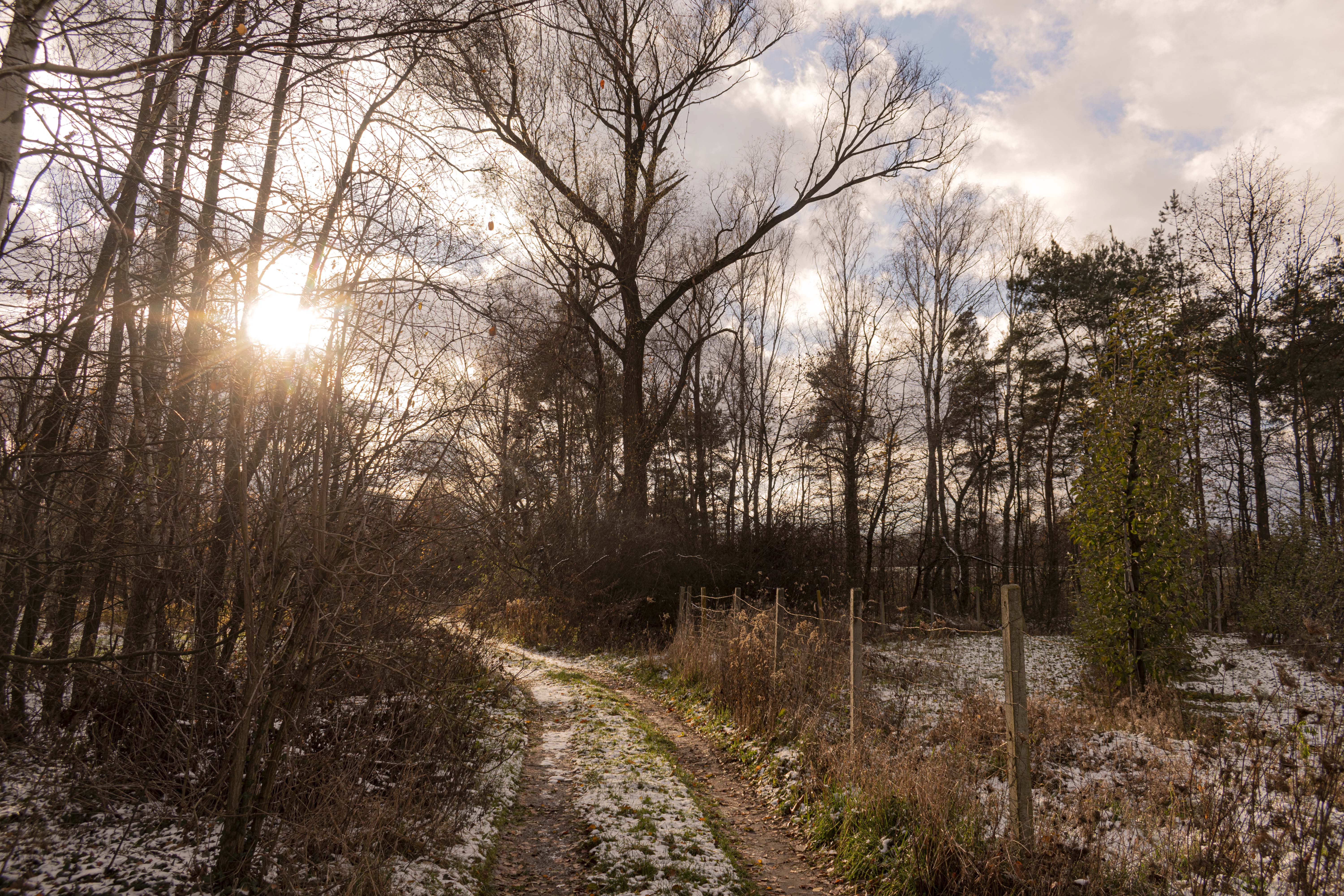
Below: low sun, field at the edge of town.


Below: on the journey back, ulica Jabłoniowa, sunset, berry field, barbed wire.


Below: ulica Torowa, half an hour or so after the horizon had swallowed the sun.


Below: Chy-town station in the snow at nightfall.


This time last year:
An afternoon and evening in Katowice

This time five years ago:
Karczunkowska viaduct opens to cars, but not to pedestrians

This time six years ago:
Edinburgh's Polish statues

This time seven years ago:
Edinburgh - walking the Water of Leith

This time eight years ago:
Poland's north-west frontier

This time nine years ago:
Cars must fade from our cities

This time 11 years ago:
Unnecessary street lighting wastes public money

This time 12 years ago:
Warsaw's heros on the walls 

This time 13 years ago:
Tax dodge or public service? 

This time 15 years ago:
Warsaw's woodlands in autumn

This time 16 years ago:
Still here, the early snow

This time 17 years ago:
Another point of view

Monday, 18 November 2024

How we look at the future

It struck me as I was walking northward along the road to Michalczew. Walking (as one should) facing the traffic, I could see the back of three road signs ahead of me. All of them triangular – warning signs. And then I imagined the following scenario...

You're driving a car with no windscreen. Just a solid metal panel in its place. All you can see is what's behind you and to the side of you; the image in the rear-view mirror and the two images in the wing mirrors; you can also see out of the side windows. You are driving forward, very slowly, along a long, straight road. The last few kilometres had all been all straight, nothing you can see behind you, or to the left or right of you suggests that the road ahead (which you can't see) won't also be straight. You pass a triangular sign. You can only see the back of it. You know it's a warning sign because of its shape – but what's it warning you of? You can't tell. Then a second triangular sign appears in your mirrors – and then a third. 

Some danger is clearly approaching. But what it is, you can't tell. You slow down anyway, and concentrate your entire attention on what you have just passed. Can you observe any patterns? You look left. You look right. Is the kerb moving away from you? Or towards you? This would suggest that the road is starting to bend one way or the other, and that you'd have to turn the steering wheel appropriately – and slow right down.

Such is our view of the world's unfolding timeline. 

The current scientific view of spacetime – the Einsteinian paradigm – defines our reality in four dimensions – three spatial dimensions and one temporal dimension. But time is the odd one out in this quartet. We can move up or down along the Y axis; left or right along the X axis; and backwards and forwards along the Z axis. And at variable speed. But when it comes to time, we can only move directly forward through it, at a steady one second per second.

We can look in all directions spatially, but we can only see backwards in time. We remember our past; we can only guess our future. Our relationship with time, compared to space, is extremely limited. Metaphysically, I regularly have flashbacks (anomalous qualia-memory events that I recognise and connect with the past), but have yet to have a flashforward. 

I am minded of this when I receive, as I do at this time each year, The Economist's The World Ahead. Journalists, commentators and analysts weigh in to describe the key trends that will define 2025. Yet despite the brain-power that goes into this publication, it's often overtaken by events by the end of the first quarter of the year in question.

An innovation in recent years is the inclusion of a panel of 'superforecasters', who answer a series of geopolitical and macroeconomic questions relating to the year ahead. The weighted results of this poll is more accurate than the musings of individual experts showcasing a pet theory. The aggregated wisdom of the crowds, especially if the crowd consists of individuals outside of the big institutions, without commercial or ideological agendas, is more accurate. But only if the right questions are asked. Questions for 2025 are quite bland; China's inflation rate, Nvidia's share price, Germany's ruling coalition. That sort of thing. 

The Economist's superforecasters got four and half out of eight with their forecasts for 2024, correctly calling the UK election, continued conflict in Ukraine, no clash between China and the West, and no euro-zone recession. But global GDP growth outpaced their forecast of 1.5%-3%; they said Narendra Modi’s alliance would win at least 300 seats in India’s election (it won just 240); and they wrongly predicted a Democrat would win the US presidency. But beyond asking a panel of superforecasters, looking ahead at 2025, The Economist raises some interesting outlier possibilities; among that of a supervolcano exploding or a new pandemic, two are intriguing – a lost text from antiquity is discovered; and evidence of alien life is detected.

Here I'd like to touch on the role of intuition in guiding us towards the future. All the intellects on earth, all the analytical powers, can sift through potential scenarios; they can work through the known knowns, the known unknowns and guessing the unknown unknowns – and still get it wrong. But if one is open to the power of intuition, a inspired glimpse into the future can prove as accurate as that a forecast based on pure analysis.

The butterfly effect – one seemingly trivial incident leading to a major event through a cascade of causal links – makes it impossible to empirically plot a future timeline that will inevitably happen. Even the most powerful supercomputer, even Laplace's demon, is unable to write the news headlines for, say, 10 August 2025. This makes an intuition-led seer's premonition just as valid as any professional forecaster.

Given the bind that theoretical science is currently in, as the physicalist/reductionist/materialist paradigm runs out of road, it would make sense to investigate what's currently considered flaky woo-woo and look more deeply at the role of our intuition in gauging the future.

I'd suggest starting locally with some =1 experiment, to see whether we can intuit what happens to us over the next week. The key thing: don't overthink it.

This time last year:
First snow, 2023

This time two years ago:
The Algorithm of Fate

This time three years ago:
Non-local consciousness - science and spirituality

This time four years ago:
Fenced in at last

This time seven years ago:
Poznań's Old Market

This time eight years ago:
Brexit, Trump and negative emotions

This time 13 years ago:
Premier Tusk's second exposé

This time 14 years ago:
Into Poland's former Heart of Darkness

This time 15 years ago:
Commuter schadenfreude