Tuesday, 16 November 2021

Pleasance, the feeling of feeling pleased

I want to return to a notion I touched upon last week - the archaic word, 'pleasance'. Google Ngram viewer reveals that 'pleasance' had its heyday in Tudor times, fading away before returning to more modest usage from the late 17th century until the end of the 19th century. Shakespeare uses the word but twice, once in a love poem, and once in Othello. As I type the word, Blogger helpfully underlines it in red, suggesting 'pleasant' instead.

Wiktionary gives: (Obsolete) The feeling of being pleased. [14th-19th c.] 

It is not so much feeling 'pleasured', but the experience of feeling pleased.

Note the passive voice. It's something that happens to you, not something you do ('I go out and enjoy').

It is momentary feeling of mild euphoria. It feels familiar; it brings back pleasant associations. It comes on quickly and passes quickly - but you notice it; it lifts your spirits. It is very much a qualia thing - a subjective conscious experience. I try to identify it, pin it down. An effect - so it must have a cause.

I had one on Sunday morning in the kitchen, stirring a home-made lentil and spinach curry and rice as I finished my coffee. And another one while eating it later on the działka, that feeling of feeling replete. This makes me wonder whether these particular qualia (individual instances of subjective, conscious experience) are endogenous (hormones released upon feeling sated by food) or exogenous (the ingestion of a stimulant).

But moments of pleasance can just happen, untriggered, unbidden, and these are the ones I want to focus on, as they appear utterly random, without obvious causation. Pleasance always accompanies those Wordsworthian flashbacks - whether from this life or elsewhere. My flashbacks are never anything other than pleasant and familiar. This is, I believe, significant - I don't have unpleasant ones that feel unfamiliar.

One I had just now (again in the kitchen), out of nowhere, a flashback to the coach carrying our Polish scout troop back to Hammersmith after our annual pilgrimage to Aylesford Priory in Kent; it's a Sunday, the coach driver has BBC Radio 1's Pick of the Pops on the radio. I'm looking out of the window at South-East London, known to me at that time only from these journeys. I must have done this trip by coach seven or eight times, with the cubs then the scouts. I could feel that precise atmosphere - the summer holidays had just ended, the school term just begun, autumn was drawing near. 

And in a second it was gone; just a pleasant micro-memory of a old, familiar memory remained to tinge my consciousness with its flavour.

This particular flashback has occurred to me often enough to be entered into the qualia compilation category. 

Another flashback that conjures up pleasance is an unbidden recall of the Hornby Dublo model railway catalogue from the early-1960s. These toy trains were decidedly too expensive for me to have, but simply having the catalogue to gaze at generated much anticipatory pleasance, something that was never to be consummated; never mind - I could imagine the engines, the carriages, the track... "Ah, vanitas vanitatum, which of us is happy in this life? Which of us has our desire, or having it, is gratified?" The last line of William Thackeray's Vanity Fair contains much truth - never having had a model railway, the memories of the catalogue - and my childhood imaginings of the models - remain powerfully pleasant in my mind when they flash back.

I have become particularly sensitive to these flashbacks when they appear within my stream of consciousness. Where are they from, why do they appear, are there triggers deeper than I am aware of; and above all the similarity between these - which I can clearly identify from this life - and those that I  feel exactly the same, but are from a pre-1957 past.

And here's one - I recently wrote about the experience of firing from a WW2-era M1 carbine. That phantom gun is with me; early today I felt the exact sensation of steadying my aim by wrapping the carbine's khaki web sling around my left elbow - yet the guns on the shooting range were all without slings. As I imagined this, I had no target, no warrior-like emotion, just that feeling of twining that strap around my arm to get a steadier shot. Completely unbidden - I was thinking about eating a box of blueberries at the time. But again, it was a moment of pleasance.

By the way, the Othello quote is nicely synchronistic:

I remember a mass of things, but nothing distinctly;
a quarrel, but nothing wherefore. O God, that men
should put an enemy in their mouths to steal away
their brains! that we should, with joy, pleasance
revel and applause, transform ourselves into beasts!

Such times we live in...

This time last year:
Another dream of Dziadio

This time six years ago:
Teetering between rage and reason

This time seven years ago:
Poland - it works!

This time eight years ago:
Bricktorian Birmingham

This time ten years ago:
Fog hits Modlin Airport

This time 11 years ago:
The local elections and what they mean

This time 12 years ago:
Synchronicity of shape - Powiśle, Hanger Lane, Mel's Drive-In

This time 13 years ago:
The last of Jeziorki's noted landmark - the Rampa na kruszywa

This time 14 years ago:
Jeziorki spared high-density development thanks to airport zoning


Sunday, 14 November 2021

Dealing with the Hammer of Darkness

 As long-term readers of this blog will know, around this time of year, especially those gloomy days when the sun fails to poke through the leaden clouds, I get mild symptoms of Seasonal Affective Disorder. Not debilitating by any means, but enough to be noticed, enough to get me down, robbing me of my usual joie de vivre.

At long last I have worked out a partial solution (other than spending four months of the year in the Southern Hemisphere). It is to ignore the time change at the end of October.

Before the clocks went back, I'd go to sleep around 23:00 to 23:15, and wake up between 07:00 and 07:15. 

This year, I have ignored the social hegemony of the clock and have kept to my natural, summer, rhythm - I go to sleep at the same time relative to the sun - not an hour later as the rest of the Northern Hemisphere does - and I wake at the same time relative to the sun.

This means being totally ready for bed at 21:45, and being asleep by 22:00-22:15. So I wake, naturally, at 06:00-06:15. And I must say, I'm finding this easier to achieve than I had thought just two weeks ago, when I wrote about the impending time change.

In the old days of having to get up to go to the office and of rigid TV schedules, this would have been impossible. That film I've wanted to see would have been on, starting at half past nine in the evening and ending 90 minutes later. Today of course, we can watch what we want, when we want to watch it. And do much of our work from home.

During the working week, I do my daily paces in daylight, as far as possible - any work that's needed for the following day can be done during the hours of darkness. Rather than working 9 till 5 (or even 8 till 4), I work until around 2pm, then go for a walk, return as it gets dark, and the work on until 7 or 8pm, as required.

So I am starting to become Master of My Own Time. Society proceeds at its own pace, I at mine. So I'm one hour ahead. Unless there's a Big Night Out (three so far since the time change, resulting in bedtimes past midnight), I'm sticking to this regime - and it works.

Late nights = higher blood pressure the following morning. That's clear from my regular blood pressure readings - an observation of cause and effect. That hour's time change can actually be dangerous if you just go with it.

At this latitude, the difference between day-length in midsummer and midwinter is nine hours. We oscillate between sixteen and half hours of daylight in late June and around seven and half hours in late December). Those daylight hours can be split into three and three-quarters after noon and three and three-quarters  hours in the morning. Year-round summer time would keep it that way. But the autumn time change robs us of an hour of afternoon daylight, adding it on in the morning. Frankly, being by nature an owl rather than a lark, that's not good for me. I really don't give a stuff at what time the sun rises, rarely being up to observe this phenomenon. But a late sunset - and lots of evening daylight - is what I crave.

As I wrote, the concept of midday being halfway between sunrise and sunset is naturally ordained. It is at noon the sun is at the zenith of its daily course, throwing its shortest shadow of the day, whatever the time of year. Midnight is noon's polar opposite, being halfway between sunset and sunrise. 

Historically, our northern European forebears would have slept longer in midwinter, going to bed a few candles after sunset, waking up with the sun, but with a longer interval between their first and second sleeps [see here]. And yet since electricity lit up our lives, we have shifted to a different circadian rhythm that the one set by the sun. We cherish our leisure hours - we like to play sports on summer evenings until 9pm, eat dinner al fresco on warm nights, stay up late to watch TV; our daily routines are out of sync with the solar day. The midsummer day starts early, even with the time change, the sun rises in Warsaw at quarter past four. Yet convention, society, employers, TV schedules, have determined that those daylight hours are less valuable that the evening ones.

Another tip I have is roller blinds, which I had installed on the działka earlier this year. They completely block out daylight, allowing me to sleep in way past sunrise in midsummer. Back in Jeziorki, dropping the blinds early, switching on several low-mounted, dim lights, creates a warm, cosy mood and cuts out that most depressing time of day, around dusk, when what little daylight there is ebbs away.

This is, for the Northern Hemisphere, the busiest time of year. Racing towards Xmas - get everything done, budgets achieved, new budgets drawn up - before the Xmas party season starts. Now there is no historical basis for stating that Joshua ben Joseph, a Christos of Nazareth, was born in late December. The early Christian Church took that decision in the 4th century AD, probably hitchhiking on the pagan festivals of Sol Invictus and Yule. It makes sense to celebrate the passing of the shortest day and earliest sunset, the returning Light. Working hard takes your mind off the gloom and dismalness going on outside during the run-up to the contemporary materialist feast of Xmas.

Anyway. 

It's now quarter to nine - quarter to ten in old money - and I will soon be getting ready for bed, ready to rise tomorrow, shortly after six. So far, so good. I'm coping. And at the last weekend of March, I intend to return to the summer routine - going to sleep around 23:00, and rising around 07:00. 

Unless I've morphed into a lark before then.

UPDATE 24 November: Ten days later and I'm sticking to this new routine. I'm fine with going to bed at ten and waking up around 6:15.

UPDATE October 2023: I came across this research pointing to a link between eye colour and seasonal affective disorder - people with blue eyes are less prone to it, which explains why latitude alone doesn't necessarily determine susceptibility to SAD. And this study from the British Medical Journal suggests that there's another danger with time change at the other end - heart attacks and stroke increase significantly after the clocks go forward in spring. (Again, going to bed an hour later and waking up an hour later could be an answer.) Time to stop fiddling with the clocks!

This time four years ago:

Poland's dream of a superconnector hub

This time five years ago:
The magic of superzoom

This time nine years ago:
Welcome to Lemmingrad

This time 11 years ago:
Dream highway

This time 12 years ago:
The Days are Marching

This time 14 years ago:
First snow, 2007


Friday, 12 November 2021

Free will, determinism and our supernatural powers

The debate as to whether humans have free will is as old as philosophy. Do we really have the will to shape our own destinies, or are we merely guided there by deterministic forces beyond our control? Or is our journey through life random and meaningless? 

Do our actions resulting from our own free will forge our future? Or has it been decided for us, long ago? By causation, or by metaphysical notions? "It is the stars, the stars above us, govern our condition" [King Lear, William Shakespeare]. 

We have no control over who our parents were, over our genetics, over the environment in which we were born and raised. A multiplicity of factors reign over our lives, from the economy to the weather and the society in which we live. Each day we walk on the edge of chaos - devastating unexpected events can shatter lives, from health diagnoses to life-changing accidents, over which we have little control.

Individual issues get resolved, new ones pop up. As I wrote in May this year, it doesn't all come right in the end; we never achieve closure on everything, no matter how long we live.

Yet I feel (in a non-empirical way) that we have more control over our destinies than a rationalist materialist might accept. But only if we consciously will it so, and believe in our powers (weak though they may be).

Can you draw an optimal outcome out of the future by strength of mind? By willing it so? The rationalist-materialist would argue that this is magical thinking - this is non-causation. There is no link between you willing something, and it happening, they will tell you.

What do I believe we can ask for? 

Freedom from anxiety; evading chance accidents (not being in the wrong place at the wrong time); comfort, peace of mind, joy - pleasance (an obsolete term, the feeling of feeling pleased). Above all, we can ask the contentment that comes from moving forward on the long road to spiritual understanding. And when these things do come to pass, feeling grateful for them is essential. They should never be taken for granted. Complacency is spiritual death, as is boastfulness.

What do I believe we cannot ask for? What we should not be asking for? Wealth, luxury, power, admiration, adoration, fun, kicks, thrills; the here-today-gone-tomorrow, the short-term high. The sugar-rush of the ego being fed. You cannot petition the Lord with prayer - for these.

We still don't know whether the many-worlds interpretation of quantum physics is right or not. But let's just grapple with it for a moment. In multiverse in which an infinite number of universes co-exist, there must therefore be one just for you! [Well - maybe not everyone, not the Trump-like p-zombies, meat-covered biological robots that act on instinct and possess no soul. Not the człowiek, który się nie zastanawia.] But given that you are here, and reading this, I assume that you, like me, are a consciousness actively engaged in a search for truth. 

Quantum mechanics, which is nearly 100 years old, has been scientifically proven but it still defies philosophical understanding. It is not intuitive, as Newtonian mechanics is. Everyone can understand what happens to a ball thrown into the air, and grasp the mathematical formula that expresses its motion. Yet we cannot wrap our human brains around the notion of superposition of particles. The idea that articles adopt all possible paths - all possible positions - until their wave functions are collapsed. All possible futures are therefore possible, until wave-function collapse limits them to just one. What causes the wave function to collapse? The Copenhagen interpretation suggests it is the presence of a conscious observer. Erwin Schrödinger claimed this was ridiculous, devising his famous thought experiment ("is the cat dead or not dead?") to highlight the absurdity. The many-worlds interpretation, however, holds that the cat is dead in one universe and alive in another, the bifurcation occurring at the moment the state of the subatomic particle is resolved. It decays in one, the cat dies. It doesn't decay in the other, the cat lives.

The implication of the many-worlds interpretation is that you are living in a universe, very similar to the one I'm currently living in, indeed, interfacing with my one in many ways - but one that has been fine-tuned for you, not for any other consciousness. Caveat: this is but one interpretation, I'm only holding this open for consideration.

I challenge anyone who says that the supernatural, the paranormal and the metaphysical are all phooey, all New Age woo-woo, to give me their interpretation of quantum mechanics in the comments box below. My interpretation is that the subjective conscious observers do have a role in the collapse of the wave function - but that role isn't understood; it is weak, and it will grow in strength as consciousness evolves. I likewise challenge those who say that all material phenomena have to have a cause to tell me what was the underlying cause of the Big Bang...

This time last year:
Hammer of Darkness cubed
[This year I've significantly mitigated the effect of Seasonal Affective Disorder, by going to sleep at the pre-clock-change time. I go to bed at 10:00-10:15pm, (summer time 11:00-11:15) and wake up at 6:00-6:15am (summer time 7:00-7:15). I've ignored the time change, I'm feeling better for it.]

This time three years ago:
Magic day, in and around Jakubowizna

This time four years ago:
Warsaw-London-Ealing

This time six years ago:
With my father and brother in Derbyshire

This time eight years ago:
In praise of Warsaw's trams

This time 11 years ago:
Setting sun in the mountains

This time 12 years ago:
That learning moment

Thursday, 11 November 2021

Sunny holiday local check-up

 Ah! The sun is out and I want some... Time for a walk to benefit from autumnal rays, and while conditions allow, to take a peek at how the S7 extension is getting on south of Zamienie. I see, looking at past years (bottom, marked with asterisks), that the national holiday celebrating Poland's regained independence is a good opportunity for photographing progress of local road-building.

Folk were out in force cycling, jogging and walking hither and yon all over the building site, with their children and their dogs - and work was still going on! Not at the usual frenetic pace, but from time to time a dumper truck would roar past. Despite the public holiday, work was very much in progress today.

Below: the new footbridge over the S7 extension will be the only pedestrian link between Zamienie and Dawidy Bankowe to the west, and Zgorzała and Jeziorki to the east. It's taking an inordinately long time compared to the pace of work elsewhere. The new road bridge, some 500m further north (just beyond the warehouse), takes four lanes of motor traffic but has no pavement. Bastards. The top end of the S7 can only be crossed on foot in three places: the tunnel along ul. Baletowa nearly two kilometres away to the north, this viaduct; and then the next one, a kilometre and half to the south, for cars and pedestrians. Entirely insufficient. Communities will end up being split in half.


Below: my first view from that new viaduct which links the two sides of Nowa Wola. Looking south towards Lesznowola


Below: looking north from the same viaduct, note the marked sweep of the S7 as it weaves between Zgorzała (to the right) and Zamienie (to the left on the horizon). Note the service roads on either side of the expressway, and the drainage ditches between the services road and the S7 itself.


Below: Ursynów rises on the horizon on this telephoto shot that shows both the footbridge and the distant cars-only viaduct crossing the S7. Note the posts for the acoustic screens that will muffle the worst of the noise from the residents of Zgorzała.


Below: steps link the service roads on both sides of the S7 to the viaduct carrying the local road. Turf has been laid, rather than waiting for grass seeds to germinate.

Below: a shot taken on Monday evening, looking north towards Warsaw's skyline, from where the slip-road from węzeł (junction) Zamienie joins the northbound carriageway. Note the 'Turdis' to the left (the flashing light on the roof was from a truck passing in the background).

I leave the S7 and head back to Jeziorki via the fields between Nowa Wola and Zgorzała, before crossing the railway line. This area is one huge expanse of housing developments, being built up at tremendous speed. I've just looked at Google Earth imagery from February this year - already out of date.

Below: I don't wanna house that looks like that! End-terrace on the border of Zgorzała and Nowa Wola. Architecturally dismal. People have now moved in. A car or two with every house. Traffic will get worse.

Below: this wasn't here last time I passed by... from behind a field of maize appears yet another new development; the land between Zgorzała, Mysiadło, Nowa Iwiczna and Nowa Wola is rapidly filling up with houses and flats. Despite this frenzy of house-building (around 15 estates in total), access roads remain limited to two muddy tracks (ul. Gogolińska south of Warsaw's border, and ul. Przepiórki), and two asphalted roads to the south (ul. Kielecka and ul. Dzikiej Róży).

Below: looking east along Rów Jeziorki ('Jeziorki Ditch'), the line of silver birches demarcating the southern boundary of Warsaw. To the right, beyond the rushes, a potato field. Beyond that - newly built rows of terraced houses.

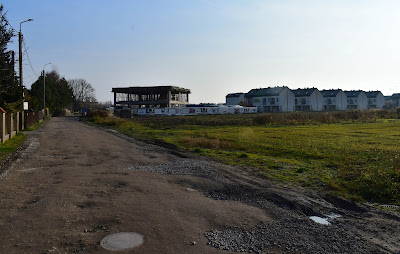
Below: looking south along ul. Gogolińska, one of just four access roads to the sprawl of development mentioned above. No asphalt - must be a river mud after a week's rain. Potholes merely filled with gravel. Another new building is appearing - fortunately, this is designated for shops and restaurants - sorely needed by the locals.

Below: "Grass triumphs, and I must say, I'm rather glad." The last line of John Betjeman's Metro-land, expressing his satisfaction that the Metropolitan Railway's plans to extend suburbia all the way out to rural Buckinghamshire failed. This is where the PiS government's flagship social-housing project, announced in October 2017, was to have been built, filling this field with flats for 8,000 people. Word was in May that it would not happen; indeed, on the Mieszkanie Plus website, there's no mention of a project for Jeziorki. All mentions of it have been deleted.


This time last year:
Zamienie is changing*

Wednesday, 10 November 2021

Governments' actions and climate change

I've been following the proceedings at COP26 closely, with a mounting sense of worry. Research group Climate Action Tracker (CAT) has forecast that the global atmospheric temperature is on track to reach 2.4C above pre-industrial levels by 2100. This is significantly higher than the 1.8C increase forecast by the International Energy Agency (IEA) last week. The IEA's figure was based on the optimistic premise that all the countries present at COP26 would live up to their new commitments that they signed up to in Glasgow, as well as delivering on those previously pledged. Backsliding and outright reneging on deals were not taken into account by the IEA.

A 2.4C rise is dangerous. The UK's Met Office warned in Glasgow yesterday that one billion people will be affected by extreme heat stress if the global temperature rises by just 2.0C. That includes heating to the point that the human body cannot cool itself through sweating, leading to an intense heat overload followed by a failure of the body's thermoregulatory mechanisms. That one billion is likely to want to move physically to somewhere cooler.

CAT’s calculation suggests that the 1.5C cap set at the Paris agreement of 2015 is still a distant goal. The forecast also warned that despite all the new measures agreed in Glasgow at COP26, greenhouse-gas emissions by the end of this decade could be twice as high as required to keep global warming down to 1.5C. This damning forecast was described as “looking through a telescope at an asteroid hurtling towards the Earth” by Greenpeace executive director Jennifer Morgan. 

However, it has to be said that the world's outlook has improved somewhat since the Paris climate summit in 2015. Six years ago, CAT estimated that despite all the policies agreed there, mankind was on a course to warm the planet by 3.6C. That would plunge the planet into an unstoppable cycle of runaway warming.

Britain’s and Canada’s chief scientist advisers said at COP26 yesterday that substantial changes in behaviour are needed to tackle the climate emergency. Sir Patrick Vallance said that behavioural change was already starting to happen, but more was needed. He said he cycled to work, ate less meat and had taken the train up to Glasgow. Sir Patrick told the BBC that the climate crisis was far bigger (“a fifty- to a hundred-year problem”) than coronavirus (“a two-to-four-year problem”) and would kill more people if immediate changes were not made. Canada’s chief scientific adviser, Mona Nemer, said there needs to be a “profound behavioural and cultural change in terms of our relation to the Earth”. 

However, the role of individual behaviour becomes more controversial, as most politicians are wary of imposing restrictions on their electorates’ freedoms to eat beef or to fly. The UK government had published a study proposing taxes on high-carbon food and a reduction in frequent flying, but then withdrew it, saying that it does not plan to dictate consumer behaviour. But will leaving such decisions down to billions of individuals - many of whom are driven solely by short-term selfish motivation - be enough to save the climate? Frankly I doubt it.

I see the governmental measures in the fight against climate change as I do in the fight against Covid-19. Had the world introduced a total lockdown early on, the pandemic might have been halted in its tracks. It wasn't; the virus mutated into faster-spreading variants, leading to successive waves of new cases and deaths that does not want to go away, despite the rapid development of effective vaccines.

Leaving frankly stupid people (those who harm others as well as themselves with their behaviour) to their own devices is dangerous. Authoritarian governments can take measures, and societies with higher scores along the collectivist-individualist axis tending to do better even without authoritarian governments. But liberal governments in individualist societies will end up being forced to take stronger measures if they do so too late. 

This time six years ago:
Cultural differences - PL & UK in the country

This time seven years ago:
Schadenfreude! The downfall of Hofman & Co.

This time eight years ago:
From the Mersey to the Tyne

This time nine years ago
Autumnal Gdańsk

This time ten years ago:
What Independence Day means for Poles

This time 11 years ago:
Words fail me: what's the Polish for 'to fail'?

This time 12 years ago:
Autumn in Dobra

This time 14 years ago:
Autumn ploughing


Sunday, 7 November 2021

A deeply spiritual experience

A huge thank-you to Andy and Roman for inviting me to what was a very special day - a chance to get acquainted with firearms of yesteryear at the PM Shooter shooting range (ulica Krakowiaków 80A, Warsaw). 


We started off with handguns before moving on to rifles. [All photos by Andy Picheta]

"Well the high sheriff, shot Lazarus, well he shot him with a mighty big number 
Well the high sheriff, he shot Lazarus, well he shot him with a mighty big number
With a forty-five, Lord, Lord, with a forty-five" 

Below: shooting with a Colt .45 M1911 pistol
 

Below: firing away with the legendary Tommy gun - the Thompson M1928 A1 submachine gun. Barrel climbs off target in automatic fire.

"Tommy gun, you ain't happy less you got one
Tommy gun, ain't gonna shoot the place up just for fun" - The Clash


The Gun that Won the West - shooting with a Winchester model 1873, the oldest firearm at the range, with its characteristic lever-action reloading mechanism. A huge technological advance over muzzle-loaded muskets that needed ramrods as used in the Napoleonic Wars a little over half a century earlier.


The highlight of the day for me was handling and firing the M1 Carbine, a gun for which I felt the strongest sense of  're-acquaintance'. Familiar. Comforting, even. This was my deeply spiritual experience. Xenomnesia flashback - hunting jackrabbit in the Texas Panhandle scrub, Christmas 1950.


On to the modern stuff. An early AK47 Kalashnikov - robust, reliable, but not that accurate.

We also fired from the Vietnam-era M16 automatic rifle, and the classic German WW2 Karabiner 98k. Firing this rifle with its bolt action (you need to pull back the bolt to remove the empty cartridge and bring up the next one) makes one realise how a rifle with a faster rate of fire (such as the American M1 Garand) gives infantrymen an immediate advantage. It was my father's weapon during the Warsaw Uprising, although his lacked the wooden stock which had been replaced by a metal rod bent into shape. He only had a handful of bullets to use in it at any one time.

A gun that everyone liked the feel of was the German MP34 submachine gun, produced between 1929 and 1940. Manufactured from the best materials available and finished to the highest standards, it was so well made that it has often been nicknamed the "Rolls Royce of submachine guns". However, its production costs were extremely high as a consequence. Also impressive was a 12-gauge pump-action shotgun, which just shredded the target.  

Below: A farewell to arms. Blasting away with a contemporary Smith & Wesson M&P15, a lightweight semi-automatic rifle. It jammed twice as I emptied the magazine.


I found the experience of immediate familiarity of handling the guns surprising. The smell of cordite. The weight, the recoil, the action, all fell immediately to hand. Later that evening, walking to Wilanowska on my way home after dinner, I felt myself carrying a phantom M1 carbine as though I was on patrol...

The powerful extractor fans on the range gave a sense of security in the pandemic, although there were too many large groups of maskless people in the small reception area while we were signing in.

I don't believe in liberalising gun laws in Poland - they are fine as they are. Mass shootings don't happen in Poland, which has among the lowest rates of gun-related deaths in the world, on par with the UK. Being able to fire a variety of guns - historic and modern - in a controlled environment under proper supervision is a worthwhile and educational experience; for me a re-connection with my spiritual Past.

This time last year:

This time four years ago:
Gliwice's new station

This time six years ago:
Reanimated - my father's car 

This time seven years ago:
Defending Poland against hybrid warfare 

This time eight years ago:
Another office move

This time ten years ago:
PiS splits again - Solidarna Polska formed 

This time 11 years ago:
Tesco vs. Auchan

This time 14 years ago:
My father's house

Wednesday, 3 November 2021

Are you serious about going green?

What with COP26 going on in Glasgow, and the pledges to cut global methane emissions, preserve rainforests and limit coal-burning, it's time to reflect on our own individual behaviour with respect to the planet that we all share.

  • Are you painfully aware that manmade climate change is real, and that the likelihood of a 3C global temperature rise by the end of this century would be catastrophic for humanity and for the environment?
  • Or is this just something you accept and brush off with a "meh" before scrolling down to the next news item or turning the page of your newspaper?
  • Or do you deny that such as thing as anthropogenic atmospheric warming exists, believing this to be nothing more than a conspiracy?

Has the reality of climate change altered your behaviour as a consumer, as a householder, as a commuter?

Do you have a nagging sense of guilt that you should be doing more as an individual to hold back the inexorable heating up of our planet? Or do you think that this is exclusively the role of governments and corporations?

What are you doing to cut your CO2 footprint?

Let's start with travelling to work.

Do you subscribe to game theory, thinking "why should I make sacrifices to my lifestyle, why should I give up comfort and convenience, if others continue to live as they always have?" Game theory is central to the conundrum of driving to work in traffic jams. Whatever incentives and disincentives the authorities devise - cheaper, better, public transport, road-pricing, higher fuel duties - the net result of getting more people out of cars and onto buses is... more people driving to work because the roads seem less congested. The average car in cities of the developed world is used to drive 1.2 people an average  11km (6.8 miles) to work,

I gave up driving to work in 2011; I did not replace my 20-year-old Nissan Micra 1.0 when it reached the end of its useful life two years later. I do not own a car. I do, however own three 125cc motorbikes, cherished and ridden only on warm sunny days, no more than a couple of thousand kilometres per year in total. I walk to do my food shopping. By not buying more than I can carry, I do not waste food. I recycle waste into six streams (general, paper/card, plastics, steel, aluminium and glass). Vegetable stalks, peelings, coffee grounds etc go into the garden. Radically, since 2011, I don't use the toilet at home to wee, instead I store urine for use as mole-deterrent and fertiliser (but then I have a big garden). This saves between 10 and 15 tonnes of clean water a year. I do not mow my lawn, allowing a meadow with wildflowers to grow back, attracting bees and butterflies. I use a scythe to maintain a small lawn around the house. 

My diet contains little meat, the occasional beef steak as a rare treat. I buy second-hand clothes wherever possible (though, I must say, all of them were bought in London - see below).

My father's death and Covid have effectively curtailed my regular flights to London. According to ICOA's Carbon Emissions Calculator, each return flight from WAW to LHR contributed 276 kilograms of carbon dioxide - over a quarter of a tonne. Times ten such flights a year, that's nearly three tonnes. Just me flying, no suitcase, just hand luggage. To put into perspective, driving a large diesel-engined SUV 16,000km / 10,000 miles a year produces five tonnes of carbon dioxide.

At times I feel I am an outlier. Do you think it's weird to take such steps to reduce to a minimum my environmental footprint upon this planet? Human life in the developed and indeed developing world cannot continue as it has done. If every human had the living standard of the average American, we'd need the natural resources of between four and half planet Earths. My consciousness plans to return after the physical demise of my body, so I feel a long-term stake in the future.

Do have a look at this BBC explainer, Four Things You can do about Your Carbon Footprint.

This time last year:
Nail-biting walk

This time three years ago:
Insights in the search for consciousness

Monday, 1 November 2021

Four days of sublime autumn weather

All day Friday, Saturday, Sunday and today, the sun shone brightly in a sky almost totally bereft of cloud. Four days of magnificent beauty, four days to make the spirit soar unto the heavens. And with a daytime highs of over 15C, balmy weather for the time of year. 

SATURDAY 30 OCTOBER

Time for a quick walk before sunset. Below: Machcin II, looking south.


SUNDAY 31 OCTOBER

The clocks having gone back, I feel I must make the Most of that extra hour in the morning, and I was rewarded for setting ofp before 8am. The richness of the colours with the low morning sun cloaks the landscape in splendour.


Below: the path ahead leads me back to Jakubowizna; the path the right to Adamów Rososki.


Below: the path to the right leads to Adamów Rososki, the path to the left to Grabina


Below: eastern edge of the forest stretching east from Jakubowizna.


Below: west of Adamów Rososki


Below: morning sun on the tops of the birches, Jakubowizna


Below: looking along the road from Jakubowizna towards Grobice


Below: the road through the forest, between Machcin II and Jakubowizna.


Below: a few hundred metres past my działka, through the wood and into the orchards.


Below: field between the barns, off ul. Słoneczna, looking east.


Below: with long lens looking along ul. Słoneczna (lit. 'sunny street')/


Below: ul. Wspólna ('common street') in Chynów, approaching the border with Jakubowizna.


MONDAY 1 NOVEMBER

Below: Canonical Jakubowizna - one of the 'flashback' views that drew me here. 


Below: the road south. Ulica Kolejowa (lit' 'railway street'), newly asphalted. Not all the way though, the station approach is still pot-holed and liable to flooding.


Below: ulica Spokojna (lit. 'peaceful street' - and such it is) runs between Chynów and Piekut, through a forest. At this time of year, no longer plagued by midges.


Below: ul. Spokojna as it approaches the railway crossing, halfway between Chynów and Krężel stations.

Below: approaching the village of  Węszełówka, south of the village of Widok. The light is such that Photoshop cannot enhance a thing. Out of the box, with polarising filter.

Below: a strong mid-century U.S.A vibe here, under an azure sky.


Below: approaching Widok from the south


Below: Is this North Dakota? Are we in Minnesota? No. This is Widok, south of Jakubowizna. And in the picture, the village shop, famed locally for its wild-boar kiełbasa.


Below: what made Grójeckie famous; most of the apples have been safely gathered in.


Today, the sun set at a few minutes past four; waiting, waiting for the hammer of darkness to come crashing down. I am thankful for these days. Intense gratitude.

This time two years ago:
Obit

This time three years ago:
Good News

This time five years ago: