For readers outside of Poland; Warsaw's mayor, Hanna Gronkiewicz-Waltz faces a no-confidence referendum this coming Sunday, brought about by an alliance of opposition party PiS and local Ursynów district mayor Piotr Guział. For her to be kicked out of office, a majority from a turnout of 29% of the eligible electorate is required. In other words, 14.5% +1 of all registered voters in Warsaw.
This is political opportunism riding the wave of public protests that followed recent public transport price hikes. Has HG-W had her day? I don't know. I'm against public money being spent on a referendum to oust an incumbent that will face regular local government elections in less than a year's time; having heard PiS leader Jarosław Kaczyński on the radio the other day, I can see his policy (rather than political) arguments are wafer-thin and this referendum really boils down to right-wing PiS trying to cash in on leftie discontent for party-political reasons.
So - the dilemma facing me on Sunday is do I go to vote (to keep HG-W in), or do I boycott the referendum as being a waste of time and money?
Before I make my mind up as whether to vote or not, I'd like to know more about the division of responsibility between City Hall and district hall. Who's really responsible for ul. Karczunkowska still not having a pavement? Who's really responsible for the appalling state of ul. Hołubcowa? (not so much as street as a giant puddle used for dumping household and construction waste) Who's really responsible for the lack of asphalt on ul. Poloneza (between ul. Jeziorki and ul. Ludwinowska, and between ul. Krasnowolska and Platan Park?
Guział or Gronkiewicz-Waltz? Where does the buck stop in issues concerning the city, and issues concerning individual districts (in our case Ursynów)?
The referendum is spurious. If less than 29% of eligible voters within Warsaw's city limits turn out to vote, the result is null and void. So - given that most of those who will be going to the ballot boxes on Sunday are PiS-ites and assorted fellow-travellers, surely those who wish to see HG-W seeing out the last nine months of her second term of office should stay at home, and let the febrile political posturings play themselves out against a vacuum of indifference?
I'm genuinely in need of advice here - smart tactical voting decisions. Gazeta Stołeczna gives me no lead - for every tactician there's an ideologist wedded to the notion that the right to vote was hard-won and should always be exercised. I'm tending towards the former view, but would be interested to see what readers think - I'd be grateful for your suggestions (you don't need to be a registered Warsaw voter to contribute).
And indeed, if you think that HG-W should go - please tell me why... Maybe you can still convince me. Four days till the polls open.
This time last year:
Gorgeous cars from Czechoslovakia
This time two years ago:
Donald Tusk and Co. get re-elected
This time three years ago:
Poland's wonderful bread
This time four years ago:
An October Friday in Warsaw
Tuesday, 8 October 2013


Monday, 7 October 2013
Warsaw has a new landmark
Won't be long now until Our City gains yet another shopping and office complex. This one's right outside my office... Temptations by the score... due to open next month, in good time for Christ's Mass.
This is Plac Unii, located on Pl. Unii Lubelskiej (Plac = Platz = Place = Square but this one's more of a roundabout). Like Rondo ONZ 1, the development is named simply after its address.
Since moving here, I've been watching it grow and grow; controversially, its height looms large over the panorama of the Belvedere palace from Łazienki park. "Sacrilege!" shout traditionalists - they have a point.
But in the less rarified environs of the bottom end of ul. Marszałkowska (where it meets the top end of ul. Puławska), the new development is a) welcome and b) pulls the neighbourhood in an up-market direction. It is, however, a shame that Warsaw's first self-service supermarket, the modernist Supersam (1962), had to go to make way for it.
Anyway, today, for the first time, I noticed that shops are in place in the new complex. There's a Maximo Ponci on the corner. There's an ING logo on top of the office tower. And leaving work this evening... Hang on a second... That's wonderful! Just look at that lighting...


May I be the first to offer a popular name for the building... Kameleon?
This time last year:
Tatra time (worth another watch and listen!)
This time two years ago:
The passing of Old Poland
This time three years ago:
A glorious week
This time four years ago:
Trampled underfoot: Sobieski and the Turks at Vienna
This time five years ago:
The first, spontaneous signs, of a Park + Ride at Jeziorki
This time six years ago:
Early autumn atmospheres, Jeziorki
This is Plac Unii, located on Pl. Unii Lubelskiej (Plac = Platz = Place = Square but this one's more of a roundabout). Like Rondo ONZ 1, the development is named simply after its address.
Since moving here, I've been watching it grow and grow; controversially, its height looms large over the panorama of the Belvedere palace from Łazienki park. "Sacrilege!" shout traditionalists - they have a point.
But in the less rarified environs of the bottom end of ul. Marszałkowska (where it meets the top end of ul. Puławska), the new development is a) welcome and b) pulls the neighbourhood in an up-market direction. It is, however, a shame that Warsaw's first self-service supermarket, the modernist Supersam (1962), had to go to make way for it.
Anyway, today, for the first time, I noticed that shops are in place in the new complex. There's a Maximo Ponci on the corner. There's an ING logo on top of the office tower. And leaving work this evening... Hang on a second... That's wonderful! Just look at that lighting...

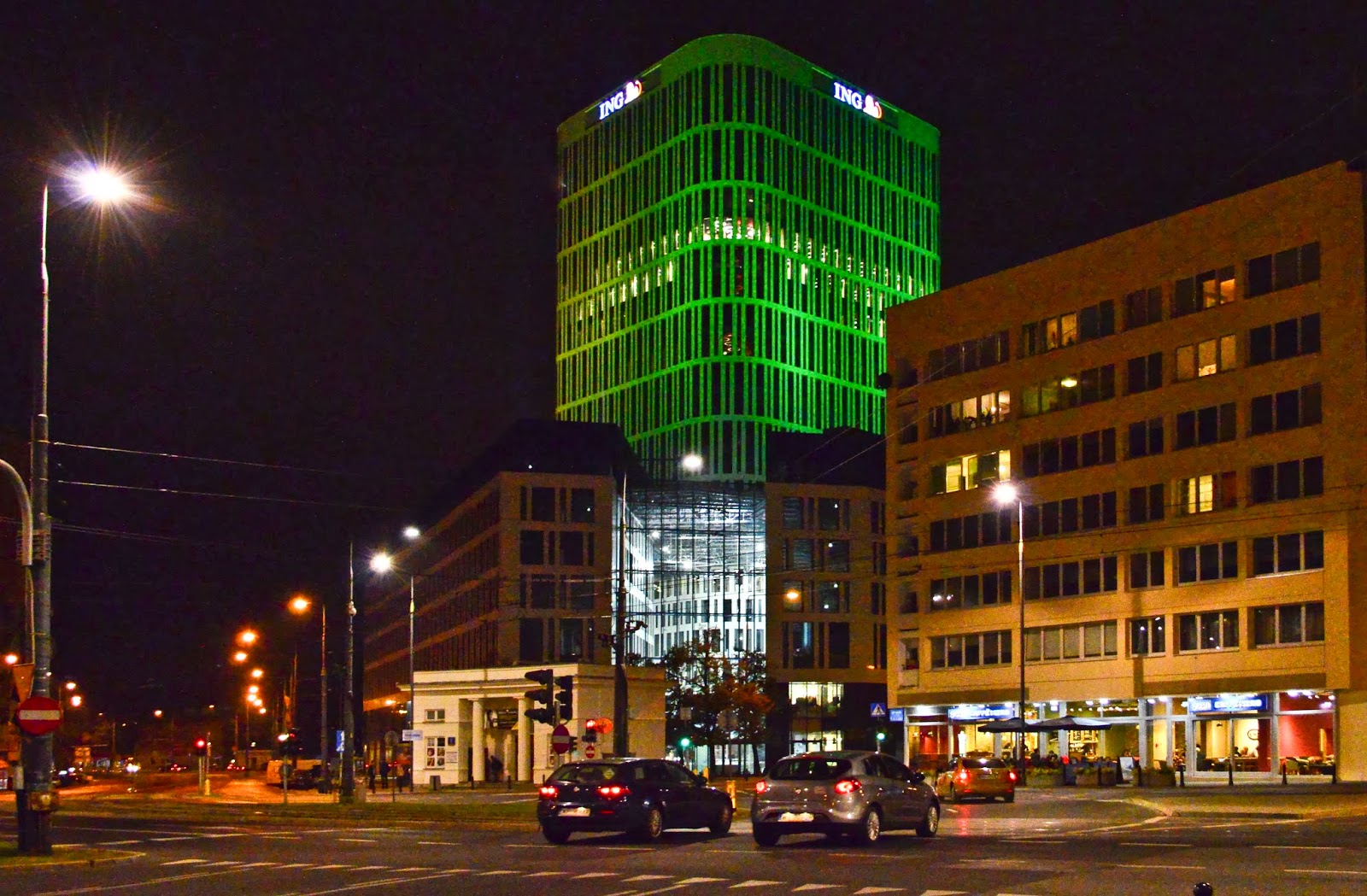

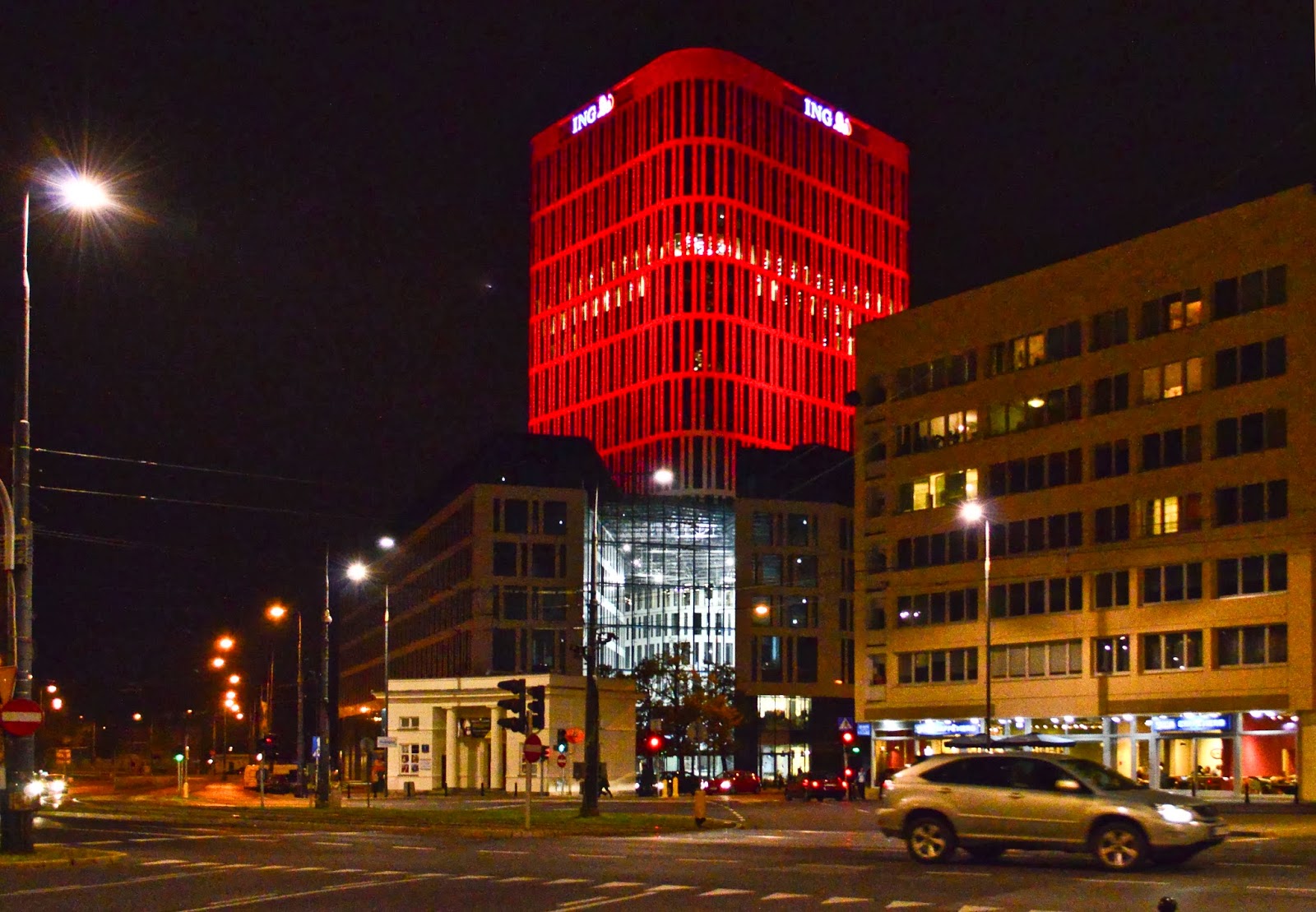

May I be the first to offer a popular name for the building... Kameleon?
This time last year:
Tatra time (worth another watch and listen!)
This time two years ago:
The passing of Old Poland
This time three years ago:
A glorious week
This time four years ago:
Trampled underfoot: Sobieski and the Turks at Vienna
This time five years ago:
The first, spontaneous signs, of a Park + Ride at Jeziorki
This time six years ago:
Early autumn atmospheres, Jeziorki
Sunday, 6 October 2013
In search of a decent ale
Until recently, I'd more or less given up hope on Polish beers. Too sweet, too strong, lacking in real flavour - a suspension of dust in sugary, alcoholised water that tend to give whopping hangovers after a modest intake. So for the last few years, I've drunk very little beer (in Poland anyway; in the UK there's no shortage of decent ales), sticking instead to red wine.
But things are looking up. Rather like the US, where a veritable explosion of microbreweries have overturned the traditional primacy of the big industrial-corporate brewers, Poland is on the verge of a beery revolution. Spearheaded by the 'you've never heard of this beer' hipster culture.
Round the corner from the British Business Centre (Marszałkowska 89), on ul. Żurawia, is a hipster bar called Spiskowcy Rozkoszy (literally 'the Conspirators of Delight') which has no fewer than six artisan ales available on tap. One I tried the other week was called 'King of Hop' from a microbrewery called Ale Browar. This beer, incredibly bitter from a massive overdose of hops, was so absolutely fantastic that its taste tantalised my memory for the next few days... I MUST TASTE IT AGAIN! When I returned to Spiskowcy Rozkoszy, it had gone; its place behind the bar taken by some other artisan ale of a less memorable character. When I checked the website of Ale Browar, it had gone.
But there are other hipster hangouts where Żywiec, Llllechhh and Tyskie are taboo. Cuda na Kiju (literally 'Miracles on a Stick' - the 'stick' being the beer tap) in the former headquarters of the Polish United Workers' Party also has some outstanding beers on offer. Below: a busy crowd on a Wednesday night - at last UK pub culture is taking hold, at least among Poland's younger, wealthier, urban consumers.

Here, one can try a beer called Atak Chmielu (literally 'Attack of Hops') from a microbrewery called Pinta. This is an American India Pale Ale brewed using imported American hops. It is advertised as being an uncompromisingly hoppy ale and so it is - fantastic stuff.
I shall be returning to this beer; its taste is so characteristic and strong that I feel I must have another goodly gulp in the near future.
Today I heard from Bob and Chris of another such bar with many artisan beers on tap on ul. Nowogrodzka, across the street from my old office. As such quality beer-drinking places spring up all over Warsaw, offering access to excellent beers made by people with a passion for brewing rather than by accountants, I feel I shall be returning to ale from time to time (though taking care to to expand in girth as a result!)
This time two years ago:
Poland's president inaugurates Moni's academic year
Autumn evening, central Warsaw
This time five years ago:
Short-term future of suburban development
This time six years ago:
"You'll look funny when you're fifty"
But things are looking up. Rather like the US, where a veritable explosion of microbreweries have overturned the traditional primacy of the big industrial-corporate brewers, Poland is on the verge of a beery revolution. Spearheaded by the 'you've never heard of this beer' hipster culture.
Round the corner from the British Business Centre (Marszałkowska 89), on ul. Żurawia, is a hipster bar called Spiskowcy Rozkoszy (literally 'the Conspirators of Delight') which has no fewer than six artisan ales available on tap. One I tried the other week was called 'King of Hop' from a microbrewery called Ale Browar. This beer, incredibly bitter from a massive overdose of hops, was so absolutely fantastic that its taste tantalised my memory for the next few days... I MUST TASTE IT AGAIN! When I returned to Spiskowcy Rozkoszy, it had gone; its place behind the bar taken by some other artisan ale of a less memorable character. When I checked the website of Ale Browar, it had gone.
But there are other hipster hangouts where Żywiec, Llllechhh and Tyskie are taboo. Cuda na Kiju (literally 'Miracles on a Stick' - the 'stick' being the beer tap) in the former headquarters of the Polish United Workers' Party also has some outstanding beers on offer. Below: a busy crowd on a Wednesday night - at last UK pub culture is taking hold, at least among Poland's younger, wealthier, urban consumers.

Here, one can try a beer called Atak Chmielu (literally 'Attack of Hops') from a microbrewery called Pinta. This is an American India Pale Ale brewed using imported American hops. It is advertised as being an uncompromisingly hoppy ale and so it is - fantastic stuff.
I shall be returning to this beer; its taste is so characteristic and strong that I feel I must have another goodly gulp in the near future.
Today I heard from Bob and Chris of another such bar with many artisan beers on tap on ul. Nowogrodzka, across the street from my old office. As such quality beer-drinking places spring up all over Warsaw, offering access to excellent beers made by people with a passion for brewing rather than by accountants, I feel I shall be returning to ale from time to time (though taking care to to expand in girth as a result!)
This time two years ago:
Poland's president inaugurates Moni's academic year
Autumn evening, central Warsaw
This time five years ago:
Short-term future of suburban development
This time six years ago:
"You'll look funny when you're fifty"
Saturday, 5 October 2013
Book review: Good night Dżerzi by Janusz Głowacki
I've written about playwright and author Janusz Głowacki before having read his autobiography, Z głowy (2004). Good night Dżerzi (2010) is a more serious work, based on the life of Jerzy Kosiński, the Polish-American novelist. The book's structure is exceptionally interesting, being a seamless blend of autobiography, biography and fiction. The trouble is with spotting where one genre ends and another begins.
For those who've come to the book familiar with the jocular tone of Z głowy, Good night Dżerzi opens as autobiography. Janusz Głowacki (Dżanus) is in New York. He's talking to a pair of Broadway producers about writing a play about the life of Jerzy Kosiński, who had committed suicide in 1991. Kosiński had achieving critical and popular acclaim with his books Painted Bird and Being There, the latter becoming an Oscar-winning film starring Peter Sellers. The former was about a boy wandering around wartime Poland, subjected to horrendous cruelties by Polish peasants. Kosiński left America thinking that Painted Bird was autobiographical; in fact he and his family were saved from the Holocaust by a Polish family.
Good night Dżerzi takes us into Kosiński's world. To what extent is it based on fact (Głowacki knew Kosiński well from his sojourn in New York in the early 1980s), and to what extent is it fiction, we can only speculate. For example, there's a scene in which Kosiński is asked to present awards at an Oscar ceremony. The producer's name is invented, as is probably much of the dialogue; but the event did happen. (Click here to see Kosiński at the 1982 Oscars.) What we don't know is how much of Głowacki's dialogue was based on conversations he may have had on the subject with Kosiński, and how much Głowacki just made up.
But hey, it's a novel, so Głowacki can be creative... But to what extent? The drifting between genres is unsettling at first, but after a while, begins to intrigue. The book follows Kosiński's fall from grace, encircled by a growing number of critics who are accusing him of plagiarism, of passing off fiction as autobiography, of manipulating editors and translators for his greater glory, and - the central thread of the novel - his callous exploitation of the women in his life.
The two Broadway producers we meet in the novel's opening have been approached by the husband of a woman that Kosiński has seduced. He is a wealthy German businessman and wants the story of the (now dead) Kosiński turned into a play. And Głowacki is the man to write it, being a) a playwright, b) a fellow-Pole and c) someone who knew Kosiński well.
Głowacki's novel about a play (to be turned into a film) he's writing about the life of a well-known author is set largely in New York City, largely among it's Russian immigrant community (the German's wife is Russian). This allows for many scenes, some with Kosiński, some with Głowacki, getting very drunk and in the depths of their drunkenness unearthing the deepest secrets of the creative soul.
Russia intrudes heavily in this book. Masha, the wife (and Kosiński's lover) is from Russia and through her we are shown a debased nation lacking in morality, drunken, debauched, lacking human values. The virus spreads with its emigrants to New York, its Little Russia on the Atlantic coast battered by storms, waves, high winds and pelting rain.
An ingenious book that questions the price that creative artists pay for achieving and clinging on to fame, Good night, Dżerzi would work well in English. The book was well received and well read in Poland; it could do well outside Poland too.
If I were to have any reservations about the book, it is with its ending; it lacks circularity; we don't return to the original premise and our two Broadway producers; it drifts away and ends somewhere else.
This time last year:
More serious setbacks on Second Metro line construction
This time three years ago:
Leonard Cohen in Katowice
This time five years ago:
The short-term future of suburban development (How right I was!)
For those who've come to the book familiar with the jocular tone of Z głowy, Good night Dżerzi opens as autobiography. Janusz Głowacki (Dżanus) is in New York. He's talking to a pair of Broadway producers about writing a play about the life of Jerzy Kosiński, who had committed suicide in 1991. Kosiński had achieving critical and popular acclaim with his books Painted Bird and Being There, the latter becoming an Oscar-winning film starring Peter Sellers. The former was about a boy wandering around wartime Poland, subjected to horrendous cruelties by Polish peasants. Kosiński left America thinking that Painted Bird was autobiographical; in fact he and his family were saved from the Holocaust by a Polish family.
Good night Dżerzi takes us into Kosiński's world. To what extent is it based on fact (Głowacki knew Kosiński well from his sojourn in New York in the early 1980s), and to what extent is it fiction, we can only speculate. For example, there's a scene in which Kosiński is asked to present awards at an Oscar ceremony. The producer's name is invented, as is probably much of the dialogue; but the event did happen. (Click here to see Kosiński at the 1982 Oscars.) What we don't know is how much of Głowacki's dialogue was based on conversations he may have had on the subject with Kosiński, and how much Głowacki just made up.
But hey, it's a novel, so Głowacki can be creative... But to what extent? The drifting between genres is unsettling at first, but after a while, begins to intrigue. The book follows Kosiński's fall from grace, encircled by a growing number of critics who are accusing him of plagiarism, of passing off fiction as autobiography, of manipulating editors and translators for his greater glory, and - the central thread of the novel - his callous exploitation of the women in his life.
The two Broadway producers we meet in the novel's opening have been approached by the husband of a woman that Kosiński has seduced. He is a wealthy German businessman and wants the story of the (now dead) Kosiński turned into a play. And Głowacki is the man to write it, being a) a playwright, b) a fellow-Pole and c) someone who knew Kosiński well.
Głowacki's novel about a play (to be turned into a film) he's writing about the life of a well-known author is set largely in New York City, largely among it's Russian immigrant community (the German's wife is Russian). This allows for many scenes, some with Kosiński, some with Głowacki, getting very drunk and in the depths of their drunkenness unearthing the deepest secrets of the creative soul.
Russia intrudes heavily in this book. Masha, the wife (and Kosiński's lover) is from Russia and through her we are shown a debased nation lacking in morality, drunken, debauched, lacking human values. The virus spreads with its emigrants to New York, its Little Russia on the Atlantic coast battered by storms, waves, high winds and pelting rain.
An ingenious book that questions the price that creative artists pay for achieving and clinging on to fame, Good night, Dżerzi would work well in English. The book was well received and well read in Poland; it could do well outside Poland too.
If I were to have any reservations about the book, it is with its ending; it lacks circularity; we don't return to the original premise and our two Broadway producers; it drifts away and ends somewhere else.
This time last year:
More serious setbacks on Second Metro line construction
This time three years ago:
Leonard Cohen in Katowice
This time five years ago:
The short-term future of suburban development (How right I was!)
Friday, 4 October 2013
Nearer to 60 than to 50
Today, I am 56. Oh dear! The pace of time accelerates with each passing year. A good time to consider ageing. At the age of ten, one year is one tenth of one's life experience. At the age of fifty, one year is one fiftieth of one's life experience.
Reaching the age of 56 (consider - this is a lot more than, say, 40), my greatest strength is the fact that my parents are alive and well - mentally and physically (no walking sticks) - aged 90 and 86 respectively. This gives me reason to consider that I'm in the mid-to-late summer of my life, with decades still to go. If one needs a target, 100 is a good one. 110 is better. And bearing in mind that 70 is the new 50, there are reasons to be cheerful.
I have 11 years to go before reaching my UK retirement age, but I feel no reason to let up. Professionally, I feel I've years to go before reaching my peak. I'm more confident, more experienced - and a better story-teller - than I've ever been.
Genes are an important factor in longevity, but then so is diet and so is exercise. An important piece of research suggests (at this stage merely suggests) that diet and exercise - and meditation - can actually extend our genetically-predetermined lifespans. Thirty minutes of exercise a day, six days a week, will go a long way to extend our lives. The simplest way to do that? Ditch the car. Walk briskly to the bus stop, walk briskly from the bus stop to the office, and back again, tot up all the walking you do each day - and that makes a difference. Ride a bicycle when the weather allows. Avoid salt snacks, cakes, biscuits, confectionary (all but the darkest chocolate) and gorge yourself on fresh fruit and vegetables. In season. Meat? A little, and only the choicest cuts (avoid processed meats). No smoking and moderate alcohol intake. All of these are proved to help extend human life.
What, then, is the point of a long life? I'm a slow learner, but when I learn something, I learn it well. What more do I want to learn? More about the purpose of life; where our consciousness stems from (biologically) and what it means (philosophically); I strive for the sublime aesthetic; I want to know whether our consciousness(es) is (are) finite and inexorably tied to our bodies' lifespan or can it (they) exist beyond the physical life of our bodies (I believe so - but seek confirmation).
This is as good incentive to keep a youthful approach to life, to keep pressing on. The Will is the Most important. If you want something enough, and it makes sense in the Great Scheme of Things, it will come to pass.
For the record, the day was entirely cloudless from sunrise to sunset, though there was a light ground frost this morning, though not enough to freeze puddles.
Turning 55
Turning 54
Turning 53
Turning 50
Reaching the age of 56 (consider - this is a lot more than, say, 40), my greatest strength is the fact that my parents are alive and well - mentally and physically (no walking sticks) - aged 90 and 86 respectively. This gives me reason to consider that I'm in the mid-to-late summer of my life, with decades still to go. If one needs a target, 100 is a good one. 110 is better. And bearing in mind that 70 is the new 50, there are reasons to be cheerful.
I have 11 years to go before reaching my UK retirement age, but I feel no reason to let up. Professionally, I feel I've years to go before reaching my peak. I'm more confident, more experienced - and a better story-teller - than I've ever been.
Genes are an important factor in longevity, but then so is diet and so is exercise. An important piece of research suggests (at this stage merely suggests) that diet and exercise - and meditation - can actually extend our genetically-predetermined lifespans. Thirty minutes of exercise a day, six days a week, will go a long way to extend our lives. The simplest way to do that? Ditch the car. Walk briskly to the bus stop, walk briskly from the bus stop to the office, and back again, tot up all the walking you do each day - and that makes a difference. Ride a bicycle when the weather allows. Avoid salt snacks, cakes, biscuits, confectionary (all but the darkest chocolate) and gorge yourself on fresh fruit and vegetables. In season. Meat? A little, and only the choicest cuts (avoid processed meats). No smoking and moderate alcohol intake. All of these are proved to help extend human life.
What, then, is the point of a long life? I'm a slow learner, but when I learn something, I learn it well. What more do I want to learn? More about the purpose of life; where our consciousness stems from (biologically) and what it means (philosophically); I strive for the sublime aesthetic; I want to know whether our consciousness(es) is (are) finite and inexorably tied to our bodies' lifespan or can it (they) exist beyond the physical life of our bodies (I believe so - but seek confirmation).
This is as good incentive to keep a youthful approach to life, to keep pressing on. The Will is the Most important. If you want something enough, and it makes sense in the Great Scheme of Things, it will come to pass.
For the record, the day was entirely cloudless from sunrise to sunset, though there was a light ground frost this morning, though not enough to freeze puddles.
Turning 55
Turning 54
Turning 53
Turning 50
Thursday, 3 October 2013
New shop or shopping centre for Jeziorki?
While in London last week, I received a tip from near-neighbour Marcin Daniecki (a big thanks!) that there's some construction going on by the old rampa na kruszywa site by W-wa Jeziorki station, just off ul. Karczunkowska. Marcin tells me that a Biedronka supermarket is being built here. Good news! Biedronka is famed for its quality Portuguese wines, and the more choice and the more competition the better when it comes to food and drink.
Below: a rough idea of where the new store will be (yellow box), superimposed on a Google Map (click to enlarge). Towards the top of the pic runs ul. Karczunkowska, with ul. Puławska some 1km to the east. The Warsaw-Radom railway line runs north-south down the map, with the island platform of W-wa Jeziorki station visible. The bus loop, where the 209 terminates and N83 night bus does an about turn, is visible on Karczunkowska to the right of the station.

A Google search (Karczunkowska+Biedronka) gives further information: the architects are TrybońPPI, and Technoprojekt will be building the shop and all the required infrastructure (HVAC, water and sewerage).
Below: looking east from the railway line. In the distance, the Sika warehouse. In the middle foreground, the new shop will appear.

Below: looking south from ul. Karczunkowska. As can be seen, the site's a fair distance from the main road. Ready-mix cement trucks are busying themselves around the foundations which the excavators are digging. To my layman's eye this looks like a brisk tempo.

Our new Lidl on Puławska was built in around nine months, but this looks like a more serious undertaking given its location quite some way off the main road. There are many questions that I'd like answered - the old rampa site is huge; the original plans by Spanish developer Sando Inmobiliaria have evaporated like a shallow puddle on a hot Andalusian afternoon. The plans envisaged several hundred houses and flats stretching out along the east side of the railway track towards Nowa Iwiczna.
The rampa was pulled down, and for years the land lay fallow, waiting for the economy to recover.
The land is still there - I'm delighted it will not be given over for housing (yet more cars trying to force their way into town along ul. Puławska). So if a Biedronka is to be built here - what else? A car park, for sure; although the retailer will not want Park+Riders leaving their cars here all day while they catch the train to town.
What will happen with the rest of the land, south of the Biedronka site? Who now owns this land (a distressed asset/fire-sale from a developer in trouble?) Other retailers? (a bookshop, an arts cinema, an English pub, a steak restaurant, a bicycle superstore, a camera shop?) Will there be a footbridge or pedestrian crossing from the railway station direct to the new Biedronka? Or will people have to walk a 400m detour to get here and get back to the train?
We shall wait and watch, following the most excellent pages on Skyscraper City, in particular posts on the [Ursynów Inwestycje] and [Piaseczno] Inwestycje sub-forums.
This time two years ago:
Moni leaves home for Łódź film school
(tomorrow she signs a contract with a film production company for her first screenplay...)
This time three years ago:
Out and about in Jeziorki
This time four years ago:
Funeral of Lt. Cmdr. Tadeusz Lesisz
This time five years ago:
Puławska by night
Below: a rough idea of where the new store will be (yellow box), superimposed on a Google Map (click to enlarge). Towards the top of the pic runs ul. Karczunkowska, with ul. Puławska some 1km to the east. The Warsaw-Radom railway line runs north-south down the map, with the island platform of W-wa Jeziorki station visible. The bus loop, where the 209 terminates and N83 night bus does an about turn, is visible on Karczunkowska to the right of the station.
A Google search (Karczunkowska+Biedronka) gives further information: the architects are TrybońPPI, and Technoprojekt will be building the shop and all the required infrastructure (HVAC, water and sewerage).
Below: looking east from the railway line. In the distance, the Sika warehouse. In the middle foreground, the new shop will appear.
Below: looking south from ul. Karczunkowska. As can be seen, the site's a fair distance from the main road. Ready-mix cement trucks are busying themselves around the foundations which the excavators are digging. To my layman's eye this looks like a brisk tempo.
Our new Lidl on Puławska was built in around nine months, but this looks like a more serious undertaking given its location quite some way off the main road. There are many questions that I'd like answered - the old rampa site is huge; the original plans by Spanish developer Sando Inmobiliaria have evaporated like a shallow puddle on a hot Andalusian afternoon. The plans envisaged several hundred houses and flats stretching out along the east side of the railway track towards Nowa Iwiczna.
The rampa was pulled down, and for years the land lay fallow, waiting for the economy to recover.
The land is still there - I'm delighted it will not be given over for housing (yet more cars trying to force their way into town along ul. Puławska). So if a Biedronka is to be built here - what else? A car park, for sure; although the retailer will not want Park+Riders leaving their cars here all day while they catch the train to town.
What will happen with the rest of the land, south of the Biedronka site? Who now owns this land (a distressed asset/fire-sale from a developer in trouble?) Other retailers? (a bookshop, an arts cinema, an English pub, a steak restaurant, a bicycle superstore, a camera shop?) Will there be a footbridge or pedestrian crossing from the railway station direct to the new Biedronka? Or will people have to walk a 400m detour to get here and get back to the train?
We shall wait and watch, following the most excellent pages on Skyscraper City, in particular posts on the [Ursynów Inwestycje] and [Piaseczno] Inwestycje sub-forums.
This time two years ago:
Moni leaves home for Łódź film school
(tomorrow she signs a contract with a film production company for her first screenplay...)
This time three years ago:
Out and about in Jeziorki
This time four years ago:
Funeral of Lt. Cmdr. Tadeusz Lesisz
This time five years ago:
Puławska by night
Monday, 30 September 2013
Observations from London's West End, W.C.

But there's more to the West End than Oxford Street shops, Theatreland and Leicester Square cinemas. You need to look up; look for history and then you will catch the real character. Above: St Giles-in-the-Fields, 'the poets' church'.
Below: 'Established 1830' - James Smith & Sons, Umbrellas on New Oxford St. A most splendid shop, very popular with American and Japanese tourists. Heritage cannot be imitated.

Below: today, a Pizza Express. Back in Edwardian times, the Dairy Supply Company Limited, on Coptic Street (and round the corner on Little Russell Street), London, West Central One.

Below: the Victorian church hall at the rear of St George's, Bloomsbury. A grimy building which reminds me of the state London was in before the sandblasting that restored most of the capital's edifices in the wake of the 1955 Clean Air Act. The church itself, in the background, is nice and clean; back in the 1960s, it was as grimy as the church hall. The sooty sombreness was how the London of my childhood appeared.


Below: Corner of Newton St. and Macklin St., London, W.C.2. St. Joseph's Catholic primary school. The building's rustic low-rise simplicity is at odds with the grandeur of the surroundings, just off Covent Garden.

Edwardian commercial where Monmouth St. (left) runs into leafy Shaftesbury Ave. (right). You are entering Theatreland. The shop on the corner will sell you tickets to the long-running jukebox musicals that seem to make up the bulk of the capital's theatrical fare this millennium.

Below: a benefactor remembered - Marmaduke Langdale provided this drinking fountain (not currently working) on Endell St. This plaque and the fountain below it were saved when the original building it was part of was knocked down.

London has a vast amount of character; but you won't find it unless you look up above eye level, and you actively seek the spirit of what once was the greatest city on earth.
Observations from the City of London
London is two cities in one; the City of Westminster, and to the east of it, the City of London. The latter is a very peculiar institution ruled over by a Corporation, and an annually-appointed Lord Mayor*, and its own police force. Just over one square mile (2.9km²) in area, home to a mere 7,375 people, but it is where 300,000 people work, generating 2.5% of the UK's GDP. If each of the remaining 94,059 square miles of the UK were to generate this amount of GDP, the country would be well over two thousand times wealthier than it currently is.
Below: St Paul's cathedral, seen at the top of Ludgate Hill. To count as a city in Britain, a town needs a diocesan cathedral. Westminster Abbey was given cathedral status by Henry VIII, sparing it from dissolution and turning Westminster into a city. (This is why small towns, such as Wells and Truro are Cities, despite having populations of only 10,000 and 20,000 respectively.) Today, the City of London and the City of Westminster function as two of the 32 boroughs of Greater London.

Street signs in the City (below) sport the coat of arms. If the typeface looks familiar, it's because it's Albertus, beloved of The Prisoner TV series fans. The names are interesting - Pageantmaster Court - the pageantry, ceremony and heritage beloved of the City. Old Fish Street Hill demonstrates the dangers of trying to translate street names into foreign languages (Górka Starej Ulicy Rybnej), and resonates with history. And a finally, a double-take: Greed Lane (apposite) or Creed Lane (historic)?

 Left: the College of Arms, which has been in existence since 1484 and present on this spot since 1555, is the authority that grants permissions to use coats of arms, heraldic devices, flags, and other national symbols.
The College of Arms is one of those institutions that maintains Britain's strong traditions as a sovereign monarchy, it dwells on the minutiae of genealogy and aristocratic pedigree, letters patent and precedence at court.
A part of the Royal Household, heralds from the College of Arms take part in royal ceremonies, such as the State Opening of Parliament. The College's location reinforces the link between the Monarch and the City of London. (Scotland has its own equivalent of the College of Arms, the Court of the Lord Lyon).
Below: you need to see the sign to know it's not a joke. The church of Saint Andrew by-the-Wardrobe (Świętego Andrzeja przy garderobie). The wardrobe in question belonged to Edward III, who moved his fine clothes and armour to this part of the City in 1361. William Shakespeare was a member of this parish for 15 years. The original church burnt down in the Great Fire of London (1666), the current building was designed by Sir Christopher Wren, destroyed by the Luftwaffe and rebuilt after the war.

 Left: a traditional City pub - the Cockpit on St. Andrew's Hill. I was intrigued to see the Courage Brewery logo on this Victorian pub - I'd thought it had long gone for a Burton. But no, the gold cockerell on red background is still proudly there, now owned by the Wells and Youngs Brewery after having been part of Imperial Tobacco, Hanson Trust, Foster's Brewing Group, Grand Metropolitan and Scottish & Newcastle. After all those travails, its good to see the brand has survived, having supped back a bottle of Courage Director's ale in Opole the other week.

The City is steeped in tradition, power and wealth, something reflected in its architecture. I'd like to delve deeper down the passageways and thoroughfares of the Square Mile, to dig up more architectural gems and historical treasures. It is a most fascinating part of London.
* It is important not to confuse the Lord Mayor of the City of London with Boris Johnson, who is the Mayor of London. The Lord Mayor is essentially an unpaid ambassador for the City's financial services industry, who travels the world, delivering hundreds of speeches during his (or indeed her) year-long term of office.
This time last year:
Civilising Jeziorki's wetlands
This time two years ago:
Warsaw's Aleje Jerozolimskie
This time three years ago:
Melancholy autumn mood in Łazienki
This time five years ago:
Autumn gold, Zamienie
This time six years ago:
Flamenco Sketches - Seville
Below: St Paul's cathedral, seen at the top of Ludgate Hill. To count as a city in Britain, a town needs a diocesan cathedral. Westminster Abbey was given cathedral status by Henry VIII, sparing it from dissolution and turning Westminster into a city. (This is why small towns, such as Wells and Truro are Cities, despite having populations of only 10,000 and 20,000 respectively.) Today, the City of London and the City of Westminster function as two of the 32 boroughs of Greater London.

Street signs in the City (below) sport the coat of arms. If the typeface looks familiar, it's because it's Albertus, beloved of The Prisoner TV series fans. The names are interesting - Pageantmaster Court - the pageantry, ceremony and heritage beloved of the City. Old Fish Street Hill demonstrates the dangers of trying to translate street names into foreign languages (Górka Starej Ulicy Rybnej), and resonates with history. And a finally, a double-take: Greed Lane (apposite) or Creed Lane (historic)?


The College of Arms is one of those institutions that maintains Britain's strong traditions as a sovereign monarchy, it dwells on the minutiae of genealogy and aristocratic pedigree, letters patent and precedence at court.
A part of the Royal Household, heralds from the College of Arms take part in royal ceremonies, such as the State Opening of Parliament. The College's location reinforces the link between the Monarch and the City of London. (Scotland has its own equivalent of the College of Arms, the Court of the Lord Lyon).
Below: you need to see the sign to know it's not a joke. The church of Saint Andrew by-the-Wardrobe (Świętego Andrzeja przy garderobie). The wardrobe in question belonged to Edward III, who moved his fine clothes and armour to this part of the City in 1361. William Shakespeare was a member of this parish for 15 years. The original church burnt down in the Great Fire of London (1666), the current building was designed by Sir Christopher Wren, destroyed by the Luftwaffe and rebuilt after the war.


Below: one hundred years ago, the underground passages linking Cannon Street and Queen Victoria Street were opened. It is worth noting that the Corporation of the City of London is quite different to any local authority in the UK, with ancient privileges and a unique relationship with the Crown.

The City is steeped in tradition, power and wealth, something reflected in its architecture. I'd like to delve deeper down the passageways and thoroughfares of the Square Mile, to dig up more architectural gems and historical treasures. It is a most fascinating part of London.
* It is important not to confuse the Lord Mayor of the City of London with Boris Johnson, who is the Mayor of London. The Lord Mayor is essentially an unpaid ambassador for the City's financial services industry, who travels the world, delivering hundreds of speeches during his (or indeed her) year-long term of office.
This time last year:
Civilising Jeziorki's wetlands
This time two years ago:
Warsaw's Aleje Jerozolimskie
This time three years ago:
Melancholy autumn mood in Łazienki
This time five years ago:
Autumn gold, Zamienie
This time six years ago:
Flamenco Sketches - Seville
Subscribe to:
Posts (Atom)


 Posts
Posts


