Following up on my recent post about familiarity, tradition and identity, I'd like to focus on music.
Let me start with a quote from the Polish classic cult comedy film, Rejs.
Inżynier Mamoń: "Proszę pana, ja jestem umysł ścisły, mnie się podobają melodie, które już raz słyszałem... po prostu. No, to poprzez, no, reminiscencje. No jakże mi się możne podobać piosenka, którą pierwszy raz słyszę?"
[Rough translation... Engineer Mamoń: "I have a scientific mind, Sir; I simply like melodies that I've once already heard, Well, it's through - reminiscences. Well, how could I like a song that I'm hearing for the first time?"]
How indeed. Out of interest, I looked up the UK singles charts for this week 50 years ago. Of the Top 30, I knew pretty well every single song. Familiar songs, familiar singers, bands - from Marmalade's Oh-Bla-Di Oh-Bla-Da (a Paul McCartney composition), number 1 in mid-January 1969, through the theme music to The Good, the Bad and the Ugly, Canned Heat's Up the Country, Stevie Wonder's For Once In My Life or Blackberry Way by the Move. My final year at primary school, the beginning of my last (full) year living in Hanwell, this for me was the soundtrack of Class 4I at Oaklands Road Primary School.
From 40 years ago this week similar blast of familiarity - Ian Dury, Funkadelic, Chic, the Clash, Third World, Rod Stewart. Songs that remind me of where I was and how I felt (I associate many of these songs, still in the charts from the Christmas break when I was working at a Tesco warehouse in Coventry).
Over this Christmas break I asked my son Eddie, 23, to name one song that was in the charts at any time in 2018. He could not. (Neither could I, but that's not surprising). Pop today is pap, driven by algorithms that take the diversity and risk out of the music business. A tiny number of artists churn out similar sounding songs with hooks created to stick in the memory - the 'earworm' phenomenon. Gone is the rich aural texture of the 1970s. I am talking about the mainstream, about what would be on in the background, played on radios everywhere.
Inżynier Mamoń's immortal words came back to me after our Christmas drive from London to see my brother and his family. Moni had brought along her smartphone which she linked to our rented Mini's stereo system via wi-fi; we then played music streamed from the internet via Spotify. [A short aside - in my lifetime, we have progressed from in-car entertainment as being none, then AM radio the FM radio, then music cassettes, then CDs, then MP3s and now internet streaming.] Anyway, there were a few songs in Moni's playlist which I knew from the original and Moni from the cover. After hearing the cover, I suggested we listen to the original; unsurprisingly, I preferred the original, and Moni the cover - which she'd come across first, before hearing the original.
We prefer that which we hear first, that with which we are more familiar. "Some people won't dance if they don't know who's singing," sang Shirley Bassey in the Propellerheads' History Repeating. Quite. If the DJ's playing something unfamiliar to me, I won't tap a foot.
Music and memory are inextricably linked and again linked to identity. From national anthems to dance-floor anthems, we are bound together in communities by tunes and beats. But is it just a matter of familiarity? Is there something that makes one piece of music intrinsically better than another? Or is it just a matter of taste? De gustibus non est disputandum - in matters of taste, there can be no disputes. Or can there? From any objective measure, a Chopin nocturne is far more sublime than a piece of Disco Polo, played using two keys on a pocket calculator. But how to settle arguments as to whether Pink Floyd were better before or after Dark Side of the Moon? I'd say before. Much better. in fact. The Wall is crap compared to Atom Heart Mother. But why?
Science is nearer to understanding how different aspects of music - timbre, tempo, musical internal, tone, beat - in particular, their complexity - is received by the human brain. Instinct will help you find the beat and move your feet. But how a piece of music is received by your consciousness, the nuance of mood, the pictures in your mind - is a different matter. Bach's music is mathematical and precise, I find it sterile; it does not create a klimat in my consciousness other than a generic early-18th century feel. Chopin, on the other hand, is far more evocative - moonlit nights in Mazowsze.
How do you react to the unfamiliar? Do you seek connections to something that you can relate to, something you've heard before? Something you cannot recall, something you have no memory of, something that Inżynier Mamoń could not possibly like, having not heard it before?
Try this. My brother sent me a link to this - Ethiopian jazz from the late 1960s/early 1970s. Give it a try - familiar?
My brother likens this to "walking into a cloud of ground Lebanese cardamom coffee". What do you think? I'd welcome your comments!
Final thought... Looking at that Top Thirty from 50 years ago, I came across a Herman's Hermits song, which has been giving me earworm. As I reach the hook in the chorus, I get the distinct memory of the smell of plastic cement (Airfix glue). I wonder what plastic model I was sticking together on a winter's day in January 1969 as I listened to Something's Happening?
This time two years ago:
On taxation and (national) defamation
This time six years ago:
Where's Britain going to be in Europe?
This time eight years ago:
Jeziorki under water
This time nine years ago:
In a nutshell - the best science book I've ever read
This time ten years ago:
Flashback to communist times
This time 11 years ago:
Pre-dawn Ursynów
Thursday, 17 January 2019


Wednesday, 16 January 2019
Signals from space... what is the meaning of 187.5?
At this deeply depressing time, some interesting intergalactic news for us humans... Last week, astronomers at Canada's CHIME observatory in British Columbia detected - for only the second time ever - repeating fast radio bursts emitted from within a distant galaxy.
Now, fast radio bursts (FRBs) are in themselves a mystery - ever since the first one was discovered in 2007 (although detected in 2001 it was found only six years later in archival data) astronomers still don't know what causes them. They are radio pulses from a fraction of a millisecond to a few milliseconds in length, originating outside the Milky Way.
Until the first set of repeating FRBs was detected at the Arecibo radio telescope in 2015, they were considered to be one-off events caused by say, a star falling into a black hole or radio waves from a similar cosmic cataclysm. But the repeating FRBs detected in 2015 suggested this could not be the case - the source had to be something different, something that was capable of sending pulses of radio bursts over and over again.

The mysterious nature of FRBs is deepened by the fact that until the 2015 discoveries, all FRBs detected had dispersion measures that were multiples of the number 187.5. This bizarre characteristic led some commentators to suggest that alien intelligence stood behind these bursts. Below: this from the New Scientist, 31 March 2015. [FRBs are numbered by the date of their detection in the format YYMMDD, so 110703 is 7 March 2011]

FRBs detected after 2015 have tended not to have dispersion measures that can be multiplied by 187.5, to the chagrin of alien numerologists looking for meaning in coincidence. But the above graph still shows something of extremely low (1 in 5,000) probability.
A further mystery is that sources of FRBs are believed to be from outside our galaxy - indeed from many different galaxies. Whatever it is that's causing them seems to be distributed widely across the universe and functioning in the same way.
Some UFOlogists have been suggesting that FRBs are signals beamed to us by intelligent beings. However, a more scientifically acceptable hypothesis is that they are pulses coming from spaceships using some kind of propulsion system that uses fast radio bursts. As the signals come from within galaxies one and half to three billion light-years from earth, the chances that aliens are signaling to us are remote; after all, one and half billion years ago, life on Earth had just evolved to simple, multicellular organisms. The spaceship theory is more readily acceptable!
Astronomers at CHIME are no doubt sharing their data with scientists around the world and work on understanding FRBs has recently (as of last week) become enriched with these new observations. Until someone comes up with a solid theory of what causes FRBs, in particular repeating FRBs - please, accept the mystery!
This time last year:
Ice - proceed with utmost care
This time two years ago:
In which I see a wild boar crossing the frozen ponds
This time three years ago:
Communicating the government's case in English
This time five years ago:
Thinking big, American style. Can Poles do it?
This time six years ago:
Inequality in an age of economic slowdown
This time seven years ago:
The Palace of Culture: Tear it down?
This time nine years ago:
Conquering Warsaw's highest snow mounds
This time ten years ago:
Flashback on way to Zielona Góra
This time 11 years ago:
Ursynów, winter, before sunrise
Now, fast radio bursts (FRBs) are in themselves a mystery - ever since the first one was discovered in 2007 (although detected in 2001 it was found only six years later in archival data) astronomers still don't know what causes them. They are radio pulses from a fraction of a millisecond to a few milliseconds in length, originating outside the Milky Way.
Until the first set of repeating FRBs was detected at the Arecibo radio telescope in 2015, they were considered to be one-off events caused by say, a star falling into a black hole or radio waves from a similar cosmic cataclysm. But the repeating FRBs detected in 2015 suggested this could not be the case - the source had to be something different, something that was capable of sending pulses of radio bursts over and over again.

The mysterious nature of FRBs is deepened by the fact that until the 2015 discoveries, all FRBs detected had dispersion measures that were multiples of the number 187.5. This bizarre characteristic led some commentators to suggest that alien intelligence stood behind these bursts. Below: this from the New Scientist, 31 March 2015. [FRBs are numbered by the date of their detection in the format YYMMDD, so 110703 is 7 March 2011]

FRBs detected after 2015 have tended not to have dispersion measures that can be multiplied by 187.5, to the chagrin of alien numerologists looking for meaning in coincidence. But the above graph still shows something of extremely low (1 in 5,000) probability.
A further mystery is that sources of FRBs are believed to be from outside our galaxy - indeed from many different galaxies. Whatever it is that's causing them seems to be distributed widely across the universe and functioning in the same way.
Some UFOlogists have been suggesting that FRBs are signals beamed to us by intelligent beings. However, a more scientifically acceptable hypothesis is that they are pulses coming from spaceships using some kind of propulsion system that uses fast radio bursts. As the signals come from within galaxies one and half to three billion light-years from earth, the chances that aliens are signaling to us are remote; after all, one and half billion years ago, life on Earth had just evolved to simple, multicellular organisms. The spaceship theory is more readily acceptable!
Astronomers at CHIME are no doubt sharing their data with scientists around the world and work on understanding FRBs has recently (as of last week) become enriched with these new observations. Until someone comes up with a solid theory of what causes FRBs, in particular repeating FRBs - please, accept the mystery!
This time last year:
Ice - proceed with utmost care
This time two years ago:
In which I see a wild boar crossing the frozen ponds
This time three years ago:
Communicating the government's case in English
This time five years ago:
Thinking big, American style. Can Poles do it?
This time six years ago:
Inequality in an age of economic slowdown
This time seven years ago:
The Palace of Culture: Tear it down?
This time nine years ago:
Conquering Warsaw's highest snow mounds
This time ten years ago:
Flashback on way to Zielona Góra
This time 11 years ago:
Ursynów, winter, before sunrise
Sunday, 13 January 2019
More Kraków pics - snow, dusk... klimat
A few more pics from Thursday's visit to Kraków...
Kraków is a city heavily visited by tourists for ten and half months of the year; once the Christmas and New Year's festivities finish with Three Kings, it gets quiet until late February. We arrive for an event at the excellent Hotel Indigo on ul. Św. Filipa (highly recommended - in particular the higher-ceilinged rooms on the first and second floors). An hour before the event starts, time for a walk to take in the klimat. It's magic hour, dusk is falling, snow is swirling lightly, a pleasant aura. In the distance, St Florian's basilica.

Below: looking down ul. Krótka ('Short Street') towards ul. Krzywa ('Crooked Street').

Below: a shop on ul. Długa ('Long Street'), splendid atmosphere!

Below: looking down ul. Długa; note the no-entry sign to the right, under which is a long list of vehicles to which the sign does not apply - just about everyone with a vested interest in the status quo! Imagine stopping your car in front of the sign and taking the time to read the notice from end to end (click to enlarge)...

Below: Plac Matejki, looking towards the Barbakan and the old city walls. One gets the feeling that it's difficult to get any view of Kraków that doesn't include a) a church and b a hotel.

Below: the Brama Floriańska gate in the city wall.

Below: looking down ul. Szpitalna ('Hospital Street'), with the Teatr Słowackiego to the left.

Below: crossing the tram tracks on ul. Pawia on our way back to the station to catch the late-evening train back to Warsaw. Kraków Główny lies on the other side of the Galeria Krakowska shopping mall, still open to allow pedestrian access to the station (until 22:00).

In three months' time, Kraków will be solid with tourists. At this time of year, one can appreciate its innate beauty.
This time last year:
Jeziorki mid-January catch-up
This time two years ago:
On ice
This time three years ago:
Tweeting and blogging
This time five years ago:
The sad truth about the pavement for Karczunkowska
This time nine years ago:
A haul of wintery wonderfulness
This time ten years ago:
Optimal way to work?
This time 11 years ago:
Highest point in Jeziorki
(photos of the Rampa before demolition)
Friday, 11 January 2019
Familiarity, tradition and identity
Kraków, near the Barbakan. Christmas illuminations still on, many tourists still wandering around. I came across this fellow (below) who was surrounded by an American couple, several Spanish students and some middle-aged Brits, all taking photos with their phones. I waited until everyone got their selfies then took some snaps myself.

Here he is, familiar, isn't he - the Lajkonik or tatarzyna on his hobby horse, with long pointy beard, a marshal's baton (buława) in his hand, a pointy hat with crescent moon on it. He's familiar to anyone growing up Polish - part of the national myth, along with the Hejnał Mariacki that dates back to the Mongol invasion of Poland. It is something we learned about in Polish Saturday-school lessons in our British childhood, a simplified part of a simplified, mythologised story of our people.
But for the foreign tourists the figure is strange, unfamiliar - exotic; what does it prompt them to think about Kraków, about Poland, even subliminally?
What surrounds us becomes familiar. We move across geographies, more importantly we move through time. Walking the same West London streets that I walked over 50 years ago, I have seen old familiar things disappear and new things taking their place. The cars. The Austin A40s and Vauxhall Crestas were replaced by Hillman Avengers and Ford Grenadas, then Golf GTIs and Toyota Carinas, now Nissan Jukes and Audi Q5s. Road signs, street lights. High-street shops change. Dolcis, Tru-Form and Woolworth's have gone. The people that inhabit these streets change. Their clothes, even their smell. We've become more hygienic. Newcomers - at first from the former colonies, then from the Continent.
Things change, and if we are not aware of these imperceptible small changes as they happen, their loss can breed a longing for the past. And this subconscious longing, when linked to a resentment stemming from the lack of success in one's life, can make one susceptible to false myths peddled by populism.
Over the centuries the Lajkonik has come to symbolise something that never happened. The Krakovians didn't successfully repel the Mongol hordes - the Mongol hordes continued to invade, occupy, capture, destroy and harass Polish cities for the best part of 250 years, right up to the end of the 15th century. But at Corpus Christi, the myth is celebrated, the Lajkonik parades around Kraków's old town market square. He is a familiar part of Kraków's history and tradition, even though no one is quite sure how that tradition emerged.
I suspect that many national myths evolve in similar ways; King Arthur burning the cakes, King Canute bidding the tide not to come in, King Charles II hiding in an oak. Stories that through their familiarity form part of our national identity.
How we deal with the unfamiliar is problematic. Some of us are open to the new, we are curious, we do not feel threatened by change. Some of us are closed to it. And with that come dangers.
This time last year:
Black hat merry-go-round
(I've found four so far this season)
This time two years ago:
Skarzysko-Kamienna and Starachowice, by train
This time three years ago:
The world mourns the loss of David Bowie
This time five years ago:
Where's the snow?
This time seven years off:
Two drink-free days a week, British MPs urge
This time eight years ago:
Depopulating Polish cities?
This time nine years ago:
Powiśle on a winter's morning
This time ten years ago:
Sunny, snowy Jeziorki
This time 11 years ago:
Eddie's giant soap bubble

Here he is, familiar, isn't he - the Lajkonik or tatarzyna on his hobby horse, with long pointy beard, a marshal's baton (buława) in his hand, a pointy hat with crescent moon on it. He's familiar to anyone growing up Polish - part of the national myth, along with the Hejnał Mariacki that dates back to the Mongol invasion of Poland. It is something we learned about in Polish Saturday-school lessons in our British childhood, a simplified part of a simplified, mythologised story of our people.
But for the foreign tourists the figure is strange, unfamiliar - exotic; what does it prompt them to think about Kraków, about Poland, even subliminally?
What surrounds us becomes familiar. We move across geographies, more importantly we move through time. Walking the same West London streets that I walked over 50 years ago, I have seen old familiar things disappear and new things taking their place. The cars. The Austin A40s and Vauxhall Crestas were replaced by Hillman Avengers and Ford Grenadas, then Golf GTIs and Toyota Carinas, now Nissan Jukes and Audi Q5s. Road signs, street lights. High-street shops change. Dolcis, Tru-Form and Woolworth's have gone. The people that inhabit these streets change. Their clothes, even their smell. We've become more hygienic. Newcomers - at first from the former colonies, then from the Continent.
Things change, and if we are not aware of these imperceptible small changes as they happen, their loss can breed a longing for the past. And this subconscious longing, when linked to a resentment stemming from the lack of success in one's life, can make one susceptible to false myths peddled by populism.
Over the centuries the Lajkonik has come to symbolise something that never happened. The Krakovians didn't successfully repel the Mongol hordes - the Mongol hordes continued to invade, occupy, capture, destroy and harass Polish cities for the best part of 250 years, right up to the end of the 15th century. But at Corpus Christi, the myth is celebrated, the Lajkonik parades around Kraków's old town market square. He is a familiar part of Kraków's history and tradition, even though no one is quite sure how that tradition emerged.
I suspect that many national myths evolve in similar ways; King Arthur burning the cakes, King Canute bidding the tide not to come in, King Charles II hiding in an oak. Stories that through their familiarity form part of our national identity.
How we deal with the unfamiliar is problematic. Some of us are open to the new, we are curious, we do not feel threatened by change. Some of us are closed to it. And with that come dangers.
This time last year:
Black hat merry-go-round
(I've found four so far this season)
This time two years ago:
Skarzysko-Kamienna and Starachowice, by train
This time three years ago:
The world mourns the loss of David Bowie
This time five years ago:
Where's the snow?
This time seven years off:
Two drink-free days a week, British MPs urge
This time eight years ago:
Depopulating Polish cities?
This time nine years ago:
Powiśle on a winter's morning
This time ten years ago:
Sunny, snowy Jeziorki
This time 11 years ago:
Eddie's giant soap bubble
Wednesday, 9 January 2019
Warsaw's pre-war autostrada, a royal visit and menthol cigarettes
For my father
Last week my father mentioned an interesting memory that I remember him once talking about in the past. He recalled the visit to Warsaw of King Carol II of Romania, and his son, Prince Michael, in 1937. Crowds of Varsovians lined the road between Pole Mokotowskie and Okęcie. A bit of googling, and I found some Pathé newsreel footage of the visit.
My father, who would have been 14 at the time, turned up with a group of his friends, and someone had some menthol cigarettes, which they tried, and agreed were modern and sophisticated. He said they walked from Pole Mokotowskie (by then no longer Warsaw's main airport but still a military base) down towards Okęcie, which since 1934 had been serving passenger traffic. My father mentioned 'autostrada' - a name that clicked with me, as I had been intrigued by this on a 1935 railway timetable (below).

A whole heap of interesting history here. Warsaw had but one main railway station, Warszawa Główna (since replaced by W-wa Centralna for inter-city trains and W-wa Śródmieście for suburban trains). W-wa Główna was flanked then as now by W-wa Wschodnia and W-wa Zachodnia, but note the '(p.o.)' after Warszawa Zach. The initials, 'przystanek osobowy', the equivalent of a halt rather than a station. It was not until the 1970s, when the bus station was built next to the railway station, did W-wa Zachodnia take on greater importance. Now, the fascinating bit is what comes next - Lotnisko (p.o.), Autostrada (p.o) and Okęcie. Also of note: in 1935 the steam hauled 'all stations' service from W-wa Zachodnia to Radom journey took 2hrs 9mins (dep. 08:00, arr. 10:09). If you were to do the same journey today, it would take 2hrs 28mins (dep. 07:59, arr. 10:27). Eighty-four years later and the same journey takes an extra 19 minutes!
Anyway, I digress. After the war, the line between Zachodnia and Okęcie was relaid and straightened out. Okęcie station was built originally where it is today. However, no trace remains of either Lotnisko or Autostrada halts, lying as they did to the south of the present line, parallel to the stretch between W-wa Rakowiec and W-wa Żwirki i Wigury. Parts of the original line ran alongside what would become ul. 17 Stycznia, even the trained eye cannot spot any vestiges. In any case, Autostrada was renamed Wyczółki in June 1936, so a year before King Carol II's visit. And the first proper plans of a Polish motorway/expressway network were not discussed until the 1st Congress of Polish Engineers in Lwów in September 1937, so the 'autostrada' name was someone jumping the gun.
May I recommend the highly fascinating Baza Kolejowa website, the most authoritative resource on Polish railways today and in history. Here's the link to the interactive map showing where the stops between W-wa Zachodnia and W-wa Okęcie used to be before the war. Check the box 'mapa interaktywna' to show the location of old railway lines around the airport.
As to Autostrada - this was meant to have been the extension of ul. Żwirki i Wigury (named after Poland's flying aces who died in a plane crash in 1934), but the extension of the runways at Okęcie airport put an end to that plan, after which the railway halt lost its rather exotic (for the time) name.
Here's how that part of Warsaw looked back then - a 1939 map of the area around Okęcie (below).

Finally, Poland's National Digital Archives (NAC) have some excellent photos from the visit of King Carol II, which can be viewed here. A total of 53 high-quality black-and-white photos in all, of which I've selected one (below), the Romanian king and Polish premier Ignacy Mościcki inspecting Polish troops on Pole Mokotowskie.

Ah! Another good photo has popped up - this from Wikimedia Commons... King Carol II decorates the standard of the Polish 57th Infantry Regiment (could well be a reverse-angle shot from the one above).

Some more on prewar railway times from Warsaw to Radom here, and a link from that post to a useful prewar map resource here.
This time last year:
Transport news
This time two days ago:
Uneasy Sunny Day - smog
This time three years ago:
Public media? State media? Party media?
[yet another year of not watching a single second of TVP1]
This time four years ago:
Beer, consumer choice and the Meaning of Life
This time five years ago:
What's Cameron got against us Poles?
The time seven years ago:
Anyone still remember the Przybyl case?
This time eight years ago:
Wetlands midwinter meltdown
This time nine years ago:
Jeziorki rail scenes, winter
This time ten years ago:
Winter drivetime, Jeziorki
This time 11 years ago:
Kraków, a bit of winter sunshine
Sunday, 6 January 2019
Jakubowizna in midwinter
Due to my long stay in London, I've not been able to visit Jakubowizna for nearly a month (last visit was 8 December). Now that the house is alarmed and fitted with security glass, I feel a lot more relaxed about leaving it unattended. Underfloor heating kept on to keep the frosts at bay. Good to be back! I managed a fair bit of writing (well, editing actually) and some rural peace and quiet.
Below: the road to my działka, snow falling gently, temperature a reasonable -6C.

Looking back with a longer lens as a Warsaw-bound train heads north. Just ten minutes from the station to my działka - a bit longer in the slippy conditions (best to walk on the virgin snow, rather than that which has been compacted by passing traffic).

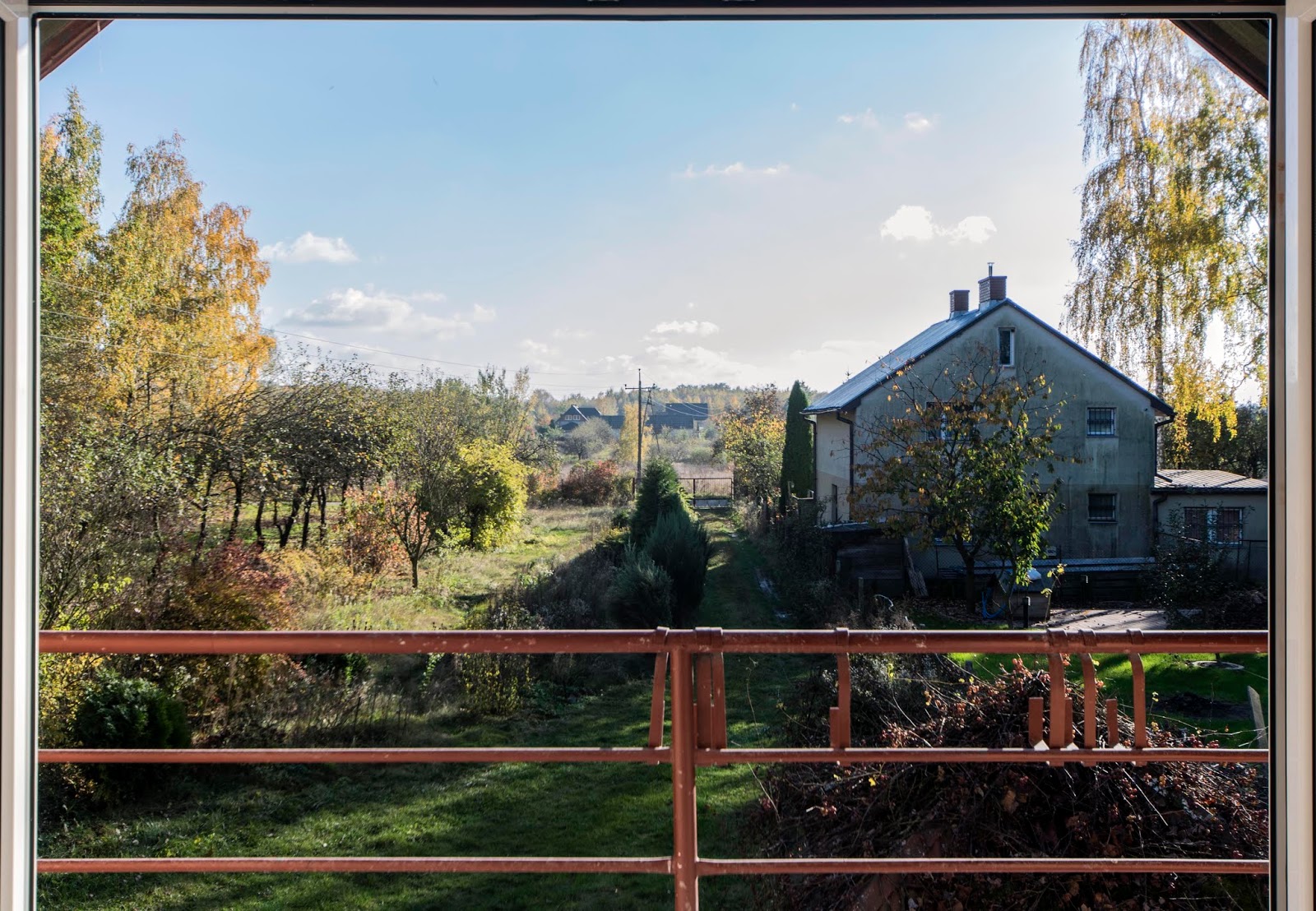
Below: view from my balcony window today...

...and from an autumnal visit (on 21 October 2018) below.

I await the spring! The sun sets in Warsaw at 15:39, whilst in London, today's sunset is at 16:08 local time, nearly half an hour later. This time next year, we'll be enjoying an extra hour of evening daylight at this dark time of year.
Below: wide-angle shot of the road towards the station.

Below: the level crossing north of Chynów station.

Below: I popped my head out of the train at Sułkowice station, the stop between Chynów and Czachówek. This is the first station to be undergoing modernisation on the section of the line between Czachówek and Warka. The platform has been bisected; half will be ripped up soon, to be replaced by a new one (the retaining walls are now visible across the track bed). This will be the 'up' platform, and once new track has been laid, it will serve both 'up' and 'down' trains until the new 'down' platform is built and 'down' track laid.

This all will take time; my guess is that in the summer of 2020 the line from Warsaw all the way down to Warka will have been modernised, shaving a few minutes off travel time.
Below: a walk home in the dusk, from W-wa Jeziorki station along ul. Nawłocka.

This time last year:
Warm winter's day in Jakubowizna
This time two years ago:
Seeking an aesthetic in the Grim
This time three years ago:
UK overtakes France as the World's 5th Biggest Economy
This time six years ago:
Ice in the Vistula
This time nine years ago:
A consolation to my British readers
This time ten years ago:
Winter in its finery
The time 11 years ago:
Snow fences keep the trains running
Below: the road to my działka, snow falling gently, temperature a reasonable -6C.

Looking back with a longer lens as a Warsaw-bound train heads north. Just ten minutes from the station to my działka - a bit longer in the slippy conditions (best to walk on the virgin snow, rather than that which has been compacted by passing traffic).

Below: view from my balcony window today...

...and from an autumnal visit (on 21 October 2018) below.
I await the spring! The sun sets in Warsaw at 15:39, whilst in London, today's sunset is at 16:08 local time, nearly half an hour later. This time next year, we'll be enjoying an extra hour of evening daylight at this dark time of year.
Below: wide-angle shot of the road towards the station.

Below: the level crossing north of Chynów station.

Below: I popped my head out of the train at Sułkowice station, the stop between Chynów and Czachówek. This is the first station to be undergoing modernisation on the section of the line between Czachówek and Warka. The platform has been bisected; half will be ripped up soon, to be replaced by a new one (the retaining walls are now visible across the track bed). This will be the 'up' platform, and once new track has been laid, it will serve both 'up' and 'down' trains until the new 'down' platform is built and 'down' track laid.

This all will take time; my guess is that in the summer of 2020 the line from Warsaw all the way down to Warka will have been modernised, shaving a few minutes off travel time.
Below: a walk home in the dusk, from W-wa Jeziorki station along ul. Nawłocka.

This time last year:
Warm winter's day in Jakubowizna
This time two years ago:
Seeking an aesthetic in the Grim
This time three years ago:
UK overtakes France as the World's 5th Biggest Economy
This time six years ago:
Ice in the Vistula
This time nine years ago:
A consolation to my British readers
This time ten years ago:
Winter in its finery
The time 11 years ago:
Snow fences keep the trains running
Saturday, 5 January 2019
New views of Jeziorki
In the three weeks since my last journey from W-wa Jeziorki station, there has been some visible progress on the Karczunkowska viaduct, not least the installation of barriers along the sides of the eastern ramp. Time for a nose around with camera, to get some early snaps of how things will look before too long (my guess is that it won't be opened to traffic before late August).
Below: first impression as I began climbing towards the crest of the viaduct was how narrow the roadway was. Designed for one lane of traffic in each direction. There are wide pavements/cycle paths on either side of the roadway. View looking east along ul. Karczunkowska.

Below: an entirely new view of ul. Buszycka, looking north.

Below: from the north-east set of steps, looking towards the junction of (what was) Karczunkowska and ul. Buszycka.

Below: there are no permanent barriers on the western half of the viaduct, so caution is advised. View looking north-west.

Below: looking down onto the 'up' platform of W-wa Jeziorki station, a Warsaw-bound passenger train just pulling in. Unelectrified coal-train line to the left.

Below: looking down onto the 'down' platform of W-wa Jeziorki station, an SM42 shunter runs light towards Konstancin-Jeziorna along the unelectrified line. The lights of Warsaw on the horizon.

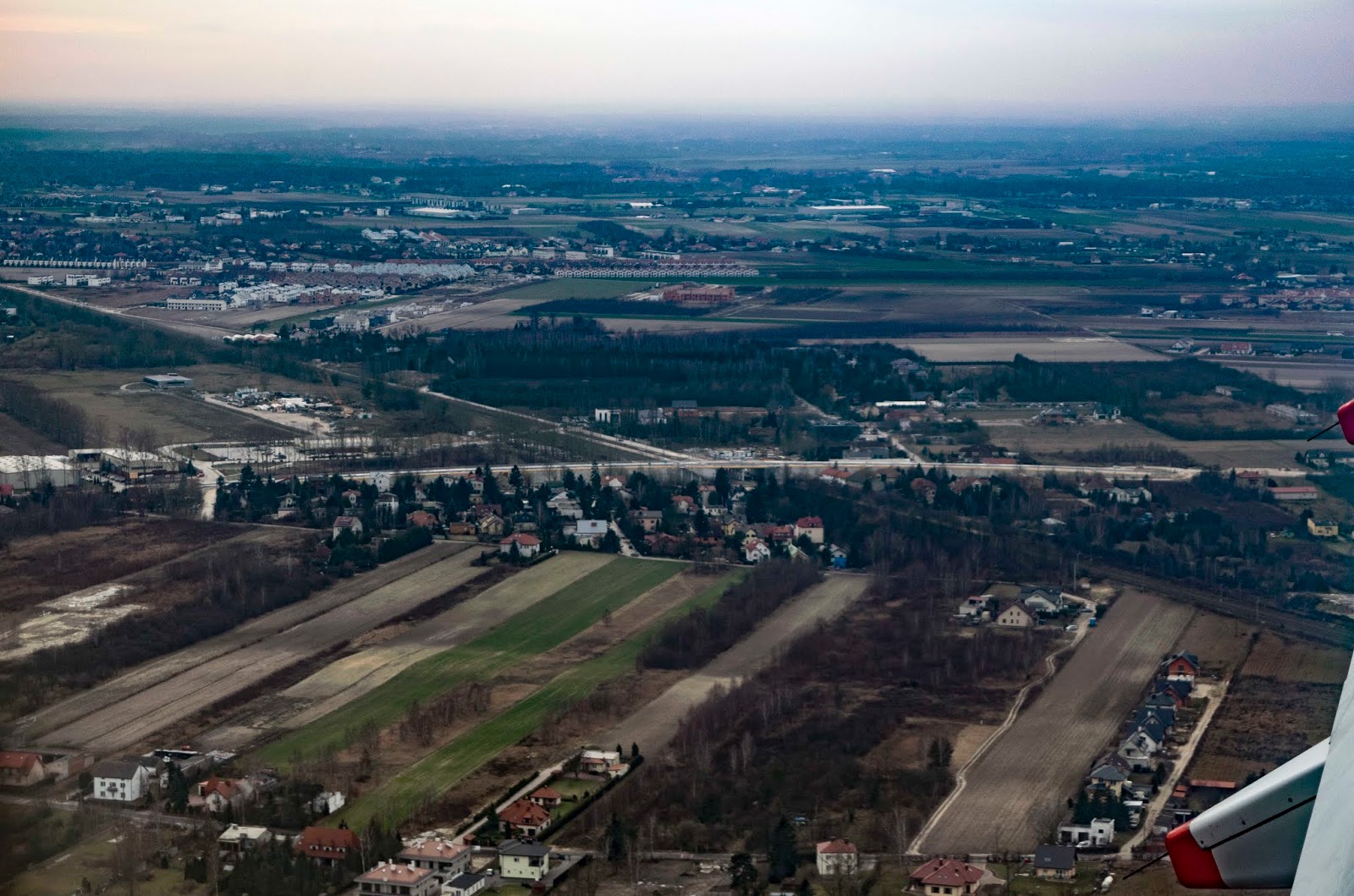
Below: a good shot of the entire viaduct from the air - coming into land on Friday. Ul. Trombity in the foreground.

It's coming on slowly, but then we locals are in no hurry to see unprecedented volumes of new traffic rushing through our sleepy suburb.
This time last year:
Warsaw's 2017-18 Christmas illuminations
This time two years ago:
Farewell to Ciocia Dziunia
This time three years ago:
Poland's roads get (slightly) safer in 2015
This time four years ago:
Convenience and the economics of bottled water
This time five years ago:
Locally, it's the little things...
This time last six years ago:
Warsaw bids farewell to its old trams
This time 11 years ago:
Five departures from Okęcie
Below: first impression as I began climbing towards the crest of the viaduct was how narrow the roadway was. Designed for one lane of traffic in each direction. There are wide pavements/cycle paths on either side of the roadway. View looking east along ul. Karczunkowska.

Below: an entirely new view of ul. Buszycka, looking north.

Below: from the north-east set of steps, looking towards the junction of (what was) Karczunkowska and ul. Buszycka.

Below: there are no permanent barriers on the western half of the viaduct, so caution is advised. View looking north-west.

Below: looking down onto the 'up' platform of W-wa Jeziorki station, a Warsaw-bound passenger train just pulling in. Unelectrified coal-train line to the left.

Below: looking down onto the 'down' platform of W-wa Jeziorki station, an SM42 shunter runs light towards Konstancin-Jeziorna along the unelectrified line. The lights of Warsaw on the horizon.

Below: a good shot of the entire viaduct from the air - coming into land on Friday. Ul. Trombity in the foreground.
It's coming on slowly, but then we locals are in no hurry to see unprecedented volumes of new traffic rushing through our sleepy suburb.
This time last year:
Warsaw's 2017-18 Christmas illuminations
This time two years ago:
Farewell to Ciocia Dziunia
This time three years ago:
Poland's roads get (slightly) safer in 2015
This time four years ago:
Convenience and the economics of bottled water
This time five years ago:
Locally, it's the little things...
This time last six years ago:
Warsaw bids farewell to its old trams
This time 11 years ago:
Five departures from Okęcie
Friday, 4 January 2019
West London to South Warsaw
After nearly three weeks at my father's in West Ealing I'm back in W-wa Jeziorki, having flown in via Heathrow on a BA flight.

Getting to Heathrow from West Ealing is now easier than ever - simply get on a TfL Rail train to the airport. Off-peak fare £6.00 (peak £7.30 - that is Monday to Friday 06:30-09:30 and 16:00-19:00). My train departed at 05:44 and arrived at Heathrow Terminals 2 & 3 at 06:03. Less than 20 minutes. As BA flights to Warsaw now depart from Terminal 5, I had to wait to catch the free inter-terminal rail service (provided by Heathrow Express trains) from the same platform. It arrived a few minutes later, with a four-minute journey time. Brilliant! Less than one hour after leaving my father's I'm inside the terminal building!
Now that national rail fares have gone up, Luton Airport is getting pricier to reach from London. The 29-mile journey on Thameslink trains now costs £20.40 (off-peak £15.36 - but 'off-peak' here means weekends) including that wretched shuttle bus from 'Luton Airport' Parkway to the actual airport, over 2km/1.3 miles away. To get to St Pancras station from Ealing Broadway costs £3.30 (peak Mon-Fri 06:30-09:30) and £2.80 all other times. And Ealing Broadway's a 20 minute walk, while West Ealing is just nine minutes away. Total travel time from my father's to Luton Airport is around two and half hours.
Add to this WizzAir's new baggage restriction. I am now only allowed to take on board for free a laptop bag (max 40x30x20cm). Taking my rucksack means buying the WizzGo package for an extra £23 - this also gives me up to 20kg cabin baggage and priority boarding - neither of which I need or want. When WizzAir announced it's reducing free cabin baggage size from 50x40x25cm, I immediately went to the Samsonite shop in Warsaw, who told me, yes, they'd heard about WizzAir's announcement, but no, they don't make a rucksack as small as 40x30x20cm. Of course I could buy a tiny rucksack with Pixar Cars or Disney Frozen graphics from the children's department at Auchan, but, well, you know... Having a laptop bag slung around one shoulder is no good for anyone's body. Rucksacks distribute weight properly across both shoulders. For someone who walks lots, that's really important.
So - I'm comparing prices for a London-Warsaw flight on the same day (a Friday three weeks hence), at the same time (around 14:00) with WizzAir and BA, with a rucksack measuring 50x40x25cm weighing no more than 8kg.
BA: £68.44 + £6.00 travel to airport = £72.44
WizzAir: £46.33 + £23.20 travel to airport = £69.53
So - for just £2.89 more, I save around an hour and half in travel time; I have the comfort of a proper airport where you can be seated at the gate rather than having stand in a queue to board for 20 minutes; arriving at Warsaw Okęcie the BA plane arrives at a sleeve rather than depositing you at the far end of the airport for a bus to take you on to passport control, and the seats are more comfortable.
WizzAir, Luton Airport, Thameslink Trains - you have lost a frequent flyer, a once-a-month reliable source of revenue over the past 15+ years.
I never wish to set eyes on Luton Airport ever again - I utterly loathe and detest the place. I detest the overcrowded seating areas and bars, the stupid shuttle bus connection to the distant railway station.
Linguistic PS: Can anyone think of a better English word for dojazd than 'journey/travel to [a place]'?
If not, may I suggest adding this excellent Polish word to the English language as a loan word?
UPDATE 9 JAN.
Booked my next flight to London and back with BA. Price: 497zł (£104). Checked WizzAir (still with my WizzAir club discount in place)... price 224zł (£47). Now, until recently, it would have been a no-brainer - that difference would have easily swallowed the extra cost of travelling from and to Luton. But with the small-rucksack surcharge, the price more than doubles to 456zł (£96). Add open return railfare (£30.30) plus return Tube fare to Ealing (£5.60) and flying through Luton would now cost me £131.90. With BA, the price is £116. A saving of £16 over the Wizz/Luton option. Plus, with BA, I get air miles!
UPDATE 28 JAN.
Flew into Heathrow Terminal 5 with BA. Plane arrives on time at 14:30, at a sleeve (no need to put coat on). Get through border control quickly - literally one person ahead of me in queue, though probably a time-of-day thing, down the stairs to the train platform. Catch Heathrow Express train (free for the one stop) to Heathrow Terminals 2 & 3 station where I wait an annoying 27 minutes for the next TfL service to town via West Ealing (off-peak the TfL trains are half-hourly). But the train's on time, soon I'm at West Ealing, from where a nine-minute walk to my father's. Ninety minutes from landing to the doorstep. Had I hustled through T5 at a brisker pace, I might have caught the previous Heathrow Express train to T2&3 and caught the earlier TfL train, cutting journey time to one hour.
This time three years ago:
Anger and hate have no place in political discourse
[Blimey! How times have changed.]
This time five years ago:
Is Conservatism rural or urban in nature?
This time six years ago:
Poland's roads get slightly less deadly
This time seven years ago:
It's expensive being rich in Warsaw
This time nine years:
Winter commuting in colour and black & white
This time ten years ago:
Zamienie in winter
This time 11 years ago:
Really cold (-12C at night)

Getting to Heathrow from West Ealing is now easier than ever - simply get on a TfL Rail train to the airport. Off-peak fare £6.00 (peak £7.30 - that is Monday to Friday 06:30-09:30 and 16:00-19:00). My train departed at 05:44 and arrived at Heathrow Terminals 2 & 3 at 06:03. Less than 20 minutes. As BA flights to Warsaw now depart from Terminal 5, I had to wait to catch the free inter-terminal rail service (provided by Heathrow Express trains) from the same platform. It arrived a few minutes later, with a four-minute journey time. Brilliant! Less than one hour after leaving my father's I'm inside the terminal building!
Now that national rail fares have gone up, Luton Airport is getting pricier to reach from London. The 29-mile journey on Thameslink trains now costs £20.40 (off-peak £15.36 - but 'off-peak' here means weekends) including that wretched shuttle bus from 'Luton Airport' Parkway to the actual airport, over 2km/1.3 miles away. To get to St Pancras station from Ealing Broadway costs £3.30 (peak Mon-Fri 06:30-09:30) and £2.80 all other times. And Ealing Broadway's a 20 minute walk, while West Ealing is just nine minutes away. Total travel time from my father's to Luton Airport is around two and half hours.
Add to this WizzAir's new baggage restriction. I am now only allowed to take on board for free a laptop bag (max 40x30x20cm). Taking my rucksack means buying the WizzGo package for an extra £23 - this also gives me up to 20kg cabin baggage and priority boarding - neither of which I need or want. When WizzAir announced it's reducing free cabin baggage size from 50x40x25cm, I immediately went to the Samsonite shop in Warsaw, who told me, yes, they'd heard about WizzAir's announcement, but no, they don't make a rucksack as small as 40x30x20cm. Of course I could buy a tiny rucksack with Pixar Cars or Disney Frozen graphics from the children's department at Auchan, but, well, you know... Having a laptop bag slung around one shoulder is no good for anyone's body. Rucksacks distribute weight properly across both shoulders. For someone who walks lots, that's really important.
So - I'm comparing prices for a London-Warsaw flight on the same day (a Friday three weeks hence), at the same time (around 14:00) with WizzAir and BA, with a rucksack measuring 50x40x25cm weighing no more than 8kg.
BA: £68.44 + £6.00 travel to airport = £72.44
WizzAir: £46.33 + £23.20 travel to airport = £69.53
So - for just £2.89 more, I save around an hour and half in travel time; I have the comfort of a proper airport where you can be seated at the gate rather than having stand in a queue to board for 20 minutes; arriving at Warsaw Okęcie the BA plane arrives at a sleeve rather than depositing you at the far end of the airport for a bus to take you on to passport control, and the seats are more comfortable.
WizzAir, Luton Airport, Thameslink Trains - you have lost a frequent flyer, a once-a-month reliable source of revenue over the past 15+ years.
I never wish to set eyes on Luton Airport ever again - I utterly loathe and detest the place. I detest the overcrowded seating areas and bars, the stupid shuttle bus connection to the distant railway station.
Linguistic PS: Can anyone think of a better English word for dojazd than 'journey/travel to [a place]'?
If not, may I suggest adding this excellent Polish word to the English language as a loan word?
UPDATE 9 JAN.
Booked my next flight to London and back with BA. Price: 497zł (£104). Checked WizzAir (still with my WizzAir club discount in place)... price 224zł (£47). Now, until recently, it would have been a no-brainer - that difference would have easily swallowed the extra cost of travelling from and to Luton. But with the small-rucksack surcharge, the price more than doubles to 456zł (£96). Add open return railfare (£30.30) plus return Tube fare to Ealing (£5.60) and flying through Luton would now cost me £131.90. With BA, the price is £116. A saving of £16 over the Wizz/Luton option. Plus, with BA, I get air miles!
UPDATE 28 JAN.
Flew into Heathrow Terminal 5 with BA. Plane arrives on time at 14:30, at a sleeve (no need to put coat on). Get through border control quickly - literally one person ahead of me in queue, though probably a time-of-day thing, down the stairs to the train platform. Catch Heathrow Express train (free for the one stop) to Heathrow Terminals 2 & 3 station where I wait an annoying 27 minutes for the next TfL service to town via West Ealing (off-peak the TfL trains are half-hourly). But the train's on time, soon I'm at West Ealing, from where a nine-minute walk to my father's. Ninety minutes from landing to the doorstep. Had I hustled through T5 at a brisker pace, I might have caught the previous Heathrow Express train to T2&3 and caught the earlier TfL train, cutting journey time to one hour.
This time three years ago:
Anger and hate have no place in political discourse
[Blimey! How times have changed.]
This time five years ago:
Is Conservatism rural or urban in nature?
This time six years ago:
Poland's roads get slightly less deadly
This time seven years ago:
It's expensive being rich in Warsaw
This time nine years:
Winter commuting in colour and black & white
This time ten years ago:
Zamienie in winter
This time 11 years ago:
Really cold (-12C at night)
Subscribe to:
Posts (Atom)


 Posts
Posts


