Wednesday, 13 February 2019

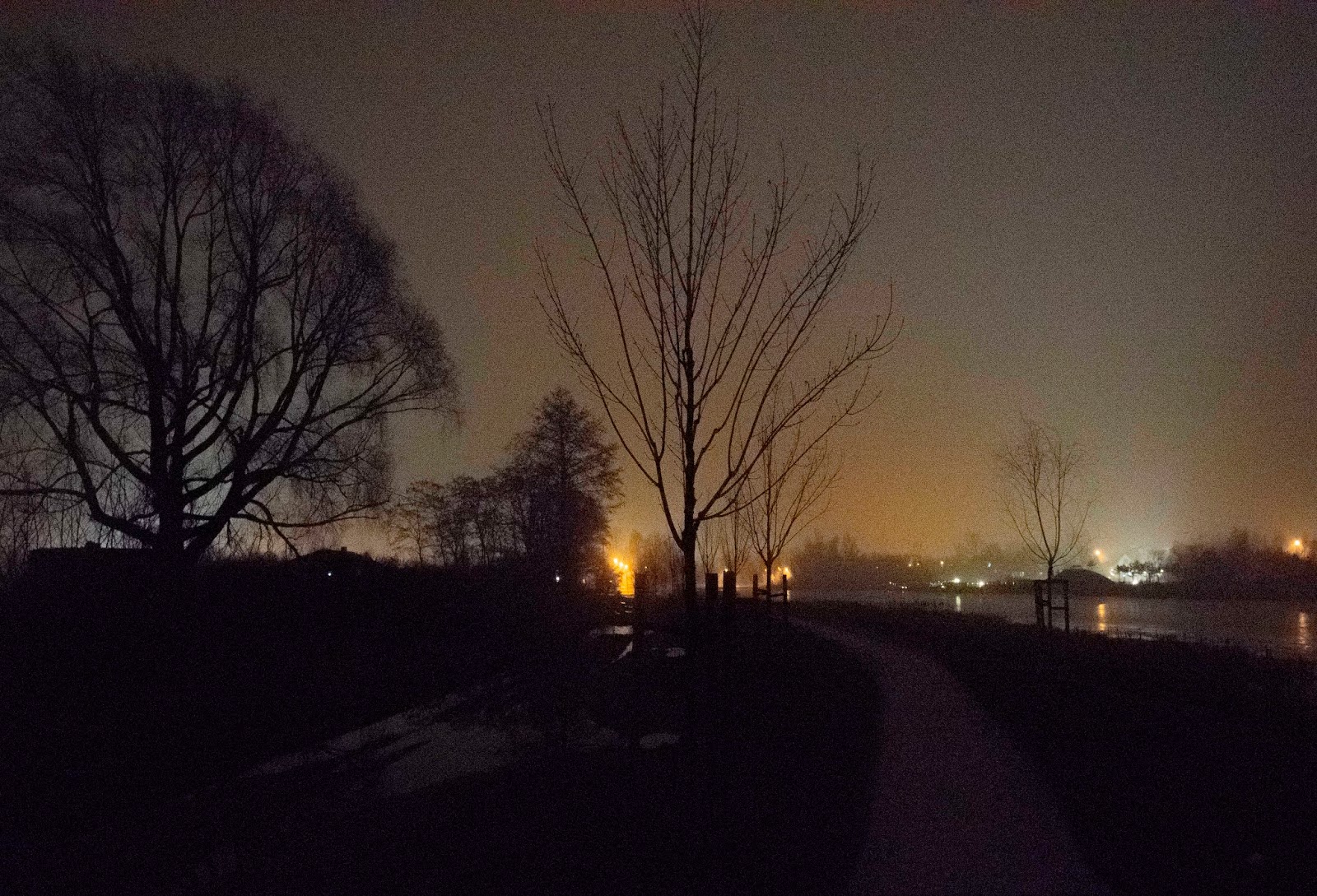
Morskie Oko in winter in black & white

Following on from last week's morning exploration of the Vistula Escarpment between Smolna and Tamka, today's morning walk to work (a seminar at the Regent hotel) took me down the escarpment by Morskie Oko. More black & white snaps with the 10-20mm Nikkor wide-angle zoom...


Snow began to fall just as the morning rush hour got under way; I travelled by bus to Stokłosy, by Metro to Racławicka, and walked from there to the Regent - I didn't see a single snow plough. Surely they were not caught out? The weather forecast predicted this fall... Whatever; there was no untoward traffic chaos either on Puławska nor on any of the side streets. Warsaw coped without skipping a beat.

It is entirely possible that in six weeks' time, we'll be enjoying 20C warmth... or still shivering under a light dusting of late snow.


This time last year:
Preparations for Lent

This time three years ago:
Religion and Spiritual Growth

This time five years ago:
When trams break down

This time seven years ago: 
Who are the thickies of Europe?

This time eight years ago:
Oldschool Photochallenge: Response No. 2

This time nine years ago:
Oligocene water from Jeziorki 

Monday, 11 February 2019

The Filth and the Fury

I AM UTTERLY FED UP OF HAVING TO TRAIPSE THROUGH LAKES OF SLUDGE TO GET TO THE STATION EACH MORNING BECAUSE THE USELESS BUILDERS WHO'VE SPENT THE LAST TWO AND HALF YEARS PUTTING UP A VIADUCT TO CARRY A LOCAL ROAD OVER THE RAILWAY ARE TOO BLOODY INCONSIDERATE TO SECURE DECENT FOOTPATHS FOR LOCAL RESIDENTS.

I AM UTTERLY FED UP WITH CONSTANTLY CLEANING SHOES. WITH BRINGING FILTH ONTO THE OFFICE CARPETS. WITH HAVING TO APOLOGISE FOR THE TOTAL INADEQUACY OF THESE HOPELESS BUILDERS WHO ARE A YEAR-AND-HALF BEHIND SCHEDULE.

LOOK AT THIS. LOOK AT IT AND ASK YOURSELVES HOW ANYONE CAN WADE THROUGH THIS SHIT AND KEEP SOME KIND OF CLEANLINESS OF FOOTWEAR OR TROUSERS.

I WANT THE NAME OF THE PERSON RESPONSIBLE FOR THIS SHIT.


No, I'm not alone in complaining. Mieszkańcy Osiedla Etap have had a TVN news crew round; Halo Ursynów has written about this, the situation persists.

I HAVE HAD ENOUGH OF THIS!!!


This time three years ago:
Defining the human experience

This time five years ago:
The City of Warsaw wants you to complain

This time six years ago:
Czachówek's wild woods in winter

This time seven years ago:
Vistula freezes over downstream of Warsaw 

This time eight years ago:
Twilight of the Ikars

This time nine year ago:
Polish TV adverts for parapharmaceuticals

This time tn years ago:
Jeziorki wetlands in winter

This time 11 years ago:
A week into Lent

Sunday, 10 February 2019

Getting over this year's flu (and some bygone Poland)

Not as bad as last year's one, which whacked me out for the best part of two weeks, but still bad enough to lay me out in bed for three and half days (Weds through to Sat lunchtime). Fever got nowhere near last year's record of 39.1C, max this time was only 37.3, alternating on Thursday morning with 35.8C. Three bad nights of sleep, nightmares, shivering or sweating, sleepless hours, but today, on Day Five, I'm on the mend. Medicines taken - exactly zero. Lots of hot drink (tea with honey, lemon, ginger, cloves). Time to get back into the exercises, planks, press-ups, weights and pull-ups; five days of foregone walking needs to be caught up on too. But take it easy. And lesson for next year - flu vaccine! My father has been getting his free on the NHS every year and I can't remember him being laid out with the virus for literally decades.

Being ill in bed is made much better in these web-enabled days by the ability to watch some good films on YouTube. Here's one I must share with you; this is a BBC documentary made in 1982 (filmed August/September that year); ostensibly about narrow-gauge steam trains, but really about the search for Poland's soul. An amazing film for so many reasons - we see how far Poland has progressed, but also wonder a bit about what's been lost. On balance, however, I feel that few Poles will get nostalgic about the lives they left behind in 1982. Life was hard; people retreated within themselves, into the fastness of the family, the countryside.


The quality isn't brilliant - the video has been uploaded from a VHS tape that mashes up a bit towards the middle, but this should not prevent you from enjoying this extremely incisive view into Poland's recent history. I dare say, this is not the same emotional effect one gets from watching a film about a quaint English branch line in the 1950s. There are many of these on YouTube. And highly enjoyable too. They generate many comments from nostalgic viewers, bewailing the Lost England in which they were born, but no longer recognise today. Few Poles would care to return to the Poland shown in this film, despite the lyrical beauty of a pastoral Poland that "seems to exist outside time, on the borders between somewhere and nowhere, where something is about to happen, but never actually does."

This time last year:
War and the absence of war

This time three years ago:
Sensitivity to spiritual evolution

This time four years ago:
75th anniversary of Stalin's deportations of Poles

This time five years ago:
Peak Car (in western Europe at least)

This time six years ago:
Pavement for Karczunkowska NOW!
[I still walk through mud or dice with speeding cars.]

This time seven years ago:
Until the Vistula freezes over 

This time eight years ago:
Of sunshine, birdsong and wet socks

This time 11 years ago:
Dziadzio Tadeusz at 90

Saturday, 9 February 2019

Fairness, simplicity, taxation and a sustainable society

Walter Scheidel's The Great Leveler: Violence and the History of Inequality from the Stone Age to the Twenty-First Century traces the rise and fall of inequality over the millennia. The Austrian economic historian has concluded that inequality has a natural tendency to increase over time, and that falls in inequality are always dramatic and sudden, and caused by war, pandemic, state collapse or revolution. And that like Kondratieff's Long Wave cycle in economics, they are inevitable.

What's worrying is that Scheidel is suggesting that we're overdue for one of these shake-ups, as the rich are now holding a similar percentage of the world's income as they did before WW2. In the years after WW2, inequality hit a low in the late 1970s; since then it has been rising inexorably. Prof Scheidel shows that events such as smaller wars not involving mass mobilisation, pandemics, civil wars or economic crises do not lead to a reset of the balance between rich and poor. It takes a whopper such as the Black Death, the Great Plague, WWI followed by the Spanish Flu, or the French Revolution to wrest the wealth out of the coffers of society's wealthiest 1% and put it into the pockets of the working man. There was a huge fall in inequality between the late 19th or early 20th century and the late 20th century. For the UK, the share of wealth of the top 1% was around 70%-75% from 1895 to 1906, but bottomed out at 15.2% in 1984.

There's not much we can do about a global pandemic breaking out, but if we don't want wars, state collapse or revolution, we ought to strive to ensure that inequality does not rise again to unsustainable levels. This is nothing to do with an ideological uravnilovka, a levelling-down of society for its own sake; all to do with avoiding social disturbances and bloodshed. Taxation, as Dutch historian Rutger Bregman said at this year's World Economic Forum in Davos, is the answer. Addressing the audience of billionaires, he said: 'It feels like I’m at a firefighters' conference and no one’s allowed to speak about water.' It is, all about paying tax. "The rest," he says, "is bullshit."

It's time to take a structural look at our tax systems. They stand on the cusp of major technological change, as the process of digitising financial transactions continue apace. I can envisage a situation in which all transactions are taxed at point of sale, and reported in real time. This is easier to implement in VAT (split-payment and real-time reporting fiscal cash registers) and PAYE than for corporation tax (CIT); companies have a duty to their shareholders not to over-pay tax - but shareholders should be mindful that tax revenues foregone to state exchequers through base erosion and profit shifting cannot be made up by charitable giving. Wheezes such as the 'double Irish with a Dutch sandwich', a tax avoidance technique employed by some corporates using a combination of Irish and Dutch subsidiary companies to shift profits to low- or no-tax jurisdictions, do not play well with consumers.

As consumers - and voters - gain a better understanding of how their societies function and are funded, egregious tax avoidance from household-name brands becomes less sustainable. But then governments have a duty to spend tax revenues wisely and not on their cronies or pumping public money into party-political propaganda.

On 19 February, we'll be holding a conference at the British Embassy in Warsaw bringing experts from Her Majesty's Revenue and Customs (HMRC) to talk about two aspects of taxation - communicating with taxpayers, and digitisation of tax systems. The audience will consist of Polish tax officials and foreign investors - the discussion should be interesting; I'm hoping for some fruitful exchange of best practice.

One key topic is the balance between fairness and simplicity. As Richard Hawthorne, deputy director of customer communications at HMRC says, if you strive to simplify a tax system, it becomes less fair; if your want to make it fairer, it becomes less simple. In Poland, one can see that a desire for fairness beats simplicity hands down. Every citizen, rich or poor, has the same onerous duties to fulfil regarding the tax authorities, including the annual completion of the PIT 11D tax form. In the UK, if you are an employee on a permanent contract (pay-as-you-earn), you may live your entire life without ever seeing a tax return form.

Another is language. The UK tax system has for decades been focused on improving the ease with which the taxpayer understands what is being requested of them. The Plain English Campaign, launched in 1979, has fought a successful battle with banks, lawyers, insurers, and yes, the taxman, to cement the notion that the writer's responsibility to be understood takes precedence over the reader's responsibility to understand.

The process of rewriting Britain's tax law began in 1997. The rewritten legislation incorporated easier-to-understand language, a more logical structure and shorter sentences, and the Plain English Campaign worked alongside Inland Revenue (as it was then) to make the necessary changes that would be incorporated across all official communications with taxpayers. The UK tax return form has earned its Crystal Mark for clarity. I can attest to this, having filled out my father's tax returns online twice in a row, and on paper the year before that. Unlike the Polish form, one can grasp exactly what the purpose of each question is and what answer is expected.

Simplifying the language used to communicate with taxpayers has clear advantages. In an experiment conducted by the Polish tax authorities (supported by experts from the World Bank) in western Poland in 2015, a letter chasing overdue tax payments, written in straightforward Polish, proved to be 30% more effective than one worded in the traditional way. Yet this experiment remained an experiment. Last year, the Polish tax authorities promoted the notion of '3xP' - proste, przejrzyste, przyjazne - 'straightforward, transparent, friendly' as part of an overall shake-up of the tax system, intended to bring it up to date with EU standards and technological changes. Will that happen? Will missives from the Polish tax authorities cease to be written in the agentless passive? (example: 'zabrania się'). I have long been banging on about the need for a Plain Polish Campaign.

UK experience over the past 20 years shows that implementing a customer-centric approach, driven by clear communication, is not expensive to do and is a good investment in terms of improved collection. It does, however, require a massive change in thinking among all tax-office employees.

The technology issue is also of huge interest. On the one hand, we have seen the full implementation in Poland of the Single Audit File (Tax) ('Jednolity Plik Kontrolny'), and the elimination of most VAT carousels based on the automatic cross-interrogation of invoices. Real-time reporting is raising revenues from sectors where cash-in-hand transactions are the norm (from car washes to hairdressers). But on the other hand, there's the rise of cryptocurrencies like Bitcoin, being used to move money across border under the noses of the tax inspectors. How will this look in the future?

Tax is going to get a whole lot more interesting in coming years - the future stability of society rests upon it.

More about taxation in Poland from me here:

Modern governance for a complex world (Dec 2015)

I'm Payin' Taxes, But What Am I Buyin'? (Oct 2015)

More about Polish officialese from me here:

Translation and cultural difficulties (Apr 2015)

Orwell's Politics and Language and Poland (Mar 2012)

*****************************

This time last year:
Polish beer cans in the UK: new shit has come to light

This time three years ago:
Lent, a time to cleanse and reflect

This time five years ago:
It was 50 years ago today... Beatles arrive in New York

This time seven years ago:
Adventures in the Screen Trade - the truth about Hollywood

This time eight years ago:
The sad end of Andrzej J.

This time ten years ago:
Today's dose of wintery gorgeousness

This time 11 years ago:
First intimations of spring

Wednesday, 6 February 2019

Smolna, Tamka. Skarpa in black and white

Photos from Tuesday morning, before I fell ill with the dreaded flu. Grim feel of a February day when spring seems distant. A walk along the brow of the Vistula escarpment, from ul. Smolna to ul. Tamka.


Below: looking down the steps descending towards Park Karola Beyera, PKP W-wa Powiśle station to the right.


Below: the Szarytki convent in winter (more about this curious institution here)


Below: the footbridge over ul. Tamka, looking down towards Most Świętokrzyski. Two murals - to the right, the permanent one facing the Chopin museum, to the left, one used to advertise forthcoming televisual/cinematic attractions.


Below: the footbridge over ul. Tamka, looking up towards ul. Kopernika. To the left, the new Motel 1 is nearing completion (work started last March - the pace of construction is impressive - unlike anything the public sector touches!). Motel 1 will have 180 rooms priced between 200zł and 300zł a night with the accent on good design. I hope the name 'motel' does not suggest 'parking for 180 cars!'


Below: round-cornered buildings a Warsaw thing. Corner of ul. Karasia and Obożna, Hotel Harenda to the left.


Got home Tuesday evening - went straight to bed feeling awful.

This time two years ago:
15 years under one roof

This time four years ago:
Białystok: Ipswich of the East 

This time five years ago:
Sadness at the death of Tadeusz Mosz 

This time six years ago:
Interpreting vs. translating vs. explaining

This time seven years ago:
More than just an Iluzjon 

This time eight years ago:
Oldschool photochallenge

This time nine years ago:
Warsaw's wonderful nooks and crannies

This time 11 years ago:
Viaduct to the airport at ul. Poleczki almost ready

Sunday, 3 February 2019

Sewerage extended up ul. Trombity's side-streets

The year-long work to provide town drains to residents of the central and northern stretches of ul. Trombity finished in the autumn. Now it's time to connect up the streets running off Trombity.

Much of Poland covered in narrow ribbons of land, the result of centuries of farmers dividing their land between their sons (rather than giving the entire estate to the eldest son - the law and custom of primogeniture, as in England). When one finally decides to quit farming and sell the narrow ribbon to developers, we have the very Polish phenomenon of side streets which have no separate names, but are numbered as a sub-set of the street from which they run. So this (below) is ul. Trombity 22-22R, the suffix letters being a rough indicator of when the house was built. Arable land to the side will be dug up to lay the pipes.


Below: one of two Tatra 815s in use to take away the soil. A remarkable vehicle, in continuous production since 1983 (with two modernisations along the way).


Below: the view from the end of Trombity 22-22R. No doubt once the sewers have been laid, Jeziorki can expect 22S-22Z to be built. There is room!


My walk takes me to the W-wa Jeziorki, where I catch a town-bound osóbka and a rake of empty coal wagons returning from Siekierki. Eight months to complete and open the viaduct? Don't think so!


Below: how muddy thy surface, ul. Dawidowska! The snows melted quickly, the soil is waterlogged.


Below: night has fallen by the time I get back to the ponds for the short walk home. Ul. Dumki beyond the asphalt.


This time last year:
What Happened at the Railway Inn (Part II)

This time four years ago:
Demand and inequality in the global economy

This time five years ago:
Sorry, takie mamy koleje

This time six years ago:
Visit to Warsaw's Jewish Cemetery

This time seven years ago:
Under Rondo Dmowskiego 

This time eight years ago:
My Most favourite bridge

This time nine years ago:
Street lighting under the snow

This time ten years ago:
Ul. Poloneza - archival video before the S2 was built

This time 11 years ago:
Aerial juxtaposition over Jeziorki

Saturday, 2 February 2019

Justify the buy – Nikkor 10-20mm vs 10-24mm

I don't like buying new, but from time to time it makes sense. It's been longer than I thought since I bought a superwide zoom for my Nikon camera – nearly seven years. Over that time, the Nikkor 10-24mm lens has delivered stunning photos. Since then, Nikon has brought out a new lens in the same category. It has two advantages over the old one. One is size and weight. The new 10-20mm lens is - would you believe it - less than half the weight of the old one, and significantly smaller. The other is vibration reduction (VR - or in Canon parlance, image stabilisation or IS). VR allows photos to be taken at longer exposures without fear of camera shake. Drawbacks? The new lens is a whole stop darker than the old one (maximum aperture is f4.5 rather than f3.5, and it zooms out to 20mm rather than 24mm.

Neither drawback can overcome the weight/size difference. The new one is 227g, the old one 465g. That's a noticeable difference when carrying it around your neck all day long. Nearly a quarter of a kilo (half a pound) less for something that does the same job. Some camera snobs like the weight and solidity of the old 10-24mm zoom, with its metal mount, focus-scale window, separate zoom and focus rings and autofocus switch. For me, it's like the difference between the paperback and hardback versions of the same novel; same content, but the hardback was designed with an eye on posterity.

The old lens I intend to sell on OLX or Allegro - the prices for a good used 10-24mm (around 1,700zł) are higher than the new price for a 10-20mm model (under 1,500zł).

First results are pleasing - I can't see any visual difference between the two. The newest versions of Photoshop correct any chromatic aberrations and distortion for both lenses. One caveat is that the new lens does not work on Nikon bodies earlier than the D3300 (and corresponding premium models).


Below: the two lenses side by side. The size difference is evident; the new lens (left) has a 72mm filter ring, the old one's is 77mm.


The old lens below looks more 'impressive' than the new one... bottom.


This time six years ago:
The Big Melt

This time nine years ago:
Waiting for the meltdown

This time 11 years ago:
Warsaw's inadequate airport (since then, Terminal Two has opened, a railway line links it to the city centre and a new road links it to the motorway network)

Friday, 1 February 2019

Plank time!

For my physicist readers - a play on words. 'Planck time' (5.39 x 10-44 second) is the shortest unit of time in the universe, the time it takes light to travel one Planck length (1.616 x 10⁻³⁵ metre, the shortest unit of distance in the universe) in a vacuum. Both being discrete units, there is no thing as half a Planck time or a third of a Planck length; they are absolutes.

For everyone else - it's about fitness. Five years of ever-improving self-discipline, fewer and fewer days without any exercise, more press-ups, more pull-ups, more walking than last year. But still a worrying tendency to accumulate the fat around the middle. So onto the Plank.

Lying face-down on the floor, I push myself up so only my toes and forearms are touching the ground, my legs and spine forming a straight line, like a plank. The pelvis should be tilted forward; as Moni points out from her yoga classes, you need to imagine you are curling your tail underneath you.

So - adopt the position, soldier! And hold it there... for a minimum of a minute and half, then 30 seconds' rest, then repeat for a further 90 seconds, 30 second break, then a final 90 seconds of plank.  This is the target. As I'm already doing 50 press-ups in one go twice a day, it's a challenge. Especially the third 90 seconds of planking. I can feel after six days of planking twice a day tighter muscle tone around the middle. More effective than the sit-ups I'd been doing in previous years, a better use of time.

Reading the many fitness articles out there on the internet, it seems that rather than holding the plank position for ever-longer periods of time, it's more effective to plank four times a day, something I'm starting today. My long-term aim will be to reduce my girth around my middle. Today, it's 101.2cm.

I only wish that I had the willpower that I have today 40, 45 years ago; as a youth and young man, my lackadaisical attitudes towards life held me back in my 20s.

Lent is coming soon*, it is a time of year I have come to cherish; a time to strengthen resolve and willpower - not just self-denial but pushing myself to do more, create more, think more - and focus on the eternal and infinite and the most fundamental questions of Life, the Universe and Everything, to quote Douglas Adams. And more about Planck, quantum mechanics, human memory and the search for the bridge between science and spirituality.

A healthy spirit in a healthy mind in a healthy body!

* Well, not that soon - Ash Wednesday is on 6 March this year, with Easter Sunday falling on 21 April. Tradition and on-spectrum RRBI, rather than strict adherence to the liturgical calendar, dictate my slavish devotion to Lenten observance, for the 27th consecutive year.

This time last year:
What happened at the Railway Hotel?

This time two years ago:
How to annoy the passengers

This time three years ago:
Zloty symbol - your suggestions 

This time four years ago:
The future of Warsaw's public transport

This time five years ago: 

This time seven years ago:
(on the superiority of Polish schools to British ones)

This time nine years ago:

This time ten years ago:

This time 11 years ago: