Thursday, 5 May 2022

Park + Ride for Jeziorki - at last.

Well, it's been a long time coming, but it's finally happening - W-wa Jeziorki station will be getting a proper Park + Ride. Work began in February - sewerage and drainage works, now the above-ground part begins to take shape. The P+R will have space for 136 cars of which six will be reserved for disabled drivers. There will be covered bicycle parking for 40 bikes, and charging points for electric vehicles and bicycles. Planned date of completion - September 2022. Cost - over 5.9m złotys (£1.1m). A better investment for Warsaw's public transport than, say, five Solaris Urbino 12 buses?

The idea is for motorists to drive into from outlying towns and villages such as Lesznowola, Prażmów and Tarczyn and park here - the first station within Warsaw's Zone 1 for onward travel by train into the city centre. This will make more sense once a) SKM ('rapid urban rail') services start serving Piaseczno this December and b) the S7 extension is open.

Below: looking east from the stairs leading from the viaduct to the 'up' platform

Below: Official visualisation of the completed project, seen from above the viaduct.


A regulatory must on every Polish building site, however humble - the information board. Contact details for the investor, contractor, building inspector etc. This board describes the investment in Polish as 'Parkuj i jedź', yet the acronym PiJ is never, ever used - rather abbreviated in  English as Park & Ride (usually styled as P+R). 

Meanwhile, train services are getting faster. On Wednesday, I took a train from Chynów to Jeziorki that was advertised (and indeed took) as taking 24 minutes. That's seven minutes less than it used to. Journey times into town will be shorter once modernisation work on W-wa Zachodnia is completed.

Below:
the way it looked, back in 2008, when drivers started leaving their cars on the muddy verge by the station to take the train into town. New station, new viaduct - the character of W-wa Jeziorki has changed totally since then.

This time last year:
Decimalisation and determination

This time four years ago:
God, an Englishman, orders his Eden thus:

This time seven years ago:
I buy a Nikon Coolpix A

This time eight years ago:
More about the Ladder of Authority

This time nine years ago:
By bike, south of Warsaw

This time 11 years ago:
Functionalist architecture in Warsaw

This time 12 years ago:
What's the Polish for 'to bully'?

This time 13 years ago:
Making plans

This time 14 years ago:
The setting sun stirs my soul

This time 15 years ago:
Rain ends the drought

Tuesday, 3 May 2022

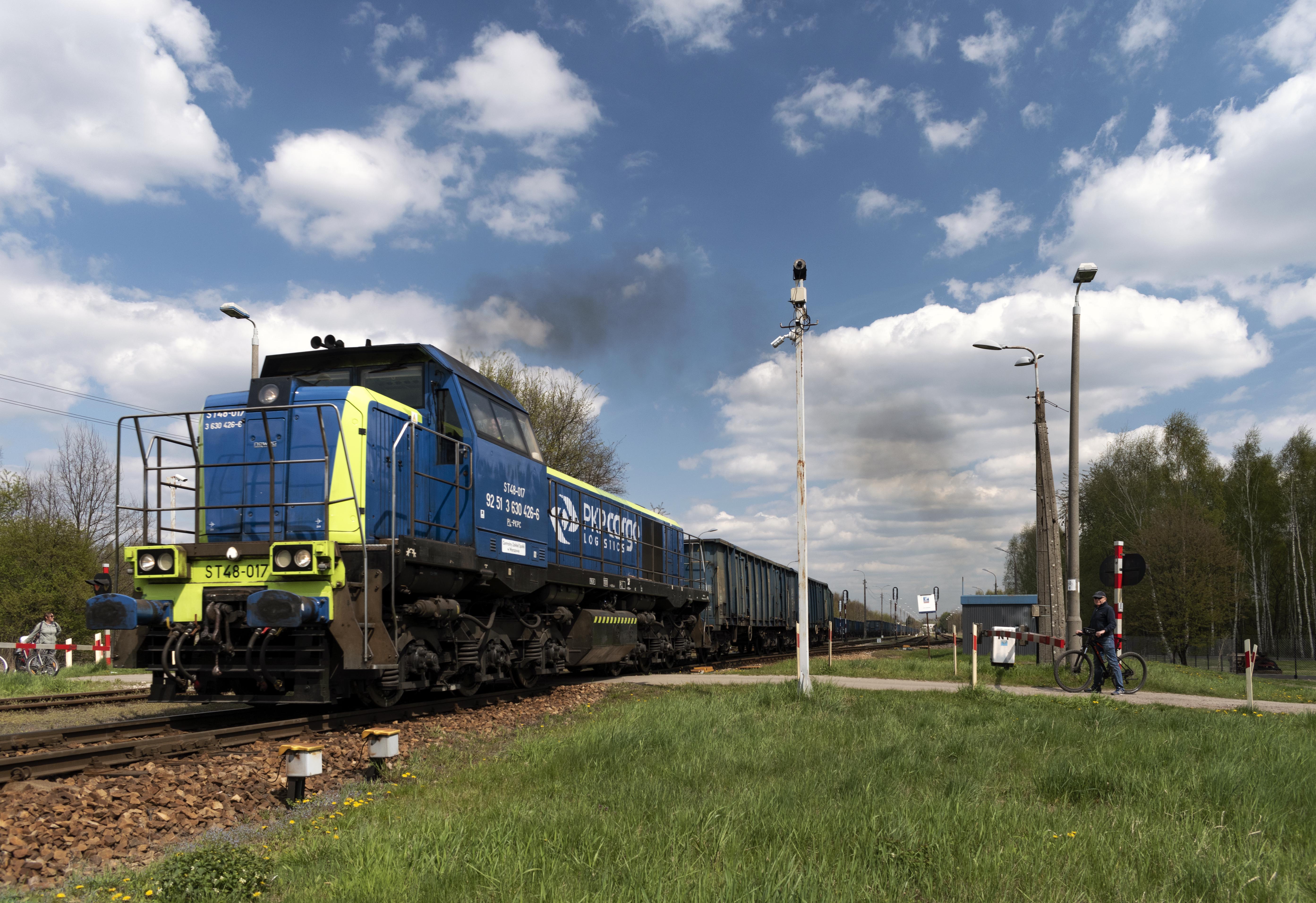
Return to Konstancin-Jeziorna coal sidings

Hunting the railway vibe, the klimaty kolejowe; going where the coal trains go. A long walk across the southern edge of the Las Kabacki, then on to the railway sidings at Konstancin-Jeziorna

Below: looking down at the sidings from the slight rise at the western end. The middle line runs straight through with two set of sidings on either side, all of them long enough to accommodate the longest rake of coal wagons (typically 40 in one set). Full trains (2,000 tonnes of coal) go from here to Siekierki power station; empties come here from Siekierki to be picked up and returned to the sidings south of W-wa Okęcie station, 14km away. 

Below: a rake of empties has just arrived on the second track, the engine the brought them in has been uncoupled, it ran forward, changed onto the middle track to run back to Siekierki. With summer on the way, there's fewer full coal trains heading to the power station. The manoeuvre done, the level crossing gates rise, and many cyclists crosses the tracks, heading to Konstancin (right of pic) or Powsin and Las Kabacki (left of pic). Click to enlarge.

Below: the train standing on the first track in the pic above is pulling out of the sidings and onto the single track towards Okęcie via Piaseczno and Nowa Iwiczna. Level crossing with barriers on ulica Wąska ('Narrow Street') and on the other side of the tracks - ul. Saneczkowa ('Toboggan Street).

Below: heading up hill, a gentle ten-metre rise over 1.7km as the line approaches - but does not enter - the Las Kabacki forest. The level crossing on ul. Głowackiego in Kierszek is close to the border of Warsaw and the forest. Foreshortening effect of telephoto lens zoomed out to 300mm makes the hill look steeper than it is .


Below: looking back towards the sidings from the end of the disused siding, that can be seen on the right of the photo above.


Below: the way things were, April 2008. View from the other end of the sidings, from the level crossing on ul. Warszawska. The train on the middle track is moving away; it has one engine at the back, pushing, and another at the front, pulling. These days, the modernised SM48 locos can pull a whole loaded train unassisted.


There are plans to upgrade this line to a passenger line, which I must say would be a splendid idea (offering a new connection across Warsaw's southern suburbs). It's been talked about for ages (usually just before local elections - see this PR visit), but at last there's a master plan being drawn up, which in February last year was said to be three and half years away. So a reality by 2030? One can but hope... The line won't be a part of the government's Kolei Plus programme, which will be restoring 34 disused and partially disused lines to passenger service, rather this line will be part of a metropolitan project devised by the City of Warsaw. 

I returned by 710 bus from Klarysew, mainly to see the new route linking Konstancin and Kabaty - ul. Stefana Korbońskiego, a sorely needed thoroughfare for local residents. When I say 'new', it opened to traffic in December 2017 (!) this was my first visit here! Below: before boarding the bus - busy scene in Konstancin. Flags out for the 3 May public holiday, the red-and-white repeated on the level crossing barriers and road signs. In the absence of a direct Jeziorki-Konstancin train, I took the 710 bus to Kabaty, Metro to Stokłosy, then 715 bus home. Total walking today: 18,500 paces.


This time three years ago:
A review of the second part of Hillier's Betjeman biog.

This time four years ago:
New roads and rails

This time six years ago:
The Gold Train shoot - lessons learned

This time eight years ago:
Digbeth, Birmingham 5

This time nine years ago:
Still months away from the opening of the S2/S79 

This time ten years ago: 
Looking at progress along the S79  

This time 11 years ago:
Snow on 3 May

This time 12 years ago:
Two Polands

This time 13 years ago:
A delightful weekend in the country

This time 14 years ago:
The dismantling of the Rampa

This time 15 years ago:
Flag day


Sunday, 1 May 2022

Łady road works

I hop on a passing 715 bus and get off at Jaworowa for a walk home via Falenty Nowe, Łady and Dawidy Bankowe. The weather - the atmosphere - flashback-perfect. I am transported back to rural America in the early 1950s. Below: ulica Jaworowska, between Jaworowa and Falenty Nowe.


Below: ul. Hrabska Droga (lit. 'Count's Road Street'), looking down ul. Grudzi. 

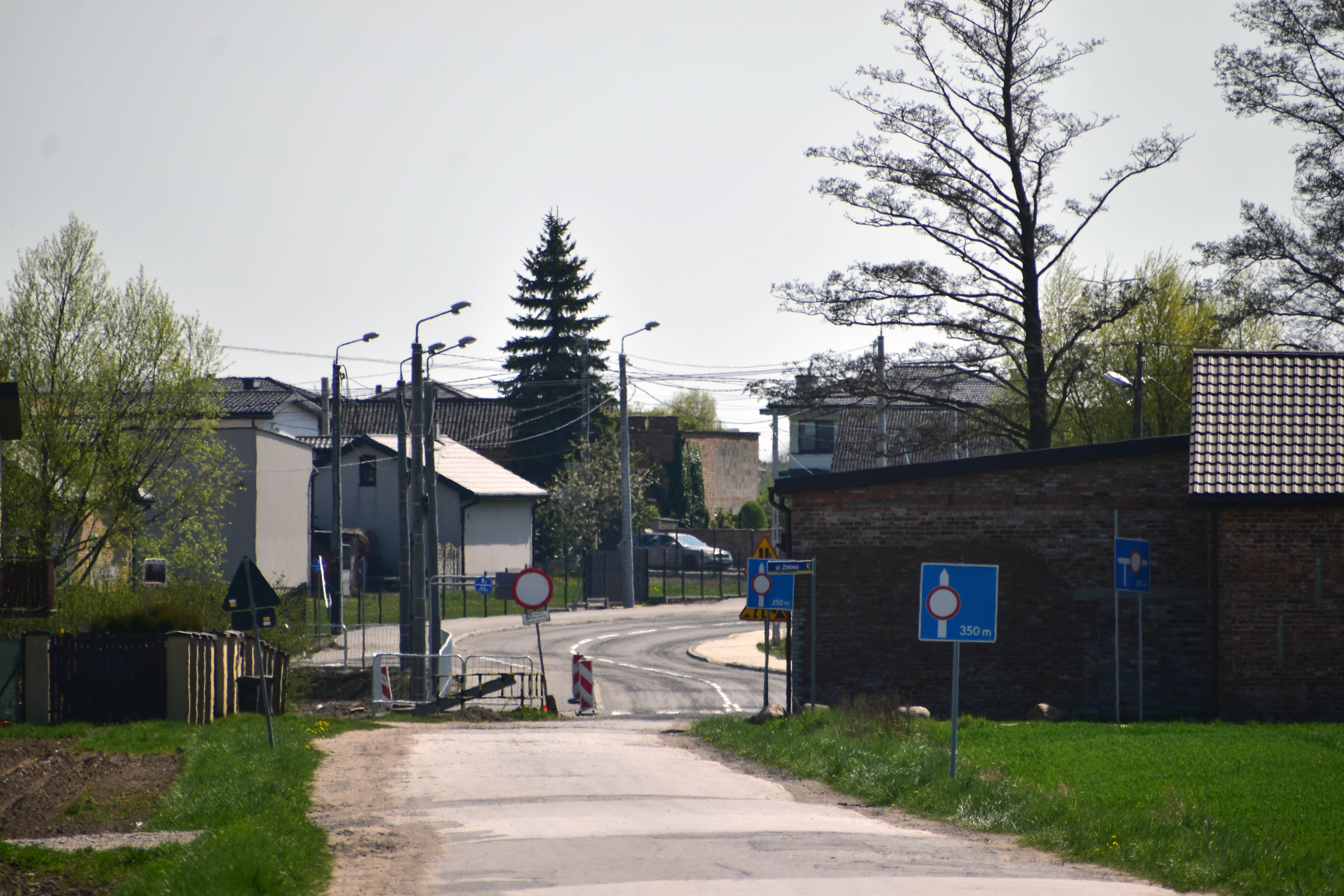
It's been six weeks since the 715 bus stopped going to Nowy Podolszyn, while the junction in the centre of the village of Łady (pron. 'Wuddy') has been closed for a remont. Now it's nearly done.

Below: looking towards Łady from the west. Note the 'no entry' signs... These are on top of the three further back (behind me). It's quite clear that the road is closed.

And yet. Yesterday, the driver of this Jaguar has ignored all eight 'no entry' and 'road closed' signs that he passed. Furthermore, he drove over the zebra crossing as it was being painted. The car went around the roundabout and could not leave, as the northern exit was closed off; he did a U-turn, tried the southern exit - also closed off. Another U-turn. Frustrated, with no way out, he had no alternative but to drive back the way he came - once again crossing the freshly-painted zebra crossing. Twat. Cham.

This is where we are; it's nearly ready. New asphalt before the traffic. A lovely warm day, temperature at last hitting 20C.


And here we are back in May 2007 - 15 years ago, the same place. The Marian shrine that formed the centre of the roundabout has gone, there's proper lighting and road markings, pavements and cycle path have been set up. The Ikarus buses - now but a memory - have been replaced by hybrid buses on the 715 route. Good that the little shop is still there

Taking advantage of today being a public holiday and a Sunday, I figured that there'd be no security around the S7 extension today, giving me a chance to cross over the new footpath/cyclepath, still unfinished (needs on-ramps at either end, hand rails, asphalt and marking). Here's the view looking north towards the road viaduct. Note the plastic barrier blocks in red and white; until the footbridge is open, this is the current route for pedestrians and cyclists. To the right, the highways maintenance depot nears completion.

This time last year:
S7 extension works
[Amazing how much progress has been achieved in a year!]

This time two years ago:

This time three years ago:

This time four years ago:
New roads and rails

This time five years ago:
The Gold Train shoot - lessons learned

This time six years ago:
The Network vs The Hierarchy in politics

This time seven years ago:
45 years under one roof

This time eight years ago:
Digbeth, Birmingham 5

This time nine years ago:
Still months away from the opening of the S2/S79 

This time ten years ago: 
Looking at progress along the S79  

This time 11 years ago:
Snow on 3 May

This time 12 years ago:
Two Polands

This time 13 years ago:
A delightful weekend in the country

This time 14 years ago:
The dismantling of the Rampa

This time 15 years ago:
Flag day

Saturday, 30 April 2022

Got a bit of a cold... Pt 2

Thursday 28 April: Day Seven. The miracle of healing is going on. For the first time, browny-green gunge comes out of my nose after I get up in the morning; this is the tipping point. I'm feeling much better, brighter, less rheumy, less of that ache in the backbone. Occasional cough; when I feel one coming on, a gulp of air in the lungs held for 20 seconds or so tends to stifle it effectively. I stay in all day (fourth day in a row) and decide to do no exercise at all. 

Friday 29 April: Day Eight. And so, a week has gone by, and the cold, left untreated (other than plenty of tea with lime and honey plus good sleep) has done the trick. Still a leftover sensation of 'dustiness' in the sinuses. The pharmaceutical industry has earned zero złotys off of me, as I've not bought any 'remedies' which do nothing in terms of dealing with the virus, only provide some relief from the symptoms, which in any case, were not debilitating. For the first time since Sunday that I've gone out for a walk (10,000 paces done) and a full set of exercises done. A bit of sunshine helps enormously, lifting the spirits.

Saturday 30 April: Day Nine and I declare this cold over! Walked 20,000 paces today (from Jeziorki to Nowy Podolszyn and back); full set of exercises. No cough, very slight nasal congestion remains. Moments during the day when I remember that I'm getting over a cold - a handful. Still, got to take care over the next few days, build up the immune system. Rest/sleep; healthy diet; exercise/movement. 

Unwillingness to exercise due to a need for physical recuperation (as opposed to outright laziness) is a good marker for how unwell you really are. This cold meant one day with zero exercise and four consecutive days without a walk. Last March whatever the mystery bug that got me (Covid? Slight fluiness, main symptom tiredness/fatigue) resulted in five days of zero exercise and five days without a walk in a row. My heavy bout of flu in January 2018 was the record during my time of record keeping - nine days without exercise and seven days without a walk.

Here's the worry though. Colds are the result of two things - one, a weakened immune system, two - a virus that latches onto a body with a weakened immune system. It turns out I caught a cold, not Covid. I've not ready anywhere how prevalent colds are compared to Covid - are they ten, a hundred times more common than Covid - even at the height of the pandemic? If I can catch an airborne virus like a cold, I could have also caught Covid. 

Where did my immune system weaken? Over the Easter weekend, I guess - Easter Monday, a sunny day but with a strong and chilly north wind. Too warm for three layers - too cold for two. I felt after an hour and half out in the fields photographing horizons that I had been thoroughly chilled in my shirt and jumper. Lots of alcohol at the end of Lent too, then on 20 April a business mixer - 120 people at the Bristol Hotel, again, lots of alcohol and contact with many people, no doubt someone with a cold out there in that crowd (though I watch out to avoid coughers and sneezers). Still, it's over, but it's one worth contemplating in terms of whole-life health maintenance.

Time for gratitude. Thankful for being back to the default state - ease (as opposed to disease). It's good to feel well; short and mercifully light viral infections make one grateful for good health; complacency needs to be kept in check.

The war in Ukraine is still ongoing; personal tragedies occurring in people's lives because of the madness of one man who needs taking down - quickly.

This time last year:
Identified - photographs from long ago

This time two years ago:
Things will never be the same
[and guess what - they won't.]

This time three years ago:
April's end, summer's beginning

This time four years ago:
Best April ever?

This time five years ago:
The search for the Gold Train: Day Two

This time six years ago:
Semi-automatic (short story)

This time ten years ago:
So good to be back in Warsaw

This time 11 years ago:
At the President's

This time 13 years ago:
Summer's here, and the time is right...

This time 15 years ago:
Why I'm staying in Warsaw

Wednesday, 27 April 2022

Got a bit of a cold... Pt 1


FOR POSTERITY

Friday 22 April: I could feel it coming on from Thursday night to Friday morning - the first symptom being a tickle on the roof of the mouth - the palate; unmistakable. I could not remove it by the power of mind. A cold was definitely on its way... Friday I went into town to meet a member (as well as excellent fish-and-chips lunch, an added benefit was the gift of a hooded sweatshirt - my first since student days). Getting home, I checked my temperature, it was 36.3C. I was sure that the cold virus was spreading. No alcohol, 9.4K paces, no press-ups or sit-ups, all other exercises done. Sauna.

Saturday 23 April: Woke up feeling slightly bunged up, a tiredness in the backbone, slightly shivery, otherwise OK. Temperature 36.1C. Crap weather, no walk. Full set of exercises. Zero alcohol, plenty of tea (0.6l glass, strong black tea with lime and honey, three of these a day). Sauna. Comfortable sleep

Sunday 24 April: Third day with cold, blowing nose more frequently, clear nasal secretions. Sneezing more often. Nice weather, so long walk (16K paces). Zero alcohol. Full set of exercises. Another long zoom call with family in UK and Poland re: stuff from my father's house (what stays and what's shipped to Poland). Temperature 36.6C. In bed by 22:30. Nightmare (about the civilians trapped in the Mariupol bunker) during the wee hours. Not a good night.

Monday 25 April: Working week starts. Nasal secretions still clear and watery. Will I be well enough to go to Poznań on Thursday? Meeting has already been postponed once... Temperature 36.1C. No Covid symptoms. Very slightly shivery. Taste and smell normal. Busy day work-wise; no time for walk even if I did feel OK, which I don't - that spinal achiness still there. Four sets of exercises (no sit-ups, planks or back extensions). No alcohol. Go to bed at 23:10 - too late.

Tuesday 26 April: Fifth day, I still do not feel that the cold is developing as it should. This ought to be the 'hump', after which the process of convalescence can begin - but no. Congested, runny nose, first symptoms that it's in the lungs (infrequent cough). Suppressing the cough by breathing in and holding a lungful of air for 15-20 seconds. Works well. Temperature 36.4C. No walk, only felt like doing two sets of exercises (squats and a few press-ups). Sauna. No alcohol. Sprinkle a few drops of Amol on my pillow. Bliss! Better than Vicks or Karvol. Love the smell, warming on the skin.

Wednesday 27 April: Good sleep (a sauna helps - I wake for a wee but once in the night - at 04:20 - rather than two or three times - bucket-loads of lime tea sweated out through the pores). I blow my nose - it continues to run clear. No way can I travel to Poznań tomorrow - I cancel. Busy day - TV appearance (online); opening and closing a webinar, and monthly board meeting online. No walk once again, no alcohol. No exercise (only the third time this year). The sixth day passes. The old line about a cold taking a week to get over treated or seven days if left untreated isn't quite right - for me it's usually ten days end to end, more than a week but less than a fortnight. In my 20s and 30s, my colds would pass leaving a dry cough that would last into the summer, but damp English climate to blame there. A lot of exercise going undone.

How will this cold resolve? Gone by next Monday? I genuinely thought last Friday that by today it would be on the wane and by tomorrow I'd be fine to go to Poznań. The weather forecast suggests sunny intervals and temperatures into the high teens for the next few days, but I still don't feel right enough to want to go for a long walk. I'm really looking forward to waking up and blowing out a noseful of thick green gunge - dead viruses and other detritus - which means the cold is beginning to go away. 

Being ill means suffering disease - dis ease, as opposed to ease. Discomfort that encroaches the consciousness. When aches and pains intrude upon your stream of consciousness and force their way into your train of thought. Has it been that bad? Not at all - I've had worse in recent years. This post is not written in self-pity, rather as a marker for the future.

This time last year:
Moon and bloom

This time four years ago:

This time six years ago:
Brexit: head vs heart, migration vs economy

This time seven years ago:
Golf course update

This time ten years ago:
The Shard changes London's skyline

This time 11 years ago:
In praise of Warsaw's trams

This time 12 years ago:
Plans for the railway line to Radom
[12 years on, the modernisation of a line it took 20 months to build, is complete]

Monday, 25 April 2022

Russia's army: not what we feared it was

Within days of the Russian invasion of Ukraine, observers could see that the invading army had many shortcomings. From the strategic (it was prepared for a three-day war, regime change, and being welcomed as liberators) and the doctrinal (the way, for example, tanks or infantry are used), to the operational (truck tyres, expired ration packs, poor wireless communication with the front line) it's clear that Russia's military leadership has (thankfully) failed to its reputation.

The world has moved on in many ways from WW2, when the Red Army seized Berlin. Some of the factors - and differences - were overlooked by Western analysts. Key is manpower. The generation of young men who fought WW2 was born at a time when the average Russian woman had a fertility rate of 7.3. The young men Putin is sending into Ukraine were born around 2000, by which time the average Russian woman was giving birth to a mere 1.23 children. In other words, Stalin had meat for the meatgrinder, Putin doesn't. (Having said that, neither does Ukraine. But the Ukrainian army isn't wasting its manpower like Russia's is.)

We could see outside Kyiv, the famous 40-km-long column, stalled for lack of fuel, less than 100km from the border. Logistics are crucial to victory. Without the 400,000 vehicles that America supplied to the USSR as part of Lend-Lease, the Red Army would not have been able to advance west at such speed in 1943-45. Of that number, 200,000 alone were Studebaker 6×6 trucks, the rest being smaller 4x4 trucks, Jeeps and Dodge Weapons Carriers. Below: a Studebaker US6 2½-ton 6×6 truck... 

...and the most-widely produced Soviet trucks of the Second World War era, the ZIS 5 and GAZ AA (left and right respectively below), outdated, less robust, and built in smaller numbers than those received from America. 


Russian logistics in Ukraine are the result of poor planning, poor training, poor maintenance, poor equipment and widespread corruption. Tanks stuck in the middle of nowhere without fuel, soldiers without rations because the campaign was to be over in three days. Many ammunition supply trucks were destroyed by Ukrainian fire because unloading shells is done crate by crate by soldiers, rather than removed from the truck by the pallet-load using a crane. Manual labour is cheaper, but it takes much longer - giving artillery-spotting drones a chance to locate and destroy their target - thousands of shells.

Russia's infantry-fighting doctrine hasn't moved on from the day of the mass charge against prepared positions. Note the long, curved magazine on the AK47/74 family of assault rifles. It cannot be fired by a soldier lying down - it's meant to be fired by a soldier advancing. But most importantly - the basic infantry unit, the squad, is without autonomy. The squad leader is not allowed to take the initiative - only to follow orders. The rigid top-down command-and-control system has been under strain due to poor quality communications equipment - senior officers have to move right up to the front line to get reluctant troops to advance - and get hit by Ukrainian artillery or snipers. Russia has lost ten generals in two months.

NATO doctrine has always focused on the autonomy of the squad. Like in any democracy, war-fighting should be done on the basis of teamwork and consensus, and not taking (bad) orders from the top.  Ukraine's armed forces - fighting for their country these past eight years - have accepted the NATO way of doing things. This leads to greater cohesion, morale and combat effectiveness. And reflects a healthier society - a network, rather than a hierarchy.

Another major factor hampering unit cohesion in the Russian army is continued presence of dedovshchina - the systematic hazing of recruits and conscripts by their elders. From Wikipedia: "Dedovshchina encompasses a variety of subordinating and humiliating activities undertaken by the junior ranks, from doing the chores of the senior ranks, to violent and sometimes deadly physical and psychological abuse, not unlike an extremely vicious form of bullying or torture, including sexual torture and anal rape. When not leaving the army seriously injured, conscripts can suffer serious mental trauma for their lifetime. It is often cited by former military personnel as a major source of poor morale." 

So - brutal stupidity, and stupid, counterproductive brutality. In close combat, the hazed can take revenge on their tormentors. Who knows where that bullet was fired from. An army formed of soldiers traumatised to the point of insensitivity is easier to order to be brutal to civilians or prisoners of war, which has negative consequences in the memetic war - the global struggle for hearts and minds. Which Russia is losing and Ukraine is winning, with its tractors and cats.

Putin drew back the forces that had been trying to capture Kyiv and reassigned them to the east of Ukraine, without much pause, with the bare minimum of new equipment - but without any of the root-and-branch reforms needed to create an effective fighting force. 'More of the same' is all Putin can muster. Reform of military doctrine means social reform - bullying and corruption are the very basis of Putin's Russia, dressed up in a nationalist ideology that has all the hallmarks of fascism.

The top-down corruption endemic in the Russian army has also played a major part - monies earmarked for research and development, for the modernisation of tanks and aircraft, were spent on villas and yachts. What was spent created a Potemkin army of T-14 Armata tanks and Sukhoi Su-57 'fifth-generation' stealth jet fighters that are only seen on parades. There were meant to have been 2,300 Armatas in service by 2020. Instead, there are now planned to be only 100 by this year; the first regiment of Su-57s is planned to become operational by 2025. [At least the money Germany didn't spend as planned on defence was diverted to social programmes.]

Russia's army, as they say, is "big and modern - just that the 'big' part isn't modern and the 'modern' part isn't big." Nevertheless, Putin has the ability to use nuclear blackmail - and this is a worry - even if only one in a hundred of his warheads work properly.

This time last year:
Long wait for apple blossom

This time three years ago:


This time nine years ago:
Kestrel on the roof

This time ten years ago:
Definitely worse in Britain

This time 11 years ago:
Miracle on the Vistula

This time 12 years ago:

This time 13 years ago:|
A new dimension to plane-spotting

This time 14 years ago:
One swallow does not a summer make

Sunday, 24 April 2022

Russian imperialism

This post is aimed at those useful idiots in the West who either support Russia or who claim they are 'neutral', because NATO is 'imperialist' which makes Ukraine just as bad than Russia. I was angered by a post on Facebook from an old friend who actually stated that Tony Blair is worse than Putin. [Blocked for good.]

Russia is an empire. An empire can be defined as "a political unit consisting of several territories and peoples, created by conquest, and divided between a dominant centre and subordinate peripheries". The difference between the current Russian empire and say, the former British or French empires, is geographic (it is contiguous, not offshore) and historic (the empire was punctuated by a period of being the 'Soviet empire'). But nevertheless, Russia is an empire.

At its peak in the 1860s, the Russian empire stretched well into Europe, with half of Poland, all of Lithuania, Latvia and Estonia, and (from 1809 to 1917) Finland, within it. But the empire also stretched into North America - Alaska was Russian until 1867. 

Today, the Russian empire - other than ethnic Russians - includes hundreds of indigenous peoples subjugated by Moscow over the centuries, Russified to a greater or lesser extent. Buryats, Komi, Yakuts, Ingush, Kalmyk, Chechens, deprived of their right to govern themselves, their languages and cultures crushed by tsars and commissars. 

Russia expanded eastward, conquering land at an average annual rate of the area of the Netherlands for 150 years. Hundreds of different nations were subjugated to the Tsar's will, and forcefully Russified. Serfdom - abolished in 1861- enslaved 23 million subjects of the Tsar (whilst in America, Lincoln's Emancipation Proclamation legally freed 3.5 million slaves - and started the Civil War).

After defeating Nazi Germany, the Soviet empire extended beyond the farthest reaches of the Tsar's domain, with the subjugated satellite states stretching to the Elbe. By the Soviet times, the terms 'Russia' and 'Soviet Union' had become interchangeable in the West, with only purists and experts pedantically using the right term.

Example. I have a copy of Russian Self-Portraits by American photographer, David Attie. Published in 1978, it was a rare glimpse of ordinary people from behind the Iron Curtain. Attie set up a large view camera and full-length mirror in a studio; subjects were invited in to pose themselves and then press the shutter with a remote-release cable. They took Polaroid prints with negatives; the subjects would get the print and Attie would use the neg to print the photos for the book. This contained 84 self-portraits of individuals and groups. And here's the thing: the sessions took place in Kyiv (or Kiev as the book calls the Ukrainian capital). But the words 'Ukraine' and 'Ukrainians' are absent. There's only one mention (in the whole book!) - the Ukrainian Folk Ballet - suggesting cute folksy customs from bygone days. The words 'Soviet Union' and 'USSR' are also absent. Otherwise it's just  'Russians' in 'Russia'. It's as though a Chinese photographer visited Cardiff to take photographs of English people in England, and used them to represent the whole of the United Kingdom.

Russians tend to believe that Ukrainians are just Russians who've gone wrong - comedic bumpkins who speak funny who belong firmly within the Russki Mir. Because these 'Russians' have gone astray, choosing the West in preference to Mother Russia, they deserve nothing less than extermination, say a great many Russians (maybe even as many as one in five).

Who's dying for Russia? It's not ethnic Russians who are bearing the brunt of the fighting in Ukraine. On 6 April, the BBC’s Russian service compiled a list of names and regions of 1,083 of the 1,351 officially confirmed military deaths using official state and regional media sources. There was not one reported death from Moscow, a city of 13 million people, while 93 deaths - 9% - come from Dagestan alone. Buryatia has the next largest number of fatalities, at 52. [More here.] Imagine if in 1914 it transpired that the British soldiers killed at Mons, Arras or Namur were mostly from Ireland, Wales, Scotland or the Isle of Man  or Guernsey - and none were Londoners.

The Soviet Union's collapse was not followed by a period of national reckoning, as happened in Germany or Japan after 1945. There was no remorse, no attempt to describe what had occurred between 1918 and 1991- collectivisation, the Gulag, the Great Terror, the Holodomor - as wrong. Putin's popularity rests on perpetuating national myths - of the 'Great Patriotic War' (no one mention the Stalin-Hitler pact), the defeat of Nazi Germany, Sputnik and Gagarin - and a nuclear-armed empire spanning 11 time zones.

I can't find it now, but I recall reading a piece by an American journalist in Moscow about a taxi ride he took around the city. His driver, on hearing he had an American passenger, began to telling him how great everything was in Russia. When the American began listing the country's many shortcomings, the taxi driver changed tack. "Yes, you're right. It is a shit hole. Can you help me get a visa for the US?" The journalist said, helpfully, that it would be much easier to get a visa for Canada. The taxi driver spat on the floor of his car and said with disgust "I could never live in a country that's not a superpower!"

The British Empire faded away shortly after the crumbling of the Third Reich and the nuclear destruction of Imperial Japan. I can still remember 'Empire Day' at primary school being rebranded 'Commonwealth Day' after 1965, with children trooping around the playground carrying flags of the Commonwealth nations. But Russia insists - to this day - that its imperial sway holds dominion over Ukraine, Belarus, Moldova, Georgia and northern Kazakhstan. As well as - and it goes without saying - Buryats, Yakuts, Ingush, Kalmyk and Komi people. Russian imperialists would dearly love to include the Baltic states and Poland into the fold - but fortunately, we are in NATO now.

See: White Fever - my review of Jacek Hugo-Bader's book about Russia's Far East

This time two years ago:
Drainage ditches and the hunters' pulpit
(The pulpit collapsed last year)

This time three years ago:
Aviation the theme 

This time four years ago:
Five closed-off hectares of central Warsaw

This time five years ago
Progress by the ponds

This time nine years ago:
Kaczyński's ignorance, deceit or folly? 

This time ten years ago:
The British electrical plug reigns supreme

This time 11 years ago:
Easter, and the end of Lent

This time 12 years ago:
That Icelandic volcano

This time 13 years ago:
Views of Historic Toruń

This time 14 years ago:
One swallow does not a summer make

Tuesday, 19 April 2022

Lenten photo catch-up

Lent coincided with the first days of the Russian invasion of Ukraine, days of foreboding and unease. A couple of trips to town, several trips to the działka, and just the one business trip - to Łódź.

Below: the S7 is coming along nicely, but no new milestones since the opening of the viaduct between Jeziorki and Dawidy Bankowe.
 

Below: Łódź - 19th century wooden building, now listed. The centre of Łódź is changing - this is less than 500m from the EC1 and Brama Miasta developments, nearing completion. 


Given a few more years, Łódź will have turned into a splendid city, a mix of the ultra-modern and carefully restored heritage buildings, old factories and palaces. Below: corner of ul. Targowa and Nawrot.


Below: old sign on Platform 3 of W-wa Zachodnia station, mid-modernisation. Platforms 8, 7 and 6 are nearly complete, the suburban platforms will be last to be changed. Sign says 'to alien persons entry is prohibited'.


Below: Zamienie, sunset, approaching equinox. Looking west along the tree-lined ulica Zakładowa that ran through what was the Bio-Vet vaccine plant; after it closed the land was bought by developers, who have built many hundreds of new houses and flats here. As usual, amenities - including proper roads, pavements and public transport - have been neglected.


Back in the garden, Felusia makes a determined run for the garage door and lunchtime. Here I must note the unusually settled fine weather - between 10 and 26 March, there was hardly a single cloud in the sky.


On the działka, my Ukrainian guests, just about to set off to a new life in London after a fortnight in Jakubowizna. Maxim, his mum and grandmother behind him. 


First of April for some fresh snow, which fell heavily through the night, giving a thick cover the next day.


Below: by the 3rd, the snow clouds had passed, a gorgeous day. I visited the działka, and walking from the station the long way via Machcin II, became the first human to tread in this virgin snow. Deep and hard to talk through! Plenty of hare tracks though.


Below: my first stork sighting of this year, 10 April, Jeziorki.


This time last year:

This time six years ago:

This time seven years ago:
Lublin - pearl of Poland's East

This time nine years ago:
70th anniversary of the Warsaw Ghetto Uprising

This time ten years ago:
Tarkovsky's Stalker: a zone of my own

This time 11 years ago:
Warsaw's big billboards

This time 13 years ago:
Pace of development falters